Uber: selling its China business to its main rival
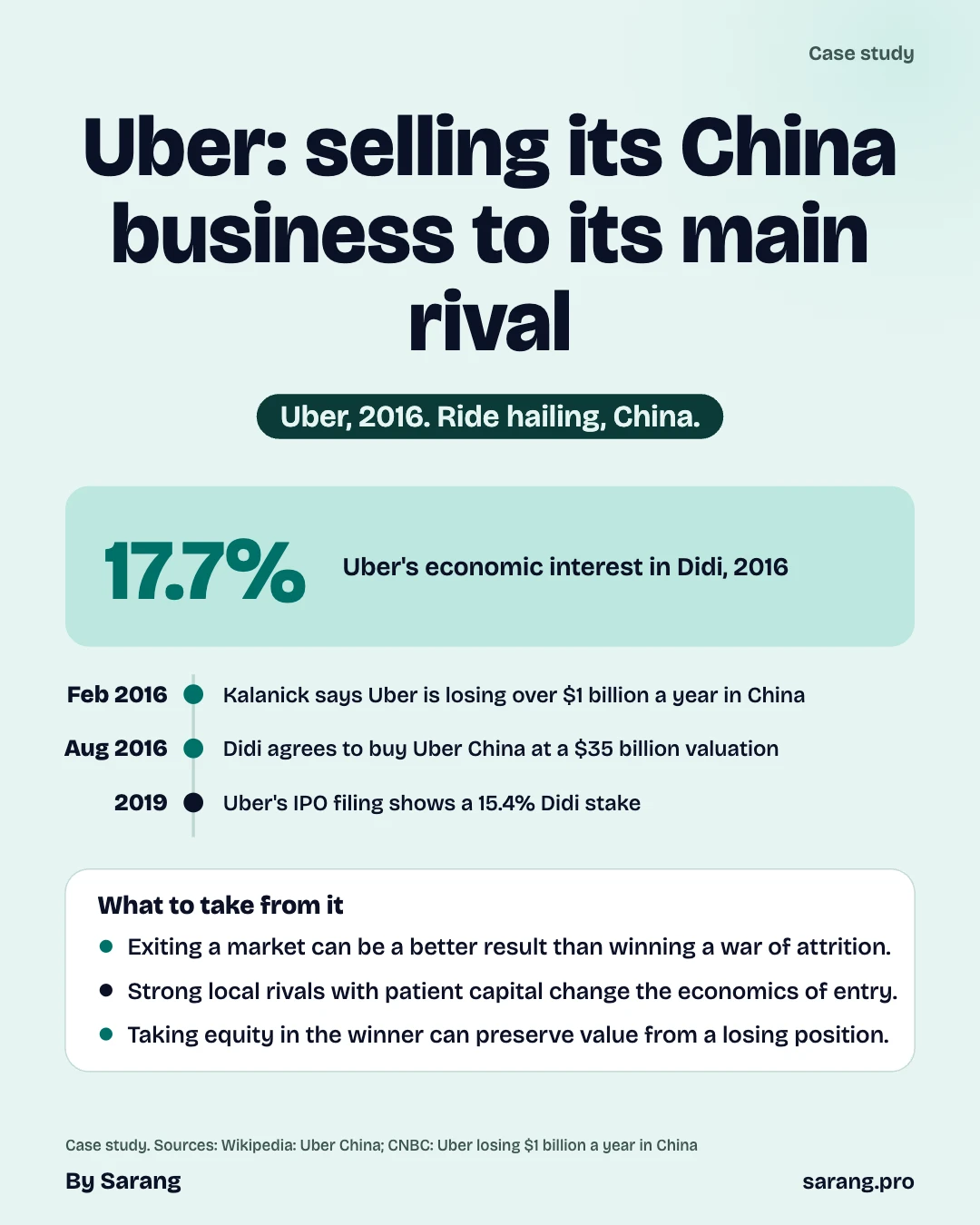
In August 2016 Uber, losing more than $1 billion a year in China, sold its Chinese arm to Didi Chuxing for a minority stake worth about 18 per cent of Didi.
- Uber's yearly loss in China, per Kalanick, Feb 2016
- $1bn+
- Didi's share of ride-hailing users, Feb 2016 (Uber: 16.2%)
- 83.2%
- Didi's funding round in June 2016
- $7.3bn
- reported value of the combined Chinese business
- $35bn
The situation
On 1 August 2016, Uber agreed to give up its Chinese business. The buyer was Didi Chuxing, the local rival it had spent two years trying to beat. Uber had been telling the world that China was its top priority. A year earlier its chief executive, Travis Kalanick, had called it exactly that, according to Fortune. Now Uber was handing over its Chinese brand, operations and data in return for a minority stake in the company it had been fighting.
The numbers explain why. Kalanick said in February 2016 that Uber was profitable in the United States but “losing over $1 billion a year in China”, as the Christian Science Monitor reported. Reports at the time of the sale put Uber’s cash losses in China at more than $2 billion over roughly two years. Later that year Kalanick put the burn rate at $200 million a month. Didi, meanwhile, had a head start, deep local backers and, from May 2016, a $1 billion investment from Apple.
The terms were reported in different ways, which is part of the story. Fortune and other outlets described Uber’s investors as receiving about 20 per cent of the enlarged Didi. Didi’s own statement, as Engadget relayed it, spoke of a 5.89 per cent stake in preferred shares that carried a 17.7 per cent economic interest. Didi also agreed to put $1 billion into Uber’s global business. The combined Chinese company was reported to be worth about $35 billion.
This case asks what a company with plenty of cash and a strong record elsewhere should do when it is losing a local market war. Uber could have kept spending, sought a deal, or left. It chose a deal that looked like retreat and turned out, on paper at least, to be a profitable one. Whether it was the right call depends on what you think Uber was really fighting for.
Background
Uber before China
By 2016 Uber was the best-known name in app-based ride-hailing. It earned a profit in the United States and Canada and, according to Fortune, in about 100 cities in total, and it used those earnings to fund expansion elsewhere. Kalanick’s own summary was that the home market paid for the foreign fights. Fortune reported that Uber was valued at $62.5 billion at that point, and the Christian Science Monitor put the figure at more than $50 billion a few months earlier. The sources differ on the exact number, but all agree that the company was among the most highly valued private firms in the world.
Entering China
Fortune dates Uber’s entry into China to 2014. It launched a service that let ordinary drivers pick up passengers, which the same article calls the first popular person-to-person ride-hailing product in the country. Baidu, the search company, backed Uber China in late 2014, and the Christian Science Monitor put Baidu’s investment at $200 million. Uber China was run separately from the rest of the company and, according to that report, by Chinese managers. Fortune later reported that it raised more than $1.5 billion from investors including China Life, state-owned banks and Baidu, at a valuation of about $8 billion.
The rival it faced
Didi Kuaidi was formed in early 2015 when the two largest ride-hailing apps in China, Didi Dache and Kuaidi Dache, merged. Fortune put the deal at $6 billion. The combined firm was backed by Alibaba and Tencent, the two largest Chinese internet groups. By February 2016 it had raised about $2 billion, double the $1 billion Uber said it had set aside for China. It had also built links outside China: it put $100 million into the American company Lyft in September 2015 and had partnerships with Grab in South-East Asia and Ola in India, according to the Christian Science Monitor.
The user numbers were lopsided. An Analysys International report, cited in the same article, gave Didi 83.2 per cent of ride-hailing users in China against 16.2 per cent for Uber. Kalanick described the opponent as “a fierce competitor that’s unprofitable in every city they exist in, but they’re buying up market share”. Both sides were paying drivers and passengers to use their apps, and both were losing money doing it.
The industry
How ride-hailing makes money, and why it is hard to win
A ride-hailing app connects riders and drivers and takes a share of each fare. It works only when enough of both groups are on the same app in the same city, so the first firm to reach that point in a city tends to pull ahead. That pushes rivals to spend heavily early on: subsidies to drivers so that cars are available, and discounts to riders so that they try the app. The Christian Science Monitor noted that both Uber and Didi had invested heavily in driver subsidies that allowed cheaper fares, and that Uber believed the strategy might pay off in the long run.
The problem is that the same subsidies are available to every rival with money. If two well-funded firms each refuse to stop, neither reaches profit. Fortune reported that Didi’s market share kept outpacing Uber’s, driven by more than $1 billion a year in subsidies and losses, and that Uber had admitted to losing about $1 billion a year without being able to close the gap.
Capital and backers
Both sides could raise large sums. In June 2016 Didi completed a $7.3 billion funding round that included Apple, China Life Insurance and Ant Financial and valued it at $28 billion, according to Fortune. Didi said it had $10.5 billion available. Uber had its own deep pool of investors, but, as Fortune reported, some of its private-equity backers wanted it to stop the losses in China, and the sale was seen as clearing the way for a later public listing.
Regulation
China had not given ride-hailing clear legal status for most of this period. Engadget reported that the government legalised ride-hailing apps days before the Uber deal, around 28 July 2016. Fortune added that the new rules required ride companies to charge at least market rates, which ended the heavy subsidies that both firms had relied on. A smaller player, Yidao Yongche, had been undercutting both on price and was seen as having no clear future once the rules changed.
William Kirby, a Harvard Business School professor who co-wrote a 2016 case study on Uber in China, argued in Harvard Business Review that the exit was about regulation rather than competition. He pointed to a September 2015 meeting in Seattle at which 30 chief executives, with a combined market value of $2.5 trillion, were photographed with Chinese President Xi Jinping. Didi’s founder Cheng Wei was in the picture. Kalanick, the article says, was conspicuously absent. The captured text of the article was short, so this case uses only its framing and the Seattle detail.
The decision
By mid-2016 Uber had three broad choices. The sources show that it weighed fighting on and a merger with Didi. A straight sale is the obvious third alternative, and is framed here as such rather than as a documented option.
Option 1: keep fighting
Kalanick had said as recently as March 2016 that he rejected talk of selling Uber’s Chinese business and was committed to the country for the long term, according to Fortune. The case for staying was that the market was huge, that subsidies might eventually work, and that Uber would have a shot at the global lead in ride-hailing if it won there. Kalanick hoped to offer Uber in more than 100 Chinese cities by the end of 2016.
The case against was in the numbers. Losses of more than $1 billion a year, a user base a fraction of Didi’s, and a rival that had just raised another $7.3 billion made a win look expensive and uncertain. The new rules on minimum fares also cut away the main tool Uber had been using to catch up. Fortune reported that Apple’s investment in Didi made it harder still for Uber to raise money, quoting Hans Tung of the venture firm GGV Capital, a Didi backer: “With Apple’s investment it became even more difficult for Uber to raise money.”
Option 2: sell and leave (an obvious alternative)
A clean sale for cash would have ended the losses at once. Its drawback is plain from the facts above: Uber was the weaker party, so it would have had little bargaining power over the price, and it would have given up any share in the growth of the market it had spent two years building. No source opened says that Uber pursued this route.
Option 3: merge and take a stake
The option Uber took let it stop the cash drain and keep an interest in the Chinese market through its holding in Didi. Fortune reported that the two companies had discussed a combination at least five times, and that active negotiations began about three months before August 2016. Fortune also noted that the deal let Uber raise $1 billion while keeping a valuation near its previous level, though the article’s figures for that valuation differ between pieces: the 1 August piece gave $68 billion for Didi’s investment price, the 4 August piece spoke of a $62.5 billion valuation.
There was one more factor: pressure from Uber’s own shareholders. Robert Salomon, writing in Fortune on 7 August 2016, said Kalanick had told people he was not worried about the losses, while shareholders grew increasingly troubled and pressed him to cut them and move on.
What they did
Step 1: the leak and the confirmation (1 August 2016)
The deal came out through a leaked blog post by Kalanick on the Chinese messaging app WeChat. In it he said Uber and Didi were investing billions of dollars in China and that both had yet to turn a profit there. Engadget reported that Didi first denied the rumours, then confirmed the merger on Weibo, and that Kalanick confirmed it on Facebook.
Step 2: the terms
Didi took over Uber China’s brand, business and data. In return Uber received a stake in Didi. The reported figures vary by outlet:
| Item | Reported figure | Source |
|---|---|---|
| Uber’s share of Didi | About 20 per cent (for Uber China’s investors) | Fortune, 1 August 2016 |
| Uber’s stake in Didi | 5.89 per cent in preferred shares, a 17.7 per cent economic interest | Engadget, citing Didi |
| Remaining Chinese shareholders of Uber China | 2.3 per cent economic interest | Engadget |
| Didi investment in Uber | $1 billion | Fortune; Engadget |
| Combined value of Didi and Uber China | About $35 billion | Fortune; Engadget |
Kalanick joined Didi’s board and Didi’s founder Cheng Wei joined Uber’s board. Uber carried on operating its own brand outside China. In a separate piece of the same story, Kalanick said the partnership would help fund work in self-driving technology, food delivery and logistics.
Step 3: the contractual line
Uber’s 2019 filing for its stock market listing says it is contractually restricted from competing with its minority-owned affiliates in certain areas, including in China through August 2023. The same filing lists Didi among those affiliates. The filing also shows that Uber treated China as discontinued operations and reported income from discontinued operations, including a gain on disposition in 2016, of $2,876 million. The excerpt the case draws on does not tie that figure to China by name, so it is best read as consistent with the sale rather than a measure of it.
Step 4: Kalanick explains (December 2016)
In December 2016, as reported by Business Standard, Kalanick said the “battle in China became global”. He pointed to Chinese sovereign wealth money going into competitors and to American technology firms being pressured to back Didi. He said Uber had been losing $200 million a month in China and called the merger a “great strategy”. His summary of the lesson was short: “We could not do everything ourselves.” Business Standard noted that Didi was also an investor in Ola in India and in Lyft in the United States, both Uber competitors, and that Uber was now turning its attention to UberEats, driverless cars and India.
What happened
Immediate results
Uber stopped a drain that its own chief executive had put at $1 billion a year or more. Fortune reported that Didi plus Uber China would control more than 95 per cent of China’s ride-hailing market by one set of estimates. For Didi, that removed the only well-funded foreign competitor. For Uber, the stake gave it exposure to the market without the costs of running it.
The stake in 2021
Didi listed on the New York Stock Exchange on 30 June 2021, at $14 a share, valuing the company at close to $70 billion, as CNBC reported. CNBC said Uber then owned about 12 per cent, making it the second-largest shareholder behind SoftBank, and that the stake was once worth $9.4 billion. Within days, Chinese officials announced a cybersecurity review. Didi was told to remove its app from Chinese app stores. By 23 July 2021 Uber’s stake was worth $4.6 billion, down from $5.9 billion at the end of March, a fall of more than $2 billion in a week. CNBC pointed out that Uber’s initial investment had been valued at about $2 billion five years earlier, so the holding still showed a profit.
| Date | Event |
|---|---|
| 30 June 2021 | Didi lists in New York at $14 a share |
| 1 July 2021 | Shares close at $16.40, the high point reported |
| 22 and 23 July 2021 | Shares fall 11 per cent and 21 per cent to $8.02 |
| Late November 2021 | Regulators reportedly ask Didi executives to plan a US delisting |
| Early December 2021 | Didi says it will leave the NYSE and pursue a Hong Kong listing |
Uber’s reaction
Marketing-Interactive reported in December 2021 that Uber’s Didi stake had recorded a loss of $2.4 billion in the third quarter, and that Reuters put Uber’s total investment at about $4.1 billion. Uber’s chief executive, Dara Khosrowshahi, said Uber would keep some strategic stakes and sell many others. He called Didi a competitor and China “a difficult environment with very little transparency”. He said Uber would not rush and would “monetise smartly over time”.
Other views
It was a defeat dressed as a deal
Fortune’s Robert Salomon called the sale a sign that Uber had given up its ambition to dominate China’s ride-hailing market. He had written in March 2016 that Uber was poorly positioned in China, and he argued that partnering with Didi from the start might have spared Uber the losses and the embarrassment of becoming a junior partner in a Chinese company. Another Fortune writer, Scott Cendrowski, described the deal as Uber’s capitulation and said its position in China had never been as strong as the opportunity.
It was a smart exit
The opposite view says that stopping a $1 billion annual loss was right whatever the label. Kalanick himself called the merger a “great strategy” in December 2016. The paper gain in Didi’s value also supports the argument: CNBC’s 2021 figures show a stake that was still worth more than the roughly $2 billion that reports said Uber had put in, even after a heavy fall.
It was about regulation, not competition
Kirby’s Harvard Business Review piece argued the cause was regulation. The timing supports at least part of this. The ride-hailing rules arrived days before the deal, and Fortune said the minimum-fare rule ended the heavy subsidies that had been Uber’s main weapon. Against that, the market-share and fundraising figures suggest Uber was losing before the rules changed.
Limits of the evidence
Several key facts are reported by the press rather than confirmed in company documents. The headline stake is quoted as 20 per cent and as 17.7 per cent, and the valuation of Uber after the deal appears as $62.5 billion and $68 billion in different pieces. Didi’s reported claim about Uber China’s profits, and what Kalanick’s meeting at Apple was about, are also unclear in the sources. Uber’s own filings give less detail about China than the press coverage.
Reading it through a framework
Network effects and switching costs
Ride-hailing rewards the firm that gets to a critical mass of riders and drivers in each city first. Didi had a head start and, by the Analysys International figure in February 2016, 83.2 per cent of users to Uber’s 16.2 per cent. Riders and drivers can use several apps at once, so switching costs are low, which is why both firms paid out subsidies. Low switching costs make a lead fragile, but only if the challenger can afford to keep spending. Uber’s problem was that Didi could afford it too, and from May 2016 Didi had more money available than Uber could easily match. The deal ended a contest in which network effects favoured the incumbent and money no longer favoured the challenger.
Stakeholder mapping
A stakeholder map of the deal shows pressures pulling in different directions. Uber’s private-equity investors wanted an end to the losses and a clearer path to a listing. Chinese state-linked investors in Uber China, such as China Life and state-owned banks, held a stake that needed protecting. The Chinese government set the rules on fares and legality and, in Kirby’s reading, favoured domestic players. Didi’s backers, Alibaba, Tencent and later Apple, were willing to keep funding the fight. Drivers and riders benefited from the subsidies and lost them when the rules changed. Kalanick had to balance the personal commitment he had voiced to China against the shareholders who pushed him to stop. Reading the deal this way makes it look less like a surrender to one rival and more like the outcome of what every group involved was willing to tolerate.
Since then
Uber moved its attention to delivery, autonomous vehicles and India, as Kalanick said in December 2016. By its 2019 listing documents it showed a gain tied to its disposals and carried Didi as a minority-owned affiliate, with a non-compete in China running to August 2023. In 2021, as covered above, the Didi stake became both a source of paper value and a source of volatility when Chinese regulators moved against the company. Khosrowshahi’s December 2021 comments suggested Uber saw the stake as something to turn into cash gradually rather than a strategic holding.
The sources opened for this case do not cover events after December 2021, so what has happened to Uber’s holding since then is not described here.
What to take from it
- Subsidy wars are only worth fighting if you can outlast a rival, and Uber could not match Didi’s local backers once Apple and others joined it.
- Strong results in your home market do not carry over to a country with different rules, rivals and political relationships.
- A deal that looks like retreat can still be rational if it ends a loss of $1 billion a year and leaves you with a valuable stake.
- Regulation can change the economics of a market within days, so timing matters as much as strategy.
- Reported deal terms often differ between sources, so check which figure measures what, such as voting shares against economic interest.
Questions to think about
- What signs in early 2016 should have told Uber that subsidies would not close the gap with Didi, and what would you have done with them?
- Would Uber have been better off partnering with a local firm from the start, as Salomon suggested, and what would it have given up?
- How should a company weigh the value of a minority stake in a rival against the risk that it cannot control or sell it?
- How far should a foreign firm adapt to a government it cannot influence, and where should it stop?
Concepts at work
This case draws on network effects, switching costs and stakeholder mapping. Explore them in Insights.
Written from the public sources listed below. Figures are as those sources report them.
Framework
Timeline
- 2014Uber enters China; Baidu backs Uber China late in the year
- Early 2015Didi Dache and Kuaidi Dache merge into Didi Kuaidi
- Sep 2015Didi's founder joins a photo with President Xi in Seattle; Kalanick is absent
- Feb 2016Kalanick says Uber loses over $1 billion a year in China
- Mar 2016Kalanick rejects talk of selling the China business
- May 2016Apple invests $1 billion in Didi
- Jun 2016Didi raises $7.3 billion at a $28 billion valuation
- Jul 2016China legalises ride-hailing and sets minimum fare rules
- 1 Aug 2016Uber agrees to sell Uber China to Didi
- Dec 2016Kalanick says the battle in China became global
- 30 Jun 2021Didi lists on the NYSE at $14 a share
- Dec 2021Didi says it will delist from New York
Recap cards
Tap a card to check yourself.
Sources and credits
- NYU Stern (reproducing Robert Salomon, Fortune, 7 August 2016): Why Uber couldn't crack China
- Engadget: Uber China merges with rival Didi Chuxing, 1 August 2016
- Business Standard (PTI): Battle in China became global, Uber CEO on exit from China, 16 December 2016
- Harvard Business Review: The Real Reason Uber Is Giving Up in China, 2 August 2016
- Christian Science Monitor: Uber loses $1 billion a year competing in China, 18 February 2016
- Fortune: Uber Didi merger, 1 August 2016
- Fortune: Apple invests in Didi Chuxing, China, Uber merger, 4 August 2016
- CNBC: Uber lost $2 billion in Didi stake this week on China crackdown threat, 23 July 2021
- Marketing-Interactive (reporting Reuters): Uber to sell Didi stake as it is not strategic, said CEO, 15 December 2021
- SEC: Uber Technologies Form S-1, 2019



