Volkswagen: one modular toolkit for dozens of models across its brands
VW launched its MQB toolkit in 2012 expecting 20% lower production costs; it built over 32 million cars in ten years, yet the VW brand's margin fell to 1.8%.
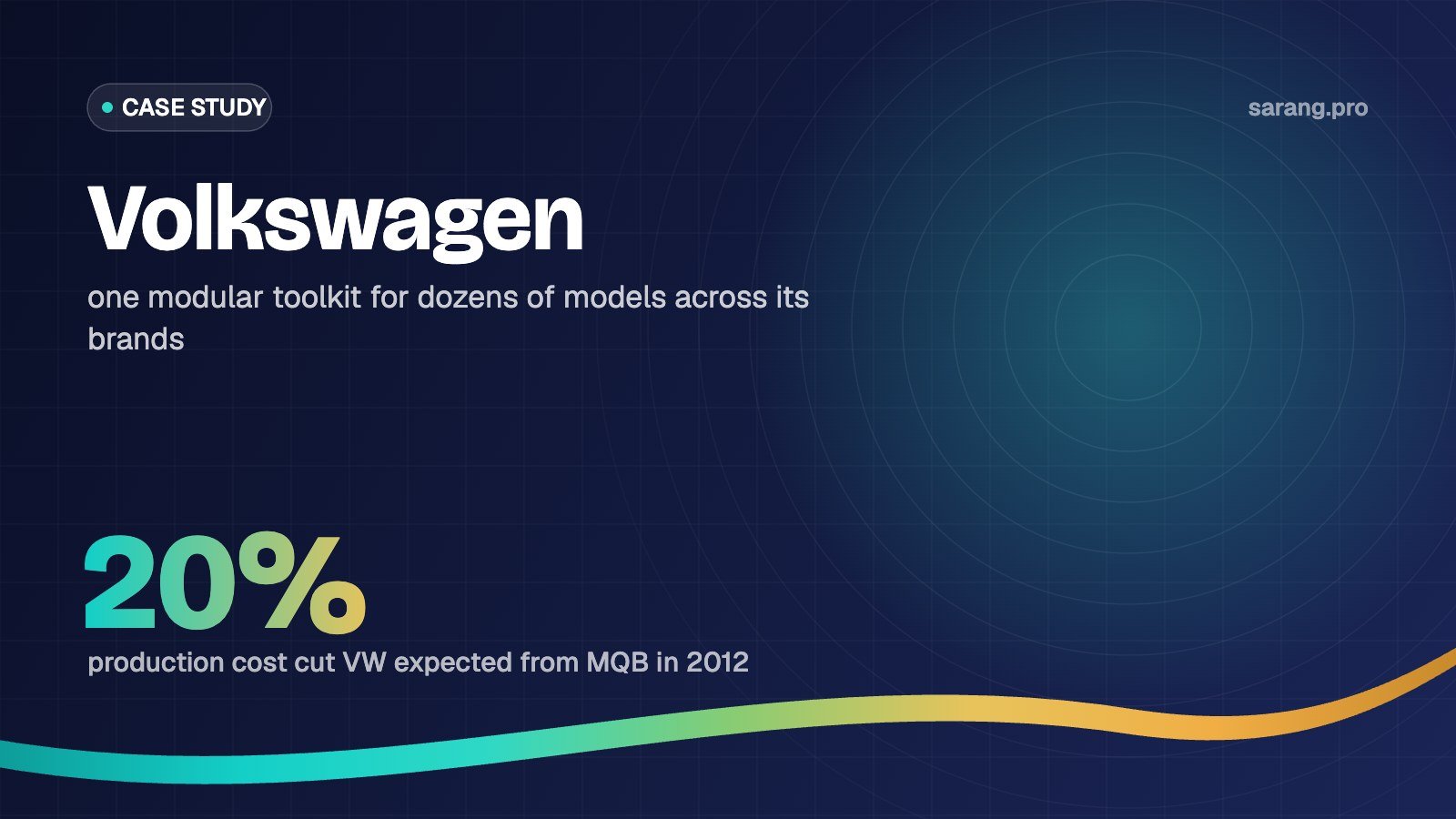
- production cost cut VW expected from MQB in 2012
- 20%
- models planned on the toolkit
- 40+
- MQB vehicles built by June 2022
- 32 million+
- heating and air conditioning unit versions
- 102 to 28
The situation
In March 2012, at the Geneva motor show, Audi unveiled the third-generation A3. To most visitors it was a new premium hatchback. To Volkswagen Group it was the first production car built on the Modular Transverse Toolkit, known by its German initials MQB. Within months the seventh-generation Volkswagen Golf, the SEAT Leon and the Skoda Octavia would follow on the same toolkit. The first production MQB Golf left the line at Wolfsburg in October 2012.
The promises were large. What Car reported at the launch that Volkswagen expected MQB to cut production costs by 20% and assembly times by 30%. Forbes, writing in April 2013, quoted the company’s claim of savings of “at least 20%” in car costs. Volkswagen planned more than 40 models on the toolkit over time, across its Volkswagen, Audi, SEAT and Skoda brands.
The bill came first. The chief executive, Martin Winterkorn, said in March 2012 that profit would not rise that year because “we need to recoup our substantial development and start-up costs”. Autocar reported the same month that Winterkorn had put spending on developing and introducing the toolkit, and preparing factories for it, at about £50bn over four years, with payback expected from 2014. That figure appears to include much wider group investment, and analysts gave other numbers: in September 2013 Morgan Stanley’s estimate of the platform’s cost was reported as about $70bn. Volkswagen did not publish a single audited figure for MQB.
The decision had been taken. The question for the following years was whether the savings would arrive, and whether they would reach the profit line of a group that was, at the same time, chasing a target of becoming the world’s largest carmaker by 2018.
Background
By 2012 Volkswagen Group sold cars under a dozen brands, from Skoda and SEAT at the value end to Audi, Porsche, Bentley and Lamborghini at the top, along with commercial vehicles. It delivered 9.3 million vehicles in 2012, about a million more than the year before. Sales revenue rose from €159.3bn in 2011 to €192.7bn in 2012, and operating profit from €11.3bn to €11.5bn. The operating return on sales fell from 7.1% to 6.0%.
The group’s plan, Strategy 2018, set four goals: to lead the world in customer satisfaction and quality, to sell more than 10 million vehicles a year, to earn a long-term return on sales before tax of at least 8%, and to be the most attractive employer in the industry. In his 2012 letter to shareholders Winterkorn wrote that the aim was to make the group “the world’s leading automaker by 2018”, both economically and ecologically.
Sharing platforms between models and brands was not new at Volkswagen. The weakness of the platform approach was that it was tied to a size class. A small car, a compact car and a mid-sized car each needed a separate platform, and each platform carried its own development budget, tooling and factory equipment. As the range spread into more niches, the number of combinations grew.
The money came mainly from the volume brands. In 2012 the Volkswagen brand alone had sales revenue of €103.9bn, but its operating profit was €3.6bn, a margin of 3.5%. The group’s operating profit that year was €11.5bn, so most of it came from businesses other than the core brand. The core brand’s low margin was the problem MQB was meant to address.
The industry
World motor vehicle production in 2012 was about 84.2 million, of which 63.1 million were passenger cars, according to the industry body OICA. Production was concentrated among a few groups. In 2015 Toyota sold 10.15 million vehicles, Volkswagen 9.93 million and General Motors 9.8 million. For each of them, the cost of developing a new engine, platform or electronic system ran to billions, while the price of a mass-market car was held down by competition. Spreading fixed engineering cost over more cars was the main route to a better margin.
In five-forces terms, the structure was hard on profits. Rivalry was intense in every major market. Buyers could compare prices easily, and in Europe many cars were bought by fleets with strong purchasing power. Large suppliers of systems such as electronics, seats and transmissions were consolidating and had growing bargaining power of their own. Entry by new carmakers was expensive, but Chinese and Korean groups were growing fast. Regulators set ever tighter limits on carbon dioxide and pollutants, which raised the cost of every engine programme.
Each major competitor responded in a similar way, by moving from fixed platforms to modular architectures that standardise the parts customers do not see. Renault and Nissan announced their Common Module Family (CMF) in June 2013, claiming that it would cut parts costs by up to 30% and the cost of entry for a new model by up to 40%, starting with about 1.6 million vehicles a year. Toyota launched its Toyota New Global Architecture (TNGA) with the fourth-generation Prius in late 2015. Toyota later applied TNGA to more than 40 models and aimed to fit TNGA-based powertrains to about 80% of the Toyota and Lexus vehicles it sold in Japan, the US, Europe and China by the end of 2023.
Exhibit 1: Modular architectures at three carmakers
| Architecture | Company | First production model | Claims made at launch |
|---|---|---|---|
| MQB | Volkswagen Group | Audi A3, 2012 | Production cost down 20%, assembly time down 30%; engine and transmission variants down nearly 90% |
| CMF | Renault-Nissan | Nissan Qashqai and X-Trail, 2013 | Parts cost down up to 30%, entry cost down up to 40% |
| TNGA | Toyota | Prius, 2015 | Over 40 models; TNGA powertrains in about 80% of Toyota and Lexus sales in main markets by 2023 |
Sources: What Car, March 2012; Volkswagen Annual Report 2012; Autocar, June 2013; Toyota TNGA pages.
Modularity carries a known risk. If one part is shared by millions of cars across several brands, a single defect can trigger a very large recall. Rebecca Lindland, an industry consultant, pointed to Toyota’s earlier recalls of millions of vehicles over faulty shared parts, saying: “There’s an example of where plans went horribly awry.” There is also a commercial risk: if an Audi and a Skoda share most of their hidden parts, the customer must still see a reason to pay the higher price.
The decision
Volkswagen’s choice, taken in the late 2000s, can be set out as three options.
Keep separate platforms
The group could continue to develop a platform for each size class, as it had done for two decades. This kept the risk of each programme contained and allowed each brand to tune its cars more freely. The cost was that the same engineering work was repeated for each class, and each new niche model added to the number of parts the group had to design, buy and stock.
Share parts selectively
A middle route was to standardise a list of components, such as air conditioning units or electrical systems, while leaving the main architecture to each platform. This would capture some savings with less upheaval. It would not tackle the main source of cost, which Volkswagen’s engineers located at the front of the car.
Commit the group to one toolkit
The radical route was to define a single set of standard modules and fixed dimensions for every car with a transversely mounted engine, from small cars to mid-sized saloons and SUVs. Forbes reported in 2013 that the area between the pedals and the front wheels, including the engine, was where about 60% of development costs were incurred. Fixing that area across the range offered the biggest saving. The risks were a very large up-front bill, a long wait before most models moved onto the toolkit, and exposure to any flaw shared across millions of cars.
Volkswagen chose the third route. The arguments in favour were scale and time. A toolkit, once built, could be reused across several model generations. The arguments against were set out later by analysts, who doubted whether the savings would be as large as claimed, and by the works council, which worried that what made sense for each brand might not make sense for the group.
What they did
The toolkit
Volkswagen’s 2012 annual report described MQB as covering cars from the A0 segment (small cars such as the Polo) to the C segment (mid-sized cars such as the Passat), with the A00 city-car segment handled by a related New Small Family. Wheelbase, track width, wheel size and seating position could be varied for each model within set ranges. The distance from the pedals to the centre of the front wheels was fixed, so every car had the same front-end layout. All petrol and diesel engines were mounted at the same angle, tilted 12 degrees backwards, which allowed the exhaust, driveshafts and transmission to be standardised. The new EA211 petrol engine had its cylinder head turned through 180 degrees compared with its predecessor.
The company said in 2012 that MQB would cut engine and transmission variants by nearly 90%. It also designed the toolkit to take petrol, diesel, natural gas, hybrid and electric drives. A matching Modular Production Toolkit set standards for factories from the press shop to final assembly, so that several models, even from different brands, could be built in the same plant.
The rollout
The first cars arrived in 2012: the Audi A3, the Golf, the SEAT Leon and the Skoda Octavia. The eighth-generation Passat followed in late 2014 as the Volkswagen brand’s second MQB model series. Over the following years the toolkit spread to the Polo, Tiguan, the Atlas for the US and the Teramont for China. Autocar reported in 2012 that Volkswagen expected to build more than six million MQB cars a year across its four volume brands by 2018. The board member for production, Michael Macht, said the group would keep the technology to itself for at least two or three years: “We do not wish to share our excellence.”
Doubts about the savings
By the autumn of 2013 analysts were questioning the numbers. Fortune reported in September 2013 that Bernstein Research thought MQB was “over-hyped” and that Volkswagen had “overpromised on savings related to the MQB program and has created market expectations that will be difficult to fulfill”. A specialist who had taken apart the new Golf said it used relatively expensive materials and engineering. Bernstein still expected Volkswagen to build 5.5 million vehicles a year on the single architecture by the end of the decade, against about 3 million on the platform it replaced. The German magazine Manager Magazin reported that the group might miss its 2015 profit goals, partly because of MQB costs, and that the finance chief, Hans Dieter Pötsch, was looking for savings of up to €1,000 per vehicle. Volkswagen called the report “without any foundation”.
Problems on the factory floor
In July 2014 Reuters reported that Volkswagen had run 37 extra weekend shifts on Golf production at Wolfsburg that year, mostly to meet demand for the Golf and the Tiguan. The Golf family had grown to 14 models, and the electric e-Golf and the Golf Sportsvan were built on the same line as the standard car, with different underbody parts. Bernd Osterloh, head of the works council, said: “Whatever seems sensible for individual brands does not at all have to be profitable for the entire group.” Stefan Bratzel of the Center of Automotive Management said: “The pitfalls of complexity are seemingly beginning to haunt VW.” Winterkorn responded by setting the Volkswagen brand a target of about €5bn a year in savings from 2017, through what he called painful cutbacks.
Applying the idea to electric cars
MQB could take an electric drive, and the e-Golf was built on it from 2013 to 2020. When Volkswagen committed to electric cars after the diesel emissions scandal of 2015, it did not stretch MQB further. It developed a separate Modular Electric Drive Toolkit (MEB), designed only for battery-electric cars, with the battery laid flat between the axles. Series production of the first MEB car, the ID.3, began at Zwickau on 4 November 2019 after a €1.2bn conversion of the plant. Volkswagen said Zwickau would be able to build up to 330,000 electric cars a year from 2021 and would eventually make six MEB models for three group brands. The chief executive by then, Herbert Diess, said the ID.3 would make “an important contribution to the breakthrough of e-mobility”. In 2019 Volkswagen also said it would make MEB available to other carmakers, and in 2020 Ford agreed to build two electric models for Europe on it.
What happened
The toolkit reached very large scale. In June 2022, ten years after launch, Volkswagen said it had built more than 32 million MQB vehicles across the group, more than 20 million of them under the Volkswagen brand. It said new MQB models were about 50 kg lighter on average than the cars they replaced, and the seventh-generation Golf almost 100 kg lighter depending on specification. The number of heating and air conditioning unit versions had fallen from 102 to 28. When Wolfsburg started building the eighth-generation Golf in 2019, about 80% of the existing body shop equipment could be reused.
The company’s figures for variant reduction changed over time. The 2012 annual report said engine and transmission variants would fall by nearly 90%. The 2022 anniversary statement said they had been nearly halved. The two statements may measure different things, but the later figure is much smaller and the company did not explain the difference.
The savings were slow to reach the profit line of the Volkswagen brand. Its operating margin fell from 3.5% in 2012 to 2.9% in 2013, against a medium-term goal of at least 6%. Reuters compared that with 8.8% for Toyota’s car business and 9.5% for Hyundai. The margin fell again, to 2.5% in 2014 and 2.0% in 2015. It reached its lowest point in 2016, at about 1.8%, the year when the group was absorbing the first costs of the diesel scandal and a large programme of model launches. Only from 2017 did it recover, to 4.2%, and it was 4.3% in 2019.
Exhibit 2: Volkswagen brand (passenger cars) results, 2012 to 2019
| Year | Sales revenue (€bn) | Operating profit (€bn) | Operating margin |
|---|---|---|---|
| 2012 | 103.9 | 3.6 | 3.5% |
| 2013 | 99.4 | 2.9 | 2.9% |
| 2014 | 99.8 | 2.5 | 2.5% |
| 2015 | 106.2 | 2.1 | 2.0% |
| 2016 | 105.7 | 1.9 | about 1.8% |
| 2017 | n/a | 3.3 | 4.2% |
| 2018 | 84.6 | 3.2 | 3.8% |
| 2019 | 88.4 | 3.8 | 4.3% |
Sources: Volkswagen Group annual reports 2013, 2014, 2015, 2016 and 2019; Volkswagen Group press release, March 2019. From 2015 the figures are before special items. The 2016 margin is calculated from reported revenue and profit. The fall in reported revenue between 2016 and 2018 suggests a change in the way the brand’s revenue was reported, so the revenue figures are not fully comparable across those years.
At group level the picture was better. Operating profit before special items was €12.8bn in 2015, a margin of 6.0%, rose to €14.6bn (6.7%) in 2016 and reached €17.0bn in 2017. The Volkswagen brand contributed €1.9bn of the 2016 figure, so most of the group’s operating profit came from its other brands and businesses. Separating the effect of MQB from everything else that happened in these years, including the diesel scandal, the growth of SUVs and changes in China, is not possible from the published figures.
The electric toolkit grew faster than MQB had. By June 2023 Volkswagen had built one million MEB vehicles in eight plants in China, Europe and the US, under the Volkswagen, Audi, Cupra, Skoda and Volkswagen Commercial Vehicles brands. The models included the ID.3, ID.4, ID.5, Audi Q4 e-tron, Cupra Born and Skoda Enyaq. Ford launched its electric Explorer for Europe on MEB in March 2023, priced from under €45,000, although Ford also said it was developing its own electric platform.
Other views
Analysts
The sharpest public doubts came from Bernstein Research in 2013, which argued that Volkswagen was already good at efficiency and might have captured most of the gains before MQB. The teardown of the Golf suggested that the toolkit had been engineered to a high standard and was costly to make, which would limit savings per car even as the number of parts fell. Morgan Stanley’s reported estimate of about $70bn for the platform’s cost, set against Winterkorn’s statement of about £50bn and the absence of any audited figure, shows how hard it was for outsiders to judge the return.
The works council
Osterloh’s warning in 2014 went to the heart of modular strategy. Each brand had an incentive to ask for more variants to serve its customers, and the toolkit made those variants easier to create. The total cost of complexity fell on the group as a whole. In Volkswagen’s governance, where labour representatives sit on the supervisory board, that comment from the works council carried weight.
The company
Volkswagen’s own account, given at the tenth anniversary in 2022, was that MQB had been a success. Ralf Brandstätter, then chief executive of Volkswagen Passenger Cars, called its introduction “a crucial step”. The company pointed to lighter cars, fewer parts and the reuse of factory equipment across model generations, and to the fact that it had repeated the approach for electric cars. It did not publish a calculation of the return on the investment.
Reading it through a framework
Porter’s generic strategies
Michael Porter argued that firms usually compete either on lower cost or on differentiation, and that those who try both without a clear plan risk being stuck in the middle. MQB was Volkswagen’s attempt to do both at group level. Shared modules, a fixed engine angle and common factory equipment were aimed at cost leadership in engineering and parts, with a promised 20% cut in production cost. Separate brands, from Skoda to Audi, each with its own styling, interiors and prices, were meant to keep differentiation where buyers could see it.
The evidence suggests the cost side worked in engineering terms: heating and air conditioning units fell from 102 versions to 28, the Golf lost almost 100 kg, and 80% of the body shop equipment was reused. But the differentiation side created new variants, such as the 14 Golf models of 2014, and those variants consumed much of the saving. The Volkswagen brand’s margin of 2.0% in 2015 and about 1.8% in 2016 shows that common parts alone did not deliver a cost leader’s profits while the range kept widening. The group as a whole did better, because its other brands and businesses earned most of its operating profit, often on shared engineering. In Porter’s terms, the toolkit allowed the group to be a cost leader in its hidden parts and a differentiator in its visible ones, but the core brand ended up close to the middle.
Three horizons
The three horizons model separates defending and extending the core business (horizon one), building emerging businesses (horizon two) and creating options for the future (horizon three). MQB served horizon one, renewing the combustion-engined core and carrying more than 32 million vehicles in ten years. MEB was a horizon two investment: a separate architecture for battery cars, launched at Zwickau in 2019 and reaching one million vehicles by 2023, with Ford as an outside customer. The Scalable Systems Platform, announced in 2021 to unify electric architecture and software across brands, sits in horizon three.
The model shows a pattern. MQB could take electric drive, as the e-Golf showed, but rather than stretch it further Volkswagen built a dedicated toolkit for each horizon, applying the same modular logic each time. The cost is running several architectures at once during the transition, which brings back the complexity MQB was meant to remove. The delays to the third horizon, described below, show the risk of that approach when the new architecture depends on software rather than steel.
Since then
The next step has proved harder than the last. When MQB turned ten in June 2022, Volkswagen said the first model on the Scalable Systems Platform, code-named Trinity, was planned for 2026. Later accounts put the platform’s introduction in 2029, and the group’s 2025 annual report describes SSP as the next generation of an electric, fully digital platform without giving a launch date. In June 2024 Volkswagen agreed to invest up to $5bn in the US electric carmaker Rivian, starting with a $1bn convertible note, and to form a joint venture to develop electrical architecture and software. The venture was launched in November 2024. Some reports put the total possible investment at up to $5.8bn by 2027; the original announcement gave $5bn. The 2025 annual report also refers to a partnership with the Chinese carmaker XPeng.
Meanwhile, the combustion business that MQB serves is still the source of most of the group’s volume. In 2025 Volkswagen Group delivered 8.98 million vehicles, of which about 983,100, or 10.9%, were fully electric. Its operating result fell to €8.9bn on revenue of €321.9bn, a margin of 2.8%, hit by €2.9bn of US tariff costs and €4.7bn of charges linked to Porsche. The group’s response has been a new round of cost cutting and, in its own words, an “overarching cost ambition for 2035”. The modular logic first applied to MQB in 2012 is now being asked to deliver savings in software, where Volkswagen has had to buy help from outside.
What to take from it
- A modular architecture can cut parts and engineering costs across many models, but the savings can be lost if the number of variants built on top of it keeps growing.
- Large up-front spending on a shared toolkit means profits may stall for years before the benefits appear, as the Volkswagen brand’s margin fell from 3.5% in 2012 to about 1.8% in 2016.
- Putting many brands on common parts works best when the parts buyers notice are kept distinct and the hidden ones are shared, which let the group sell the same hidden engineering under brands with very different prices.
- Claims of savings at launch should be treated with care, since Volkswagen’s own figure for engine and gearbox variant reduction fell from nearly 90% in 2012 to nearly half in 2022.
- A company can apply the same modular logic to a new technology by building a separate toolkit, but running several architectures at once during a transition brings back the complexity the first one removed.
Questions to think about
- How should Volkswagen have weighed the savings from MQB against the risk that a single fault in a shared module could affect millions of cars across several brands?
- Using Exhibit 2, how much extra operating profit would the Volkswagen brand have earned in 2015 if it had reached its target margin of 6% on the same revenue? What does the gap suggest about where MQB savings went?
- Winterkorn’s figure of about £50bn and Morgan Stanley’s estimate of about $70bn were both reported as the cost of MQB. Why might outside estimates of a platform’s cost differ so widely, and how would you build your own estimate?
- Osterloh said what made sense for individual brands need not be profitable for the group. What governance rules would you put in place to control the number of variants on a shared toolkit?
- Was Volkswagen right to build a separate platform for electric cars rather than adapt MQB, and what would you advise for the next generation now that software is the main source of cost and delay?
- Renault-Nissan claimed CMF would cut parts costs by up to 30%, and Toyota fitted TNGA powertrains to about 80% of its main-market sales. If every large carmaker adopts modular architectures, can any of them keep a cost advantage from doing so?
Concepts at work
Porter’s generic strategies, three horizons, modular product architecture, economies of scope. Explore them in Insights.
Further reading
Oxford University Press covers this story as a teaching case in Cases in International Business on Oxford Business Trove. The sources below are the public record this page was written from.
Written from the public sources listed below. Figures are as those sources report them.
Framework
Timeline
- Mar 2012MQB debuts in the Audi A3 at the Geneva motor show
- Oct 2012First MQB Golf leaves the Wolfsburg line
- Jun 2013Renault-Nissan announces its rival CMF architecture
- Sep 2013Bernstein says VW overpromised on MQB savings
- Jul 2014Reuters reports 37 extra shifts and complexity problems at Wolfsburg
- Late 2014Eighth-generation Passat moves to MQB
- Late 2015Toyota launches TNGA with the Prius
- Nov 2019ID.3 production starts on the MEB electric toolkit at Zwickau
- Jun 2022MQB passes 32 million vehicles
- Jun 2023MEB reaches one million vehicles
- Jun 2024VW agrees to invest up to $5bn in Rivian for software
- 2025Group operating margin falls to 2.8%
Recap cards
Tap a card to check yourself.
Sources and credits
- Volkswagen AG Annual Report 2012: Launching the Modular Transverse Toolkit
- Volkswagen AG Annual Report 2012: Results of operations
- Volkswagen AG Annual Report 2012: Letter to shareholders
- Volkswagen AG Annual Report 2013: Goals and strategies
- What Car?: VW profits unlikely to increase in 2012 (March 2012)
- Autocar: VW could sell £50bn MQB platform (26 March 2012)
- Forbes: Volkswagen's mission to dominate global auto industry gets noticeably harder (April 2013)
- Fortune: VW heading for a profit speed bump (20 September 2013)
- The Truth About Cars: MQB costs may put the squeeze on VW profit goals (20 September 2013)
- WardsAuto (Reuters): VW experiencing growing pains with new modular platform (July 2014)
- Volkswagen AG Annual Report 2013: Volkswagen Passenger Cars
- Volkswagen AG Annual Report 2014: Volkswagen Passenger Cars
- Volkswagen AG Annual Report 2015: Volkswagen Passenger Cars
- Volkswagen AG Annual Report 2016: Brands and business fields
- Volkswagen Group: Volkswagen Group brands deliver a solid performance (March 2019)
- Volkswagen AG Annual Report 2019: Volkswagen Passenger Cars
- Volkswagen Newsroom: Production of the ID.3 starts in Zwickau (4 November 2019)
- Volkswagen Newsroom: The MQB celebrates its tenth anniversary (23 June 2022)
- Electrek: Volkswagen Group hits 1 million MEB-based EV production (16 June 2023)
- Autocar: Renault-Nissan Alliance announces Common Module Family (June 2013)
- Toyota: TNGA powertrain feature
- OICA: 2012 production statistics
- NBC News: Rivian secures up to $5 billion from Volkswagen (June 2024)
- Volkswagen Group Annual Report 2025: Results of operations
- Volkswagen Group Annual Report 2025: Goals and strategies