Starbucks Australia: why it shut 61 of its stores in 2008
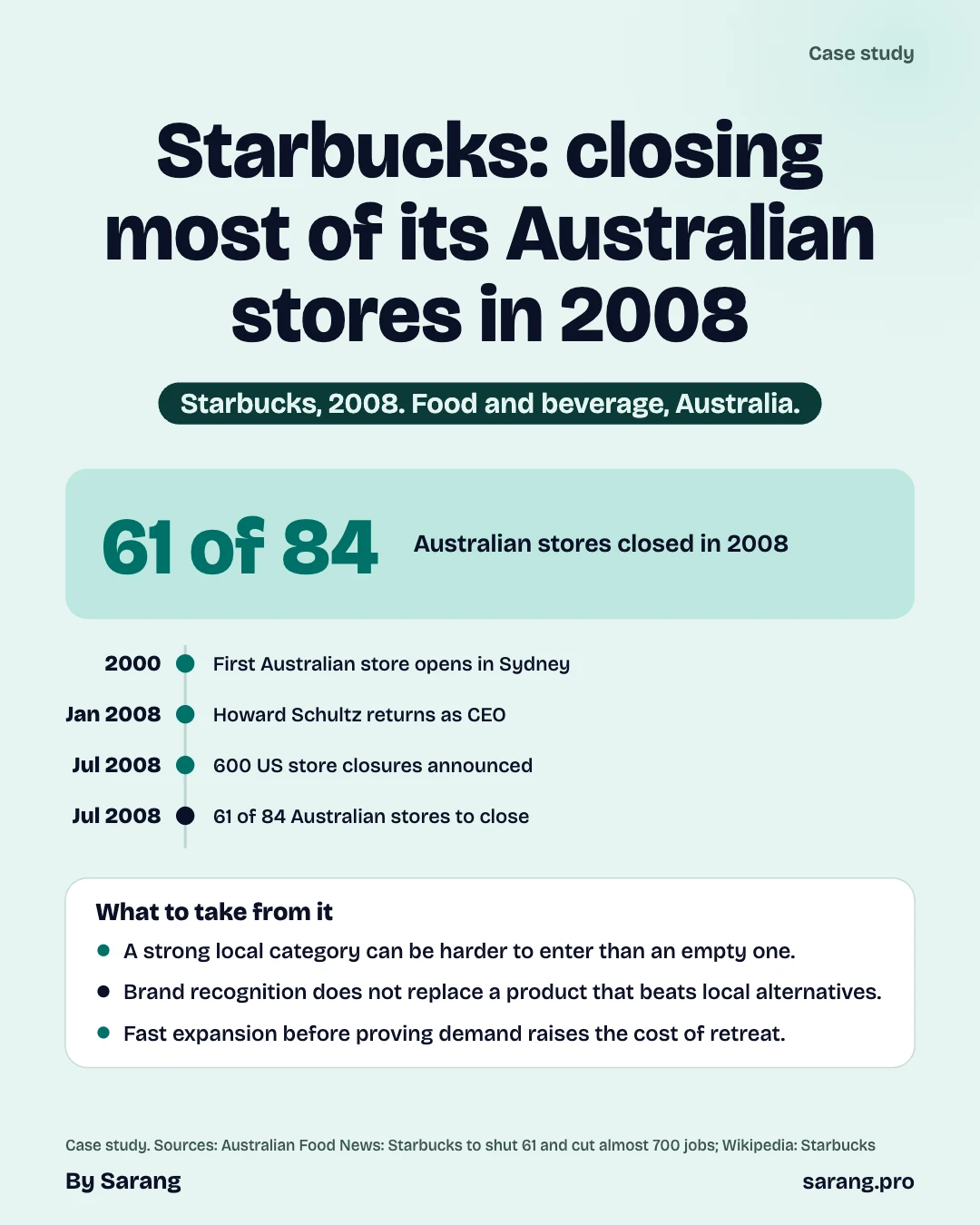
In July 2008 Starbucks closed 61 of its 84 or 85 Australian stores in days, cutting about 685 jobs, and blamed conditions it called unique to Australia.
- Australian stores closed in July 2008
- 61
- stores before the closures, depending on source
- 84 or 85
- stores left
- 23 or 24
- jobs lost, as reported in Australian media
- 685
The situation
On 29 July 2008 Starbucks Coffee International announced that it would close 61 of its Australian stores by 3 August. Sources count the network before the cuts as either 84 or 85 stores, so between 23 and 24 would stay open, all of them in and around Sydney, Melbourne and Brisbane. About 685 staff were due to lose their jobs, a figure reported in Australian media at the time. Another report, from a local paper, said “almost 700”.
The cuts fell hardest in New South Wales, where 28 stores closed, followed by Victoria with 17 and Queensland with 8. All eight stores in South Australia, the Australian Capital Territory and Tasmania closed. In South Australia, that included the three outlets opened only a year earlier in 2007 at Rundle Mall, Glenelg and Noarlunga.
It was an unusual retreat for a company that had spent the early 2000s opening roughly one store a day worldwide and had reached about 15,000 stores. Chief executive Howard Schultz called Australia’s problems “unique” and said no other international market needed to be treated in the same way. This case looks at what Starbucks had built in Australia, why the network shrank by about three quarters in a week, how the company and outside observers explained it, and what happened to the brand afterwards.
Background
A company-owned chain that grew fast
Starbucks is a Seattle company that ran its stores itself instead of franchising them. A City Hub report from August 2008 made the consequence plain: the model leaves the owner carrying debts and exposure that are much larger than those of a franchise-based competitor. When a store loses money, the parent pays.
The company’s expansion in the 1990s and early 2000s was fast. One commentator in Australian Food News described roughly a new store per day over that period, ending with about 15,000 stores worldwide, and a customer base that had shifted toward middle and lower-income consumers. In February 2007 Schultz had sent a memo to top executives acknowledging that a series of decisions had led to a “watering down of the Starbucks experience”, according to the ICMR case summary of the Australian episode.
Entry to Australia
Starbucks opened its first Australian store in the Hyde Park area of Sydney in 2000. By 2007 it was still adding stores, including those in South Australia. Sources give different peak counts: the 84 and 85 above, and a World Coffee Portal history that says the network grew to 80 stores. These are close enough to describe a chain of about 80 to 85 outlets, but the exact figure on closure day differs by source.
Schultz returns
Schultz returned as chief executive on 7 January 2008, after about eight years away from day-to-day operations, according to the ICMR summary. He led what the company called a transformation strategy, developed early in 2008. The Australian closures were presented as part of it. Jason Ball, the store development manager, was named managing director for Australia from 1 September 2008.
The industry
A coffee culture that already existed
Nick Wailes, an associate professor at the University of Sydney, argued in 2008 that Starbucks’ early success elsewhere came from introducing European-style coffee culture to markets that lacked one. Australia, he said, already had “a fantastic and rich coffee culture”. Another commentary, cited on the same Australian Food News page, said Starbucks entered Australia eight years earlier into a market with an established café scene, and that its original model does not transfer well between markets.
Local competitors and independents
The SmartCompany report on the 2014 sale named Gloria Jeans, McDonald’s McCafe and independent coffee shops as the competition that made it hard for Starbucks to build a following. IBISWorld figures cited by HospitalityHub described an industry in which small boutique coffee houses had multiplied, especially in inner cities. The industry’s annual growth over five years was 3.0%, and chains performed worse than the sector as a whole.
A trading slump
Timing mattered too. The City Hub report cited the Australian Bureau of Statistics to say that retail sales had slumped over the previous six months, with cafes and restaurants among the worst hit. Starbucks was therefore cutting at a time when consumer spending on eating out was weak.
The decision
The decision was made at group level, in Seattle, as part of a wider plan. It is easier to understand against the group’s finances.
The group was under pressure
For the quarter ended 29 June 2008, Starbucks reported a net loss of US$6.7 million, or $0.01 per share, compared with net income of US$158.3 million, or $0.21 per share, a year earlier, according to the ICMR summary. Australian Food News described it as the first quarterly loss since the company listed in 1992, on revenue of US$2.57 billion. US store traffic had fallen for the first time in the company’s history. The company mainly blamed one-time costs of closing underperforming stores in the United States and Australia.
A few weeks before the Australian news, Starbucks had said it would close 600 company-owned US stores. SmartCompany later described Schultz’s cuts as closing about 800 US stores and hundreds more abroad, as part of a plan to save US$500 million in fiscal 2009, while the company still opened 140 US stores and 170 elsewhere that year.
Option one: keep trading and wait
The obvious alternative was to keep the network and wait for the market to catch up. The sources do not record this being seriously debated. The company’s statement did say the closures were of “underperforming” stores and that it expected them to be completed within days, so the scale of the cut was already settled when it was made public.
Option two: trim a few stores
A smaller cull could have kept a national footprint. Instead, Starbucks chose to concentrate on the three eastern cities and their surrounding regions. A reading of the closure list shows that the cuts removed every store in three jurisdictions and left the rest clustered around Sydney, Melbourne and Brisbane.
Option three: change the model, not only the footprint
Some commentators argued the problem was the model itself. In the Australian Food News piece, Wailes said it did not transfer well. Jason Gehrke of the Franchise Advisory Centre said in 2014 that Starbucks had failed to adjust its offering to the Australian palate and that its “lounge” style stores were too ambitious for a small customer base. The company, for its part, said it believed “strongly, unequivocally in the model, in the brand”, while announcing changes to its international operations, including a new food platform and the reduction of sandwich smells so that coffee aroma returned.
What they did
29 July 2008: the announcement
The announcement came from Starbucks Coffee International, a subsidiary of the parent. The 84 stores were spread across six of Australia’s eight states and territories. Schultz called the decision “difficult, yet necessary” and said the closures reflected “business challenges unique to the Australian market”. He added that “There are no other international markets that need to be addressed in this manner”, and that the company was “well into the implementation phase of transforming Starbucks”.
The closures themselves
Closures were due by 3 August 2008, five days after the announcement. City Hub, reporting on 2 August, found staff at the Victoria Cross store in North Sydney declining to answer questions because of confidentiality agreements, and named three more inner-city stores at Wynyard, Darlinghurst and St James among those closing. Management called the move a “geographical refocus”.
Keeping international growth going
While closing stores in Australia, Starbucks said it planned to open 975 new international locations that year. Schultz tied the Australian cut to that growth, calling it a step that would support international expansion. The sources do not report how the savings were used.
Restructuring around the survivors
After the closures the company ran the remaining stores, clustered in the three eastern cities, as a small network. SmartCompany and InDaily describe 24 stores left in 2014, while the 2008 reports give 23. The sources opened do not explain the one-store gap.
What happened
Customer reaction
SmartCompany’s 2011 look back reported that coffee drinkers criticised the chain despite its free WiFi, saying the coffee was not good. That is one report of opinion, not a survey, but it fits the academic view that the product did not win over a market with exacting habits.
The immediate cost
| Item | Figure reported | Source |
|---|---|---|
| Stores before closures | 84 or 85 | City Hub, ICMR, SmartCompany |
| Stores closed | 61 | All sources |
| Stores left | 23 or 24 | Australian Food News, InDaily |
| Jobs lost | 685, or almost 700, or more than 650 | ICMR, City Hub, SmartCompany |
The slow years
For the next six years the surviving chain stayed small. In May 2014 the Withers Group, which owns the Australian arm of 7-Eleven, took over the local operation for an undisclosed sum. Its chief executive, Warren Wilmot, said the aim was “to make Starbucks the most successful coffee chain in Australia”. The group planned to open company-owned stores near its roughly 600 7-Eleven outlets, starting in central business districts and metropolitan areas, and said the brand would stay independent of 7-Eleven.
Who bought it
The buyer was a family business with a long record in Australian retail. According to the SmartCompany report of 28 May 2014, Russell Withers and his family were estimated the year before to be worth $725 million. The family brought 7-Eleven to Australia in 1977, and Russell Withers owns the Australian rights with his sister, Bev Barlow. Their grandfather, George Withers, bought his first grocery store in 1913. The Withers Group said it wanted to use its experience in bringing international brands to Australia and adapting them to the local market.
Gehrke saw a structural gain in the sale: the franchise infrastructure the family already had in Australia was, he said, “vastly greater than what Starbucks currently had as a 24 store chain”. Yet the Withers Group chose to run Starbucks stores itself rather than through franchisees, at least at the start, and the stores were to stay independent of 7-Eleven.
A first profit and a second go
The World Coffee Portal reported in July 2024 that Starbucks Australia posted its first profit in 2023. By then it operated 72 stores in Victoria, New South Wales and Queensland, with chief executive Chris Garlick saying the chain had the “right size and scale” to speed up expansion and that there was “latent, built-up demand” in the western states. The plan was an initial 12 drive-thru stores in suburban Perth over six months, with nine more sites in the pipeline for early 2025. The first Perth-area store arrived in October 2024.
A December 2024 World Coffee Portal item said the licensed business lost AU$5.8 million in the twelve months to 30 June 2024, with chairman Michael Smith saying the business “remains focused on expansion”. Cost of new stores and high living costs were cited as obstacles. The article was paywalled, so the detail is thin.
Other views
Company: Australia is unique
Schultz’s position was that Australia was a special case and the brand itself was sound. The statement that no other market needed this treatment was meant to calm investors who might have feared a wider retreat. Whether that was accurate depends on later results elsewhere, which the sources opened do not cover.
Academic: a mismatch with local culture
Wailes’ argument was that a model built on introducing coffee culture had little to offer where the culture already existed. HospitalityHub, citing IBISWorld, went further and called the closure “a decisive rejection of Starbucks by Australian consumers”.
Franchise adviser: the offer was wrong
Gehrke said the stores were too big and the offer did not suit local taste. He also said the Withers Group would likely review its decision not to franchise, though he added “I would never say never with franchising it though.”
Other explanations
Australian Food News listed three other candidate reasons: the company’s own account of worsening US economic conditions and poor real estate decisions, competition from McDonald’s, and rapid expansion that eroded the brand. Each of these is a claim by a commentator or the company, not a measured cause. The evidence for any one is thin, and they are not exclusive.
Trade press: how to relaunch
HospitalityHub, drawing on IBISWorld analysis, set out what a relaunch would need. It expected an emphasis on convenience, with a focus on busy central business district sites, stores near 7-Eleven outlets for cross-promotion, and longer opening hours than independent cafes, which mostly trade in business hours. It also expected a wider menu, noting that chains such as The Coffee Club and Michel’s Patisserie had gained from a food focus over the previous five years. The report added that the new owner would need to “carefully reassess the operating model of the stores” to avoid repeating the first attempt. Its comparison with Asia is useful context: Starbucks grew strongly in markets such as China largely because it entered early into a relatively untapped market, which Australia was not.
Limits of the evidence
No Starbucks Australia financial statements were opened for the years before 2008. The sources therefore do not show store-by-store losses or when individual stores started to fail. Counts differ by source, and the cause of each closed store is not recorded.
Reading it through a framework
Positioning: the wrong place in customers’ minds
Positioning asks where a brand sits in a buyer’s mind relative to alternatives. In many countries Starbucks sat as a new, European-style coffeehouse. In Australia, Wailes said, that space was already taken by an established café culture, and Gehrke said the large lounge format and the menu did not match local taste. McCafe, Gloria Jeans and independents offered coffee at close range. The facts above point to a brand that was less different in Australia than the company assumed.
Porter’s five forces: rivalry, buyers and the cost of the model
Rivalry was intense, since rivals included chains, McDonald’s McCafe and many independents, and IBISWorld described low barriers to entry. Buyer power was high because switching between cafes costs a customer nothing. The company-owned model raised its own cost: with no franchisees to share the burden, the parent carried the rent and the debts of every store. In a retail slump, those fixed costs fell on Starbucks directly. This helps explain why a deep cull, rather than a gentle trim, looked attractive in Seattle.
Since then
Since 2014 the Australian operation has been licensed to the Withers Group, which sold its 7-Eleven chain of about 750 stores to 7-Eleven International for AU$1.7 billion in December 2023, according to the World Coffee Portal. The sources opened do not say what happened to the Starbucks licence in that sale, and the December 2024 report refers to the licensee and its chairman Michael Smith.
The market Starbucks returned to is more crowded in some ways. By mid-2024, Hungry Jack’s Jack’s Cafe had more than 400 outlets, McCafe had over 1,000 sites, Soul Origin had 150 stores, Zarraffa’s Coffee planned to grow from 76 to 130 outlets by 2026, and the Chinese chain Cotti Coffee had entered with a take-away site in Sydney in February 2024. Starbucks was by then trying drive-thru stores in Perth rather than lounges.
Taken together, the sources describe two different clocks. The first is the group clock: a fall in US store traffic, a quarterly loss and a plan to save US$500 million in fiscal 2009 forced fast decisions in Seattle. The second is the local clock: eight years of trading in a market where, by most accounts, the brand never found its place. The closures happened where the two met, which is why the company could say the cause was unique to Australia while outside observers pointed to wider limits of the model. Neither the company nor the commentators had access to store-level figures in the public record, so the weight of each explanation remains a matter of judgement.
What to take from it
- A format that wins in a market without a coffee tradition may have little to offer in one with a strong local tradition, as Wailes argued.
- Rapid expansion across the group left Starbucks with stores that did not earn their keep, and the Australian closures were part of a global clean-up of about 800 US stores and hundreds abroad.
- A company-owned model puts every store’s losses on the parent, so a downturn can force a quick and deep cut.
- A retreat is not always the end: the same brand came back under a different owner, a smaller footprint and a drive-thru format, and posted its first profit in 2023.
- Executives’ public explanations, such as calling Australia “unique”, are claims to test against the other evidence rather than findings.
Questions to think about
- Which was the main cause of the closures: the product, the format, the model of ownership, or timing? What evidence would settle it?
- Would franchising have saved more stores in 2008, or only spread the losses?
- What should a company check about local competitors before opening its first store in an established coffee market?
- How would you judge the 2024 return to Australia: by store count, by profit, or by something else?
Concepts at work
This case draws on market positioning, ownership models such as company-owned versus franchised, and market entry. Explore them in Insights.
Written from the public sources listed below. Figures are as those sources report them.
Framework
Timeline
- 2000Starbucks opens its first Australian store in Sydney
- Feb 2007Schultz memo warns of a watering down of the Starbucks experience
- Jan 2008Schultz returns as chief executive
- Jul 2008Starbucks says it will close 600 US stores
- 29 Jul 2008Announcement to close 61 Australian stores by 3 August
- 3 Aug 2008Closures due to be complete
- Sep 2008Jason Ball becomes managing director for Australia
- May 2014Withers Group takes over the remaining stores
- 2023Starbucks Australia posts its first profit
- Oct 2024First stores open in Western Australia
Recap cards
Tap a card to check yourself.
Sources and credits
- Australian Food News: Starbucks, what went wrong? (31 July 2008)
- SmartCompany: Starbucks Australia closures (August 2011)
- City Hub: Buck stops here for coffee chain (2 August 2008)
- ABC7 New York archive: Starbucks to close 61 Australian stores
- ICMR: Starbucks' Australian Experience (case catalogue entry, 2009)
- InDaily: Starbucks' second crack at local market (28 May 2014)
- SmartCompany via Apartments.com.au: Rich List family behind Australia's 7-Eleven snaps up Starbucks (28 May 2014)
- HospitalityHub: Coffee giant reattempting to break boutique culture
- World Coffee Portal: Starbucks sees fortunes improve in challenging Australian market (17 July 2024)
- World Coffee Portal: Starbucks Australia posts AU$5.8m loss amid expansion (12 December 2024)