Leicester City: a 5,000-1 outsider that won the Premier League with a cheap, stable team
Leicester won the 2015-16 Premier League at 5,000-1 with an eleven that cost about £22m and barely changed, then fell to the third tier within ten years.
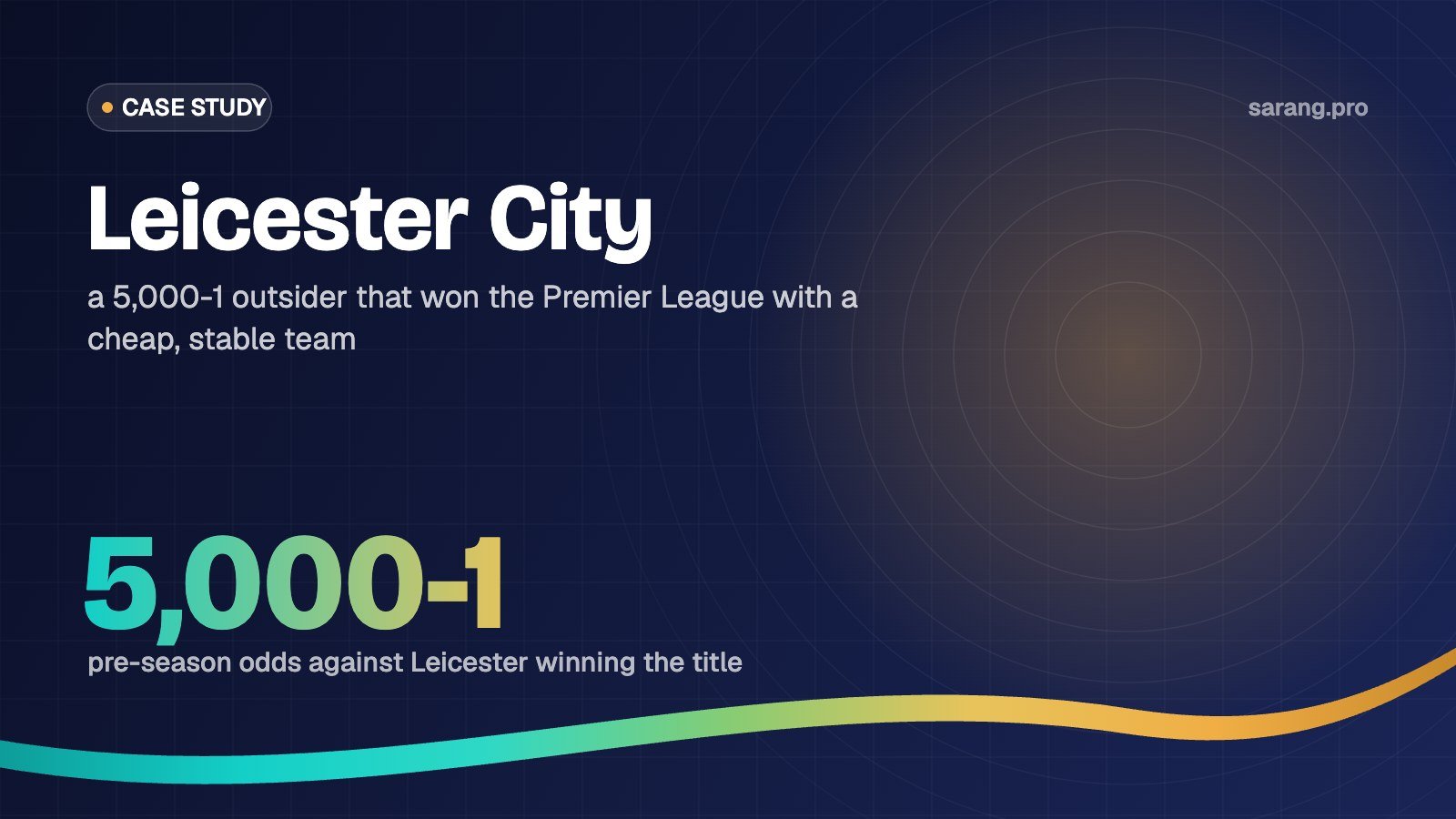
- pre-season odds against Leicester winning the title
- 5,000-1
- points, ten clear of Arsenal
- 81
- reported cost of the usual starting eleven
- £21.95m
- changes to the starting eleven all season
- 33
The situation
On 30 June 2015 Leicester City’s board sacked its manager, Nigel Pearson. The club statement said “fundamental differences in perspective” existed between him and the board, and that the working relationship could not continue. Two weeks earlier the club had ended the contracts of three young players, one of them Pearson’s son James, after a video from an end-of-season tour of Thailand, the home country of the club’s owners, was leaked to the press. Pearson had just kept Leicester in the Premier League with a late run of results. The club finished 2014-15 in 14th place with 41 points.
The owners, the Srivaddhanaprabha family of the Thai duty-free group King Power, now had to choose a new manager and decide how to use a modest transfer budget for a club whose realistic aim was to stay in the division. On 13 July they appointed Claudio Ranieri, aged 63, on a three-year contract. It was his 16th managerial job. He had not won a league title as a manager, and he was returning to the Premier League 11 years after Chelsea dismissed him in 2004.
Bookmakers offered odds of up to 5,000 to 1 against Leicester winning the 2015-16 title. Ten months later the club were champions, ten points clear of Arsenal. This case looks at how a club with a cheap squad and one of the smaller wage bills in the league won the title, what the win did to its finances, and why the club was playing in the third tier of English football ten years later.
Background
A provincial club with no top-flight title
Leicester City had existed for 132 years by 2016 without winning the top division. Like many English clubs outside the largest cities, it had spent its history moving between divisions. As recently as 2008-09 it had played in the third tier. It returned to the Premier League for 2014-15 after winning the Championship in 2013-14, a season in which its losses exceeded the Football League’s financial fair play limit of £8 million, which led to a long dispute and arbitration.
Ownership
A consortium led by Vichai Srivaddhanaprabha bought the club from Milan Mandaric in August 2010 for a reported £39 million. Vichai became chairman in February 2011, and the stadium was renamed the King Power Stadium. King Power had grown from a duty-free shop Vichai opened in 1989 into a chain of airport duty-free stores across Thailand, which Forbes valued at about US$4.9 billion in 2018. The owners promised large sums. ITV reported a pledge of about £180 million over three years to push the club into the top five and into Europe. City AM described the £180 million commitment as a 2014 promise to win promotion. The two accounts differ on the purpose, but agree that the family was prepared to fund losses in pursuit of the Premier League.
Vichai’s son Aiyawatt, known as Top, was vice-chairman and became the public face of the board. Day-to-day football decisions sat with the manager and the club’s football staff, including the recruitment department.
How a Premier League club made money
A Premier League club earns money from three main sources: broadcasting, which is sold centrally by the league and shared among clubs; matchday income from tickets and hospitality; and commercial income from sponsorship and merchandise. For a club of Leicester’s size, broadcasting was by far the largest. Most of the money went on players’ wages and on transfer fees, which are spread across the length of a player’s contract in the accounts. The financial logic was simple and harsh. Staying in the league kept the broadcast income flowing. Relegation cut revenue sharply while many player contracts remained.
A squad built cheaply over several years
The players who won the title had mostly been bought for small fees from lower divisions or smaller leagues. Kasper Schmeichel came from Leeds United for £1.25 million in 2011. In January 2012 the club bought Wes Morgan from Nottingham Forest for £1 million and Danny Drinkwater from Manchester United for £700,000. Jamie Vardy arrived from Fleetwood Town, then a non-league club, for £1 million in July 2012. Riyad Mahrez joined from the French second-tier club Le Havre in January 2014 for £400,000. Marc Albrighton came on a free transfer from Aston Villa and Danny Simpson from Queens Park Rangers for £2 million, both in 2014.
Exhibit 1: Cost of Leicester’s usual starting eleven, 2015-16
| Player | Signed from | When | Fee |
|---|---|---|---|
| Kasper Schmeichel | Leeds United | July 2011 | £1.25m |
| Danny Simpson | Queens Park Rangers | August 2014 | £2m |
| Wes Morgan | Nottingham Forest | January 2012 | £1m |
| Robert Huth | Stoke City | July 2015 | £3m |
| Christian Fuchs | Schalke 04 | July 2015 | Free |
| Riyad Mahrez | Le Havre | January 2014 | £400,000 |
| N’Golo Kanté | Caen | August 2015 | £5.6m |
| Danny Drinkwater | Manchester United | January 2012 | £700,000 |
| Marc Albrighton | Aston Villa | July 2014 | Free |
| Shinji Okazaki | Mainz 05 | July 2015 | £7m |
| Jamie Vardy | Fleetwood Town | July 2012 | £1m |
| Total | £21.95m |
Source: theScore, “Anatomy of an underdog”. Fees are as reported, not from club accounts.
The industry
Size and structure
The Premier League is a closed competition of 20 clubs each season, open at the bottom through promotion and relegation with the Championship. According to Deloitte, its clubs earned a record £3.6 billion in 2015-16 (£3,639 million), up 9%. Broadcasting provided £1,927 million, or 53%. Wages took £2.3 billion (£2,279 million), up 12%, and the ratio of wages to revenue rose from 61% to 63%. A new set of broadcasting contracts started in 2016-17, and Deloitte reported that central distributions to clubs rose by 46% to £2.4 billion that season, an average increase of £38 million per club.
Revenue was very unequal. Six clubs (Arsenal, Chelsea, Liverpool, Manchester City, Manchester United and Tottenham Hotspur) earned far more than the rest from matchday and commercial income, and from regular Champions League football. Deloitte noted that even after its revenue rose by £25 million in the title season, Leicester still earned less than 40% of the average revenue of those six clubs. Its wage bill ranked 15th in the league.
Forces at work
Read through Porter’s lens, the industry gives most of its value to its suppliers. The scarce input is playing talent, and the best players and their agents can move between clubs and countries. That bargaining power shows in a wage ratio of 63%. Broadcasters, the largest buyers, deal with the league as a single seller, which has kept rights fees rising. Rivalry is intense, because league position is a zero-sum ranking, and the penalty for finishing in the bottom three is the loss of most broadcast income. Entry comes through promotion, and new entrants usually spend heavily to survive.
If talent can be bought, money should usually win, and the bookmakers’ odds of 5,000 to 1 reflected that assumption. A club ranked 15th by wages was not expected to finish first.
Regulation
Clubs were subject to spending rules. The Football League had financial fair play limits on losses in the Championship, which Leicester had exceeded in 2013-14. The Premier League had its own profitability and sustainability rules, setting a maximum loss over a rolling three-year period. These rules matter later in this case.
Technology and sports science
By 2015, clubs routinely used GPS tracking of players in training, strength testing and recovery tools. The spread of performance data also made it easier for scouts to find players in smaller leagues. That helped clubs like Leicester at first, but it also meant other clubs could find the same players.
The decision
Who to appoint
After Pearson’s departure, assistant manager Craig Shakespeare and Steve Walsh, the head of recruitment, took charge of first-team duties while the board searched for a replacement. The owners said they remained committed to long-term development and to further investment in the squad.
The board’s options ran from a manager with a record of keeping clubs in the Premier League, which matched the club’s realistic target, to an experienced international coach who might bring a different approach. Ranieri had held 15 managerial jobs before Leicester, including Chelsea, but had never won a league title. Appointing him was a bet that a calm, experienced coach could get more from an existing squad than a specialist in relegation battles.
How to spend
The second decision was whether to spend heavily on new players or add a few at modest prices. The club chose the second path. In the summer of 2015 it signed Robert Huth from Stoke City for £3 million, Christian Fuchs on a free transfer from Schalke, Shinji Okazaki from Mainz for £7 million and N’Golo Kanté from Caen for £5.6 million. These were players with experience or potential who were not in demand at the richest clubs.
How to play
The third decision belonged to the new manager. Leicester had used 11 different formations in 2014-15, including a back three during the late escape. Ranieri could keep experimenting or settle on one system and a stable set of players. He chose stability.
What they did
A simple system
Ranieri dropped the back three and used a compact 4-4-2, built on two disciplined banks of four, a hard-working deep-lying forward and a fast striker. Without the ball it became a 4-4-1-1. The Premier League’s own analysis found that Leicester used this shape in 35 of their 38 league matches. The team did not try to control the ball. Average possession was 42.4%, the lowest on record for a Premier League champion since data collection began in 2003-04. Leicester won the ball back, broke quickly and relied on Vardy’s pace and Mahrez’s dribbling. Shots per 90 minutes rose from 12 to 13.7 and shots faced fell from 14.6 to 13.6 compared with the previous season.
The individual numbers were striking. Kanté made 175 tackles and 156 interceptions, the most in the division. Vardy scored 24 league goals and set up six. Mahrez scored 17 and set up 11.
A stable team
Ranieri made only 33 changes to his starting eleven during the league season. That was the second-fewest by any Premier League champion and 20 fewer than any other title winner this century. Okazaki made the fewest starts of the regular first-choice players, with 28. Seven players played more than 3,000 of the 3,420 league minutes available.
Keeping players fit
Stability depended on fitness. Leicester had fewer injuries than any other Premier League club that season, according to the club’s head physiotherapist, Dave Rennie, who had been at the club for 17 years. Speaking to the Chartered Society of Physiotherapy’s magazine in August 2016, he said the record had been strong for four or five years. He credited teamwork between physiotherapists, the sports science team led by Matt Reeves and strength and conditioning staff, not any single screening test. The staff used GPS to monitor training loads, a NordBord device to test hamstring strength and whole-body cryotherapy, in chambers cooled with liquid nitrogen to between about minus 135°C and minus 150°C, to help recovery. They also explained injuries and exercise programmes to players. “We empower the players to take accountability for themselves,” Rennie said.
The run-in
Leicester lost only three league matches all season. They won the title on 2 May 2016, when Tottenham Hotspur, the only side that could still catch them, drew 2-2 at Chelsea. They finished with 23 wins, 12 draws and three defeats.
What happened
On the pitch
Leicester finished on 81 points, ten more than Arsenal. The 40-point improvement on 2014-15 was the second-largest in Premier League history. Ranieri was named FIFA’s best men’s coach of 2016.
Exhibit 2: Leicester’s league record, 2014-15 and 2015-16
| Measure | 2014-15 | 2015-16 |
|---|---|---|
| Final position | 14th | 1st |
| Points | 41 | 81 |
| Formations used | 11 | 4-4-2 in 35 of 38 matches |
| Average possession | 42.9% | 42.4% |
| Shots per 90 minutes | 12.0 | 13.7 |
| Shots faced per 90 minutes | 14.6 | 13.6 |
| League defeats | n/a | 3 |
Source: Premier League, “PL30: How Ranieri masterminded Leicester’s title victory” (2022); final position for 2014-15 from Malay Mail (AFP), March 2017.
For the bookmakers
British bookmakers were reported to have lost about £25 million on the result. Ladbrokes said it was the biggest anti-post payout in its 130-year history. Of the 57 customers who had backed Leicester at 5,000 to 1 with Ladbrokes, all but 21 had cashed out early. A Ladbrokes spokesman said bookmakers would “have to completely recalibrate how we approach betting on outsiders”.
In the accounts
The title season itself made only a modest difference to the club’s finances. Turnover in the year to May 2016 rose by more than £24 million to £128.7 million, helped by prize money, higher domestic television income and larger crowds. Pre-tax profit fell by about £10 million to £16.4 million, mainly because of spending on players. Staff costs were £80.4 million, or 62.4% of turnover. Deloitte said Leicester’s wage costs rose by about 40%, partly because of bonuses for winning the league.
The large financial effect came in the following year, through the Champions League. Turnover in the year to May 2017 nearly doubled to £233 million. The Champions League run added just over £70 million, with UEFA payments of €81.7 million. Ticket revenue rose 42%. Pre-tax profit was £92.5 million, believed to be the largest by a single club in Premier League history. Of that, £38.8 million came from selling players, mainly Kanté to Chelsea and Jeffrey Schlupp to Crystal Palace. Staff costs rose to £112.6 million, but because revenue grew faster, the wage ratio fell to 48.3%. The club invested £102 million in player registrations. Its chief executive, Susan Whelan, said the club was realistic about the chances of such results being repeated soon.
She was right. In the year to May 2018, without European football, turnover fell to £158.9 million and pre-tax profit to £1.6 million, even though the accounts included the £35 million sale of Drinkwater to Chelsea.
Exhibit 3: Leicester City finances by year (years to 31 May)
| Year | League finish | Turnover | Staff costs | Staff costs / turnover | Pre-tax profit (loss) |
|---|---|---|---|---|---|
| 2015-16 | 1st | £128.7m | £80.4m | 62.4% | £16.4m |
| 2016-17 | 12th; Champions League quarter-final | £233.0m | £112.6m | 48.3% | £92.5m |
| 2017-18 | n/a | £158.9m | n/a | n/a | £1.6m |
| 2022-23 | Relegated | n/a | n/a | n/a | (£89.7m) |
Sources: Inside World Football (March 2018, March 2019); Malay Mail (AFP), March 2017; City AM. Blank cells mark figures not checked for this case.
The sacking of Ranieri
The league form did not last. On 23 February 2017, nine months after the title, the club sacked Ranieri. Leicester were one point and one place above the relegation zone with 13 games left. They had not scored a league goal in 2017 in six matches, had won one of their last ten league games and had been knocked out of the FA Cup by Millwall, then in the third tier. The night before, they had lost 2-1 away to Sevilla in the first leg of the Champions League last 16. Sixteen days earlier the club had issued a statement backing him.
Aiyawatt Srivaddhanaprabha said the club was “duty-bound to put the club’s long-term interests above all sense of personal sentiment”. Ranieri said: “After the euphoria of last season and being crowned champions, all I dreamt of was staying with Leicester.” Shakespeare took over. Leicester went on to reach the Champions League quarter-finals and finished the league season 12th with 44 points.
Other views
Luck or method
One reading is that Leicester benefited from an unusual season in which the richest clubs underperformed at the same time, and from a remarkable run of fitness. The bookmakers’ own response, Ladbrokes’ talk of recalibrating how it priced outsiders, suggests the industry saw the result as a sign that its models had understated the chance of an upset, not as proof that a cheap squad could repeat the feat. The club’s own accounts make a similar point. Whelan’s statement that the club was realistic about repeating its results was a public warning against assuming the title would become the norm.
The other reading stresses method. The Premier League’s analysis presents the title as the product of a deliberate tactical choice: a counter-attacking side that did not need the ball, used in nearly every match. Rennie’s account presents the injury record as the result of years of work, not one lucky season. These views are compatible. The method made the team good enough to take advantage when its rivals stumbled.
The board’s decisions
The board’s decision to sack Ranieri divided opinion. The club argued that domestic results had put its Premier League status at risk and that sentiment could not outweigh that. Critics later saw the decision as the start of a pattern. When Leicester were relegated to the third tier in April 2026, an AFP report described Ranieri’s successors, Craig Shakespeare and Claude Puel, as inadequate replacements, criticised the sporting director Jon Rudkin and tied the fall to the club’s finances. Those are a news agency’s judgements, made with hindsight. The case for the board is that the team was close to the relegation zone when it acted, and that it finished 12th and reached a European quarter-final afterwards.
Regulators
The independent commission that ruled on Leicester’s finances in 2026 took a dim view of the club’s conduct. It found that the club had exceeded its permitted losses by £20.8 million over the period ending 2023-24, rejected its competition-law challenges, found that it had breached its duty to provide accounts on time and rejected its claim of exceptional co-operation. It did treat the club’s improving financial position as a reason to reduce the penalty by one point.
Players and staff
The public statements from players and staff at the time mostly credited togetherness and simplicity. Rennie’s comment that success depended on relationships with players rather than gimmicks is one of the few on-the-record accounts from inside the club of how the season worked, and it comes from a member of staff with an interest in presenting his department well.
Reading it through a framework
Hackman’s conditions for team effectiveness
The organisational psychologist J. Richard Hackman argued that teams perform well when five conditions are in place: a real team with clear and stable membership, a compelling direction, an enabling structure, a supportive organisational context and expert coaching. Applied to Leicester in 2015-16, most conditions held.
Membership was unusually stable. Only 33 changes to the starting eleven across 38 matches means fewer than one change a game, and seven players took part in at least 3,000 of the 3,420 minutes available. Direction is the hardest condition to evidence from the public record. The club’s starting position made survival the obvious target, and results changed the goal during the season. The structure was simple. One shape in 35 of 38 matches, against 11 formations the season before, gave each player a defined role. Kanté’s 331 tackles and interceptions show how that structure turned one player’s job into a team function.
The supportive context came from the medical and sports science staff, who kept the stable eleven on the pitch, and from owners who had kept funding the club. Coaching was expert in a quiet way: Ranieri fitted the system to the players he had. In 2016-17 the conditions weakened. Kanté left for Chelsea, so a central role in the structure had to be filled. The Champions League added matches, which strained the small squad. By February 2017 the board judged that the direction had changed from winning to avoiding relegation. Hackman’s model suggests that the team’s decline was partly about conditions changing, not only about individual players playing worse.
VRIO
Jay Barney’s VRIO framework asks whether a resource is valuable, rare, costly to imitate and supported by the organisation. Leicester’s most important resource was its ability to find good players that richer clubs had overlooked, and to buy them cheaply.
It was valuable: an eleven that cost £21.95 million won a league in which total club wages were £2.3 billion. It was rare, at least in the sense that few clubs had found players of the quality of Mahrez (£400,000), Vardy (£1 million) and Kanté (£5.6 million) at those prices. It was not costly to imitate for long. Once the players performed, their market value rose and richer clubs bought them. Kanté went to Chelsea within a year, Drinkwater followed for £35 million, and the directors put the squad’s market value above £300 million by 2017. That converted the advantage into cash: £38.8 million of player trading profit in 2016-17. But it also meant the advantage could not be held as a team.
The organisation test is where the story turns. To sustain a scouting advantage, a club needs systems to keep finding replacements and to keep spending within its means. The commission’s finding that Leicester exceeded its loss limit by £20.8 million, and the 2022-23 loss of £89.7 million, suggest that the organisation did not sustain the discipline that had produced the title squad.
Since then
The club suffered a personal tragedy on 27 October 2018, when Vichai Srivaddhanaprabha was killed with four others in a helicopter crash outside the stadium after a match. Aiyawatt became chairman. According to City AM, he owns 55% of the club, with the rest held by his mother and siblings.
Under Brendan Rodgers the club won the FA Cup, but it was relegated from the Premier League in 2023, with Rodgers dismissed as relegation loomed. It reported a loss of £89.7 million for 2022-23. It won promotion and returned to the Premier League for 2024-25, then was relegated again in 2025. Vardy, the last link to the title-winning side, left at the end of that season.
In February 2026 an independent commission found that Leicester had broken the profit and sustainability rules for the three years to 2023-24. Its permitted loss was £83 million and it had exceeded it by £20.8 million. The commission recommended a six-point deduction, starting from seven and reduced by one for the club’s improving finances. The deduction was applied immediately in the Championship. An appeal board chaired by Lord Dyson dismissed the club’s appeal on 8 April 2026, and also dismissed the Premier League’s own appeal for a heavier sanction.
The season went badly on the pitch too. Marti Cifuentes was sacked in January 2026. His successor, Gary Rowett, a former Leicester defender, won one of his first 12 matches. On 21 April 2026 a 2-2 draw at home to Hull City confirmed relegation to League One, the third tier, for the first time since 2008-09. It was the club’s third relegation in four seasons. Rowett said the club had to rise again and learn its lessons.
What to take from it
- A stable team with clear roles can outperform far richer rivals, as Leicester did with only 33 changes to its starting eleven and one shape in 35 of 38 matches.
- Finding undervalued talent is a strong advantage but a temporary one, because success reveals the talent to buyers with more money.
- Investment in prevention, such as monitoring training loads, protects the stability that a small squad depends on.
- A single exceptional season can double revenue, as the Champions League did for Leicester in 2016-17, but the gain disappears quickly unless costs fall back with it.
- Spending rules turn financial indiscipline into sporting punishment, so a club’s finance function matters as much as its scouting department.
Questions to think about
- Was sacking Ranieri nine months after the title a reasonable response to the club’s position in February 2017, or the start of the decline that followed?
- Leicester’s staff costs were £80.4 million in 2015-16, when Premier League clubs paid £2,279 million in wages in total. What share of the league’s wage bill did Leicester account for, and what does that suggest about the link between spending and results?
- Turnover rose from £128.7 million to £233 million and then fell to £158.9 million. How should a club plan its wage commitments when one season’s income is unlikely to repeat?
- Which of Hackman’s five conditions do you think mattered most to Leicester in 2015-16, and which was the first to fail in 2016-17?
- How could Leicester have protected its scouting advantage after rival clubs began buying its best players?
- The commission cut Leicester’s penalty from seven points to six because its finances were improving. Is that a sensible principle for a regulator to follow?
- What can a small business learn from a team that won with less of the ball, fewer changes and fewer injuries than its rivals?
Concepts at work
Team effectiveness, VRIO, Squad rotation. Explore them in Insights.
Further reading
Oxford University Press covers this story as a teaching case in Cases in Organizational Behaviour on Oxford Business Trove. The sources below are the public record this page was written from.
Written from the public sources listed below. Figures are as those sources report them.
Framework
Timeline
- Aug 2010King Power consortium buys Leicester City for a reported £39m
- Jul 2012Jamie Vardy signed from Fleetwood Town for £1m
- Jan 2014Riyad Mahrez signed from Le Havre for £400,000
- May 2015Leicester finish 14th with 41 points after a late escape
- 30 Jun 2015Nigel Pearson sacked
- 13 Jul 2015Claudio Ranieri appointed on a three-year contract
- Aug 2015N'Golo Kanté signed from Caen for £5.6m
- 2 May 2016Leicester win the Premier League with 81 points
- 23 Feb 2017Ranieri sacked with the club one point above the relegation places
- May 2017Champions League run helps turnover reach £233m
- Oct 2018Owner Vichai Srivaddhanaprabha killed in a helicopter crash
- 2023 and 2025Relegated from the Premier League twice
- Feb 2026Six-point deduction for breaching spending rules
- 21 Apr 2026Relegated to League One
Recap cards
Tap a card to check yourself.
Sources and credits
- Premier League: PL30, how Ranieri masterminded Leicester's title victory (18 August 2022)
- Sports Illustrated: Leicester City wins Premier League title (2 May 2016)
- theScore: Anatomy of an underdog, how Leicester's squad was built
- FourFourTwo: On this day in 2015, Leicester appoint Claudio Ranieri as first-team manager (13 July 2022)
- TNT Sports (Eurosport): Leicester City sack Nigel Pearson due to differences in perspective (30 June 2015)
- Irish Times: Leicester sack trio involved in explicit Thai video (17 June 2015)
- ITV News: Who is Leicester City owner Vichai Srivaddhanaprabha? (28 October 2018)
- City AM: Who owns Leicester?
- Chartered Society of Physiotherapy, Frontline: Success under the spotlight (3 August 2016)
- PokerNews: Leicester City's Premier League win costs bookmakers £25 million (May 2016)
- Deloitte: Annual Review of Football Finance 2017
- Malay Mail (AFP): Leicester make £16.4m profit from title season (2 March 2017)
- Inside World Football: Leicester break Premier League records with £92.5m profit (3 March 2018)
- Inside World Football: European campaign sparks king-sized jump in valuations of Leicester's players (9 March 2018)
- Inside World Football: Profits at Leicester's Foxes slump by more than £90m (7 March 2019)
- CFJC Today (AP): English champion Leicester fires Ranieri as relegation looms (23 February 2017)
- Southeast Asia Globe: How a Thai billionaire turned Leicester City into Premier League champions (2026)
- Premier League: Statement on Leicester City (5 February 2026)
- Premier League: Statement on appeal decision on Leicester City (8 April 2026)
- 7KBW: The Premier League Board v Leicester City Football Club (2026)
- Malay Mail (AFP): Former Premier League champions Leicester relegated into third tier (22 April 2026)