Lenovo: a Chinese PC maker that bought IBM’s PC arm and became the world’s largest
Lenovo paid US$1.25bn for IBM's PC division in 2004, came through two restructurings and became the world's largest PC seller by 2013, then bought Motorola.
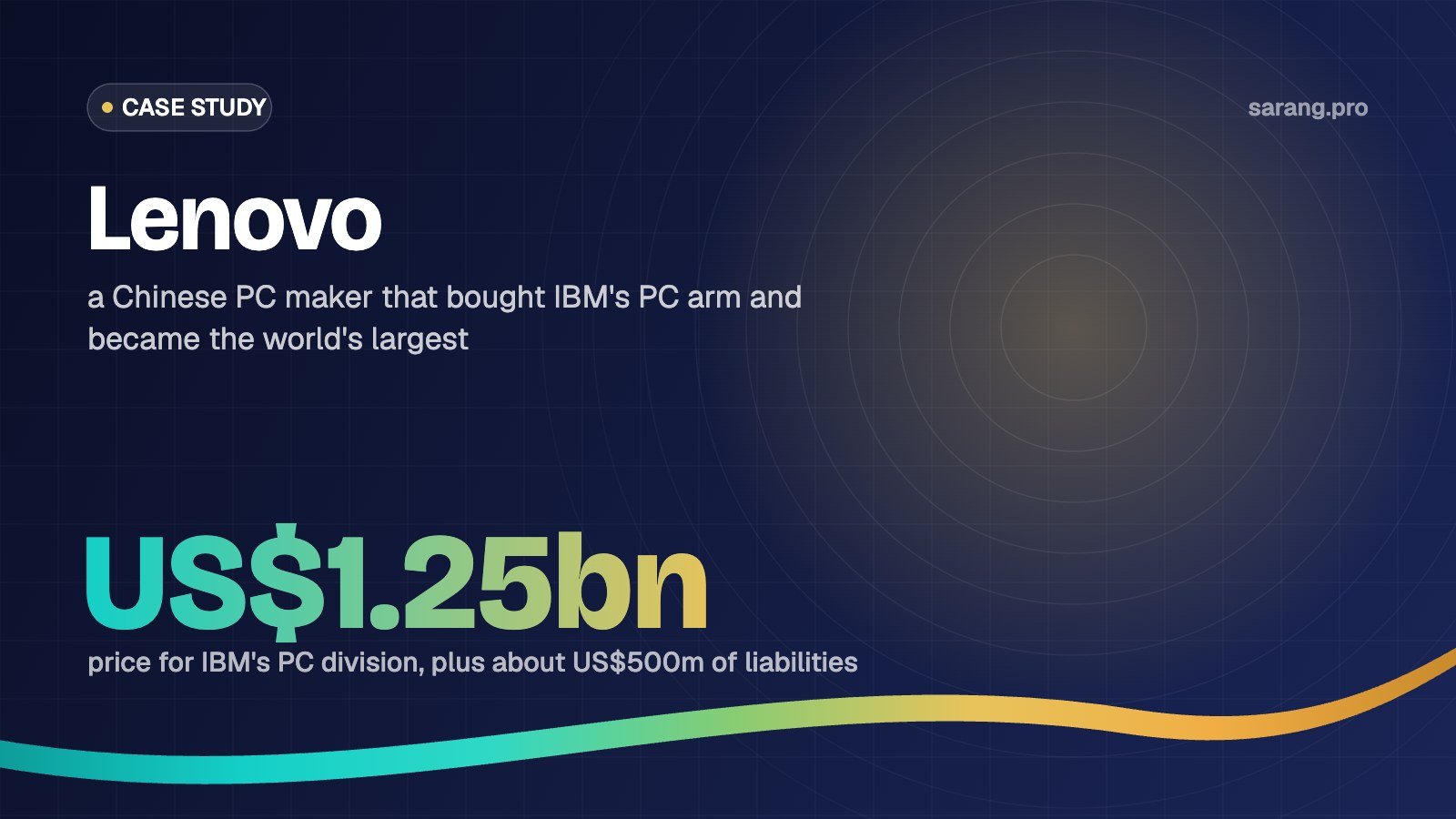
- price for IBM's PC division, plus about US$500m of liabilities
- US$1.25bn
- IBM's stake in Lenovo after the deal
- 18.9%
- Lenovo's annual revenue before the deal
- US$3bn
- Lenovo's world PC share when it took first place in Q2 2013
- 16.7%
The situation
On 7 December 2004 IBM and Lenovo announced that Lenovo, a Beijing-based computer maker little known outside Asia, would buy IBM’s personal computer business. IBM’s filing with the US Securities and Exchange Commission put the price at US$1.25 billion in cash and Lenovo shares. Lenovo would also take on about US$500 million of net liabilities, bringing the total value to about US$1.75 billion.
The two businesses were very different in size and reach. Lenovo’s annual revenue was about US$3 billion, almost all of it in China, where it had been the best-selling PC brand for seven years in a row. IBM’s PC business had revenue of more than US$9 billion in 2003 and sold ThinkPad notebooks and ThinkCentre desktops to companies around the world through IBM’s sales force. On a 2003 basis the combined company would have had about US$12 billion of revenue, shipped 11.9 million PCs and held about 8% of the world market, according to the research firm IDC. That made it the third-largest PC business in the world. It would employ about 19,000 people, roughly 10,000 of them from IBM.
For Lenovo, the purchase was a bet that it could run a global business, with customers, staff and a management culture far larger and more international than its own, without losing the corporate buyers who made the IBM unit valuable. For IBM, it was a way out of a hardware business that no longer fitted its strategy, on terms that kept some of the benefit. This case follows the deal from signing through two restructurings, Lenovo’s rise to first place in the world PC market, its second wave of acquisitions in 2014, and its position in 2026.
Background
Lenovo
Lenovo was founded in 1984 in Beijing, under the name Legend, by a group of engineers from the Chinese Academy of Sciences’ Institute of Computing Technology, led by Liu Chuanzhi. IBM’s 2004 filing described it as the first company to introduce the idea of the home computer to China. It listed on the Hong Kong Stock Exchange in 1994 and was a member of the Hang Seng Index. By 2003 it held 27.0% of China’s PC market by units and 12.6% of the Asia-Pacific market outside Japan, first in both, according to IDC. It employed about 9,000 people and had a market value of about US$2.5 billion. It had adopted the Lenovo name in 2003, and had signed up as a technology partner of the International Olympic Committee for 2005 to 2008.
Lenovo’s chief executive in 2004 was Yang Yuanqing. Liu Chuanzhi was chairman. The company’s controlling shareholder, Lenovo Holdings, agreed to vote for the deal.
IBM’s PC business
IBM’s PC business sold mainly to companies, through IBM’s enterprise sales force, and its ThinkPad and ThinkCentre lines were backed by IBM’s service and financing arms. IBM’s chief executive, Sam Palmisano, was moving the company towards services, software and high-value hardware. IBM’s filing said that since 2002 it had spent about US$9 billion on more than 30 acquisitions and had sold businesses such as hard disk drives and displays.
The filing set out IBM’s view of where PCs were heading. It said the market was splitting into two models: one based on high-value, innovation-led solutions, and one based on low cost and scale. Palmisano argued that PCs increasingly resembled consumer electronics, a business that rewards scale and a focus on individual buyers. IBM expected that removing the PC business would raise its gross margin by about three percentage points and its pre-tax margin by about one point.
How the business made money
PC makers buy processors from Intel or AMD and operating systems from Microsoft, assemble machines, often through contract manufacturers in Asia, and sell them through retailers, distributors and their own sales teams. The largest share of the value goes to the component and software suppliers. A PC maker’s profit depends on volume, which gives it purchasing power, and on tight control of operating expenses, inventory and logistics. Corporate customers pay more for reliability, service and management tools, which is why the IBM brand and its enterprise relationships mattered to Lenovo.
The industry
Size and structure
IBM’s figures imply a world market of roughly 150 million PCs in 2003 (11.9 million units being about 8%). The combined business would rank third in the world. Lenovo’s later statements and press coverage name Dell and HP as its main global rivals, and InfoWorld’s 2006 report describes Lenovo’s small-business range as aimed squarely at them. In China, Lenovo’s 27% share made it the clear leader, competing with local brands and with the global makers.
Forces at work
Seen through Porter’s five forces, the PC industry gave most of its profit away. Suppliers were powerful: Microsoft and Intel each controlled a component that every Windows PC needed, and they captured much of the value. Buyers were becoming powerful too. Large companies bought in volume and could switch brands, and consumers compared prices online and in stores. Products were increasingly similar, so rivalry was mostly on price. Entry barriers were moderate, because contract manufacturers in Taiwan and China could build machines for anyone with a brand and distribution. An analyst quoted by InfoWorld in 2006, Gordon Haff of Illuminata, put it simply: “Business desktops are a narrow, narrow margin business; they are almost a commodity.”
The two ways to make money in such an industry are scale, which lowers purchasing and fixed costs per unit, and differentiation in the segments where customers will pay for it. IBM’s ThinkPad had a premium reputation in corporate notebooks. Lenovo had scale and low costs in China. Each had what the other lacked.
Regulation and politics
The deal needed approval from Lenovo’s shareholders and from regulators in several countries. IBM’s filing referred to certain regulatory reviews and said closing was targeted for the second quarter of 2005. Some local agreements outside the United States would follow after legal and labour processes. Foreign ownership of American technology assets was a sensitive question, and in 2014 the Committee on Foreign Investment in the United States reviewed Lenovo’s purchase of IBM’s server business for about ten months.
Technology
The product mix was moving towards portable machines. By late 2008 notebooks made up 57% of Lenovo’s sales and desktops 41%. Within a decade of the deal, smartphones and tablets were competing with the PC for consumers’ spending, which shaped the later part of this case.
The decision
Lenovo’s options
Lenovo could grow abroad slowly under its own name, building brand awareness and distribution one country at a time, or it could buy a global business in one step. Slow organic growth carried less risk but would take many years. Buying IBM’s division offered a known brand, corporate customers in many countries, and engineering and sales teams outside China. Yang argued the case at the announcement: “To succeed, PC companies need to have global scope, leading-edge technology and highly efficient operations.”
The risks were plain. Lenovo would be taking on a business three times its size by revenue, with most of its customers outside China and many of its managers used to IBM’s systems and culture. It had to keep IBM’s corporate customers from defecting to Dell and HP during the handover, and it had to make a business that IBM was leaving profitable enough to justify the price.
IBM’s options
IBM could keep the PC unit, close it, sell it to a financial buyer or sell it to an industry buyer. Keeping it tied up capital in a low-margin business. Closing it would cost money and upset customers who bought PCs alongside IBM servers and services. A sale to Lenovo let IBM keep a stake in the business, earn fees from services, financing and sales linked to the PCs it no longer made, and present the change to customers as continuity. IBM expected a pre-tax gain of US$900 million to US$1.2 billion when the deal closed. Stephen Ward, who ran IBM’s PC business and would become Lenovo’s chief executive, called it “a winning transaction for customers of both companies”.
The terms
The price was at least US$650 million in cash and up to US$600 million in Lenovo shares, issued at HK$2.675 each, the closing price on 3 December 2004. IBM would own 18.9% of Lenovo and become its second-largest shareholder. Its shares were subject to lock-ups expiring over three years.
Exhibit 1: Main terms of the December 2004 agreement
| Item | Term |
|---|---|
| Headline price | US$1.25bn (at least US$650m cash, up to US$600m in Lenovo shares) |
| Liabilities assumed | About US$500m of net balance sheet liabilities |
| Total value | About US$1.75bn |
| Share price for consideration | HK$2.675 |
| IBM stake in Lenovo | 18.9%, second-largest shareholder; lock-ups over three years |
| Brand | Five-year licence to use the IBM brand; Lenovo owns the Think trademarks |
| Services | IBM Global Services preferred provider of warranty and maintenance; IBM Global Financing preferred provider of leasing |
| Sales | IBM’s enterprise sales force (about 30,000 people) and ibm.com to support demand, for a fee based on Lenovo’s sales |
| Leadership | Stephen Ward (IBM) chief executive; Yang Yuanqing chairman |
| Headquarters | New York, with main operations in Beijing and Raleigh, North Carolina |
| IBM’s expected pre-tax gain | US$900m to US$1.2bn |
Source: IBM Form 8-K, 7 December 2004.
What they did
Designing for continuity
The structure of the deal tried to make the change of owner as invisible as possible to corporate buyers. IBM Global Services would provide warranty and maintenance for Lenovo PCs, for a fee. IBM Global Financing would be the preferred leasing provider. IBM’s enterprise sales force and website would support Lenovo’s marketing in return for a fee based on sales. Lenovo would become IBM’s preferred PC supplier, and IBM would buy its own PCs from Lenovo. Lenovo received a five-year licence to use the IBM brand and owned the Think trademarks. Products would move over 60 months from IBM logos to Lenovo-branded machines endorsed by IBM.
The people side was handled the same way. More than 40% of the IBM staff transferring were already in China, and fewer than 25% were in the United States. An IBM executive led the combined company, while Lenovo’s chief executive became chairman. The new headquarters would be in New York, the home of IBM, not Beijing.
Closing and the first year
The deal was completed on 1 May 2005. In the financial year to March 2006, Lenovo’s revenue rose 359% to HK$103.6 billion (about US$13.3 billion at the pegged exchange rate), but profit attributable to shareholders fell to HK$173 million after restructuring charges. Yang, now chairman, said Lenovo had met its first-year integration objectives. By then Ward had gone, and William Amelio was chief executive.
The 2006 restructuring
On 16 March 2006 Lenovo announced it would cut about 1,000 jobs, around 5% of its 21,400 staff, and move its headquarters from Purchase, New York, to Raleigh, where the ThinkPad team was based. The plan was expected to cost about US$100 million and save US$250 million a year. Amelio said Lenovo needed “to bring our expense-to-revenue ratio closer to industry benchmarks”. The company took a charge of about US$70 million in the last quarter of its financial year and reported a loss for that quarter. It also launched the Lenovo 3000 range for small businesses, with a desktop at US$349 and a notebook at US$599, aimed at Dell and HP. Yang said the international business would focus on PCs and small and medium-sized firms for the next two years, leaving servers, phones and printers for later.
The next two years went well. Revenue in the year to March 2007 rose 10% to US$14.6 billion and profit to US$161 million. In the year to March 2008, revenue reached US$16.4 billion and profit US$484 million, and Lenovo’s PC shipments grew 22% against an industry average of about 16%.
The 2009 reset
The global financial crisis hit Lenovo hard, especially in its corporate business outside China. In the quarter to 31 December 2008, sales fell 20.1% to US$3.59 billion, gross margin fell 5.4 points to 9.8%, and Lenovo lost US$97 million. Its shipments fell 6% in the Americas against a market decline of 3%, and 23% in Asia-Pacific outside China against a market decline of 4%. In China, by contrast, its share rose 1.8 points to 30.5% while the market shrank 7%.
Lenovo began a worldwide restructuring on 8 January 2009, aimed at saving about US$300 million in the following year. On 5 February 2009 Yang returned as chief executive, replacing Amelio, whose three-year contract had ended. Liu Chuanzhi returned as chairman. Rory Read became president and chief operating officer. For the full year to March 2009, Lenovo lost US$226 million, including US$146 million of restructuring charges.
The turnaround was quick. In the year to March 2010 revenue rose 11.4% to US$16.6 billion and profit returned to US$129 million. Yang said the results completed the turnaround from 2008/09.
Growth beyond PCs
From 2013 Lenovo used acquisitions again, this time to move into new products. In January 2014 it agreed to buy IBM’s x86 server business for US$2.3 billion. After about ten months of regulatory review, including by the Committee on Foreign Investment in the United States, the deal closed on 1 October 2014 at US$2.1 billion. Lenovo did not explain the lower price in detail, although officials implied that revenue and inventory changes played a part. At the time, IDC put IBM’s share of server revenue at 23.3% in the second quarter of 2014, behind HP’s 25.1%. Lenovo’s Gerry Smith said the deal had much in common with the PC purchase.
On 30 October 2014 Lenovo completed the purchase of Motorola Mobility from Google for about US$2.91 billion. That was made up of about US$660 million in cash, US$750 million in Lenovo shares (about 4.7% of the company) and a US$1.5 billion promissory note payable over three years. Google kept most of Motorola’s patents and gave Motorola a licence, while Motorola kept more than 2,000 patent assets and its brand. Motorola brought about 3,500 staff, 2,800 of them in the United States. Lenovo said the deal made it the world’s third-largest smartphone maker.
What happened
First place in PCs
In the second quarter of 2013, Lenovo overtook HP to become the world’s largest PC seller. Gartner put its share at 16.7% against HP’s 16.3%, and IDC also gave Lenovo 16.7%. The quarter was a bad one for the industry: shipments fell 10.9% according to Gartner and 11.4% according to IDC. Lenovo’s own shipments fell slightly, but its rivals’ fell further. Yang told Fortune the PC “definitely will not die”, while setting out a PC-plus strategy that added tablets and smartphones.
From a combined share of about 8% in 2003, Lenovo reached a record 15.5% for the year to March 2013, 17.7% for the year to March 2014 and 21% for the year to March 2016. In the year to March 2025 it said it had widened its lead over the second-placed maker to 3.6 percentage points, and in the quarter to March 2026 its share reached 24.4%.
Exhibit 2: Lenovo’s PC market position over time
| Period | Measure | Figure |
|---|---|---|
| 2003 (combined with IBM PC business) | World unit share (IDC) | About 8%, third |
| 2003 (Lenovo alone) | China unit share (IDC) | 27.0%, first |
| Quarter to December 2008 | China share | 30.5% |
| Year to March 2013 | World share | 15.5% |
| April to June 2013 | World share (Gartner) | 16.7%, first (HP 16.3%) |
| Year to March 2014 | World share | 17.7% |
| Year to March 2016 | World share | 21% |
| Quarter to March 2026 | World share | 24.4% |
| Quarter to June 2026 | World share | 24.2% |
Sources: IBM Form 8-K (2004); Lenovo results announcements; Fortune (July 2013).
Mixed results from the 2014 deals
In the year to March 2015, revenue reached a record US$46.3 billion and profit US$829 million. Lenovo shipped 60 million PCs and 76 million smartphones, and said it was third in the world in servers. The next year was harder. In the year to March 2016, revenue fell 3% to US$44.9 billion and Lenovo made a net loss of US$128 million, including US$330 million of non-cash charges related to acquisitions. The company said the Motorola integration had not met expectations, and its smartphone shipments in China fell 85% in the final quarter.
The server business took longer to settle. Lenovo reported that its Infrastructure Solutions Group, which grew out of the IBM server deal, was profitable for the full year to March 2022, with record revenue of US$7 billion. In the year to March 2025 the group’s revenue jumped 63% to US$14.5 billion, but it only broke even in the second half. In the year to March 2026 its revenue reached US$19.2 billion and it made a full-year operating profit of US$73 million.
Exhibit 3: Lenovo revenue and profit by financial year (years to 31 March)
| Year | Revenue | Profit (loss) attributable to shareholders | Note |
|---|---|---|---|
| 2004/05 | HK$22.55bn | HK$1.12bn | Before the IBM deal closed |
| 2005/06 | HK$103.6bn | HK$173m | First year with IBM PC business |
| 2006/07 | US$14.6bn | US$161m | |
| 2007/08 | US$16.4bn | US$484m | |
| 2008/09 | US$14.9bn | (US$226m) | Restructuring charges US$146m |
| 2009/10 | US$16.6bn | US$129m | |
| 2012/13 | US$33.9bn | US$635m | World PC share 15.5% |
| 2013/14 | US$38.7bn | US$817m | |
| 2014/15 | US$46.3bn | US$829m | Server and Motorola deals closed |
| 2015/16 | US$44.9bn | (US$128m) | US$330m acquisition-related charges |
| 2021/22 | US$71.6bn | US$2.03bn | |
| 2024/25 | US$69.1bn | US$1.38bn | |
| 2025/26 | US$83.1bn | US$1.91bn |
Source: Lenovo annual results announcements for each year. Figures for 2004/05 and 2005/06 were reported in Hong Kong dollars.
Other views
The seller’s view
IBM presented the sale as a sound strategic move: PCs were becoming a scale business resembling consumer electronics, and IBM’s future lay elsewhere. On that view IBM got a good result, with a large expected gain, a stake in the buyer and continuing fees. The later history of the PC industry gives the argument some support. Fortune reported in 2013 that HP had considered leaving the PC business in 2011 before reversing course. The counter-view is that IBM gave up a famous brand and a large customer relationship to a company that went on to lead the market.
Sceptics of the deal
The scepticism at the time centred on whether a Chinese company with little international experience could run a global business with a large American workforce. The 2006 job cuts and headquarters move, and the 2009 losses and leadership change, gave the sceptics evidence. Lenovo’s own statements were candid: Amelio spoke of expense ratios that were out of line with industry benchmarks, and the company later said the Motorola integration had not met expectations. Analysts such as Haff stressed that much of what Lenovo bought was a commodity business with thin margins.
Competitors
Lenovo’s rise came partly from rivals’ weakness. In the second quarter of 2013, when it took first place, its own shipments fell slightly, but HP, Dell, Acer and Asus lost more. Dell and HP were Lenovo’s main targets with its small-business range in 2006, and both remained its main competitors in corporate PCs.
Regulators and governments
The 2014 server deal needed about ten months of review, including by CFIUS, which examines foreign takeovers for risks to US national security. That review showed that Chinese ownership of American technology assets remained politically sensitive a decade after the PC deal.
Investors
The financial record gives investors grounds for both views. Revenue rose from about US$3 billion before the deal to US$83.1 billion in the year to March 2026. But profit margins stayed thin, between about 1.8% and 3% of revenue in the profitable years shown in Exhibit 3, and the company made losses in 2008/09 and 2015/16. In the quarter to June 2026 Lenovo reported a net loss of US$609 million on its statutory measure, against an adjusted profit of US$1.08 billion, a gap explained by items such as fair value changes and acquisition-related charges that its adjusted figure excludes.
Reading it through a framework
McKinsey 7-S
The 7-S model separates hard elements (strategy, structure, systems) from soft ones (shared values, style, staff, skills), and argues that an organisation performs well when they fit together. Lenovo’s hard elements were settled at signing. The strategy was to buy global scale and a premium brand. The structure placed headquarters in New York with operations in Beijing and Raleigh. The systems for service, financing and sales were rented from IBM through the transition agreements.
The soft elements took far longer. Style changed three times in five years: an IBM chief executive (Ward) from 2005, an outside hire (Amelio) by 2006, and the return of Lenovo’s own leaders (Yang and Liu) in 2009. Staff were cut by about 5% in 2006, and headquarters moved from New York to Raleigh within a year. The test of fit came in the downturn. In the quarter to December 2008 Lenovo lost ground in the Americas and Asia-Pacific while it gained share in China, where its original management, systems and culture were strongest. The 2009 return of the founders and the US$300 million cost programme can be read as an attempt to bring the soft elements back into line with a strategy that had not changed. The quick recovery in 2009/10 suggests that once they were aligned, the hard elements (the brand, the customers, the scale) were sound.
The model also explains the value of the transition agreements. By keeping IBM’s service and sales systems in place, Lenovo bought time to work on the soft elements without losing customers in the first year.
Ansoff matrix
The Ansoff matrix classifies growth by whether products and markets are new or existing, and predicts that risk rises as a firm moves away from what it knows. The 2005 deal was mainly market development: Lenovo sold the same product, PCs, in markets outside China where it had little presence, using an acquired brand to enter them. It worked, though with two restructurings, and took Lenovo from about 8% to first place in eight years.
The 2014 deals moved into new products. Servers were sold to existing corporate customers, so the server deal was closer to product development. Smartphones through Motorola meant new products in both new and existing markets, closer to diversification. The results fit Ansoff’s prediction. The Motorola deal was followed by a loss in 2015/16 and an 85% fall in China smartphone shipments in one quarter. The server business took until 2021/22 to report a full-year profit, slipped back, and returned to full-year profit in 2025/26. In each move Lenovo bought rather than built, buying from large American companies that were leaving a market, which cut the time to enter but not the work of integration.
Since then
Lenovo’s revenue reached US$83.1 billion in the year to March 2026, up 20%, and profit attributable to shareholders rose 38% to US$1.91 billion. Yang described it as Lenovo’s best year. Its Intelligent Devices Group, which includes PCs and smartphones, earned US$58.9 billion; the infrastructure group US$19.2 billion; and the Solutions and Services Group passed US$10 billion for the first time. Lenovo said revenue related to artificial intelligence had more than doubled and made up 33% of group revenue.
In the quarter to June 2026 revenue rose 43% to US$26.9 billion, with the infrastructure group’s revenue almost doubling to US$8.5 billion. The statutory loss of US$609 million in that quarter, against a large adjusted profit, shows that acquisitions and financial instruments still weigh on Lenovo’s reported results. Its world PC share was 24.2%. Yang remains chairman and chief executive, more than two decades after he signed the IBM deal.
What to take from it
- An acquirer from an emerging market can use transition agreements with the seller, such as service, financing and sales support, to keep customers through a change of owner.
- Agreeing the price and structure of a cross-border deal is easier than aligning leadership, culture and costs afterwards, as Lenovo’s restructurings of 2006 and 2009 showed.
- In a low-margin, scale-driven industry, buying share can work if the buyer then brings its costs into line with its largest rivals.
- A strong home market can carry a company through a crisis abroad, as China did for Lenovo in 2008 and 2009.
- Moving into new products by acquisition raises risk, and returns can take years longer to arrive than in the original business.
Questions to think about
- Why might IBM have preferred to keep an 18.9% stake and a set of service and sales agreements rather than sell its PC division outright for cash?
- IBM’s filing said 11.9 million units equalled about 8% of the world PC market in 2003. Estimate the size of that market, and the number of units Lenovo would have needed to ship to hold 16.7% of a market of the same size.
- Lenovo’s profit attributable to shareholders in 2013/14 was US$817 million on revenue of US$38.7 billion. What was its net margin, and what does that tell you about the economics of the PC industry?
- What would Lenovo have needed to do differently to avoid the restructurings of 2006 and 2009, or were they an unavoidable part of integration?
- Was buying Motorola Mobility and IBM’s server business a sensible way to grow beyond PCs, or would building those businesses internally have been better?
- Using the 7-S model, which soft element do you think caused the most difficulty after 2005, and what evidence in the case supports your view?
Concepts at work
McKinsey 7-S, Ansoff matrix, cross-border acquisition. Explore them in Insights.
Further reading
Oxford University Press covers this story as a teaching case in Cases in International Business on Oxford Business Trove. The sources below are the public record this page was written from.
Written from the public sources listed below. Figures are as those sources report them.
Framework
Timeline
- 1984Lenovo founded in Beijing as Legend
- 1994Listed on the Hong Kong Stock Exchange
- 7 Dec 2004Lenovo agrees to buy IBM's PC division
- 1 May 2005Deal completed
- Mar 2006Lenovo cuts about 1,000 jobs and moves headquarters to Raleigh
- 5 Feb 2009Quarterly loss; Yang Yuanqing returns as chief executive and Liu Chuanzhi as chairman
- Q2 2013Lenovo becomes the world's largest PC seller
- 1 Oct 2014IBM x86 server deal closes at US$2.1bn
- 30 Oct 2014Motorola Mobility purchase completed
- Year to Mar 2016Lenovo reports a US$128m loss
- Year to Mar 2022Infrastructure group profitable for the full year
- Year to Mar 2026Lenovo revenue reaches US$83.1bn
Recap cards
Tap a card to check yourself.
Sources and credits
- IBM Form 8-K (SEC): IBM and Lenovo agreement (7 December 2004)
- Lenovo Group: 2004/05 annual results announcement
- Lenovo Group: 2005/06 annual results announcement
- InfoWorld: Lenovo to lay off 1,000, move its headquarters (March 2006)
- Lenovo Group: 2006/07 annual results announcement
- Lenovo Group: 2007/08 annual results announcement
- Lenovo Group: 2008/09 third quarter results announcement (February 2009)
- Lenovo Group: 2008/09 annual results announcement
- Lenovo Group: 2009/10 annual results announcement
- Lenovo Group: 2012/13 annual results announcement
- Fortune: How Lenovo became No. 1 in PCs (July 2013)
- Lenovo Group: 2013/14 annual results announcement
- eWeek: Lenovo, IBM to close US$2.1 billion server deal (September 2014)
- Lenovo Group: Lenovo completes acquisition of Motorola Mobility (October 2014)
- Lenovo Group: 2014/15 annual results announcement
- Lenovo Group: 2015/16 annual results announcement
- Lenovo Group: 2021/22 annual results announcement
- Lenovo Group: Q4 and full year 2024/25 results (May 2025)
- Lenovo Group: Q4 and full year 2025/26 results (May 2026)
- Lenovo Group: Q1 2026/27 results, quarter to June 2026



