IBM: Lou Gerstner scraps the breakup plan and keeps the company whole
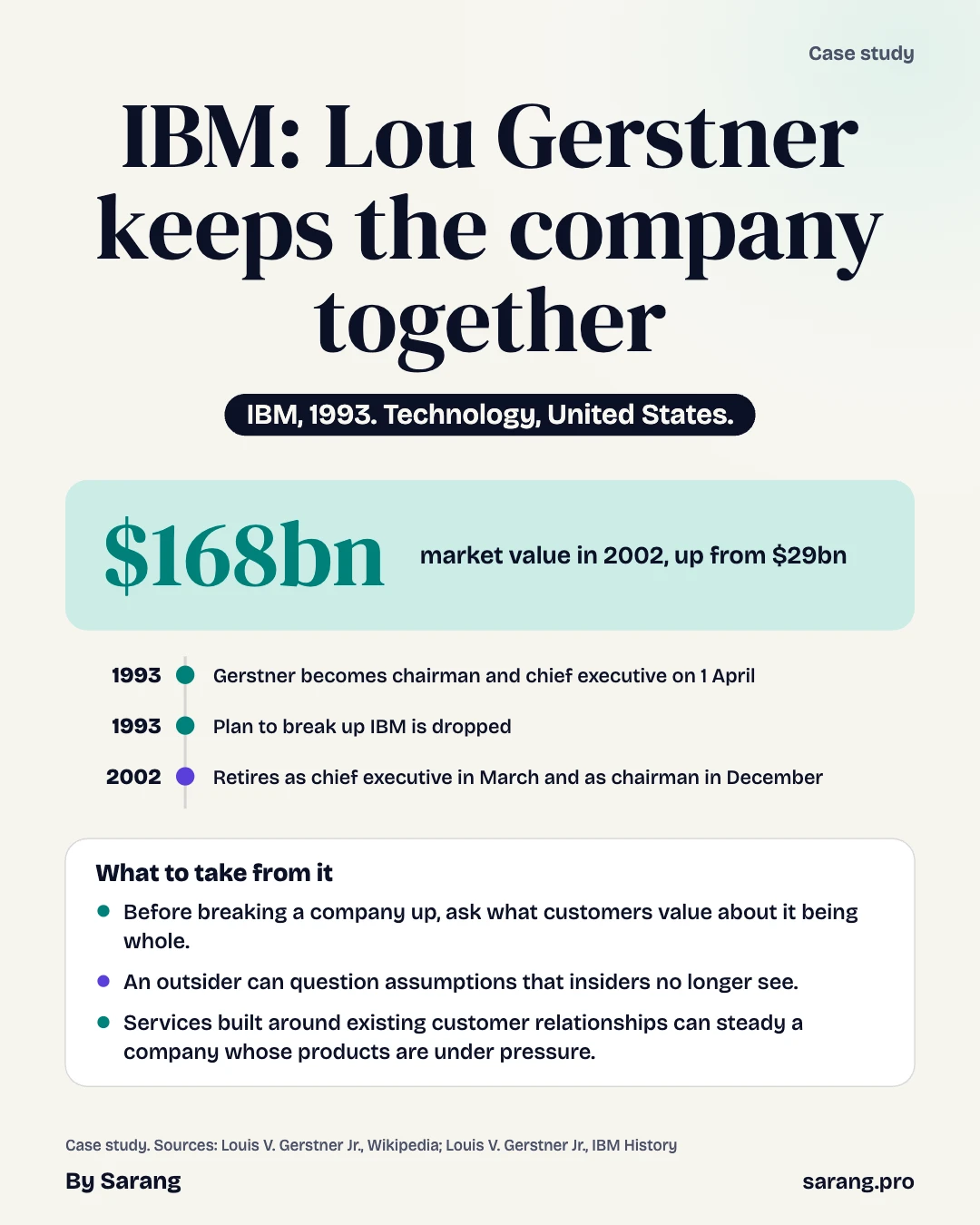
Gerstner took IBM's top job in April 1993 after losses of about $8.1 billion, rejected a plan to split the company, and left in 2002 with market value near $168 billion.
- IBM loss for 1993 (one source dates it 1992)
- $8.1 billion
- Share price, 1987 to 1993
- $43 to $12
- Share of profit from mainframes
- 90%
- Market value at arrival
- $29 billion
The situation
On 1 April 1993, Louis Gerstner, a 51-year-old former McKinsey director and American Express and RJR Nabisco executive with no technology background, became chairman and chief executive of IBM. He was the first outsider to lead the company. John Akers had resigned on 26 January 1993 after losses that had been growing for three years: $2.9 billion in 1991 and about $5 billion in 1992, followed by a loss of about $8.1 billion for 1993. One source calls the $8.1 billion loss the largest annual loss in US corporate history, though it dates it to 1992.
The company’s shares, which had sold for $43 in 1987, could be bought for $12 in 1993. Market value was about $29 billion. More than 90 per cent of IBM’s profit came from mainframe computers, whose sales were falling fast. Bill Gates reportedly predicted that IBM would not last seven years.
A plan to split IBM into smaller companies was already well under way. The reasoning was that a business so large and so slow could do better as a set of separate, focused firms. Gerstner stopped it. He later called that “the most important decision I ever made”. His reason was that customers needed someone to put technology together for them, and IBM was the one supplier big enough to do it in every industry.
By the time he stepped down as chief executive in March 2002, IBM’s market value had reached about $168 billion and its services revenue had grown from $7.4 billion in 1992 to $30 billion in 2001. This case looks at what he decided, how he did it, what it cost, and where the sources disagree.
Background
From mainframes to the PC
IBM dominated computing in the 1960s and 1970s through mainframes. Its PC, launched in 1981, started a shift in which cheaper, easier machines built on Intel processors and Microsoft’s DOS and Windows took the market. IBM lost ground. One account says it could not compete effectively in PCs and laptops, where rivals undercut its prices.
A company of 13 divisions and a bloated structure
Gerstner found a company with 13 divisions, some of them competing with each other and hiding information. In his memoir, as summarised by a Wharton interview, units spent long hours arguing over transfer pricing between them. IBM’s staff had peaked at 406,000 in 1985. The company was also, in Gerstner’s account, a leader in software that worked only with IBM’s own hardware, since IBM was the largest software company in the world but its products did not connect with rivals’ machines.
Why he was chosen
Gerstner was one of 16 candidates considered and declined the job twice before accepting, according to an encyclopedia entry on his career. He had spent 11 years at American Express, and the Wharton interview says that experience as an IBM customer shaped his view that mainframes were still needed. At RJR Nabisco he had cut debt from $25 billion to $14 billion. He insisted on being both chairman and chief executive and on the authority to build his own team. The Wharton piece says he felt he lacked the technical expertise and initially turned the job down.
The industry
Prices and competitors
The problem in mainframes was price, not product. Gerstner said IBM had not lowered its prices to match competitors, and he asked for a price reduction plan within two weeks of arriving. Rivals named in the sources include Microsoft and Sun Microsystems, which were taking relevance from IBM, and Amdahl, which sold mainframe-compatible machines. In the Wharton interview Gerstner describes a manager at American Express who installed one Amdahl computer, after which an IBM representative withdrew support from a credit card data centre.
What customers wanted
Gerstner’s reading of the market was that customers no longer wanted to depend on one supplier but also did not want to assemble systems from thousands of vendors. He wrote that in every industry there is an integrator. His conclusion was that IBM, given its size and reach, could be that integrator across brands. IBM’s current chief executive, Arvind Krishna, put the same point in 2025 by saying Gerstner understood that clients did not want fragmented technology but integrated solutions.
The internet
The internet was reaching business at the time. Bloomberg’s account says Gerstner bet early on the internet and e-business, which favoured servers and routers over PCs. IBM launched an e-business campaign in 1995, and by 1998 Gerstner said IBM was seen as the company for e-business solutions, with a 2-to-1 margin over its closest rival, though that is his own claim.
The decision
Gerstner arrived with a choice between three broad courses. Sources describe the breakup plan and his rejection of it. The other options are framed here as the obvious alternatives.
How he approached the choice
Gerstner did not begin with a strategy paper. His first weeks went on customers and on the cost base. He spoke to customers, asked for the price plan, and learned that IBM’s own staff were spending time on internal accounting between units. The decision to stop the breakup grew out of that listening, and he describes it as easy once he had seen what customers wanted. This is his own account, written afterwards, and the sources do not show how close the call was inside the company.
Option one: break IBM into separate companies
The plan under way when he arrived, associated with the project known as “Baby Blues”, was to split the company. Accounts disagree on its shape. One describes four units: mainframes, software, services and semiconductors. Another says roughly a dozen semi-independent units. A third says smaller companies focused on PCs, software and semiconductors. The sources agree on the direction and differ on the detail, so the case does not choose between them. The argument for a split was focus and speed. The argument against, which Gerstner made, was that it would break up the one thing customers could not get elsewhere.
Option two: shrink and defend the mainframe
Another route was to protect the profitable mainframe business with cost cuts and wait. Over 90 per cent of profit came from it, so the temptation was obvious. The difficulty was that sales were falling fast, and that the problem he identified was price. A company that defended mainframes alone would have been shrinking with them.
Option three: keep IBM together and sell integration
Gerstner chose to keep the company whole, cut costs and prices, and turn the size into an advantage by selling services that tied hardware, software and consulting together, including products from rivals. He described the choice as one of his easiest. He also described culture as the heart of the matter, writing that culture “is the game”.
What was at stake
The stake was the survival of the company in its existing form. The Bloomberg report quoted in The Star says IBM faced either bankruptcy or breakup. Gerstner set priorities that were not about vision. At his first press conference he said the last thing IBM needed right now was a vision, and that he wanted to return the company to profit and serve existing customers better.
What they did
1993: stop the bleeding
The first moves were financial. IBM took a charge of $8.9 billion to clear restructuring costs, and one account ties this to about 85,000 job losses, a figure that comes from a 1993 newspaper report cited by a secondary source. Mainframe prices were cut. Gerstner sold unproductive assets, including real estate and an art collection, and demanded a $1 billion cut in the research budget. The encyclopedia entry says he reduced costs by more than $6 billion. Another account says annual savings reached $14 billion, so the totals differ.
Cutting headcount
The sources disagree on how many jobs went. Bloomberg says 35,000 of about 300,000. Another account says the workforce fell from 406,000 to roughly 315,000 by 2002. The encyclopedia entry says staff went from 406,000 in 1985 to 220,000. These measure different periods and start points, and the 1985 peak figure includes cuts made before Gerstner. In the Wharton interview he says the central problem was culture, not numbers.
Changing how people were paid and managed
Gerstner changed pay so that rewards depended on total corporate performance instead of unit performance, and he revised promotion rules. Senior executives were expected to review work rather than do it. He sent regular emails to employees and abolished the white shirt and tie dress code, which drew the most publicity. He is quoted as saying that people do what you inspect, not what you expect. He also told a European executive who had been intercepting his emails to staff that the employees belonged to IBM, not to him.
Operation Bear Hug and the customer
Under what the sources call Operation Bear Hug, senior executives had to visit customers directly. Gerstner made it his own policy to speak with at least one customer a day. The sales force was reorganised around industries, and dozens of advertising agencies were consolidated into Ogilvy and Mather.
1995 onwards: services, software and openness
IBM Global Services was launched in 1995. In the same year IBM bought Lotus Development. The price is given as $3.52 billion in one source and $2.2 billion in another, so the sources differ. It also acquired Tivoli Systems for network management. Gerstner committed IBM to open standards so that its products could work with rivals’, and he moved the company to offer solutions that could include competitors’ hardware and software. In early 1999 IBM announced a seven-year, $16 billion technology-sharing arrangement with Dell. A summary of his legacy says he abandoned OS/2, IBM’s operating system designed to rival Windows.
Software, middleware and Lotus Notes
The software side needed a different kind of change. IBM already had a large software business, but its products worked only with IBM hardware. Open standards turned that into a selling point for customers who ran mixed equipment. Bloomberg’s account adds that Lotus Notes helped customers collaborate across enterprises, and a 2025 summary says the company worked with Linux communities. The sources describe the direction rather than the detail, and they do not say how much of the later software income came from each acquisition.
What happened
Return to profit
IBM made a profit of more than $3 billion in 1994, its first profitable year in a decade. In 1997 revenue exceeded $78 billion and net income exceeded $6 billion. Services made up 25 per cent of sales and employed nearly half the workforce. The same year, IBM’s Deep Blue computer beat the chess champion Garry Kasparov in a six-game match.
Another account says that within about two years the turnaround was credited with making IBM competitive again, and that in Gerstner’s first four and a half years the shares quadrupled. These are summary claims, so the table below uses the figures that come with dates.
The scale of the recovery
| Measure | At arrival (1993) | At departure (2002) |
|---|---|---|
| Market value | About $29 billion | About $168 billion |
| Net income | Loss of about $8.1 billion | Profit of about $7.7 billion (one source) |
| Revenue | About $64 billion | About $88 billion (one source) |
| Services revenue | $7.4 billion (1992) | $30 billion (2001) |
Share price figures vary by measure. One account says IBM stock was above $100 when Gerstner left, and Bloomberg says the split-adjusted price climbed from $13 to $80. Other accounts say the stock rose nearly ninefold or more than 800 per cent. The sources use different bases and dates, so they should not be set side by side as one series.
The business mix
By 2002, services and software made up more than 60 per cent of revenue, up from about 30 per cent when he arrived, and IBM Global Services generated more than $30 billion a year. The company had changed from a hardware vendor into one whose income came mainly from work done for customers and from software.
Other views
Buybacks and the share price
The Wharton interview records critics who said IBM’s share price was inflated by a major buyback effort, which the memoir does not mention. A 2025 summary also lists repurchases of stock among Gerstner’s actions. The sources do not measure how much of the rise came from buybacks, so the criticism stands as a question rather than a finding.
Pension accounting
The same interview notes critics who said revenue was boosted by a controversial change to IBM’s pension plan, also left out of the book. The sources do not give detail, so the size of any effect is unknown.
The human cost
Layoffs of tens of thousands drew criticism at the time, according to a 2025 obituary piece, and another source says more than 100,000 people left IBM during the broader turnaround. That figure comes from a secondary summary and is not confirmed in the primary reports used here. The pace of cuts has to be set against the company’s losses, but the sources do not say whether fewer cuts would have worked.
Outsider or insider leaders
A secondary source cites Jim Collins’s research that homegrown leaders tended to outperform outside turnaround hires, and that celebrity outside chief executives correlated negatively with sustained results. This sits awkwardly with IBM’s case, in which an outsider did well. It is a general finding, not a verdict on Gerstner.
Limits of the evidence
Many of the sources are obituaries or summaries, written when he died in December 2025. They disagree on losses (one dates the $8.1 billion loss to 1992, others to 1993), on headcount, on the Lotus price and on the shape of the breakup plan. The memoir, Who Says Elephants Can’t Dance?, is Gerstner’s own account of his nine years and omits some failures, such as education software, according to the Wharton interview.
Reading it through a framework
McKinsey 7-S
The 7-S model looks at strategy, structure, systems, shared values, style, staff and skills as parts that must fit. In 1993 they did not. Strategy was shifting towards a split while structure was 13 competing divisions, and systems such as transfer pricing absorbed time. Gerstner’s changes touched several at once: strategy (integrator, open standards), structure (one company, industry-based sales), systems (pay tied to corporate results), style (regular emails, direct customer contact, no dress code) and shared values (his statement that culture is the game). The framework helps explain why cost cuts alone would not have worked, since the problem sat in how the parts related. Its limit is that it describes fit and does not show which element mattered most.
Stakeholder mapping
Stakeholder mapping asks who has power and interest in a decision. Customers were the stakeholders Gerstner prioritised, through Bear Hug and his own daily calls. Employees bore the cuts but also gained a new pay system. Shareholders had watched the stock fall from $43 to $12. Rival suppliers became partners in a sense, since IBM would sell solutions including their products. Critics suggest the balance was not neutral: they say buybacks and a pension change flattered the numbers shown to investors, and the layoffs fell on staff. The map shows why he started with customers, who could judge whether integration had value.
Since then
Sam Palmisano succeeded Gerstner as chief executive in March 2002, and Gerstner planned to retire as chairman in January 2003. He later chaired the Carlyle Group, retiring in 2008 to focus on philanthropy, including biomedical research. Palmisano and later Ginni Rometty built on the foundation, including cloud and AI work such as Watson.
Gerstner died on 27 December 2025 at the age of 83. In a message to staff Krishna said he led not by looking backward but by focusing relentlessly on what clients would need next. By then IBM had a share price of about $305 and a market value of about $285 billion. For its 2024 financial year it reported revenue of $62 billion, net income of $6 billion and operating cash flow of $13.4 billion, with software and consulting about 75 per cent of the business. Recent purchases include HashiCorp for $6.4 billion and Software AG assets for $2.3 billion, which the obituary source says continue the shift towards software.
What to take from it
- Breaking up a struggling company is not always the answer, and Gerstner kept IBM whole because customers valued the integration only a large supplier could offer.
- A firm in decline may be failing on price and culture rather than product, as Gerstner found when he asked for a price reduction plan within two weeks.
- Pay and promotion rules shape behaviour, so tying rewards to total company performance addressed the internal competition between units.
- Spending time with customers gives a leader information that reports do not, which is why Operation Bear Hug and a daily customer call mattered.
- Turnaround stories are told mainly by those involved, so figures on layoffs, share price and pensions need cross-checking, as the disagreements in these sources show.
Questions to think about
- If you had been on the board in 1993, what evidence would have convinced you to back the breakup plan or to reject it?
- Gerstner said IBM did not need a vision at that point. When is a vision a distraction for a struggling company?
- How should a leader weigh the cost to employees of large layoffs against the survival of the company?
- Does the buyback and pension criticism change how you judge the turnaround, and what further information would you want?
Concepts at work
The McKinsey 7-S model, stakeholder mapping and the integrator role in services all appear in this case. Explore them in Insights.
Written from the public sources listed below. Figures are as those sources report them.
Framework
Timeline
- 1985IBM staff numbers peak at 406,000
- 26 Jan 1993John Akers resigns as chief executive
- 1 Apr 1993Gerstner becomes chairman and chief executive
- 1993Breakup plan stopped; large restructuring charge taken
- 1994Profit of more than $3 billion, first profitable year in a decade
- 1995IBM Global Services launched; Lotus Development bought
- 1997Revenue above $78 billion; Deep Blue beats Kasparov
- Early 1999Seven-year, $16 billion technology-sharing arrangement with Dell announced
- Mar 2002Gerstner steps down as chief executive; Sam Palmisano succeeds
- 27 Dec 2025Gerstner dies aged 83
Recap cards
Tap a card to check yourself.
Sources and credits
- Knowledge at Wharton: Lou Gerstner's turnaround tales at IBM
- Fintool: Lou Gerstner, IBM legacy
- Encyclopedia.com: Lou Gerstner
- The Star (Bloomberg): Louis Gerstner, CEO credited with turning around IBM, dies at 83
- SiliconANGLE: Louis Gerstner obituary
- WebProNews: The architect of IBM's revival
- Rework: Lou Gerstner leadership style



