Slack: how a failed online game left behind a $27.7bn chat tool
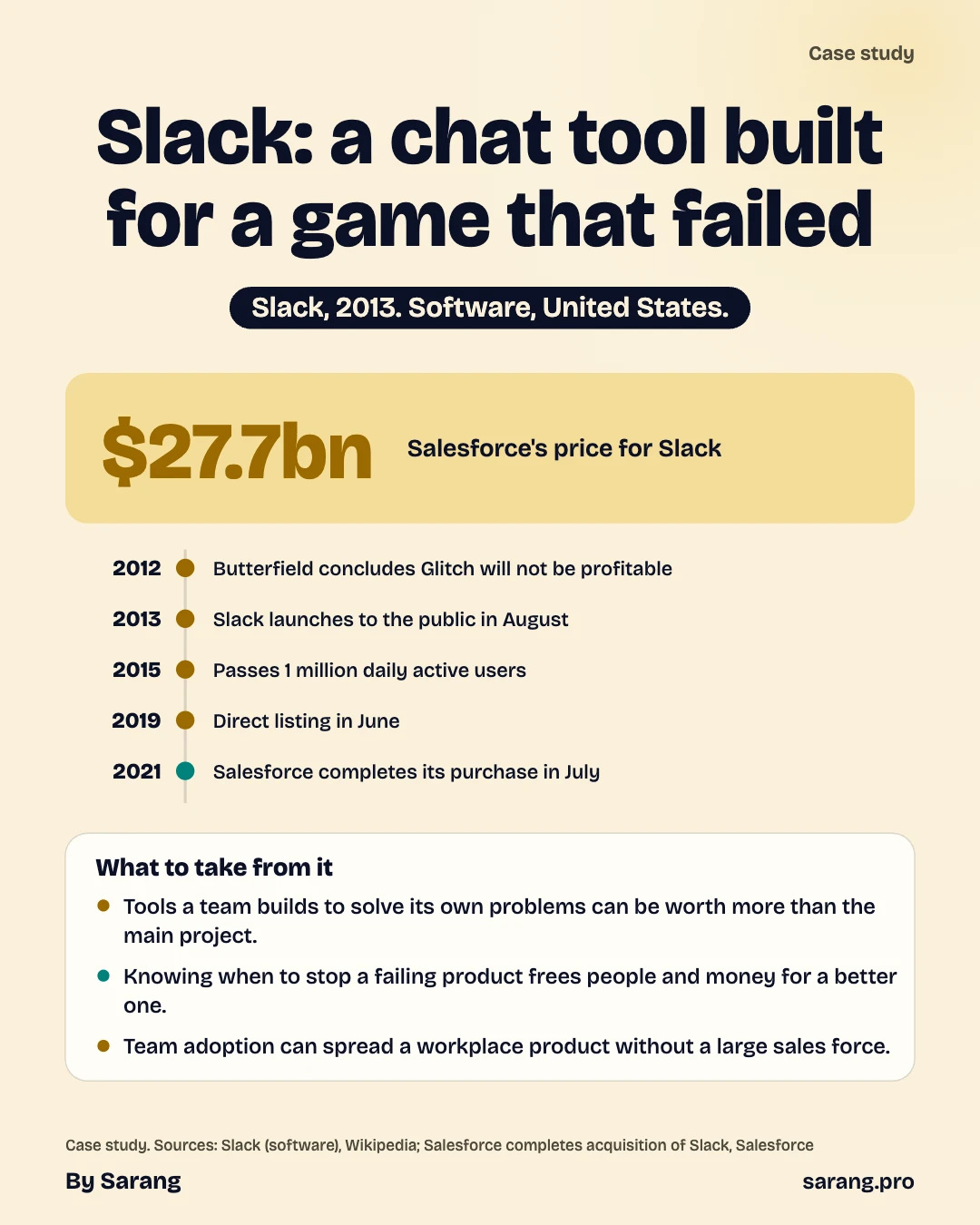
Tiny Speck closed its game Glitch in December 2012, built Slack from its internal chat tool, and sold the company to Salesforce for $27.7 billion in 2020.
- Salesforce deal value, December 2020
- $27.7bn
- April 2014 funding round
- $42.75m
- daily users in April 2014
- 60,000
- revenue, year to 31 January 2019
- $400.6m
The situation
At the end of 2012 a small Vancouver company called Tiny Speck closed the online game it had spent about three years building. Glitch, a browser-based, non-violent, collaborative game, had launched on 27 September 2011. The company announced its closure on 30 November 2012 and shut it on 9 December, according to a secondary account of the game’s history. The Crunchies awards write-up later said the game closed citing limited audience appeal.
The company did not close with it. The four founders, including Stewart Butterfield, had built an internal messaging tool while making the game, and they turned that tool into a product. They called it Slack. By April 2014, about ten weeks after it left limited beta, Slack had around 60,000 daily users and 15,000 paid seats and raised $42.75 million. By September 2017 it reported 6 million daily users and 2 million paid users, and by 2018 its valuation was reported at more than $5 billion. On 1 December 2020 Salesforce announced that it would buy the company in a cash-and-stock deal valued at $27.7 billion.
This case looks at how a failed game left behind a successful product, why the product’s early traction came so fast, and why the story is more complicated than the tidy version. Slack never made a profit in the period covered by the sources, and its largest rival was a company that could give away a competing product.
Background
Flickr and the first attempt
Butterfield had been here before. He co-founded the photo-sharing site Flickr, which Yahoo bought for about $25 million; TechCrunch dates that sale to 2005, while other accounts give 2004. All four Tiny Speck co-founders, Butterfield, Cal Henderson, Eric Costello and Serguei Mourachov, had played major parts in building Flickr, according to TechCrunch’s report on the 2015 Crunchie awards.
Tiny Speck and Glitch
Slack’s annual report says the company was incorporated in Delaware in 2009 as Tiny Spec, Inc., renamed Tiny Speck later that year, and renamed Slack Technologies in 2014, the year it launched publicly. The game it was built to make was Glitch, described by one account as a side-scrolling online game with a non-violent, collaborative design whose story centred on eleven sleeping giants. After the closure, Tiny Speck released nearly all of the game’s art, code and music under a Creative Commons licence, and former players built successors.
The same account attributes Glitch’s failure to a mass market that did not take to the game’s unusual value system, and it notes that other sources list lack of funding as the reason. The page is a secondary source with some inconsistencies, so the explanation should be read as one view and not as settled fact.
The internal tool
TechCrunch’s report on the Salesforce deal says Slack grew out of an internal messaging tool at Tiny Speck, and that the game did not succeed while the tool did. The secondary account adds that co-founder Cal Henderson reportedly said the tool was itself the product. It also says the name is an acronym for a searchable log of conversation and knowledge, while noting that nobody has confirmed whether that was the original intent. Development of Slack as a product started after Glitch closed in late 2012, the same account says, with the same four founders.
The industry
Workplace communication before Slack
When Slack opened its beta in 2013 the established way for teams to talk was email, and the established enterprise answers to its limits were tools such as Yammer, which TechCrunch named alongside Convo as competitors in 2014. Slack’s own estimate, given at its listing in 2019, was a market of $28 billion for workplace collaboration software.
Big rivals
The field became crowded. TechCrunch’s 2018 report named Workplace by Facebook, Google Hangouts and Microsoft Teams among the other players, and Atlassian’s HipChat and Stride were already in the market until Atlassian gave up and sold their intellectual property to Slack in July 2018. By 2020 the Salesforce deal coverage listed Cisco, Facebook, Google, Asana and Monday.com as further competitors alongside Microsoft.
The Microsoft problem
The most serious threat was Microsoft, which could bundle a chat product into software that businesses already paid for. CNBC reported in July 2020 that a Slack filing with the US securities regulator named Microsoft as its primary competitor. Slack’s general counsel, David Schellhase, said that month that Microsoft was “reverting to past behavior”, comparing its conduct with the browser wars of the late 1990s. In May 2020 Butterfield had told The Verge that Microsoft was perhaps unhealthily preoccupied with killing Slack.
Salesforce’s position
The eventual buyer had its own gap. TechCrunch’s December 2020 report said Salesforce’s internal social tool, Chatter, never really caught on, and that Salesforce had bought the document tool Quip in 2016 for $750 million. It added that Salesforce was reported to have been interested in Twitter in 2016 but walked away after shareholders objected. A company with more than $20 billion in annual revenue and no strong workplace chat product was a natural buyer for the category leader outside Microsoft.
Economics
Slack used a free-to-paid model. In the year to January 2019 it had 600,000 organisations on its platform, of which 88,000 paid, and 550,000 used the free plan, according to TechCrunch. The company said its losses came from investing in growth. That meant the business depended on turning free users into paying customers and on continually raising money or listing to fund the gap.
The decision
When Glitch ran out of road in 2012, the founders and their investors faced a choice. The sources do not record a formal option list, so the paths below are the obvious alternatives, with the evidence for each.
Option one: keep trying to fix the game
Tiny Speck had investors in Accel and Andreessen Horowitz, who took part again when Slack raised in 2014. The game had enough fans that former players built successors after it closed, but not the mass audience a venture-backed game needs. Continued investment would have meant betting that a second relaunch would find the audience the first one had missed.
Option two: wind the company down
Closing the company and returning what was left would have ended the story at Glitch. The pages opened for this case do not show that investors pushed for this, though the Crunchies write-up shows that the same investors were willing to back the team again.
Option three: turn the internal tool into the product
The founders chose to build a business out of the thing they had made to run their own team. This was a cheaper bet than a new game, because they were the first customers and knew the problem, and because the team already had experience with web products from Flickr. It was also a bet that other teams had the same problem. The risk was that a crowded field punishes late entrants.
What they did
Build and test inside the team
The founders began the work on Slack after Glitch closed. A secondary account says a private beta started in August 2013, with about 8,000 people signing up on the first day of invitations, though the same page gives the figure both as a first-day number and as a 24-hour number. TechCrunch’s 2015 piece describes Slack as a team communication tool launched in mid-2013 with Mac, iOS and Android clients, a strong API and extensive customisation.
Launch in February 2014
Slack went public in February 2014, which fits TechCrunch’s April 2014 report that it had left limited beta roughly ten weeks earlier. At that point it had about 60,000 daily users and 15,000 paid seats, with users that included Rdio, Medium, SoundCloud, Heroku, Lonely Planet and BuzzFeed. The company said the aim of its funding was to scale usage higher.
Raise money fast
The April 2014 round of $42.75 million was led by Social+Capital, with Accel and Andreessen Horowitz taking part. The Crunchies write-up reports that Slack raised $120 million at a valuation of $1.12 billion about a year after launch. TechCrunch’s July 2018 report put its valuation at more than $5 billion, and later coverage of the 2019 filing put total funding at about $1.2 billion.
Absorb a rival and list
In July 2018 Atlassian sold the intellectual property of HipChat and Stride to Slack and invested in it, in a deal TechCrunch called an alliance. At that point Slack had 8 million active users, 3 million of them paid, in May 2018, up from 6 million daily users, 2 million paid users and $200 million in annual recurring revenue in September 2017. Slack then filed to list directly on the stock exchange rather than through a traditional offering, with its filing on 26 April 2019. A direct listing lets existing shareholders sell stock to the public without a new share sale. The filing showed revenue of $400.6 million for the year to 31 January 2019, compared with $220.5 million a year earlier, and a net loss of $138.9 million against $140.1 million. It reported more than 10 million daily active users.
The sale
Slack went public in 2019, opening at $38.50 a share. It traded below $30 for most of November 2020, until takeover talk lifted it. On 1 December 2020 Salesforce announced a cash-and-stock deal valued at $27.7 billion, with Slack shareholders receiving $26.79 in cash plus 0.0776 Salesforce shares for each share, according to TechCrunch. Butterfield called it the most strategic combination in the history of software. Butterfield was to remain chief executive, and Salesforce planned to build Slack into its Customer 360 platform.
What happened
Growth and losses
Slack’s annual report for the year to 31 January 2021 shows revenue of $902.6 million, up 43% from $630.4 million, with more than 156,000 paid customers and over 756,000 organisations with three or more users, over 600,000 of them on the free plan. Its net loss was $292.5 million, down from $568.4 million the year before.
| Year to 31 January | Revenue | Net loss |
|---|---|---|
| 2018 | $220.5m | $140.1m |
| 2019 | $400.6m | $138.9m |
| 2020 | $630.4m | $568.4m |
| 2021 | $902.6m | $292.5m |
The 2018 figures come from TechCrunch’s report on the 2019 filing and the others from the 2021 annual report. The jump in the 2020 loss is shown in the filing without an explanation in the pages opened for this case.
Pressure from Microsoft
On 22 July 2020 Slack filed a complaint with the European Commission, alleging that Microsoft had used its dominance to push Teams by bundling it with Office, so that millions had Teams installed and could not remove it. The Commission said it would assess the complaint under its standard procedures.
Share price before the deal
TechCrunch reported that Slack had lost about 40% of its value since going public and fell 16% after its latest earnings report. Net losses were $147.6 million over the two quarters to 31 July 2020. TechCrunch added that Microsoft had passed on buying Slack at an earlier time for a fraction of the Salesforce price, though the sources opened give no figure.
Other views
Pivot or accident
The common retelling is that the founders saw a better business inside a failed one. The evidence is thinner. TechCrunch says only that the tool grew out of the game’s development, and the founders’ own accounts are not in the pages opened for this case. The decision to go all-in on the tool may have been clear in the moment, or it may have been a sequence of small choices. Readers should treat the neat version with caution.
The price
Slack sold for $27.7 billion. TechCrunch reported that Microsoft had passed on buying Slack at an earlier time for a fraction of that price, and that Slack had lost about 40% of its value since listing while its losses continued. For Salesforce, which had reached more than $20 billion in annual revenue, the deal bought a communication layer that its own social tool, Chatter, had never provided, according to the same report. Whether the price was fair depends on whether Slack could have stayed independent against Microsoft.
The cost of growth
Slack’s own numbers show how expensive its growth was. In the year to 31 January 2020 its net loss of $568.4 million was close to 90% of its revenue of $630.4 million, a ratio calculated here from the annual report’s two figures. A year later the loss was $292.5 million on $902.6 million. The trend is encouraging, but the pages opened do not explain what drove the 2020 spike, so any reader of the case should be careful about saying that the business had reached a stable footing before the sale. The company’s own filing language, as TechCrunch reported it, put the losses down to investment in growth.
Salesforce’s reasoning
Marc Benioff, Salesforce’s chief executive, called the deal a match made in heaven, according to TechCrunch. That is a promotional line, and the report gives the more concrete reasons itself: Salesforce lacked a successful chat product, and Slack’s losses and falling share price made it available at a time when its independence looked costly. Whether Slack’s shareholders were better off selling than staying public cannot be settled from the pages opened, because they do not say what Slack’s shares might have been worth as an independent company.
Microsoft’s side
Microsoft did not respond to the CNBC report in July 2020, and later did not respond to The Register’s request for comment in 2025. So the pages opened carry no account of Microsoft’s reasoning beyond what the Commission accepted as concessions.
Limits of the evidence
The account of Glitch relies on a single secondary page with internal contradictions, and several figures, such as the beta sign-up count, differ within it. Revenue and loss figures come from filings and reports and are firmer.
Reading it through a framework
Real options
Real-options thinking treats a project as a chain of small bets that keep the right to continue or stop. Glitch gave Tiny Speck an unplanned option: a working internal tool, tested daily by its own team, with a group of experienced founders and investors already in place. Exercising it cost much less than starting a new company. The first staged round of $42.75 million, a year-later round at $1.12 billion, and the later rounds each bought more time to find out whether usage would convert to paid seats. The framework also shows the limit: options only help if a use is waiting, and in 2014 TechCrunch showed 15,000 paid seats among 60,000 daily users, which was evidence of demand.
Porter’s five forces
Porter’s five forces ask about rivalry, new entrants, substitutes, and the power of buyers and suppliers. Slack’s problems sit in the first three. Rivalry was fierce: Microsoft, Facebook, Google and others were all in the market. Substitutes were strong: email, existing office suites and a free bundled product. And the barrier to entry was low enough that Atlassian and others had tried and left. Slack’s answers were product quality and a free tier that let teams adopt it without a purchase order, which TechCrunch’s report on its filing shows turned into 88,000 paid customers by January 2019. The EU complaint can be read as an attempt to change the rules of rivalry when product quality was not enough.
Since then
The Salesforce deal was agreed on 1 December 2020, with each Slack share converting to 0.0776 Salesforce shares plus cash, according to Slack’s annual report. A secondary account says it closed on 21 July 2021 and that Butterfield stepped down as chief executive in January 2022; neither date was confirmed in a primary source.
The regulatory story ran for five years. The Register reports that on 12 September 2025 the European Commission accepted Microsoft’s commitments over Teams and closed its investigation without a fine. The case began with the Slack complaint of 2020, and the Commission opened its formal probe in 2023. Microsoft offered European customers Microsoft 365 without Teams at a slightly lower price or with Teams at extra cost, promised to open more programming interfaces, and agreed to improve data portability. The concessions last seven years, and the interoperability and portability commitments last ten. The Register put Teams at about 320 million monthly users and Slack at about 52 million total users, and noted analysts expected little change because many organisations are too tied to Microsoft to switch. The Commission’s competition chief, Teresa Ribera, said the decision opens up competition in an important market.
What to take from it
- A failed product can leave behind a useful asset; Tiny Speck’s internal tool was the thing worth keeping, and the team noticed.
- Building for yourself is a cheap way to test a need, because the first customers are in the room and the feedback is immediate.
- Growth funded by investors can run well ahead of profit, and Slack’s losses of $138.9 million to $568.4 million a year show how much capital a fast-growing software business can consume.
- A strong product can still be exposed to a rival that bundles a similar one into software customers already buy, which is why Slack went to regulators.
- Selling to a larger company can be a way to resolve that exposure, and Slack’s 2020 sale followed a fall in its share price and a long fight with a bundled competitor.
Questions to think about
- What signs should a team look for before deciding that an internal tool is a product in its own right?
- Slack grew on a free plan while losing money. At what point should a company like this prioritise profit over growth?
- Was the European complaint a sound use of regulation, or an admission that Slack could not compete on its merits?
- If you had been a Slack director in 2020, would you have sold at $27.7 billion?
Concepts at work
Three ideas run through this case: real options, bundling and platform competition, and the freemium model. Explore them in Insights.
Written from the public sources listed below. Figures are as those sources report them.
Framework
Timeline
- 2009Tiny Speck incorporated
- 27 Sep 2011Glitch launches
- 30 Nov 2012Closure of Glitch announced (closed 9 December)
- Aug 2013Private beta begins (secondary account)
- Feb 2014Slack launches publicly
- Apr 2014$42.75m round led by Social+Capital
- Sep 20176m daily users, 2m paid users, $200m annual recurring revenue
- Jul 2018Atlassian sells HipChat and Stride IP to Slack
- Apr 2019Slack files to list directly on the stock exchange
- 22 Jul 2020Slack files EU complaint against Microsoft over Teams
- 1 Dec 2020Salesforce announces $27.7bn acquisition
- 12 Sep 2025European Commission accepts Microsoft's Teams commitments
Recap cards
Tap a card to check yourself.
Sources and credits
- StackSync: The video game that failed, the origin story of Slack
- TechCrunch: Slack's co-founders take home the Crunchie for Founder of the Year, 5 February 2015
- TechCrunch: Slack raises $42.75M, 25 April 2014
- TechCrunch: Slack forms key alliance as Atlassian throws in the towel on enterprise collaboration, 26 July 2018
- TechCrunch: Slack files to go public, 26 April 2019
- Slack Technologies: Form 10-K for the year ended 31 January 2021 (SEC)
- TechCrunch: Salesforce buys Slack, 1 December 2020
- Business in Vancouver: Vancouverite Stewart Butterfield's Slack sold to Salesforce for US$27.7B, December 2020
- CNBC: Slack accuses Microsoft of anticompetitive practices in EU complaint, 22 July 2020
- The Register: EU regulators let Microsoft off the hook after Teams unbundling pledge, 12 September 2025