Airbnb: how a cereal stunt and better photographs kept a start-up alive
In summer 2008 Airbnb earned a couple of hundred dollars a week, then a $30,000 cereal stunt and a rented camera in New York helped it reach 100,000 listings by 2012.

- Nightly price of the first air-mattress stays in autumn 2007
- $80
- Raised by the cereal boxes in 2008 (about 1,000 boxes at $40)
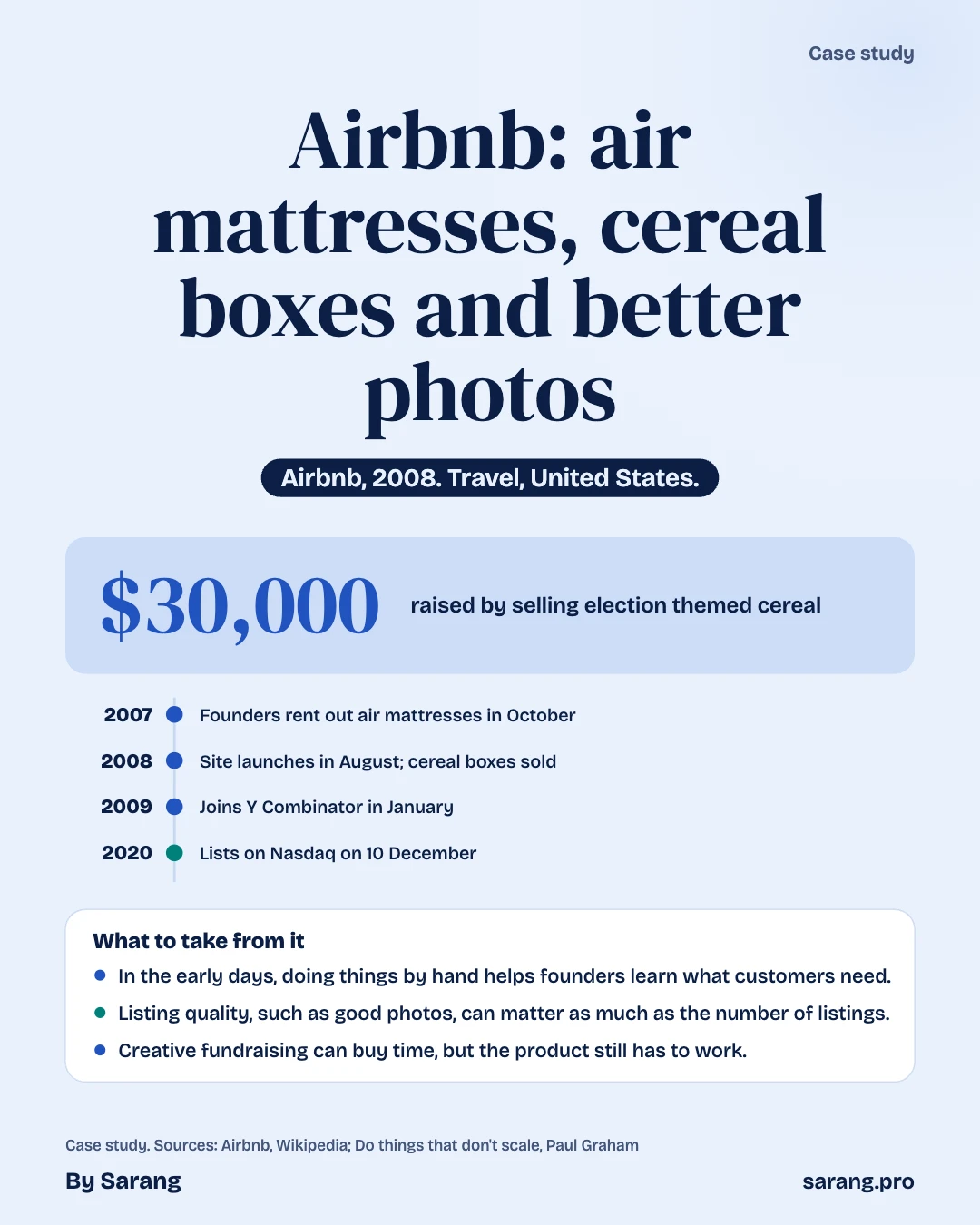
- $30,000
- Listings in March 2009, with close to 10,000 users
- 2,500
- Raised from Andreessen Horowitz, DST and General Catalyst in July 2011
- $112m
The situation
In the summer of 2008, Airbnb was earning a couple of hundred dollars a week. Its three founders had about $20,000 of credit-card debt between them and no outside investors, according to a Fast Company profile of the company published in 2012. The website had launched only that August, under the name AirBed and Breakfast. Investors who heard the pitch mostly said no. Nathan Blecharczyk, the engineer among the founders, told a Harvard alumni profile in 2015 that for the entire first year they could not raise any money.
The founders’ answer to this was practical rather than clever. They produced about 1,000 boxes of two political cereals, Obama O’s and Cap’n McCain’s, and sold them at $40 a box. Fast Company and Fortune both put the take at about $30,000, enough to keep the business alive until Y Combinator took it on in the winter 2009 batch. Then, once inside the programme, they found that the problem was not money. In New York, the most promising market, people were not booking. The listings looked poor. The fix was a rented camera and a flight east.
This case follows the first four years: the air-mattress idea in October 2007, the cereal, the photographs, the first rounds of funding, and the point in 2012 when the company could claim around 100,000 active listings in 192 countries and a valuation reported at $1bn or more. It also looks at what the early choices say about how a marketplace starts, and at the problems that came with success: trust, safety and local rules.
The decision at the centre is a small one that looks large in hindsight. With almost no money and no traction outside a few events, the founders could keep building software and wait, or they could do slow, manual work that nobody would call a scalable strategy. They chose the second.
Background
Two designers and a conference
Brian Chesky and Joe Gebbia were roommates in San Francisco who needed money for rent. In the autumn of 2007 an international design conference filled the city’s hotels. Fortune’s 2012 account says they put three air mattresses on their floor and offered a bed, breakfast and sightseeing tips for $80 a night per guest, and called the idea Airbed and Breakfast. Airbnb’s own stock-market filing, the S-1 it lodged in November 2020, tells the same story: three designers became the first guests, and Chesky and Gebbia were the first hosts. The first listing was an apartment on Rausch Street in the SoMa district of San Francisco.
The third founder and the first launch
Blecharczyk, a Harvard computer science graduate, joined as the technical founder. The S-1 says the company was incorporated on 27 June 2008 as AirBed & Breakfast, Inc. TechCrunch covered the website launch on 11 August 2008. The site, its report said, had been built with less than $20,000 of seed money from friends and family. It was timed for the Democratic National Convention in Denver, where hotels were already sold out ahead of an expected crowd of about 20,000 people. Anyone with an airbed or a couch could post a room and set a price, and travellers booked and paid on the site.
TechCrunch recorded more than 600 people who had found accommodation through the site by then, and 50 to 100 new listings a day. Prices ranged from $20 a night for an airbed to $3,000 for a whole house. In San Francisco the median was $85 a night. The report described the target customer as a younger traveller or conference attendee who could not get a normal hotel room, and it noted the pitch to guests: a local host could point out restaurants and shops they would not otherwise find.
How the company made money
By March 2009 TechCrunch described the fee structure plainly. Airbnb took 7 to 10 per cent of the traveller’s payment, with the percentage falling as the price rose, plus a flat 3 per cent of what the host received. At that point the site had roughly 2,500 listings and close to 10,000 registered users. Revenue had risen 50 per cent and the company had become profitable, the article said, though it gave no figures. It also said the company had no plan to copy eBay’s auction model. Fortune’s 2012 piece put the commission at 6 to 12 per cent, against the 15 to 20 per cent it said traditional agents charge. Fast Company reported fees of up to 15 per cent. The sources differ because the fee changed over time and by price.
The industry
Short-term accommodation in 2008 was dominated by hotels, and the TechCrunch launch report showed why that mattered: when a large event came to town, rooms ran out and prices rose. The alternative was the informal market of room and holiday-home listings. The March 2009 TechCrunch article named Vacationrentals.com and Free-rental.com as existing sites for short-term rentals, and it noted that HomeAway, a vacation-rental site, had just raised $250 million and was valued at more than $1bn. That showed that holiday rentals could support a large business. Airbnb’s difference was that it dealt in spare rooms and couches in cities, often for very little money. The same article found a furnished one-bedroom in Midtown Manhattan at $160 a night, and rooms and couches in Washington, DC and Paris for under $20.
The economics of such a marketplace are simple but fragile. The company owns no rooms. It earns a commission on each booking, so it needs a lot of hosts, a lot of guests, and a reason for both to trust a stranger. In 2012 Fortune quoted an Andreessen Horowitz partner, Jeff Jordan, as saying of Airbnb: “It’s eBay all over again.” An analyst quoted in the same article, Jordan Rohan of Stifel Nicolaus, said Airbnb should keep doing what it did and do it well, because the market was big enough.
Regulation sat in the background from early on. Fortune noted in 2012 that some cities questioned whether rentals under 30 days were legal, that New York co-op boards were taking notice, and that in April 2012 San Francisco had asked whether Airbnb should pay hotel and tourism taxes. Airbnb’s S-1 shows the issue never went away. Its risk factors list changes in short-term occupancy and lodging-tax law, government enforcement against home sharing, and private limits imposed by landlords, condominium boards, leases and mortgages as things that could reduce listings and bookings.
Competition in the early period was a mix of listing sites, and, as Fortune put it, copies of the idea for bikes, baby clothes, office space, ride shares and dogs. The same article named Etsy, Amazon, Yahoo and eBay as large internet firms with an interest in marketplaces.
The decision
By late 2008 the founders had a working site, a handful of events that had brought traffic, and a growing list of people who had said no to them. Fast Company said investors doubted a team of designers and one told them strong teams need engineers. Paul Graham of Y Combinator has said he initially thought the idea was crazy, according to the same profile. The question was how to use scarce time and money.
Option one: keep building and wait for demand
The default for a software start-up is to improve the product and let growth come from the product. The founders had a site that worked. Blecharczyk’s account shows why waiting was risky: for the first year no money came in, and then a recession arrived. Waiting meant living off a few hundred dollars a week of revenue and credit cards.
Option two: buy attention with a stunt
The cereal was a stunt with a point. The 2008 convention gave the team a news hook. Fortune said the founders recruited Denver residents to list spare bedrooms for visiting delegates and then gave away and sold the cereal boxes online as collectibles, which earned evening news coverage. The money was small but kept the company going. CNN Business quoted Chesky in 2012 as saying that without the convention it was hard to know what Airbnb would be today.
Option three: go to the users and do the work by hand
The third option was to treat the weak New York numbers as a problem to be investigated in person, not fixed from a desk. Paul Graham’s essay on doing things that do not scale describes the founders going door to door in New York to recruit users and help them improve their listings, and taking professional photos of their first hosts’ apartments. He wrote that they were just trying to survive, and that roughly 30 days of this kind of in-person work could make the difference between success and failure. The founders took that route.
What they did
October 2007 to August 2008: the first guests and the launch
The first guests came in October 2007, during the design conference. The company then spent most of 2008 trying to turn a one-off into a service. Blecharczyk joined, the site launched on 11 August 2008, and the convention in Denver supplied a short burst of demand.
Summer to autumn 2008: the cereal
Two cereals, one named for Barack Obama and one for John McCain, were printed in boxes with Airbnb branding. Fast Company says about 1,000 cartons sold at $40 each and netted $30,000. The arithmetic gives a gross of $40,000, so the gap is presumably cost of production, though the article does not say so. Fortune says the founders gave boxes away as well as selling them. The figure should be treated as approximate. Fast Company said the money lasted until Y Combinator invested.
Winter 2009: Y Combinator
TechCrunch described the company in March 2009 as a Y Combinator start-up from that winter’s session. In the same month it shortened its name from AirBed and Breakfast to Airbnb and widened its offer from airbeds to apartments, houses and holiday rentals, because that is what users had begun to list. Fortune says Sequoia Capital led a seed round and that by 2010 Greylock Partners and angels including Ron Conway and Jeremy Stoppelman were backers. The exact size of the seed round is not given in the sources used here.
2009: New York and the photographs
New York was a large market, yet bookings stayed low. According to Fast Company, the team flew there and booked rooms with about two dozen hosts to find out why. The hosts’ photographs were poor, often taken on camera phones. Gebbia told the magazine: “No one was booking because you couldn’t see what you were paying for.” The team did not send tips by email. They rented a camera that Fast Company says cost $5,000 and photographed as many host apartments as they could. Bookings rose and New York revenue doubled by the end of the month. Gebbia said the same fix later worked in Paris, London, Vancouver and Miami.
2010 to 2012: making the fix a programme
What began as a trip became a service. By early 2012 Airbnb offered free professional photography to hosts. Fast Company counted more than 2,000 freelancers who had visited 13,000 listings across six continents, and reported that travellers were two and a half times more likely to book the enhanced listings. Fortune gave a slightly different picture of the same programme: a database of 3,000 photographers paid $60 a job. The two numbers can both be right if the pool grew or if one counts active photographers and the other counts everyone on file. Either way, the company paid for something that a pure software firm would have left to its users.
2011: scale, trust and a safety failure
Funding followed. Andreessen Horowitz, DST Global and General Catalyst invested $112 million in July 2011. Fortune put the valuation at $1bn, while Fast Company reported $1.3bn. In the same year, a San Francisco host’s home was ransacked, which created a public-relations problem. Fortune and Fast Company say the company responded with a $50,000 property guarantee, voice and video verification and a 24-hour support line. Before that, Fortune said, the hotline had gone to an answering machine checked each morning. CNN Business later reported the cover as up to $1 million in damages, so the guarantee was raised after its first version.
What happened
Figures from the first years are patchy, but several sources allow a rough path.
| Date | Measure | Source |
|---|---|---|
| August 2008 | More than 600 people housed; 50 to 100 new listings a day | TechCrunch |
| March 2009 | About 2,500 listings; close to 10,000 registered users | TechCrunch |
| Early 2012 | About 100,000 active listings; 192 countries; more than 4.5 million bookings | Fortune, Fast Company |
| 2012 | More than 10 million nights booked; growth of 400 per cent year on year | CNN Business |
| 2019 | Revenue of $4.8bn; gross booking value of $38.0bn; 327 million nights and experiences booked | Airbnb S-1 |
In 2012 Fortune reported about 100,000 active listings and more than a million renters and hosts, and said total funding stood at about $120 million. Fast Company counted $500 million in transactions in 2011 and Fortune put the figure at $500 million of revenue, which is almost certainly the same number described differently; revenue at that level would be far above anything the commission rates imply, so the transaction value reading is the safer one. CNN Business, in September 2012, reported over 10 million nights booked, funding of $119.8 million and growth of 400 per cent a year across 10 offices. It noted that the DNC had been a turning point for the company.
The photography effort mattered in measurable ways. Fast Company said hosts with enhanced listings earned an average of $1,025 a month. In the New York case, revenue doubled in a month, though the number rests on the company’s own account and the base was small. The long-run results are clearer. In its 2020 S-1 Airbnb said it had more than 4 million hosts, 7.4 million listings available on 30 September 2020, more than 825 million guest arrivals since founding, and operations in over 220 countries and regions. Revenue in 2019 was $4,805 million.
Other views
The cereal story is told more neatly than it happened
The $30,000 figure appears in Fast Company, Fortune and CNN Business, so it is well supported, but the details of how it was earned differ. One source speaks of 1,000 boxes sold, another of boxes given away and sold as collectibles. Nobody has published sales records. Treat it as a useful episode rather than as a sound financial plan. Thirty thousand dollars would not have built a business without the later Y Combinator money.
Investors were not irrational
It is easy to mock the investors who passed. The idea asked strangers to sleep in strangers’ homes, run by designers with a site funded on under $20,000. Graham’s own reaction, as relayed by Fast Company, was that it sounded crazy. The evidence that investors were wrong is the later outcome. At the time of the pitch, the numbers were a few hundred dollars a week. Blecharczyk pointed to the recession as a second obstacle.
Trust problems were real
The 2011 ransacking showed that a company which owns no rooms still carries the reputational risk of every stay. Inc. reported in 2011 that Airbnb had no screening process for listings and relied on the community to police them. That model works until it fails publicly. The guarantee, the verification and the support line were reactions to an incident, not plans made in advance.
The limits of the photography number
The claim that professional photographs doubled New York revenue comes from the company and its founders. Fast Company repeats it, and Paul Graham’s essay confirms the photographs but gives no figure. Secondary write-ups cite a later academic finding that puts a dollar value on professional photography per listing, but that study is not among the sources used here. Revenue could also have risen because the founders’ presence, in person, led hosts to update prices and calendars. The experiment was not a controlled test.
Reading it through a framework
Network effects and the cold-start problem
A marketplace is only useful if both sides are present. Guests want a choice of places, and hosts want a stream of guests. Airbnb’s early work was about seeding one city at a time. The convention in Denver gave a single dense market for a week. The New York trip gave it a second. The 2009 TechCrunch report counted 2,500 listings and 10,000 users, a small base that suggests why concentrated effort in a few places was more practical than general advertising. The Inc. report from SXSW in 2011 gives another example: in 2008 there were fewer than five hosts at the festival, and by 2011 there were roughly 40 to 50 hosts and 500 to 700 listings. The company went back to the same place and built density.
The same lens shows why quality matters. A listing with poor photographs reduces trust across the whole marketplace, not only for that host, because guests learn what to expect from the platform. The photography programme raised the quality floor. It also shows the limits of network effects: the benefit is local, so a strong position in New York does not carry over to Paris without new work, which is why Gebbia described repeating the fix city by city.
Jobs to be done
The jobs-to-be-done view asks what customers hire a product to do. Guests in 2008 were hiring a bed when the hotels were full, or a cheaper bed, or a stay with a local. TechCrunch’s launch report listed all three: the event shortage, the price (a median of $85 in San Francisco), and local knowledge. Hosts were hiring the site to earn money from space they already had. The founders themselves started as hosts with that job, to cover the rent.
The framework also explains the name change. In 2009 users were listing apartments and houses, not only airbeds. The job was about a place to stay, not about an air mattress, so the company dropped Airbed and Breakfast. And it explains the six months Fortune says the team spent serving large vacation-rental companies, which Chesky admitted cost them time (“We probably lost six months”). Those customers had a different job and the small team lost focus.
Since then
The S-1 filed in November 2020 showed a company of a different size: 2019 revenue of $4.8bn, gross booking value of $38.0bn and 54 million active bookers. It also showed how far regulation had moved from a footnote to a standing risk, with the filing warning that governments might enforce or tighten rules on home sharing and that the company might be jointly liable with hosts for lodging taxes. Its pandemic-era changes, the filing said, relied on current legal guidance that regulators might challenge.
Airbnb’s newsroom, in a page last updated in May 2026, reports more than 5.5 million hosts, more than 2.5 billion guest arrivals, over 9 million active listings and listings in more than 220 countries and regions and 150,000 cities and towns. The company that began with three air mattresses is now a business with listings in well over 100,000 places, though the sources for the period after 2020 give only these headline counts and not recent revenue figures.
What to take from it
- When a marketplace has too few transactions to learn from, the founders may need to do the work by hand, in person, until the pattern is clear enough to build into software.
- The cause of weak sales can sit outside the product. In New York the software worked, but poor photographs made listings look untrustworthy.
- Small, memorable stunts can buy time. The cereal raised about $30,000, and the coverage it earned mattered as much as the money.
- A marketplace takes on the risks of the people who use it. The 2011 ransacking forced Airbnb to invest in guarantees, verification and support that it had not planned.
- Success draws regulators. Rules on short stays and lodging taxes were visible in 2012 and are still a risk factor in the company’s 2020 filing.
Questions to think about
- Which of the founders’ early actions would have been impossible, or foolish, if the company had already raised a large round? What does that suggest about the advantage of being short of money?
- The photography programme costs money on every listing. Under what conditions is it right for a platform to pay for something its users could do themselves?
- Fortune and Fast Company disagree on several numbers. How would you decide which to use if you were writing an investment memo about the company in 2012?
- How should a platform split responsibility with hosts when a stay goes wrong, and how did the 2011 response set a precedent for later years?
Concepts at work
Three ideas run through this case: network effects in a two-sided marketplace, the cold-start problem, and doing things that do not scale. Explore them in Insights.
Written from the public sources listed below. Figures are as those sources report them.
Framework
Timeline
- Oct 2007Chesky and Gebbia rent out air mattresses during a San Francisco design conference
- 27 Jun 2008AirBed & Breakfast, Inc. is incorporated
- 11 Aug 2008The website launches, timed for the Democratic National Convention in Denver
- Summer 2008Revenue is a couple of hundred dollars a week; cereal boxes sold at $40 raise about $30,000
- Winter 2009Airbnb joins Y Combinator
- Mar 2009Name shortened to Airbnb; about 2,500 listings and 10,000 users
- 2009Founders photograph New York listings themselves; city revenue reportedly doubles
- Jul 2011$112m raised from Andreessen Horowitz, DST Global and General Catalyst
- 2011A host's home is ransacked; Airbnb adds a guarantee and 24-hour support
- Feb 2012Photography programme reported at 2,000+ freelancers and 13,000 listings photographed
- Nov 2020S-1 reports 2019 revenue of $4.8bn and 7.4 million listings
- May 2026Company reports 5.5 million hosts and 9 million active listings
Recap cards
Tap a card to check yourself.
Sources and credits
- Paul Graham: Do Things that Don't Scale
- TechCrunch: AirBed and Breakfast takes pad crashing to a whole new level (11 Aug 2008)
- TechCrunch: Y Combinator's AirBed and Breakfast casts a wider net, as AirBnB (4 Mar 2009)
- Fortune: Airbnb, more than a place to crash (3 May 2012)
- Fast Company: Airbnb profile (7 Feb 2012)
- CNN Money: Airbnb, the DNC's billion dollar startup (6 Sep 2012)
- Harvard Alumni Association: Nathan Blecharczyk '05 profile (10 Sep 2015)
- Airbnb, Inc.: Form S-1 (Nov 2020)
- Airbnb Newsroom: About us (May 2026)
- Inc.: Airbnb mobile app stands out at SXSW (Mar 2011)