WhatsApp: Facebook pays $19bn for a messaging team of about 50 people
In February 2014 Facebook agreed to pay $19 billion for WhatsApp, a no-ads messaging app with about 50 staff and 450 million users, which was carrying ads by 2025.
- Headline price, including $3bn in restricted stock units
- $19bn
- WhatsApp employees at the deal, 32 of them engineers
- ~50
- Monthly users in February 2014
- 450m+
- Monthly users reported in April 2025
- 3bn+
The situation
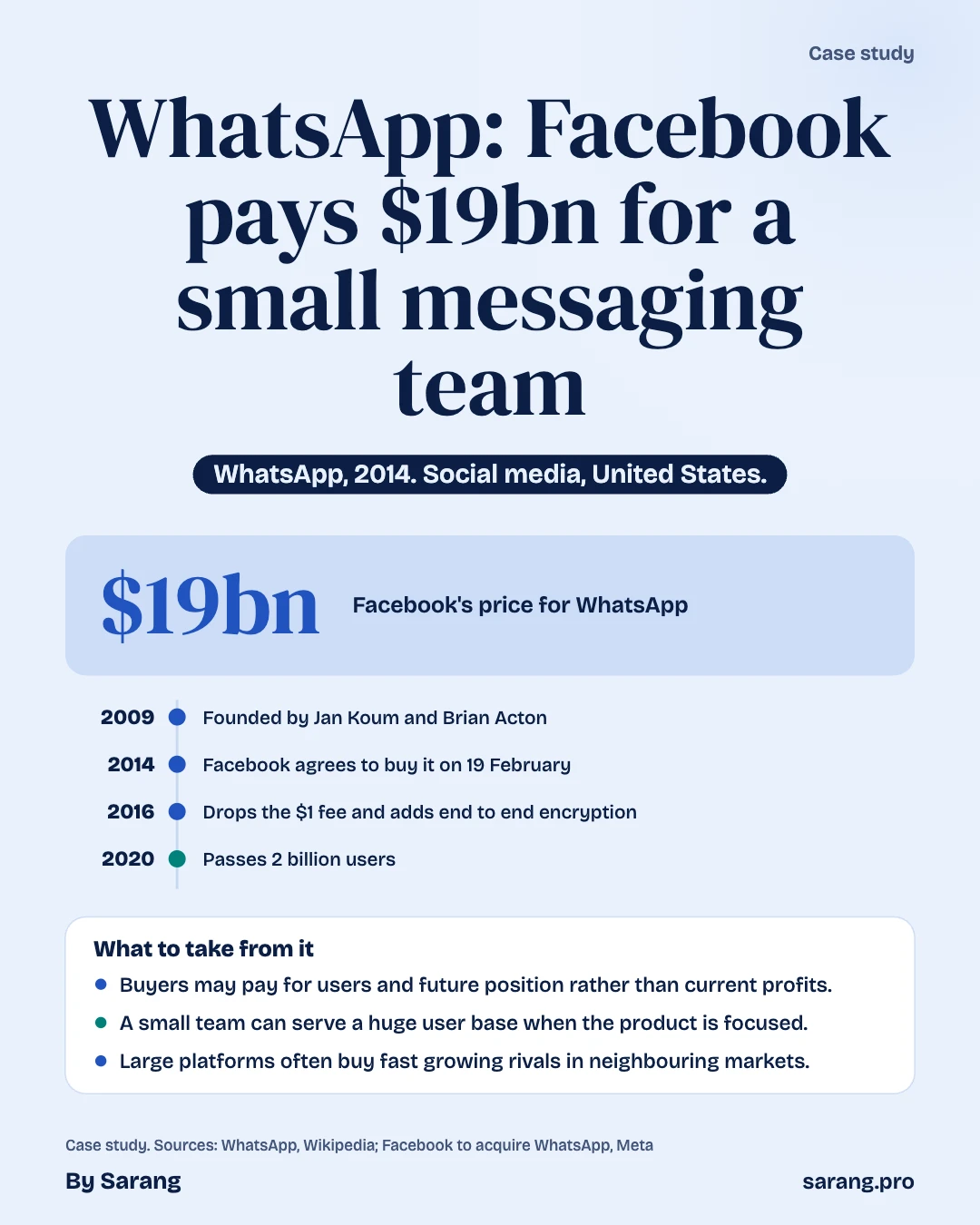
On 19 February 2014, Facebook announced that it would buy WhatsApp. The headline price was $19 billion. Facebook’s own announcement set out the pieces: $4 billion in cash, about $12 billion in Facebook Class A shares (roughly 183.9 million of them), and a further $3 billion in restricted stock units, about 46 million, to be paid to WhatsApp’s founders and employees over four years. The first two parts add to $16 billion. The units bring the total to $19 billion.
What was being bought was small in people and large in users. TechCrunch, reporting the deal the same day, said WhatsApp had about 50 employees, 32 of them engineers. It had more than 450 million monthly users, of whom 70% were active on a given day, and it was adding more than a million new sign-ups a day. It carried no advertising. It charged a subscription of $1 a year per user after the first year, and the founders said they would keep that model. On the arithmetic in these figures, Facebook was paying roughly $42 a user, or about $380 million for each employee.
The deal also came with a promise. In a post on the WhatsApp blog that day, the founders told users they could “still count on absolutely no ads interrupting your communication” and that WhatsApp “will remain autonomous and operate independently”. Whether those promises could be kept by a company that earned most of its money from advertising is the story of the following decade. WhatsApp’s co-founder Brian Acton left Facebook in September 2017, giving up an estimated $850 million in unvested stock. The European Commission fined Facebook €110 million for misleading it during the merger review. And on 16 June 2025, Meta announced that WhatsApp would carry advertising in its Updates tab.
Background
A simple app that won on usage
WhatsApp’s two co-founders were Jan Koum, its chief executive, and Brian Acton. The sources opened here say little about their earlier careers, so this case does not describe them. What the sources do show is the shape of the product and the business at the time of sale. The first year was free and later years cost $1 per user per year. The company took no advertising, and the stance attributed to it in Sophos’s account of the Forbes interview was “No ads, no games, no gimmicks”. Sequoia was an investor, and reported that the service was handling 50 billion messages a day across seven platforms.
Scale compared with Facebook
TechCrunch set WhatsApp beside the buyer. Facebook had 556 million mobile daily active users. WhatsApp had 350 million. So a company with about 50 staff already had a daily mobile audience around two thirds the size of the world’s largest social network. Facebook’s own news release said WhatsApp was adding more than a million registrations a day.
An earlier approach
TechCrunch also reported that Facebook and WhatsApp had held abortive acquisition talks in late 2012, and that Mark Zuckerberg claimed WhatsApp “had every option in the world”. The sources opened do not identify any rival bidder, so this case does not claim that one existed.
The industry
Messaging as a race for attention
A messaging app is valuable because other people are on it. A user who wants to reach friends, family or a shop must join the network where they are, which means the leading app in each country tends to hold its position. The Facebook figures above show the pattern: the company that owned the largest social network was seeing its audience move towards a mobile messaging service it did not own. By buying WhatsApp, Facebook acquired the daily habit of hundreds of millions of people at once.
Different ways to earn
The business models were not alike. Facebook sold targeted advertising, built on knowledge of who its users are and what they do. WhatsApp took a small annual fee and held very little data. Facebook’s 2014 annual report was candid about the result: “We currently monetize WhatsApp in only a very limited fashion”. Paying $19 billion on those terms implied a bet that a vast audience would be worth more than short-term revenue.
Regulation and privacy
The deal was large enough to be reviewed by competition authorities. The agreement included a termination fee of $1 billion in cash and $1 billion in Class A stock, payable if the deal failed because of regulatory approvals. The European Commission reviewed it under the EU Merger Regulation in 2014. Privacy later became a second source of scrutiny, once WhatsApp’s terms linked its accounts to Facebook.
The decision
The sources opened show the choice from both sides, though not as a formal list of options. The three below are framed from what each party said.
For the founders: stay independent
The first option was to keep running WhatsApp as it was. It had a subscription that the founders had said they would keep, a fast-growing base and a small team. The blog post of 19 February 2014 shows how seriously the founders took independence: it says the partnership would not have happened if it had required compromising the company’s core principles. Staying independent would have meant continuing to fund growth to a billion users with a business that took $1 per user per year after the first year.
For the founders: sell to Facebook
The second option was to sell. The terms gave the founders and staff cash and shares, plus $3 billion in units that vested over four years, which tied them to the new owner. Koum joined Facebook’s board. The founders’ public promises, no ads and operational independence, were meant to protect the product. The retention units show Facebook wanted the team to stay, not only the code.
For Facebook: build, ignore or buy
For Facebook the options were to build its own messaging, to accept WhatsApp’s rise as a competitor, or to buy it. Zuckerberg’s claim that WhatsApp had every option, and the failed talks of 2012, suggest that the price was set by a seller who could have said no. Paying $19 billion for a company that earned very little was a bet on the network and on later monetisation. The sale of a $1 per user subscription business at roughly $42 per user shows what a buyer thought each daily habit was worth.
What they did
Announcing the deal, 19 February 2014
Facebook announced the agreement with the terms above. Koum was to join the board. The blog post from WhatsApp promised that users would notice no changes, that the service would stay available on any smartphone, and that the small fee would continue. TechCrunch noted the termination fee and that the cash and stock figures were set out in a regulatory filing.
Closing the deal, 2014
Facebook’s 2014 annual report says that during the year it paid about $4.6 billion in cash and issued 178 million Class A shares for WhatsApp. That is more cash than the $4 billion in the announcement; the filing excerpt opened does not explain the difference. The report also lists an issue of 177,760,669 shares on 6 October 2014 as consideration for an acquisition of “all the outstanding shares of a company”. It does not name the company, though the count closely matches the WhatsApp figure, so this case treats early October 2014 as the likely closing date, and flags that as an inference.
The EU review and the account-linking terms, 2014 to 2016
During the 2014 merger review Facebook gave the European Commission information that the Commission later called inaccurate or misleading. Then, according to the account of Acton’s Forbes interview published by Sophos, within 18 months WhatsApp’s new terms linked user accounts to Facebook. The Commission’s fine of €110 million, announced in 2017 under reference IP/17/1369, was for the misleading information during the merger review. The page opened does not give the date, and does not say what was misleading, so the detail of the claim is outside this case.
The founder’s exit, 2017 and 2018
Acton left Facebook in September 2017. In an interview with Forbes in September 2018 he said he had left because of disagreement over how to earn money from WhatsApp, and that he had forgone roughly $850 million in stock that would have vested a year later. Sophos’s summary reports that Zuckerberg had promised “zero pressure” to monetise for five years. Fox Business quoted Acton as saying, “I sold my users’ privacy to a larger benefit,” and as saying that Facebook “isn’t the bad guy” and that its leaders were “just very good businesspeople”.
The business push and the 2021 policy row
In January 2021 WhatsApp announced an update to its terms that covered how people message businesses and how WhatsApp collects and uses data. Privacy campaigners objected to data-sharing with Facebook. City A.M. reported that many users moved to Telegram and Signal, and that WhatsApp delayed the date by which users had to accept the terms from 8 February to 15 May. WhatsApp said messages and calls remained encrypted and that the changes did not mean more data shared with Facebook. The delay was a setback to its plans to earn from business and shopping services.
Ads and fees, 2025
On 16 June 2025 Meta announced that businesses could run ads in the Status feature of the Updates tab, separate from personal chats, and that channel owners could pay to boost visibility and charge monthly subscriptions, with Meta planning to take a 10% cut eventually. Meta said it would use basic data such as country, city, device, language and ad interactions, and that personal messages and calls stayed encrypted. From 1 July 2025 business messaging prices moved from per conversation to per message, for about 200 million monthly business users.
What happened
Users
| Date | WhatsApp monthly users | Source |
|---|---|---|
| February 2014 | Over 450 million | Facebook announcement |
| April 2025 | Over 3 billion | Zuckerberg to analysts, per CNBC |
That is more than a sixfold increase in just over a decade, on the company’s own figures. Meta said more than 1.5 billion people visit the Updates tab each day.
Revenue
Meta does not report WhatsApp’s revenue as a separate line. Analysts quoted by CNBC had estimated $500 million to $1 billion, mostly from charging businesses for messaging tools. The Stack reported that WhatsApp’s “other revenue” was $510 million in the first quarter of 2025, up 34%, driven mainly by business messaging on the WhatsApp Business Platform. That quarter’s revenue for all of Meta was $41.9 billion. So eleven years after a $19 billion purchase, WhatsApp’s disclosed revenue was about 1% of the group’s.
The promises
The no-ads promise lasted eleven years and four months. Acton and Koum, CNBC noted, had publicly criticised the advertising industry, and had reportedly clashed with executives who wanted ads. The 2025 ads are limited to the Updates tab and are not inserted into personal chats, which is a narrower form of advertising than the one the founders objected to, though a different position from the original promise.
What the price implied
Dividing the $19 billion headline by 450 million users gives about $42 a user, which is arithmetic from the reported figures and not a figure any source gives. Because WhatsApp charged $1 a user a year after a free first year, and not every user paid, a subscriber would have needed many years to repay that sum from fees. The price therefore rested on what Facebook could earn from the audience in other ways, not on the fee income WhatsApp was then collecting. The same logic gives about $380 million per employee on a base of 50 staff.
Price paid
Sources state the price differently. Facebook’s release gave about $16 billion plus $3 billion in units. The press called it $19 billion. Fox Business in 2018 referred to a $22 billion offer. The differences probably come from what is counted and from the movement of Facebook’s share price between announcement and closing, but the sources opened do not say so directly.
Other views
The co-founder
Acton’s account is the sharpest criticism from inside. He said that he sold his users’ privacy for a larger benefit, and that the dispute was over monetisation. He also declined to cast Facebook as a villain. This is one person’s account, given four years later, and the sources opened do not include Facebook’s reply.
Regulators
The European Commission’s decision treated the issue as one of accuracy during the merger review. Its title says Facebook gave misleading information about the WhatsApp takeover. The page opened does not include the Commission’s reasoning, so the question of whether the deal should have been blocked is not answered here. Sophos gives the fine as $122 million, presumably a dollar conversion of the figure the Commission itself gives, €110 million.
Users
The 2021 episode shows users reacting to uncertainty about data, not only to fact. WhatsApp said the changes would not share more data with Facebook, yet many people looked at alternatives. The sources opened give no precise number of users who left, and WhatsApp’s user count has risen since.
Facebook’s side
Facebook’s public case in 2014 was in the announcement and in Zuckerberg’s claim, reported by TechCrunch, that WhatsApp had every option in the world: the price was what the seller could have refused. Facebook’s 2014 annual report was open about the limited revenue from the app. The sources opened do not include later statements from Facebook or Meta on whether the ads announced in 2025 were part of the plan from the start.
Limits of the evidence
WhatsApp’s own revenue before 2025 is not disclosed in the sources opened. The founders’ reasons for selling are mostly described in the blog post, which is a public statement written for users. Several documents that would help, such as the Commission’s merger decision and Facebook’s acquisition note, were not available in the pages opened.
Reading it through a framework
Network effects
A network effect exists when each additional user makes a service more valuable to the others. Messaging is a clear case. Facebook’s figures for WhatsApp, 450 million users, 70% active daily and a million new sign-ups a day, show a network growing by itself, with a tiny team. The $19 billion price reflects a view that the network, not the software, was the asset. The same logic explains why the 2025 move was possible: with over 3 billion monthly users, Meta can place ads in one corner of the app and still expect people to stay, because there is nowhere else their contacts all are.
Stakeholder mapping
A stakeholder map lists who has power and interest in a decision. In 2014 the founders and staff held the product and were retained with $3 billion in units. Users held the trust, and the blog post was written to them. Facebook’s shareholders paid, in cash and in stock. Regulators held a veto, shown by the $1 billion plus $1 billion termination fee. In later years the map shifted. Acton walked away from about $850 million, which shows an insider with strong interest choosing exit over compromise. European regulators moved from reviewing the deal to punishing inaccurate information about it. Businesses, paying for messaging, became the stakeholder whose money the company needed.
Since then
By April 2025 Zuckerberg told analysts WhatsApp had over 3 billion monthly users. On 16 June 2025, Meta announced advertising in the Updates tab, channel subscriptions, and new business pricing. The disclosed revenue line for WhatsApp and other services in the first quarter was $510 million. The sources opened do not cover results after that.
What to take from it
- A tiny team can be worth a very large price if it owns a network that is growing quickly and that the buyer cannot build itself.
- Promises made at the moment of sale, such as no ads, are only as durable as the incentives of the buyer’s business model.
- Retention units paid over years tie founders to a deal, but they also give a founder a large amount to lose by leaving, as Acton’s departure showed.
- Information given to regulators during a merger review has consequences later, as the €110 million fine showed.
- Monetising a network after buying it can take over a decade, and it may be done through businesses before it is done through consumers.
Questions to think about
- If you were Koum and Acton in 2014, what would have made you keep WhatsApp independent?
- Was $19 billion for a company with about 50 staff and almost no revenue sensible, or did it only work because of what Facebook could do later?
- Meta kept personal chats free of ads in 2025. Does that keep the spirit of the 2014 promise, or break it?
- How should regulators judge a deal where the buyer pays for an audience that the seller has deliberately not monetised?
Concepts at work
This case draws on network effects, stakeholder mapping and acquisition valuation. Explore them in Insights.
Written from the public sources listed below. Figures are as those sources report them.
Framework
Timeline
- Late 2012Abortive acquisition talks between Facebook and WhatsApp
- 19 Feb 2014Facebook announces the deal; WhatsApp blog promises no ads
- 2014EU reviews the merger; deal closes in the autumn
- 2016New WhatsApp terms link accounts to Facebook
- 2017EU fines Facebook EUR 110m over misleading information
- Sep 2017Brian Acton leaves Facebook
- Sep 2018Acton tells Forbes he sold his users' privacy
- Jan 2021Privacy policy update; deadline moved from 8 Feb to 15 May
- Apr 2025Zuckerberg cites over 3bn monthly users
- 16 Jun 2025Meta announces ads in Updates tab and channel subscriptions
- 1 Jul 2025Business messaging billed per message
Recap cards
Tap a card to check yourself.
Sources and credits
- Facebook: Facebook to acquire WhatsApp (19 Feb 2014)
- WhatsApp Blog: Facebook (19 Feb 2014)
- TechCrunch: Facebook buying WhatsApp for $16B in cash and stock, plus $3B in RSUs (19 Feb 2014)
- Facebook Inc: Form 10-K for 2014 (SEC)
- European Commission: Commission fines Facebook EUR 110 million for providing misleading information about WhatsApp takeover (IP/17/1369)
- Sophos Naked Security: WhatsApp cofounder, I sold my users' privacy (28 Sep 2018)
- Fox Business: WhatsApp co-founder calls himself 'sellout' for $22B Facebook deal (27 Sep 2018)
- City A.M.: WhatsApp delays controversial update following privacy backlash (Jan 2021)
- CNBC via NBC Bay Area: Meta is finally bringing ads to WhatsApp (16 Jun 2025)
- The Stack: Meta looks to sweat WhatsApp with ads, price tweaks (Jun 2025)



