PayPal: eBay buys its biggest payment rival for $1.5 billion in 2002
eBay agreed in July 2002 to buy PayPal for about $1.5 billion in stock, then in 2014 decided to spin it off, by which time PayPal handled $235 billion a year.
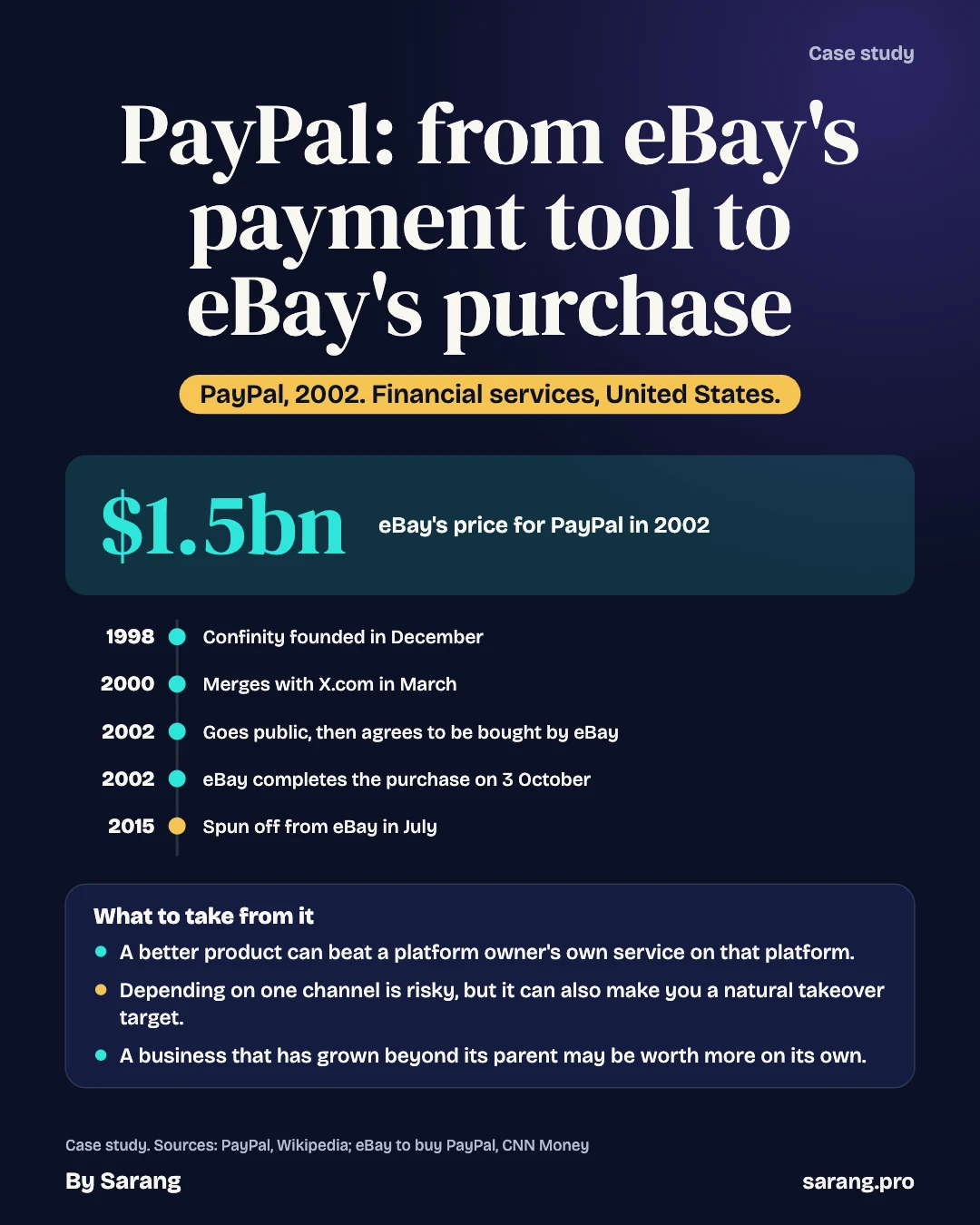
- deal value at announcement, July 2002
- $1.5 billion
- eBay shares per PayPal share
- 0.39
- of PayPal business on eBay in 2002
- 60%
- eBay users worldwide in July 2002
- 46 million
The situation
On Monday 8 July 2002 eBay said it would buy PayPal in a tax-free, all-stock deal. Each PayPal share would convert into 0.39 of an eBay share, a fixed ratio, which eBay valued at about $1.5 billion using its share price of 5 July. PayPal had floated on the stock market only in February that year. Now its largest customer was buying it, and eBay was giving up its own Billpoint payment service, which had competed with PayPal.
The numbers in the announcement explain why. About 60 per cent of PayPal’s business already took place on eBay, and the other 40 per cent came mainly from small merchants. eBay had about 46 million users worldwide. PayPal was available in 38 countries. For the second quarter of 2002 PayPal guided to revenue of $53 million to $54 million and total payment volume of $1.61 billion to $1.63 billion. In the same release eBay reported net revenue of about $266 million, GAAP net income of $54.3 million and a gross margin of 83 per cent. PayPal was small next to eBay, but a large part of eBay’s buyers and sellers had already chosen it.
The deal closed on 3 October 2002. At closing Peter Thiel resigned as chief executive, the Billpoint service began to be wound down and PayPal had become a reporting segment inside eBay. Twelve years later, in September 2014, eBay announced it would separate the two again.
Background
PayPal before the sale
According to Eric M. Jackson, writing for VentureBeat, PayPal launched in 1999 when paying by credit card online was hard for most small merchants. It moved from a few thousand users to more than a million accounts in under six months, while burning roughly $10 million a month. After a merger and several changes of chief executive it adopted a freemium model, fought fraud, and grew by serving small sellers who depended on eBay. Jackson later founded the firm CapLinked, per the article’s author note, and the article is a commentary, so its figures need the caution that applies to any single secondary source.
eBay and its in-house payments
eBay’s own payment service, Billpoint, was a joint venture with Wells Fargo. VentureBeat reports that it had gained little traction, that eBay was in talks with Wells Fargo to make it free for auction sellers, and that the subsidy could have hurt PayPal. About 70 per cent of eBay auctions accepted PayPal, and roughly one in four closed auction listings was paid for through it. The announcement itself called PayPal the most preferred electronic payment method among eBay users.
Where eBay stood
The July 2002 release shows a business with an 83 per cent gross margin and a pro forma operating margin of 30 per cent. Meg Whitman said in the release that the two companies had “complementary missions”. The filings also tell us what eBay expected to pay in accounting terms: about $18 million of acquisition costs, plus quarterly charges of roughly $4 million for stock-based compensation and $9 million for amortisation of intangible assets. The deal would add to eBay’s pro forma earnings per share at once but lower its GAAP earnings.
The industry
Online payments in 2002
The sources describe a young market with two layers. Auction sellers needed a way to receive money from strangers. Card networks and banks controlled the underlying rails. PayPal worked on top of them, and Jackson notes that in its early years it often had to work against the credit card associations to get merchants onto the internet at all. That explains both its appeal to small sellers and its exposure to the banks it depended on.
Regulation
VentureBeat lists the regulatory pressure on PayPal in these years. The US deposit insurer, the FDIC, ruled that PayPal was not a bank, which meant it needed money transmitter licences state by state. The New York Attorney General, Eliot Spitzer, challenged it, and at one point it was banned in Louisiana. The announcement shows a related decision: PayPal’s gaming business would be phased out after closing because of the uncertain regulatory environment for online gaming.
Competition
In 2002 the rival that mattered was Billpoint, and it was owned by the buyer. By 2014 the picture had changed. The Entrepreneur report on the separation names Google Wallet and other vendors as competitors and says Apple was about to enter online payments with Apple Pay the following month. A payment product that began as a tool for one marketplace now faced technology giants.
The decision
The sources do not record eBay’s board papers, so the options below are the obvious ones, framed as alternatives and checked against what the sources show.
Keep Billpoint and compete
eBay could have kept investing in Billpoint, with its Wells Fargo partner, and used its control of the marketplace to push sellers to it. VentureBeat reports that eBay was considering making Billpoint free to sellers. The weakness was that sellers and buyers had already chosen PayPal at the checkout, and an effort to force a change risked annoying the most active users.
Partner with PayPal
A commercial agreement would have been cheaper. But PayPal also served small merchants who did not sell on eBay, and those made up 40 per cent of its business. A partner with that independent base could always trade elsewhere, and eBay would not have captured the economics of the payment.
Buy PayPal
This is what eBay did. The release shows what it gained: a payment method already used by the majority of its buyers, a business whose guided volume was $1.61 billion to $1.63 billion for one quarter, and an end to the Billpoint contest. The price was around $1.5 billion in stock, which diluted eBay’s GAAP earnings but did not require cash. The sources do not record why eBay chose 0.39 as the ratio or whether other bidders existed.
Leave PayPal alone
The final option was to do nothing. In that case a payment company with perhaps two thirds of its revenue from eBay (Jackson says over two thirds a decade before 2012) would have remained dependent on a platform that could change its rules at any time. Each side could hurt the other.
What they did
8 July 2002: announcement
The deal was priced on eBay’s 5 July close. PayPal would remain an independent brand. The service called eBay Payments by Billpoint would be phased out after closing. PayPal would drop its gaming business. The companies expected to close around the end of the year, subject to shareholder, government and regulatory approvals.
3 October 2002: closing
eBay’s 8-K filing reports that PayPal stockholders approved the merger, with holders of about 65 per cent of outstanding shares voting and more than 99 per cent of the votes cast in favour. A subsidiary named Vaquita Acquisition Corp. merged into PayPal, leaving PayPal as a wholly owned subsidiary. About 26.5 million eBay shares were issued or reserved for options, and eBay assumed the outstanding PayPal options at the adjusted ratio. The value stayed at about $1.5 billion, now using the average eBay price over the two days either side of the announcement. Costs were estimated at about $17 million.
Leadership and operations
Peter Thiel resigned as chief executive. Matt Bannick, eBay’s senior vice president for global online payments, took over his responsibilities. Gaming was to end by the close of 2002. Billpoint would finish winding down in the first half of 2003. PayPal would still be reported on its own: eBay said payments would be a separate segment from the fourth quarter of 2002.
Guidance for the first year
eBay told investors to expect PayPal to add $60 million to $64 million of net revenue in the fourth quarter of 2002, with Billpoint adding about $6 million, and about $6 million to pro forma net income. For 2003 it expected the payments segment, including Billpoint, to bring in $300 million to $310 million of net revenue, within consolidated net revenue of $1.77 billion to $1.83 billion. In round terms that put payments at about a sixth of the group’s expected revenue.
What happened
Growth inside eBay
The VentureBeat article gives the longest view. By 2012 PayPal had more than 117 million active users and $35 billion of quarterly payment volume. In the most recent quarter it cited, PayPal contributed $1.37 billion of sales, a little over 40 per cent of eBay Inc.’s net revenue, up 22 per cent on the year earlier. A decade earlier over two thirds of PayPal’s revenue had come from eBay auctions, but by 2012 that share was about a third. PayPal had become a business that served large merchants too, with Home Depot and Dell among the examples the article names.
The 2014 figures
When eBay announced the separation on 30 September 2014, the Entrepreneur report put eBay’s marketplaces and enterprise revenue at $9.9 billion over the previous four quarters, up 10 per cent. PayPal’s revenue stood at $7.2 billion, up 19 per cent, with more than 152 million active users. Retail TouchPoints, reporting on the spin-off in July 2015, gave full-year 2014 figures of $235 billion in payment volume, more than $8 billion in revenue and $46 billion in mobile payment volume.
| Date | Measure | Figure |
|---|---|---|
| Jul 2002 | Deal value | About $1.5 billion |
| Q2 2002 guidance | PayPal total payment volume | $1.61 billion to $1.63 billion |
| 2012 | PayPal quarterly volume | $35 billion |
| Sep 2014 | PayPal trailing revenue | $7.2 billion |
| 2014 | Payment volume | $235 billion |
| Jul 2015 | Active accounts | More than 169 million |
The separation
The announcement of 30 September 2014 said eBay would spin PayPal off as a publicly traded company in the second half of 2015, tax-free to shareholders. eBay shares rose 10 per cent to $58.15 in premarket trading. Carl Icahn, an activist investor with 2.48 per cent of eBay at 30 June, had pressed for the split before backing off in April and withdrawing his two board nominees. John Donahoe, the chief executive, said the decision came from “a deliberate process”, not outside pressure. Devin Wenig was to lead the new eBay and Dan Schulman, from American Express, PayPal.
PayPal began trading on Nasdaq under the ticker PYPL by 20 July 2015, when Retail TouchPoints reported that eBay shareholders of record on 8 July 2015 had received one PayPal share for each eBay share. By then PayPal reported more than 169 million active accounts in 203 markets, and had bought Paydiant in March 2015 and Xoom in July.
Other views
The critic
Jackson, in the VentureBeat article, reports that some critics, including himself in a Forbes column, called the sale “the worst tech decision in the last 10 years”. His argument, in the sources, is that PayPal grew into a large business and a source of talent. He compares the $1.5 billion price to Facebook’s $750 million purchase of Instagram, which had no revenue. The view is one author’s, and the article’s own purpose is to argue that the sale gave away a great deal.
The PayPal network of founders
The article also lists what PayPal’s alumni went on to do: LinkedIn (Reid Hoffman), YouTube (Chad Hurley, Steve Chen and Jawed Karim), Yammer (David Sacks), Tesla and SpaceX (Elon Musk), and Yelp (Jeremy Stoppelman and Russel Simmons). Peter Thiel funded Facebook, Palantir and Zynga, among others. The sources list these careers as a record of where PayPal’s people went; they do not claim that the sale caused any of those companies.
eBay’s own view
eBay’s side, in the 2014 report, is that the separation was a considered choice. Donahoe presented it that way. The same report records Icahn’s earlier campaign and his April withdrawal. The sources do not settle which account is more accurate, and an outsider cannot see the board’s discussions.
Reading the numbers with care
The table mixes forecasts and results, and the measures are not like for like. The 2002 figures are guidance given at announcement. The 2012 figures are trailing quarterly numbers from a commentary. The 2014 and 2015 numbers come from press reports of company data. They show direction clearly, a business that grew from about $1.6 billion of volume in a quarter to $235 billion in a year, but they should not be used to calculate a precise return on the purchase price, and the sources do not give one.
Limits of the evidence
No primary source used here gives the share of eBay’s volume that moved to PayPal after closing, and the 70 per cent and one in four figures come from the VentureBeat article, not a filing. The GAAP effect of the deal on eBay’s earnings is shown only as guidance, not as outcome.
Reading it through a framework
Porter’s five forces
The deal looks sensible through supplier and buyer power. PayPal depended on eBay for most of its revenue, so eBay held strong bargaining weight as the marketplace and had the means, in theory, to steer sellers to Billpoint. Sellers and buyers, however, held power in the other direction: 70 per cent of auctions accepted PayPal and many users had picked it. Buying it ended a fight in which each party had real bargaining weight. Value also moved along the chain: in 2002 eBay owned the listing and the buyer relationship while PayPal owned the step where money changed hands, so buying PayPal brought that last step in-house. The threat of new entrants was real in payments, as the 2014 mention of Google Wallet and Apple Pay shows, which is part of why owning the dominant payment method looked valuable in 2002 and less secure in 2014.
Switching costs and network effects
Payments have two-sided network effects: sellers accept the method that buyers hold, and buyers hold the method that sellers accept. Billpoint gained little traction even with talk of making it free to sellers, which suggests that habit and acceptance were worth more than price to users. That is a high switching cost, even without contracts. The same logic worked against eBay in 2014: PayPal’s growth in large-merchant payments meant it no longer needed eBay’s marketplace to keep its network, which was the logic for separating them.
Since then
The 2014 announcement repeated a number the 2002 deal had hinted at: PayPal, once the smaller part, now produced $7.2 billion in revenue against $9.9 billion for eBay’s marketplaces and enterprise business over the same four quarters. That is roughly 42 per cent of the combined total, close to the little over 40 per cent given for 2012, so the proportion held steady while both parts grew.
The separation brought different pressures to each side. The new eBay was a marketplace business led by Devin Wenig. The new PayPal, led by Dan Schulman, set out to compete as an independent payments company, and in 2015 it bought Paydiant, a mobile payments firm, in March and Xoom, a money transfer business, in July. Those purchases show PayPal choosing to extend beyond the eBay checkout once it controlled its own strategy.
PayPal listed on Nasdaq in July 2015, led by Dan Schulman. By the end of 2014 it handled $235 billion of volume and, in the following year, reported 169 million active accounts. No source used here gives PayPal’s 2024 or 2025 results. PayPal’s newsroom page for its full-year 2024 results directs readers to its investor relations site, so those figures should be read there. Likewise the sources used here do not describe eBay’s marketplace after 2015.
What can be said from the sources is that the 2002 judgement, that payments belonged inside the marketplace, was reversed by the same company in 2014, and that the reason stated was strategic and competitive, not financial.
What to take from it
- A company that competes with a product its customers already prefer can lose more by fighting than by buying; eBay’s Billpoint gained little traction while PayPal was used in about 70 per cent of eBay auctions.
- Fixed-ratio stock deals move in value with the buyer’s price, so the headline figure ($1.5 billion) depends on the date chosen to measure it.
- Dependence cuts both ways: PayPal relied on eBay for most revenue, and eBay relied on PayPal for how its sellers got paid.
- A division that grows beyond its parent’s platform may be worth more apart; PayPal’s revenue share from eBay fell to about a third by 2012, and it was spun out in 2015.
- Regulation shapes payment businesses as much as technology does; licences, bank status and state action all appear in PayPal’s early history.
Questions to think about
- What would eBay have had to believe about Billpoint to keep competing instead of buying PayPal?
- Was the 2014 separation a reversal of the 2002 logic, or did the market simply change?
- How should a buyer value a target whose largest customer is the buyer itself?
- If a critic calls a deal the worst decision in a decade, what evidence would you need to judge that claim?
Concepts at work
Switching costs, network effects and vertical integration all show up in this case. Explore them in Insights.
Written from the public sources listed below. Figures are as those sources report them.
Framework
Timeline
- Feb 2002PayPal floats on the stock market
- 8 Jul 2002eBay announces the $1.5 billion all-stock purchase
- 3 Oct 2002Deal closes; Thiel resigns as chief executive
- First half 2003Billpoint winding down completed
- 2012PayPal at 117 million active users, over 40% of eBay revenue
- 30 Sep 2014eBay announces plan to spin off PayPal
- Mar 2015PayPal buys Paydiant
- 8 Jul 2015Record date for PayPal share distribution
- 20 Jul 2015PayPal trades independently on Nasdaq
Recap cards
Tap a card to check yourself.
Sources and credits
- SEC (eBay 8-K exhibit): eBay to acquire PayPal announcement, July 2002
- IT World Canada: EBay makes bid for PayPal
- SEC (eBay 8-K): Completion of the PayPal acquisition, October 2002
- VentureBeat: How eBay's purchase of PayPal changed Silicon Valley
- Entrepreneur: eBay and PayPal to separate as independent companies in 2015
- Retail TouchPoints: PayPal officially splits from eBay, celebrates Nasdaq listing



