Xerox PARC: the research lab whose inventions made money for other companies
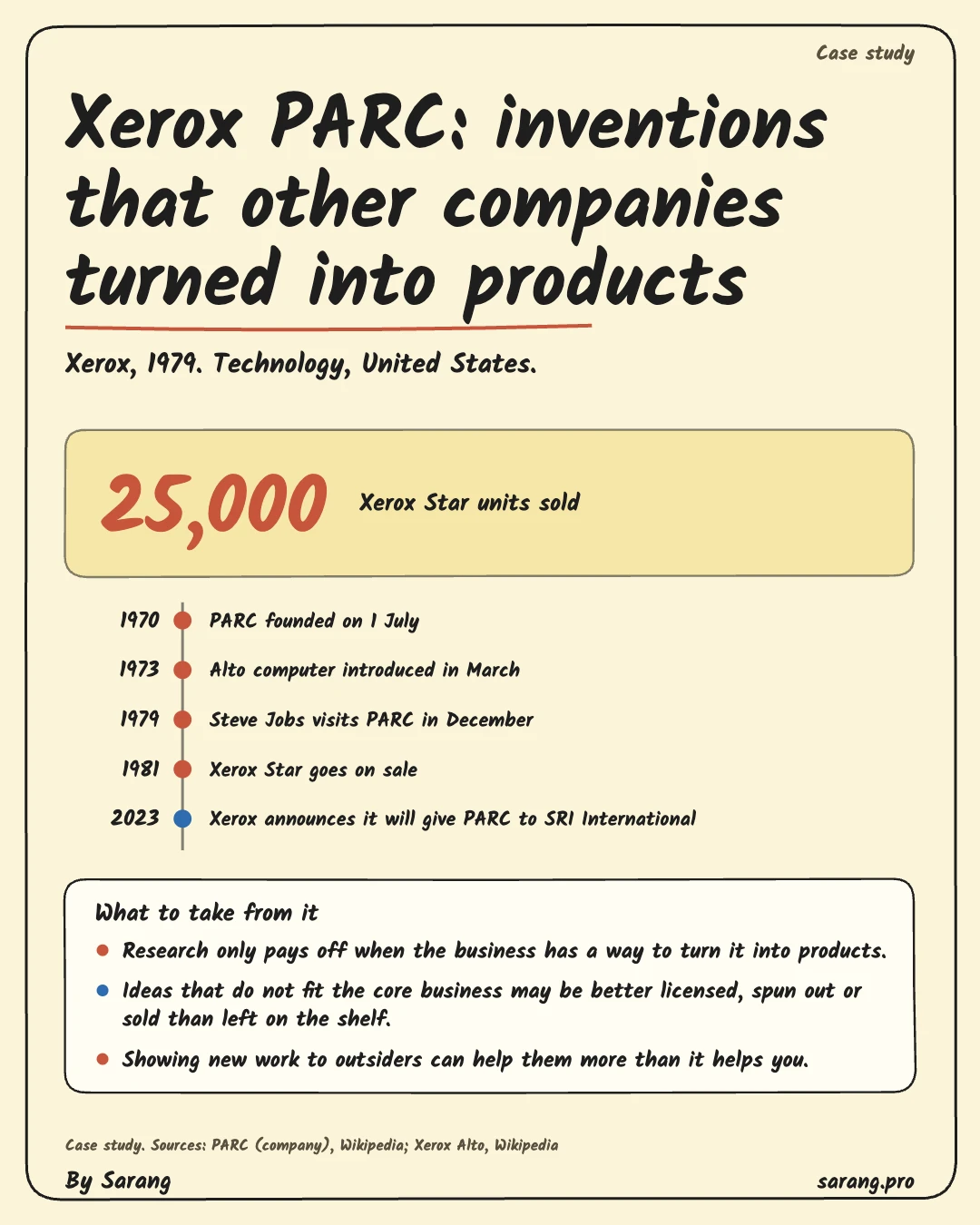
Xerox founded PARC in 1970 and it produced the Alto, Ethernet and laser printing, yet its $16,595 Star workstation failed in 1981 while Apple, 3Com and Adobe built businesses on the ideas.
- year Xerox founded PARC
- 1970
- Xerox investment in Apple for 100,000 pre-listing shares, 1979
- $1 million
- Xerox Star price per workstation, 1981
- $16,595
- Macintosh launch price, 1984
- $2,495
The situation
In December 1979 a group from Apple, including its co-founder Steve Jobs, went to see the Xerox Palo Alto Research Center (PARC) in California. They watched a demonstration of the Alto, a computer with a bitmapped screen, overlapping windows, icons and a mouse. The visit followed a business deal: Xerox’s venture arm had put $1 million into Apple in return for the right to buy 100,000 shares before Apple’s public listing, and Apple was given a look at PARC in exchange. Four years later Apple launched the Lisa, and in 1984 the Macintosh. Xerox, meanwhile, had a research lab that had produced the personal computer, Ethernet, the laser printer and the graphical interface, and a business that struggled to sell most of it.
That gap between invention and income is the case. PARC was founded in 1970 and was told to build “the office of the future”. It succeeded at the first part. By the mid 1970s it had produced the Alto, Ethernet, laser printing, the Smalltalk programming language and a what-you-see-is-what-you-get text editor. The sources disagree on how much money Xerox made from all this. The Computer History Museum says some ideas produced billions of dollars of sales for Xerox. A marketing blog goes further and calls the laser printer the only PARC invention that Xerox turned into a lasting product. Both agree that the companies that gained most from the work were not Xerox.
This case follows the lab, the products, the Apple visit and what each party did next. It also covers an argument that the story of Apple “taking” the idea is too simple, and sets out why a company can lead in research and fail to lead in the market.
Background
A copier company with a research problem
Xerox grew from xerography, invented by Chester Carlson in 1938. According to a marketing blog that gives the dates and figures, the Xerox 914 copier launched in 1959 and the company’s revenue rose from $37 million in 1960 to $1.1 billion by 1968. No primary source for those figures was available, so they should be read as a secondary account. The point they make is simple: a single product had made Xerox rich, and its owners wanted to avoid being overtaken by the next change in how offices worked. That is the reason the company funded a lab in 1970.
Building PARC
Britannica describes PARC as a division of Xerox, set up in Palo Alto to explore information technologies not necessarily tied to the copier business. A Stanford account of the Apple visits adds that Robert Taylor, who had earlier directed a research programme at the US defence research agency, ran the computer science work and recruited people from Douglas Engelbart’s group at the Stanford Research Institute, where the mouse and windowed interfaces had been developed in the 1960s. The mouse itself dates to 1965 at that institute, according to a Kent State history page and to the linfo reference site, not to PARC.
A lab that published
The Stanford account also argues that PARC was open. Its researchers published widely and had regular contact with Stanford’s computer scientists. In 1975 about 2,000 visitors saw the Alto, mostly seeing only the machine. That matters for the later story, because it means the ideas were not hidden from the industry. Starting around 1980 researchers began leaving PARC to join other computer companies.
The industry
Computing in the 1970s
When PARC was set up, computers were large and shared. The Alto, begun in 1972, was a different idea: one machine for one person, with a display that showed an 8.5 by 11 inch page, proportional type, folders and icons, and a connection to other machines. The Kent State page records 128K bytes of memory and Ethernet linking, and says there were about 150 Altos at PARC. A later machine, the Dorado, had a cycle time of 60 nanoseconds, matching an IBM supercomputer from about 11 years earlier, according to the Computer History Museum.
Networking and printing
Bob Metcalfe and Dave Boggs co-invented Ethernet in 1973, in a 3 megabit form, to link the Altos and what the IEEE describes as the first networked laser printer. In 1975 Dave Liddle became head of a new Xerox division charged with turning the Alto and Ethernet into products. In 1980 Digital, Intel and Xerox released a joint Ethernet specification, which became the starting point for the IEEE 802.3 standard. Metcalfe founded 3Com and promoted Ethernet across the industry. Xerox announced its Network Systems servers in November 1980 and the Star 8010 workstation in April 1981.
Rivals and prices
By 1981 the personal computer market had arrived without Xerox. The marketing blog lists the IBM PC as launching that year at under $1,600, the Xerox Star at $16,595 per workstation, and the Macintosh in 1984 at $2,495, with 50,000 sold in 74 days. Those figures come from one secondary source, but the order of magnitude of the price gap matters more than the exact numbers.
The decision
The sources do not record a single board decision. They show a series of choices, which are presented as alternatives to what Xerox did.
Productise the work inside Xerox
This was the route Xerox took, through the System Development Division created in 1975 and the Star. The cost was price and compatibility. The Star required proprietary Xerox servers and could not connect to IBM PCs, per the marketing blog. The Raskin Center account says the Alto was an expensive, unreliable research prototype that depended on networking not found outside research settings, and that it was aimed at skilled users, whereas the Macintosh was aimed at newcomers.
License or spin out the technology
A second route was to let people leave with it. John Warnock and Chuck Geschke developed Interpress, a page description language, at PARC. According to a history of Adobe, Xerox declined to market Interpress, and they left to start Adobe. Apple later took a stake and used PostScript in its LaserWriter printer. This was an outcome Xerox accepted rather than planned. A licence or an equity stake could have given Xerox a share. The Adobe article mentions no Xerox stake, so no claim about one is made.
Invest in a future competitor
The third choice was the Apple arrangement. Xerox Development Corporation paid $1 million for pre-listing Apple shares, and Apple gained access to PARC. The Raskin Center account says Jobs had his own reasons for the visit: the venture arm had just invested and agreed to show the lab. It describes this as a business exchange and not as secret espionage.
Keep the lab closed
A closed lab would have limited leakage. But the Stanford account shows that PARC’s open practice drew talent and published results, and that a fully secret programme would have lost the researchers who valued publishing. The cost of openness was that the ideas travelled. The cost of secrecy would have been a smaller, slower lab.
What they did
1970 to 1975: invention
PARC was founded in 1970, and work on the Alto began in 1972. Ethernet followed in 1973, and the Smalltalk programming environment was part of the same body of work. By the mid 1970s the lab had a working set of ideas that fit together: the personal computer, the network and the printer.
1979: the Apple visits
There were two Apple visits in 1979, and Jobs went on the second, in December. Jef Raskin helped arrange both. The Computer History Museum says Adele Goldberg at first refused to demonstrate Smalltalk to Jobs and his engineers, fearing they would appropriate the technology, but Xerox management overruled her. Jobs later said that it was obvious to him that all computers would work like this some day. The Raskin Center account stresses that PARC held back its most advanced work and that the Smalltalk environment and software went beyond what was shown.
1981: the Star
Xerox announced the Star 8010 in April 1981, with a graphical interface, mouse, Ethernet, file servers and email, at $16,595 per workstation according to the marketing blog. That blog calls it a commercial failure, and Kent State’s page says it failed in 1981 largely because of its price.
1982 to 1984: others take it to market
In 1982, per the Adobe account, Jobs offered $5 million for Adobe and the founders agreed to sell Apple a 19 per cent stake. The Apple LaserWriter was the first printer to use PostScript. Apple launched the Lisa in 1983 and the Macintosh in 1984. The Computer History Museum says the Lisa’s graphical interface was developed from scratch at Apple, though heavily influenced by PARC, and that its commercial failure was due to price and performance, not features.
What happened
Where the money went
| Invention at PARC | Who sold it | Source |
|---|---|---|
| Ethernet | 3Com, whose founder Metcalfe promoted it; DEC and Intel joined Xerox in the 1980 specification | IEEE |
| Page description (Interpress to PostScript) | Adobe, with Apple as 19% shareholder and LaserWriter maker | Rickard |
| Graphical interface, mouse | Apple (Lisa, Macintosh) | Computer History Museum |
| Laser printing | Xerox, per the marketing blog | Marketing Monk |
Adobe
Adobe, founded in 1982, went public in 1986 at $11 a share, according to the history of the company. The same source gives a company value of $243 billion in January 2022. That is a figure for Adobe’s market value, not a measure of anything Xerox lost, and the article does not claim Xerox ever held a stake.
Apple
The Macintosh sold 50,000 units in 74 days at $2,495, per the marketing blog. The Raskin Center account lists what Apple designed itself: the top-of-screen menu bar, the single-button mouse, the trash can, click and double-click behaviour and dialogs. It names Larry Tesler, who came from PARC, Bill Atkinson and others. Whether those choices amount to invention or adaptation depends on the reader’s view of the evidence.
The lawsuit
In 1989 Xerox sued Apple over the Macintosh interface. According to the Raskin Center account, the court found the claims time-barred and, on the merits, held that the interface elements claimed were not protectable. Jobs argued that Apple and Microsoft both took ideas from Xerox and not implementations.
Reading the table
The table is a simplification. Ethernet became an industry standard with several backers, so no one firm took all of its value. The laser printer row rests on a single blog’s claim, while the Computer History Museum’s wording is broader, that some PARC ideas produced billions of dollars of sales for Xerox. The honest conclusion is that Xerox earned real money from some PARC work and far less than the lab’s reputation suggests, but these sources give no income figure that would let a reader measure it.
The lab itself
PARC became an independent company in January 2002, according to the linfo reference site, and Britannica lists its Xerox period as 1970 to 2002.
Other views
The Prometheus story and its critic
The Raskin Center account, which is labelled editorial commentary, calls the popular account of Jobs discovering and taking the graphical interface in 1979 inaccurate on three counts: the sequence of events, what Apple already knew, and how secret PARC was. It notes that the Macintosh and Lisa projects were already under way before the visits, with plans for bitmapped screens and a graphical input device recorded in autumn 1979 documents. It argues that commercialising an idea is a form of innovation in its own right. This is the view of a site dedicated to the Macintosh’s history, so it speaks for Apple’s side, but it relies on dated documents and named people.
PARC engineers
The same account says reactions at PARC were mixed. Some engineers were proud that their ideas reached consumers. Others were frustrated by Xerox’s failure to ship and by the simplifications Apple made. Alan Kay called the Mac “the first personal computer good enough to be worth criticizing”, and felt its $2,000 price forced compromises.
Xerox management
The commonly told view, in the marketing blog and in other popular accounts, is that Xerox management failed to see what it held. The sources used here do not include Xerox executives’ own account or a primary document recording their reasoning. A fair statement is that the outcome shows a failure to commercialise, and the cause is not documented here.
Limits of the evidence
The accounts differ on the Alto count: Kent State says about 150 at PARC, linfo says Jobs saw about 150 in use, and the marketing blog says Xerox built roughly 2,000, given to labs and universities. Those can all be true at different dates and places, but the sources do not reconcile them. Linfo also gives a figure of about 25,000 units for an Alto-based computer, which could not be checked and is left out.
What the visit did and did not give Apple
The visit gave Apple a demonstration, not a design. The Stanford account notes that most visitors in 1975 saw only the Alto, and the Raskin Center account says the full Smalltalk software stack went beyond what Apple was shown. The Macintosh then went through its own design work at Apple, including choices that differed from the Alto, such as a single-button mouse. So the fair summary of the evidence is that PARC supplied direction and proof that the idea could work, and Apple supplied engineering, cost reduction and a product that people could buy.
Reading it through a framework
Disruptive innovation and the home market
The case fits an idea from innovation theory: a successful company serves its existing customers well and finds it hard to build a product for a different market. Xerox’s money came from copiers sold to offices and from xerography. The Alto and Star were personal computers, which sold on different terms. The Star at $16,595 aimed at organisations, while the IBM PC cost under $1,600 and the Mac $2,495. A company set up around expensive office equipment found it hard to reach buyers who wanted something cheaper and simpler, which is the pattern the theory predicts. The evidence for Xerox’s internal reasoning is thin, so this is a fit with the facts, not a proof.
VRIO
The VRIO test asks whether a resource is valuable, rare, hard to imitate and organised to be captured. PARC’s work was clearly valuable and rare: the Alto, Ethernet and laser printing in the mid 1970s had no equal. Imitation was possible because the lab published widely, because thousands of visitors saw the Alto, and because staff left. The fourth question, whether Xerox was organised to capture the value, is where the evidence is worst for Xerox. The Star was expensive and incompatible, Interpress was not marketed, and Ethernet became an open standard promoted by the founder of 3Com. By that test PARC was a resource of high potential value that Xerox’s organisation failed to convert into lasting advantage.
Since then
The question this case raises, how a firm captures what its researchers invent, did not end with Xerox. The 2002 decision to make PARC independent changed the relationship from internal lab to commercial partner. What each side earned from that change is outside the sources I opened.
PARC became independent from Xerox in 2002 and is listed by Britannica as formerly a Xerox lab for the years 1970 to 2002. Adobe’s founder-led history and its value of $243 billion in 2022, as reported by the Adobe article, show how large the business built on one PARC-derived idea became. Beyond those facts, no source used here covers PARC’s work or Xerox’s results in 2025 or 2026, so no claim is made about them.
The Ethernet story reached a settled form through an open standard: the 1980 specification from Digital, Intel and Xerox was a starting point for IEEE 802.3. That choice made Ethernet widely used, and it also meant that no single company, Xerox included, could claim most of its value.
What to take from it
- Inventing a technology and earning from it are separate skills, and a research lab can excel at the first while its parent lacks the second.
- Open research spreads ideas quickly; PARC published widely, drew about 2,000 visitors in 1975 and saw staff leave from around 1980.
- Price and compatibility decide whether a product reaches the market: the Star cost $16,595 per workstation and could not connect to IBM PCs, while the Macintosh cost $2,495.
- Letting a team leave with a project can create a large company elsewhere, as the Interpress founders did with Adobe, and the original owner may gain nothing from it.
- Accounts of who copied whom depend on chronology; the Raskin Center account argues Apple’s projects pre-dated the 1979 visits, and a careful reader should check dates.
Questions to think about
- What would Xerox have needed to change, in structure or in pricing, to sell the Star to the market that later bought the Macintosh?
- Was investing $1 million in Apple and opening PARC to its engineers a reasonable bet, or an avoidable leak?
- When does adapting an idea count as invention, and who should be paid?
- Should a research lab be judged on products sold by its parent or on the industries it helped start?
Concepts at work
Disruptive innovation, VRIO and appropriability (who captures the value of an invention) run through this case. Explore them in Insights.
Written from the public sources listed below. Figures are as those sources report them.
Framework
Timeline
- 1970Xerox founds PARC in Palo Alto
- 1972Work begins on the Alto
- 1973Metcalfe and Boggs co-invent Ethernet at PARC
- 1975Xerox creates a division to productise the Alto and Ethernet
- Dec 1979Apple team including Steve Jobs visits PARC
- 1980Digital, Intel and Xerox publish the Ethernet specification
- Apr 1981Xerox announces the Star 8010
- 1982Adobe founded; Apple buys a 19% stake
- 1983Apple launches the Lisa
- 1984Apple launches the Macintosh
- 1989Xerox sues Apple over the Macintosh interface
- Jan 2002PARC becomes an independent company
Recap cards
Tap a card to check yourself.
Sources and credits
- Computer History Museum: Xerox PARC
- Stanford University Libraries: The Xerox PARC Visit
- Raskin Center: The Xerox PARC visit, what Apple actually saw
- linfo.org: Xerox PARC
- Britannica: PARC (company)
- Kent State University: Xerox PARC Alto (1972)
- IEEE Silicon Valley Technology History Committee: Ethernet's emergence from Xerox PARC, 1975 to 1980
- Matt Rickard: The Story of Adobe
- Marketing Monk: Marketing mistakes made by Xerox