Domino’s: admitting the pizza was bad and rewriting the recipe
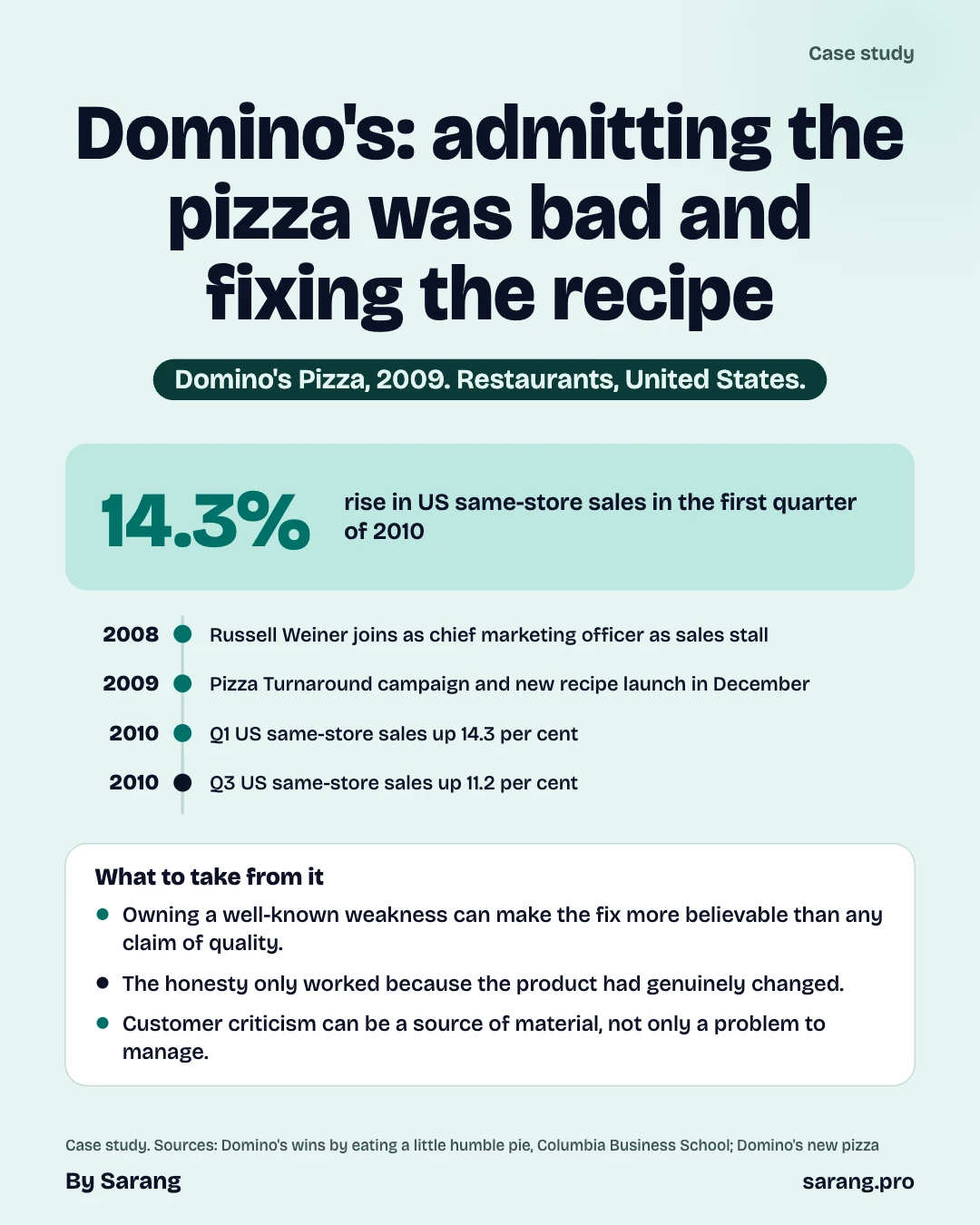
In December 2009 Domino's replaced a 49-year-old recipe and told customers why, and US same-store sales rose 14.3 per cent in the first quarter of 2010 while the delivery market fell.

- US same-store sales growth, first quarter 2010
- 14.3%
- Share price close in November 2008, against $13.90 at flotation in 2004
- $2.52
- Age of the recipe replaced in late 2009
- 49 years
- Franchisees who preferred the new pizza in a company taste test
- Over 90%
The situation
At the end of 2009, Domino’s Pizza did something that large food chains rarely do. It told the public that its pizza had not been good enough. In the last week of the year it replaced the recipe it had used for 49 years with a new crust, sauce and cheese blend, and it filmed customers calling the old product “cardboard” and the sauce “ketchup”. Executives appeared in the ads to say they had heard the complaints.
The company had reason to be worried. A 2009 Brand Keys survey placed it tied for last on taste among national chains, according to QSR magazine. The chain’s share price had closed at $2.52 in November 2008, against a flotation price of $13.90 in 2004, the Ann Arbor Observer reports. Its sales at stores open for at least a year had fallen for about two and a half years by the time its new marketing chief, Russell Weiner, joined in September 2008.
The result came quickly. Domino’s reported that same-store sales in the United States rose 14.3 per cent in the first quarter of 2010, a figure its chief executive J. Patrick Doyle called historic and one analyst described as a record for the company. This case looks at how a delivery business that had built its name on speed decided that its product was the problem, what it changed, how much of the later growth can be traced to that decision and where the evidence is thinner than the legend suggests.
| Measure | Figure | Source |
|---|---|---|
| Share price at flotation, 2004 | $13.90 | Ann Arbor Observer |
| Share price close, November 2008 | $2.52 | Ann Arbor Observer |
| US same-store sales, Q1 2010 | Up 14.3% | PMQ; Nation’s Restaurant News |
| Revenue, Q1 2010 | $381.1 million, up 18.4% | Nation’s Restaurant News |
| Restaurants worldwide, spring 2010 | 9,036 | Nation’s Restaurant News |
| Restaurants worldwide, end of 2024 | More than 21,300 | Domino’s Form 10-K for 2024 |
Background
From one store to a delivery giant
Domino’s opened its first store in Ypsilanti, Michigan, in 1960. The company’s own history page says it took the name Domino’s Pizza in 1965, and the 2024 annual report adds that it opened its first franchised store in 1967. It took its first store outside North America, in Queensland, Australia, in 1983 and in 1989 launched its first new product, the Handmade Pan Pizza. Founder Tom Monaghan built the business on fast home delivery, and the company’s spokesman Tim McIntyre said in 2010 that delivery convenience, not flavour, had been its core strength for 50 years.
In 1998 Monaghan retired and passed ownership to Bain Capital. Dave Brandon became chief executive in 1999, and the Ann Arbor Observer credits him with professionalising the organisation. Doyle, who had run Gerber’s baby-food business before joining in 1997 as senior vice president of marketing, rose to president of Domino’s USA. The company floated on the New York Stock Exchange in 2004 under the ticker DPZ, with sales of about $1.5 billion that year, according to the Motley Fool.
A growth story that stalled
The share price traded between $20 and $30 for several years and then dropped below the offering price in 2007, the Observer says. The recession deepened the fall. Jonathan Maze of Nation’s Restaurant News told the Observer that the 2008 low was an artificial valley caused by the Great Recession, but that the company was in terrible shape. QSR notes that Domino’s led its category in delivery but ranked tied for last in taste in 2009. Revenue fell to $1.4 billion in 2009, the Motley Fool reports, while QSR gives domestic sales of about $3.03 billion that year, slightly below $3.037 billion in 2008. The two figures measure different things, revenue for the company and system-wide sales for the US stores.
Menu launches and an early digital bet
Management tried to widen the menu before it changed the pizza. QSR lists Oven Baked Sandwiches in August 2008 at $4.99, American Legends specialty pizzas in January 2009 and Breadbowl Pastas in April 2009. The company had begun online and mobile ordering in 2007 and, in 2008, launched what its history page calls Domino’s Tracker, an industry first that let customers follow an order from placement to delivery. These digital habits would matter later, but the core product had not changed.
The industry
Pizza delivery in a recession
The US pizza delivery business was shrinking when Domino’s made its move. PMQ, citing the research firm Technomic, reports that the $22 billion pizza-delivery market fell 3 per cent in the period covered by the 2010 results. The article attributes the decline to the recession and to better frozen pizza. The firm that wanted to grow was therefore trying to take share, not ride a rising market.
Rivals and positioning
Time described Domino’s in January 2010 as the second-largest pizza seller in the world, behind Pizza Hut. The Ann Arbor Observer later put Domino’s share at 19 per cent of the US pizza market and about 8 per cent globally, still second to Pizza Hut. The Everything PR case study adds that Papa John’s was marketing better ingredients and independent pizzerias were gaining premium customers, which is consistent with the Brand Keys ranking but comes from a secondary source. Further down the market, Little Caesars grew sales more than 150 per cent between 2010 and 2015, according to the Observer, although Domino’s outsold it by more than two to one in 2015.
Franchising and the supply chain
Domino’s is mostly a franchisor. Its 2024 annual report shows 7,014 US stores of which 6,722 are franchised, and 14,352 international franchised stores. It also earns most of its revenue by supplying them: in 2024 the supply chain segment brought in $2.85 billion, or 60 per cent of consolidated revenue, against $1.54 billion from US stores. That structure explains why the 2009 decision needed franchisee agreement. QSR reports that Domino’s ran a side-by-side taste test with franchisees, and well over 90 per cent preferred the new pizza.
The decision
The question for management was why customers who valued Domino’s delivery were not rating its product. The sources do not give a list of options the board debated, so the alternatives below are the obvious ones, framed as such. What is known is that development of the new pizza took about two years, according to QSR, and that in 2008 Doyle and Brandon decided to reformulate, the Ann Arbor Observer says.
Option one: keep the product and sell the convenience
The company could have continued to build on delivery speed, the online tracker and new menu items such as sandwiches and pasta. This was the path it had been on through 2008 and 2009. Its weakness was a product that customers ranked last in taste, which put a ceiling on repeat orders once rivals matched on convenience.
Option two: improve the recipe quietly
A second route was to change the recipe and say little. Many food companies do this, and it avoids reminding people of past complaints. The cost is that customers who stopped ordering would not hear that anything had changed. Time quoted McIntyre explaining only that consumers’ tastes had changed and that competition had grown, and Time’s writer suspected that Domino’s wanted to get ahead of rivals competing for the title of worst dinner option.
Option three: change the recipe and say so loudly
The path Domino’s took was the third. The Ann Arbor Observer reports that Weiner proposed publicly admitting that the old recipe needed replacing. The Motley Fool says the approach was later called “Radical Authenticity” by Ad Age and that Brandon approved it. This choice carried risk: a company that confesses to a poor product gives critics a quotation to repeat. It also carried a benefit, because a plain admission gave lapsed customers a reason to try the pizza again.
What they did
2008 to 2009: rebuilding the pizza
The company reworked the crust, sauce and cheese. Nation’s Restaurant News describes a sturdier sauce, a new cheese blend and a crust with a stronger garlic flavour, and Time’s reviewer described a mix of several cheeses, a crust with garlic, salt and butter, and a pepper-spiked sauce. Franchisees tasted the new pizza next to the old one before launch, and QSR says well over 90 per cent preferred it.
December 2009: the new pizza
The new pizza launched in the last week of 2009. QSR calls it “New and Inspired” and the company’s history page, which says it replaced a 49-year-old recipe, uses the same name. The marketing used candid customer comments and a money-back guarantee, according to QSR.
January 2010: the confession
The advertising agency was Crispin Porter + Bogusky, the Motley Fool and Everything PR both say. On 29 January 2010 Time reported on a video in which executives responded to customer complaints such as “tastes like cardboard” and “the worst excuse for pizza I ever had”. Everything PR adds that the campaign ran on the Domino’s homepage and on a site called PizzaTurnaround.com, with a four-minute documentary and a feed of favourable and unfavourable tweets, and that television spots followed a week later. The same source says Domino’s chefs delivered the new pizza to critics at their doors.
January 2010: a change of chief executive
Doyle became chief executive in January 2010, succeeding Brandon, who left to become athletics director at the University of Michigan, QSR reports. Weiner had come to the company from PepsiCo. The Ann Arbor Observer says follow-up ads to promote the new recipe were planned but never aired, and that Doyle said sales rose by double digits in the first week of the campaign. That is Doyle’s own account, years later.
Beyond the recipe
The recipe was one part of a longer shift. The Motley Fool says online orders were 20 per cent of the total in 2009 and 65 per cent by 2018, and that Domino’s added ordering by app, social media and voice assistants. The company’s history page lists Pizza Profiles in 2013 and the AnyWare ordering suite in 2015, and a new logo and “pizza theater” store design in 2012.
What happened
First-quarter 2010
For the quarter ended 28 March 2010, Domino’s reported US same-store sales up 14.3 per cent. Nation’s Restaurant News says Doyle credited the new pizza, introduced the previous December, with all of the jump. Net income rose 3.2 per cent to $24.5 million from $23.8 million, and revenue was $381.1 million, up 18.4 per cent from the first quarter of 2009. Excluding one-off items, earnings per share were 35 cents, up from 20 cents. International same-store sales rose 4.2 per cent, the 65th consecutive quarter of growth for the international division, which had not had the new recipe. The company operated or franchised 9,036 restaurants worldwide.
The following years
The Ann Arbor Observer, writing in 2016, says US sales per store rose 37 per cent after the new pizza debuted and the company opened nearly 3,500 stores, more than 90 per cent of them outside the United States. Global sales in 2015 were $9.9 billion, up 60 per cent from 2010. The share price was about $136 in April 2016, and the Observer says $1,000 invested at the 2008 low would have grown to over $50,000. Quartz noted that the price was just under $9 in 2010 and above $160 when it wrote, and that Domino’s had over 50 per cent of its global orders arriving digitally.
By mid-2019 the store count had grown from just under 9,000 in 2009 to over 16,000, with about two-thirds outside the United States, according to the Motley Fool. Revenue grew from $1.4 billion to $3.5 billion and the shares rose more than 2,500 per cent over ten years. Doyle left as chief executive at the end of 2018 and Weiner became chief operating officer.
Marketing recognition
Everything PR reports, citing the agency’s Cannes Lions entry, that PizzaTurnaround.com drew over a million visits and the documentary 610,000 views, and that the campaign was shortlisted in the Titanium and Integrated category in 2010. The phrase “pulling a Domino’s” came to describe corporate candour, the same source says. These claims come from the agency and a secondary write-up, so they are weaker than the company’s filings.
Other views
Was it the pizza or the marketing?
Doyle credited the new pizza for the sales jump, and Nation’s Restaurant News reports it that way. The confession in the advertising was part of the same event, so it is hard to separate the two. The Ann Arbor Observer reports that the planned follow-up ads never ran, which suggests that the admission itself carried the effect. Domino’s launched the product and the explanation together, so the evidence cannot separate them.
Was the recipe really better?
Taste is subjective. Time’s reviewer found the reboot “slightly softer and greasier” than before and enjoyed it, and he suspected the company had not explained its reasons. The Brand Keys study that put Domino’s at the bottom in 2009 was a consumer survey of perception, and the sources do not show a repeat ranking after the change. The franchisee preference of over 90 per cent comes from a test run by the company.
Other forces at work
The first-quarter jump came in a quarter when the delivery category was falling, which makes the gain more striking, but a weak comparison base may have helped: sales had been falling for about two and a half years. The company also brought in a new chief executive and kept growing abroad independent of the recipe, since the international division had 65 straight quarters of growth. The Observer also describes a digital push and store expansion abroad, so later growth had several sources.
Limits of the evidence
Several figures differ by source. The Motley Fool gives 2009 revenue of $1.4 billion while QSR gives US system sales of $3.03 billion. The Fool says Brandon handed the chief executive role to Doyle after approving the idea, while QSR dates Doyle’s appointment to January 2010. The launch date is given as the last week of 2009 by QSR and as December 2009 by the Observer, which are consistent. Whether the 14.3 per cent was all due to the pizza cannot be settled from public documents.
Reading it through a framework
Value chain and the product
Porter’s value chain separates primary activities from support. Domino’s had invested heavily in logistics and technology, which were its strengths: delivery, ordering and the tracker. Operations at the store, where the pizza was made, relied on a recipe the market had ranked last. The turnaround improved one link, the product, so that the efficiency in the other links had something worth delivering. It also shows the limits of competing on one activity: Time’s quote from McIntyre that delivery convenience was the strength for 50 years describes a chain with one strong link.
Switching costs and repeat purchase
A second lens is switching costs. In pizza delivery they are very low, since a customer can change brand with one phone call or tap. Domino’s therefore could not rely on lock-in, and the only defence was a better reason to choose it each time. Digital ordering added a mild form of lock-in through saved profiles and loyalty features, the Motley Fool notes, which is part of why the later growth lasted. The recipe change reduced the reason to leave, and the digital tools raised the effort of leaving.
Since then
By the end of 2024 Domino’s operated in more than 90 markets with more than 21,300 stores, according to its annual report, 7,014 of them in the United States. Revenue by segment that year was $1.54 billion from US stores, $318.7 million from international franchising and $2.85 billion from supply chain. Its history page records a Parmesan Stuffed Crust launch in 2025. The company also introduced a Carside Delivery option in 2020, according to the history page.
What to take from it
- A company can regain attention by naming its own weakness, but only if it fixes the weakness at the same time.
- Strength in one part of the business, such as delivery, does not offset a product that customers rate last.
- Getting franchisees to taste the new product first made the change a shared decision, not an order from head office.
- Low switching costs mean that a better product and an easier way to order must work together.
- Results that look like a single cause usually have several, so managers should be cautious about giving one change all of the credit.
Questions to think about
- What would Domino’s have gained and lost if it had changed the recipe without telling anyone?
- Which kinds of company could not safely admit that their product was poor, and why?
- How would you separate the effect of the recipe from the effect of the advertising, given the data in the sources?
- Was the 14.3 per cent rise a one-off, and what evidence in the case would help you decide?
Concepts at work
Three ideas run through this case: radical transparency, the value chain and switching costs. Explore them in Insights.
Written from the public sources listed below. Figures are as those sources report them.
Framework
Timeline
- 1960First Domino's store opens in Ypsilanti, Michigan
- 1998Tom Monaghan retires and Bain Capital takes ownership
- 1999Dave Brandon becomes chief executive
- 2004Domino's floats on the NYSE
- 2007Online and mobile ordering launched
- 2008Domino's Tracker launched; shares close at $2.52 in November
- Sep 2008Russell Weiner joins as chief marketing officer
- 2009Brand Keys survey ranks Domino's tied for last on taste
- Dec 2009New and Inspired pizza launches
- Jan 2010Patrick Doyle becomes chief executive; mea culpa video
- Q1 2010US same-store sales rise 14.3%
- 2018Doyle leaves as chief executive
- 2024More than 21,300 stores worldwide
Recap cards
Tap a card to check yourself.
Sources and credits
- QSR magazine: The many acts of Domino's Pizza
- PMQ Pizza Magazine: New pizza recipe did wonders for Domino's sales
- Nation's Restaurant News: Domino's new pizza delivers sales surge
- Time: Domino's mea culpa and America's pizza passions
- Ann Arbor Observer: New and Inspired
- Motley Fool: The secret behind Domino's epic turnaround
- Quartz: In 2010 Domino's admitted it made terrible pizza
- Domino's: History
- Domino's Pizza: Form 10-K for 2024
- Everything PR: How Domino's Pizza turnaround became a masterclass in food PR