Old Spice: a tired deodorant brand speaks to women and sales jump
In February 2010 Old Spice aimed a 33-second body wash film at women, and sources report body wash sales up from 60 to 125 per cent, though the figures conflict.

- Length of the original film, shot in one take
- 33 seconds
- Internal sales target for the body wash
- 15%
- Rise in Red Zone body wash sales by May 2010
- 60%
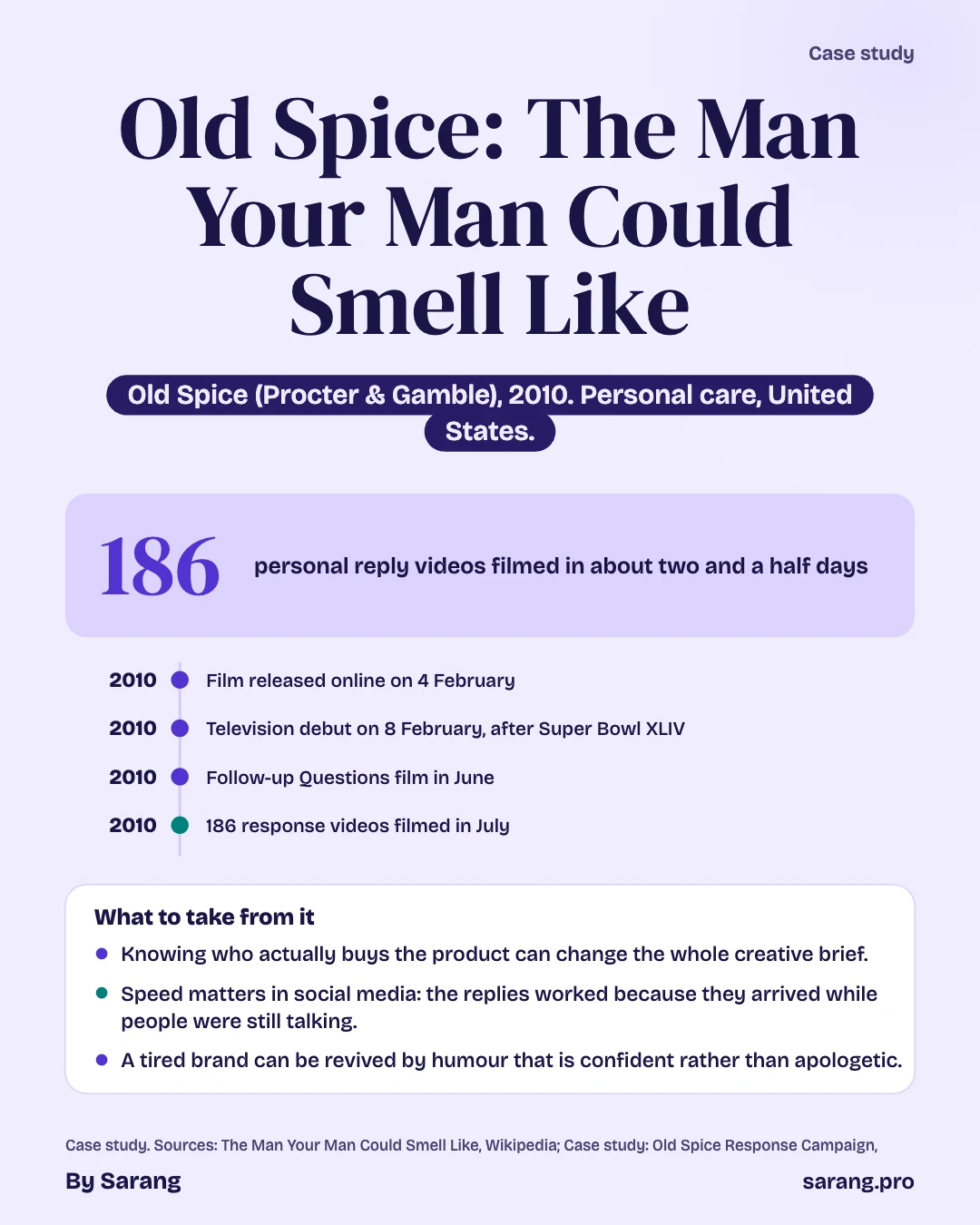
- Personal response videos in about two and a half days, per D&AD
- 186
The situation
In early February 2010, a 33-second film appeared online. A tall, shirtless man stood in a bathroom and spoke straight to the camera, addressing women and telling them that their man could smell like him. In one continuous shot he moved from the bathroom to a boat to the back of a horse. The film was an advertisement for Old Spice body wash, made by the agency Wieden+Kennedy for Procter & Gamble. It went online on 4 February and on American television on 8 February, around the Super Bowl, according to the agency account summarised by Everything PR.
The brand was not in a strong position. The agency’s own awards entry called it “tired”, Everything PR reports, and the D&AD case study says Old Spice had been losing ground when Wieden+Kennedy was appointed in 2006. The internal target for the body wash was a 15 per cent lift in sales, according to Muse by Clios’s oral history of the campaign. Instead, Muse reports, sales of Old Spice Red Zone After Hours body wash were up 60 per cent by May and had doubled by July.
In July the agency followed with a stunt that became as famous as the film. Over about two and a half days it made hundreds of short personal video replies to people online, with the same actor, Isaiah Mustafa, speaking to questions from fans and celebrities. This case looks at why a deodorant brand aimed a body-wash advert at women, what the numbers really show, and why the sources disagree about how much the campaign was worth.
| Measure | Figure | Source |
|---|---|---|
| Original film online / on TV | 4 February / 8 February 2010 | Everything PR |
| Internal sales target for body wash | 15% lift | Muse by Clios |
| Red Zone body wash unit sales, April 2010 | Up 60% on a year earlier (Nielsen, via the Effie entry) | Everything PR |
| Response videos | 186 (D&AD, Effie) or 162 (Muse) | Sources differ |
| Response campaign views | More than 65 million | D&AD |
| Sales growth claimed | 107% (press), 125% (D&AD, by end July) | Sources differ |
Background
A brand with a long history
Old Spice belonged to the Shulton group of American Cyanamid before Procter & Gamble bought the Old Spice business and the Sante Fe lines for $300 million, according to a UPI report dated 13 June 1990. The company’s chairman and chief executive, Edwin Artzt, said the deal “gives us a strong foothold in the male toiletries business worldwide”. The deal included a plant in Memphis, Tennessee, and three facilities abroad, and left out the Pierre Cardin fragrance line.
An ageing image
By the 2000s the name was associated with an older generation. The Time update on the campaign makes the point that Old Spice had long been linked to older men, and that a funny shirtless spokesman alone might not change that image. Wieden+Kennedy was appointed in 2006, and the D&AD summary says the brand was losing ground at the time. The agency’s One Show entry described the brand as tired, per Everything PR.
Body wash comes in
Old Spice introduced body wash for men in 2003, Everything PR says, citing the 2011 Effie entry. By 2010, total body wash sales had passed bar soap, which brought in Dial, Irish Spring and Nivea. This was a growth category in which the old brand had to win new customers, not defend loyal ones.
The industry
Men’s grooming and who buys it
Men’s body wash was a product that men used but that, according to the agency’s research, women often bought. The sources give slightly different figures for the share. D&AD says women made more than 50 per cent of body-wash purchases, while Muse and Everything PR say roughly 60 per cent. Both versions led to the same conclusion: an advert addressed only to men would miss the person standing in the shop aisle. Everything PR adds that agency accounts say the media buy favoured settings in which couples watch television together.
Competition
The rivals named in the sources are other grooming and soap brands: Dial, Irish Spring and Nivea. They entered a category that Old Spice itself had opened for men in 2003. The sources do not give market shares for 2009, so the starting position can only be described qualitatively, as a brand that D&AD says was losing ground.
Media habits in 2010
The media plan combined television with online video. P&G had bought Super Bowl airtime at the last minute, Muse says, and the film went online first. D&AD says the first film helped the brand capture 75 per cent of conversation in the category.
The decision
The brief came from P&G. According to Muse, it wanted a Super Bowl spot to sell Old Spice Red Zone After Hours body wash and asked Wieden+Kennedy’s Portland office for a fun spot aimed at women. The sources do not list the options the team debated, so the alternatives below are the obvious ones, framed as such.
Option one: speak to men, as before
Earlier Old Spice adverts were deodorant spots in which a male spokesman talked to men, Muse reports. The simplest decision would have been to repeat that model with body wash. The agency’s research on who buys body wash made this less attractive, and the brand needed to change its image, not repeat it.
Option two: speak to women
The team chose to address women, using a man to show what men wanted to be. Everything PR describes this as having the ads speak to women while the man in them modelled what men wanted to be. The script was written in about two days, because the airtime had been bought late, and the creatives Craig Allen and Eric Kallman wrote it almost like radio dialogue, Muse says. The idea was to show, in the visuals, what the spokesman described.
Option three: a different script
Muse reports that P&G first picked a different script, featuring a bear in a hot tub firing a rocket launcher. Wieden+Kennedy went back to the client, which then switched to “The Man Your Man Could Smell Like”. The agency also had to push to air the 30-second film at all, because P&G initially wanted to scrap it, Muse says. The film was pulled from the Super Bowl itself but ran shortly after.
What they did
Casting and shooting
Isaiah Mustafa, a former football wide receiver, was found during callbacks. Muse says he won the role by shifting to a deeper, superhero-like voice. The director Tom Kuntz shot the film as one continuous take on a Malibu beach with minimal computer effects. The shoot ran long: two days gave no usable take, the client paid for an extra day, and the successful take came in the final 30 minutes, Muse reports. The same account describes a winch failure that dropped bathroom walls on the set, landing about an inch from Mustafa.
The film itself
Muse describes how the script took shape. It began in a bathroom, moved to a boat and ended on a horse, and the horse ending came from a script rejected earlier for the same assignment. Two W+K colleagues, Jason Bagley and Eric Baldwin, suggested that the pictures could simply show whatever the spokesman described. TheGrio adds that the film was one take with little computer work, so Mustafa moved from the boat to the horse without a cut. A 15-second version showed him riding backwards on the horse, and Muse says the client liked a moment in that take that was not planned.
February 2010: online first
The film was posted online over Super Bowl weekend and aired on television on Monday 8 February, Muse and Everything PR say. A TWiT interview with the two writers helped build momentum, Muse reports. The Search Engine Watch post of 28 July counted 11,740,466 views for the main film at the time of writing, and said it was the most-viewed video on YouTube in the previous month.
June and July 2010: the response campaign
The follow-up came in two parts. A set of fan-response videos began in June, Muse says, and the main burst followed in July. D&AD describes 186 personal videos made over two and a half days, many in 10 to 15 minutes, with four writers working on the scripts, three at a time, and one directing. Muse puts the number at 162. Everything PR says the team started with commenters who already had audiences, including Perez Hilton and Ellen DeGeneres, and then pulled live questions from Twitter, Facebook, Reddit, Digg and 4chan.
How the replies were made
Everything PR, citing the Effie entry, says a proprietary media-monitoring system supported the effort. D&AD says many videos were made in 10 to 15 minutes. Muse quotes a team member who credits the response work with the largest effect of the whole campaign, and says the second day produced eight of the 11 most-watched videos online. The speed is the unusual part: an advert normally takes weeks to make, and here a reply could be written, filmed and posted within a quarter of an hour.
What the team measured
D&AD gives day-by-day figures: 5.9 million YouTube views on day one, eight of the 11 most popular videos online on day two, and more than 20 million views on day three, doubling within a week. The videos drew more than 65 million views in total. Twitter followers rose by 2,700 per cent, Facebook fans went from 500,000 to 800,000 and YouTube subscribers from 65,000 to 150,000, D&AD reports.
What happened
Sales
The sales numbers vary by source, and the table shows how. Muse says Red Zone body wash sales rose 60 per cent by May against a 15 per cent goal and had doubled by July. Everything PR cites Nielsen data in the Effie entry showing a 60 per cent rise in April 2010, and an 80 per cent rise in premium body wash sales after the response videos, a figure from the agency’s One Show entry. D&AD says sales were up 125 per cent year on year by the end of July, and that by the end of 2010 Old Spice was the top-selling men’s body wash in the United States. Adweek’s Social Pro Daily reported in August 2010 that the campaign moved Old Spice to number one in men’s body wash.
The figure that circulated most widely was 107 per cent. Search Engine Watch said several outlets had reported that brand sales rose 107 per cent, and theGrio repeated it in 2011. The Time update on the story, however, said the earlier statistics were too specific, that PRWeek had found body wash sales overall up 107 per cent, and that WARC had reported a 7 per cent fall in Red Zone After Hours sales despite the ads. CNBC, looking back in 2020, cited Nielsen data reported by Adweek showing Old Spice body wash sales up 11 per cent over the previous 12 months. These numbers cannot all be right for the same product and period.
Attention and reputation
The campaign drew widespread attention. Muse says it brought interest from Oprah, Ellen and Jay Leno and many spoofs. theGrio says the videos had drawn more than 140 million YouTube views by early 2011. D&AD says it generated more than one billion unpaid impressions, and P&G said the campaign brought a 300 per cent increase in website traffic, according to CNBC.
Awards
The first film won the Film Grand Prix at Cannes Lions in 2010, according to CNBC and theGrio. The response work won a Yellow Pencil from D&AD in 2011, and Everything PR lists a Gold Effie for media innovation and a Gold Pencil at the One Show in 2011. The sources differ on the Emmy: CNBC mentions a nomination and theGrio says he won an Emmy in 2010.
The actor
Mustafa became a public figure. TheGrio reports a talent deal with NBC in the summer of 2010 and film roles including Horrible Bosses. Time reported the NBC deal as well.
Other views
Did the response videos cause the sales?
Everything PR makes the key caveat. The 60 per cent gain was already in place by April 2010, three months before the July videos, so the data do not show that the response campaign caused it. The 80 per cent figure was reported by the agency and the public record has no independent audit. The article concludes that the evidence supports the view that the original spot moved sales and the response amplified attention, but does not prove that real-time video drives sales.
Mixed messages
Time’s update quoted Jezebel as saying the brand sent mixed messages. The tagline “Smell Like a Man, Man” clashed with Mustafa’s opening “Hello, ladies”, which left it unclear who should buy the product. The same update reported WARC’s finding that Red Zone After Hours sales fell 7 per cent despite the ads.
Ending the campaign
BNET argued, as Time reports, that Mustafa’s popularity made ending the campaign a public relations disaster.
Counting views
Everything PR also warns that view counts measure plays and not unique people, and that the claim of eight of the top 11 videos describes one moment in July 2010. Agency numbers are written to win awards, which gives them a reason to be generous.
A television idea or an internet idea?
The sources describe two different ideas. The February film was a television advert that happened to spread online, and Muse says it later aired on television after going online first. The July replies were native to the internet. Muse credits the second for much of the effect, while Everything PR argues that the evidence points to the first as the one that moved sales. A manager reading the case should decide which to copy, since they need different skills: a film needs a script and a shoot, while the replies need speed and a team able to write on the spot.
Limits of the evidence
The sources disagree on the number of response videos, the sales growth and the Emmy. Most figures come from the agency and the awards entries, or from articles that quote them. The independent data, Nielsen’s 11 per cent over 12 months, are less dramatic than the claims.
Reading it through a framework
Positioning
Positioning asks who a brand is for and what it stands for. Old Spice was linked to older men, and the campaign repositioned it by talking to the person who bought the product. Everything PR notes that the man in the advert modelled what men wanted to be, so the ads spoke to women while giving men an ideal. The D&AD summary says the aim was to speak to men and women at once. CNBC adds that the creators later told Ad Age they wanted to appeal to women without alienating men and longtime users, the tension that Jezebel’s criticism points at.
AIDA and the funnel
The AIDA model moves from attention to interest, desire and action. The film’s single take, strange logic and direct address won attention, and the response campaign turned a one-way advert into a conversation, which added interest. The sales figures concern action, and here the chain is weaker. A 300 per cent rise in website traffic and more than a billion unpaid impressions show attention, but the sources do not show how many viewers bought. That is why the caveat about April sales matters: the funnel’s top was clearly filled, while the bottom is measured by data of mixed quality.
Since then
In January 2020, ten years after the original, Old Spice launched a new campaign. CNBC reports that Wieden+Kennedy Portland created it for new Ultra Smooth products, with Mustafa returning and Keith Powers playing his son, and with appearances planned around the Super Bowl. Muse describes three anniversary spots. The sources opened for this case do not cover the brand’s results after 2020.
What to take from it
- Find out who actually buys the product: research that women bought a large share of men’s body wash changed who the advert spoke to.
- A single idea carried out in one take can win attention more than a long list of features.
- Responding to individuals in public can extend a campaign, but it needs a team that can write and film in minutes.
- Sales claims should be traced to their source, since 60, 80, 107 and 125 per cent all appear for the same campaign.
- Timing matters when judging cause: a sales rise that came before the second stage cannot be credited to it.
Questions to think about
- Why might an advert addressed to women help sell a product used by men, and what could go wrong?
- Which of the sales figures would you trust most, and what would you want to see before you relied on it?
- How should a brand keep a campaign going once its main character becomes more famous than the product?
- Is a campaign a success if it wins awards and attention but the sales evidence is disputed?
Concepts at work
Three ideas appear here: brand positioning, the AIDA funnel and the gap between attention and sales. Explore them in Insights.
Written from the public sources listed below. Figures are as those sources report them.
Framework
Timeline
- 1990P&G buys Old Spice from American Cyanamid's Shulton group for about $300 million
- 2003Old Spice introduces body wash for men
- 2006Wieden+Kennedy appointed
- 4 Feb 2010The Man Your Man Could Smell Like goes online
- 8 Feb 2010Film airs on US television
- Apr 2010Red Zone body wash sales up 60 per cent on a year earlier
- Jun 2010Fan-reply videos begin
- Jul 2010Response campaign, about two and a half days of videos
- End 2010Old Spice top-selling men's body wash brand in the US, per D&AD
- 2010Film Grand Prix at Cannes Lions
- 2011Gold Effie and D&AD Yellow Pencil
- Jan 2020Ten-year anniversary campaign with Mustafa
Recap cards
Tap a card to check yourself.
Sources and credits
- Muse by Clios: Behind the Towel, an oral history of the legendary Old Spice ad
- D&AD: Old Spice case study insights
- Everything PR: Old Spice campaign case study
- CNBC: Old Spice Guy returns for reboot of Smell Like a Man, Man ad
- UPI: P&G buys Old Spice, Santa Fe lines for $300 million
- Search Engine Watch: Old Spice commercial increases sales 107 percent
- Time NewsFeed: Old Spice's viral ads got attention, not sales
- theGrio: Isaiah Mustafa, Old Spice pitchman makes splash with new media
- Adweek Social Pro Daily: Old Spice response campaign was more popular than Obama