Dove: how a campaign for real beauty lifted sales by 20% in 2005
Dove put ordinary women in its ads after a survey found only 2% called themselves beautiful, and reported US sales up 20% in 2005 on a $13 million media budget.
- of 3,200 women surveyed called themselves beautiful
- 2%
- US media budget in 2005
- $13 million
- reported US Dove sales growth in 2005
- +20%
- reported US Dove sales growth in 2006
- +7.3%
The situation
By the end of 2004, Dove had a problem that its own sales figures hid. The brand had started in the United States in 1957 as a bar of soap, and it had since added body wash, hair care, facial cleansing and moisturisers. Soap now made up less than half of its sales. Yet shoppers still thought of Dove as a soap bar, and the brand’s gentle, submissive idea of femininity looked dated next to its rivals.
Unilever, which owns Dove, wanted the brand to move into hand and body lotions with a new product, Dove Firming Lotion. The category was crowded. The research firm Mintel counted 1,760 new facial skincare products launched in 2004 alone, and most would not last. Unilever also had little money to spend. The 2005 US media budget for the work was $13 million, which the agency case study describes as roughly one-fifth of what a typical personal care launch would cost.
The answer was a campaign built on a survey finding. In a study of 3,200 women in ten countries, only 2% chose the word “beautiful” to describe themselves. Dove decided to put ordinary women, not models, in its advertising and to start an argument about what beauty means. The figures reported for the United States were large for the money spent: Dove sales up 20% in 2005 and a further 7.3% in 2006, and more than 650 million free media impressions.
This case follows how the campaign came about, what Dove did, what the evidence shows, and why the campaign has drawn criticism as well as awards.
Background
A soap brand with wider ambitions
Dove’s US launch in 1957 was as a soap bar. According to the 2007 case study that Ogilvy entered for an industry research award, the brand then grew by moving into other countries and into other personal care products: body wash, hair care, facial cleansing and moisturising. By 2004 soap was less than half of Dove’s sales.
That growth left a gap between what Dove sold and what people thought it was. The case study says consumers still saw Dove as a soap bar, and that the brand lacked energy. Its portrayal of women as soft and submissive looked old-fashioned.
The agency and the parent company
Fox Business reported in 2017 that Ogilvy had handled much of Dove’s advertising, and the 2007 case study used here was entered by Ogilvy. The brand sits inside Unilever, a group that also owns Axe and Slim-Fast, brands whose advertising critics later set against Dove’s message. Unilever reported in 2024 that Dove generated about 6 billion euros of turnover in 2023, so the brand is now one of the group’s largest.
What the brand needed in 2004
Two objectives are stated in the case study: raise sales across the Dove range, and raise the brand’s salience and cultural relevance. The first was commercial. The second recognised that a brand people thought of as a soap bar would struggle to sell lotions at a premium.
The industry
A crowded, image-led category
Beauty and personal care is a business of frequent launches and heavy promotion. The Mintel count of 1,760 facial skincare launches in 2004 shows how many products competed for the same shelf space. Few of these could hope for a large advertising budget, so brands competed on a promise, usually an improvement to appearance.
The standard advertising formula
The agency case study says competitors in beauty advertising showed a narrow ideal: a young, slim, blonde, flawless woman. Many women, the research suggested, found that ideal either out of reach or depressing. That observation gave Dove an opening. If every rival showed the same type of woman, an advertiser that showed women of different ages, shapes and sizes would stand out.
Parent company and portfolio
Unilever’s range includes brands with very different messages. Axe, a male grooming brand, and Slim-Fast, a weight-loss product, have both been pointed to by critics as at odds with a brand that tells women to feel good about their bodies. The sources used here do not describe the regulation of beauty advertising in any detail, so this case does not cover it.
The decision
The research that framed the choice
Dove commissioned a global study, “The Real Truth About Beauty: A Global Report”, written by Nancy Etcoff of Harvard, Susie Orbach of the London School of Economics and two researchers from StrategyOne. It was a telephone survey of 3,200 women aged 18 to 64 in the United States, Canada, Great Britain, Italy, France, Portugal, the Netherlands, Brazil, Argentina and Japan, carried out between 27 February and 26 March 2004. The report itself is dated September 2004; the case study gives May 2004 as the publication date, so the sources differ on when it first appeared.
Its main findings shaped the campaign. Only 2% of women described themselves as beautiful. Most chose “natural” (31%) or “average” (29%). Some 68% said the media and advertising set an unrealistic standard of beauty, and 57% said the attributes of beauty had become very narrowly defined. Three-quarters wanted more diversity in age, shape and size in media portrayals, and 76% wanted beauty shown as more than physical attractiveness. A caveat applies: Dove paid for the study, and the authors’ conclusions are their reading of the data.
Option one: keep selling products on product claims
The obvious alternative was to launch the firming lotion in the usual way, with a claim about skin and a typical beauty model. This was the approach rivals took, and it needed a large media budget to be noticed. With one-fifth of a normal launch budget, Dove would have been outspent.
Option two: a brand message first, product second
The case study shows Dove chose a different order. It used a message about beauty as the entry point, then attached the firming lotion to it. The idea was a “referendum” on beauty, designed to provoke debate and get people talking, not necessarily agreeing. The stated creative idea was that real beauty comes in all shapes, sizes and ages.
Option three: a cause with no product attached
A third route would have been to run the beauty message as a pure cause, with no product link. Dove did not choose it, and the case study states that sales were an objective. The two-tier structure kept a brand message and a product launch side by side, so the debate could draw attention and the lotion could collect it.
The risks
The decision carried risk. Showing curvy women in underwear in a mass-market ad could draw complaints. A message about accepting yourself could also sit uneasily with a product called a firming lotion, since firming implies something needs fixing. The case study does not discuss internal debate on this point, and critics later returned to it.
What they did
A two-tier campaign
The campaign had two layers. The brand tier began in October or November 2004 with what the case study calls “tickbox” work. It showed a range of beauty stereotypes and was meant to start a national debate. The product tier followed in January or February 2005 with Dove Firming Lotion, then the Cool Moisture line and Nourishing hand and body lotion. The target audience was women aged 27 to 67.
Ordinary women instead of models
The ads used women who were not professional models, including curvy women in underwear. Viewers were sent to a website, campaignforrealbeauty.com, where the debate could continue.
Small media spend, large public relations effort
The media plan followed one principle: use a small amount of mass media to generate a lot of public relations coverage. A modest amount of television followed the brand tier. Most of the money went to print and outdoor advertising in the ten largest US cities, with extra weight in New York City, including Times Square and the sides of buses.
Research used as campaign content
Dove published the survey as a report, so the findings worked as material for the press and not only as a briefing for the agency. The detail in the report gave journalists numbers to quote. Among them were that 89% of women strongly agreed a woman can be beautiful at any age, that 85% believed every woman has something beautiful about her, and that being loved (91%) and doing something one loves (86%) were the top reasons women gave for feeling beautiful.
Differences between countries
The survey sample was 500 women in the United States and 300 in each of the other nine countries, with a margin of error of 1.7 points for the total. The results were not uniform. Japanese women reported markedly lower satisfaction with their beauty, and were the only group that did not see society as demanding beauty. Brazil had the highest rate of cosmetic surgery, with 7% of women saying they had had it. The case study describes a US campaign, so these differences matter mostly as a warning that one message does not carry unchanged to every market.
The sources used here do not give a full dated list of the films and events that Dove added after the first phase, so this case does not trace them in detail.
What happened
Awareness and brand perception
The tracking study cited in the case study was run by Synovate in August 2005 and covered outdoor advertising for the firming lotion. Total ad awareness rose by 22% between the before and after waves. Linkage of the ad to Dove rose 14%, and linkage to Dove Firming rose 27%. Among people who saw the ad, 76% agreed the women in it were beautiful, 72% said the brand was really different from others, 68% said it made them think differently about the brand, 81% liked the ad, and 71% said they would consider buying.
Sales
| Year | Change in US Dove sales |
|---|---|
| 2005 | Up 20% |
| 2006 | Up 7.3% |
These figures come from Unilever sales data as reported in the case study. They cover the whole Dove brand in the United States, not only the lotion, and the lines that grew included personal wash, hair, deodorant and hand and body lotion. The case study does not give dollar sales, market share or website traffic, so the size of the gain in absolute terms is not available from this source.
Public relations value
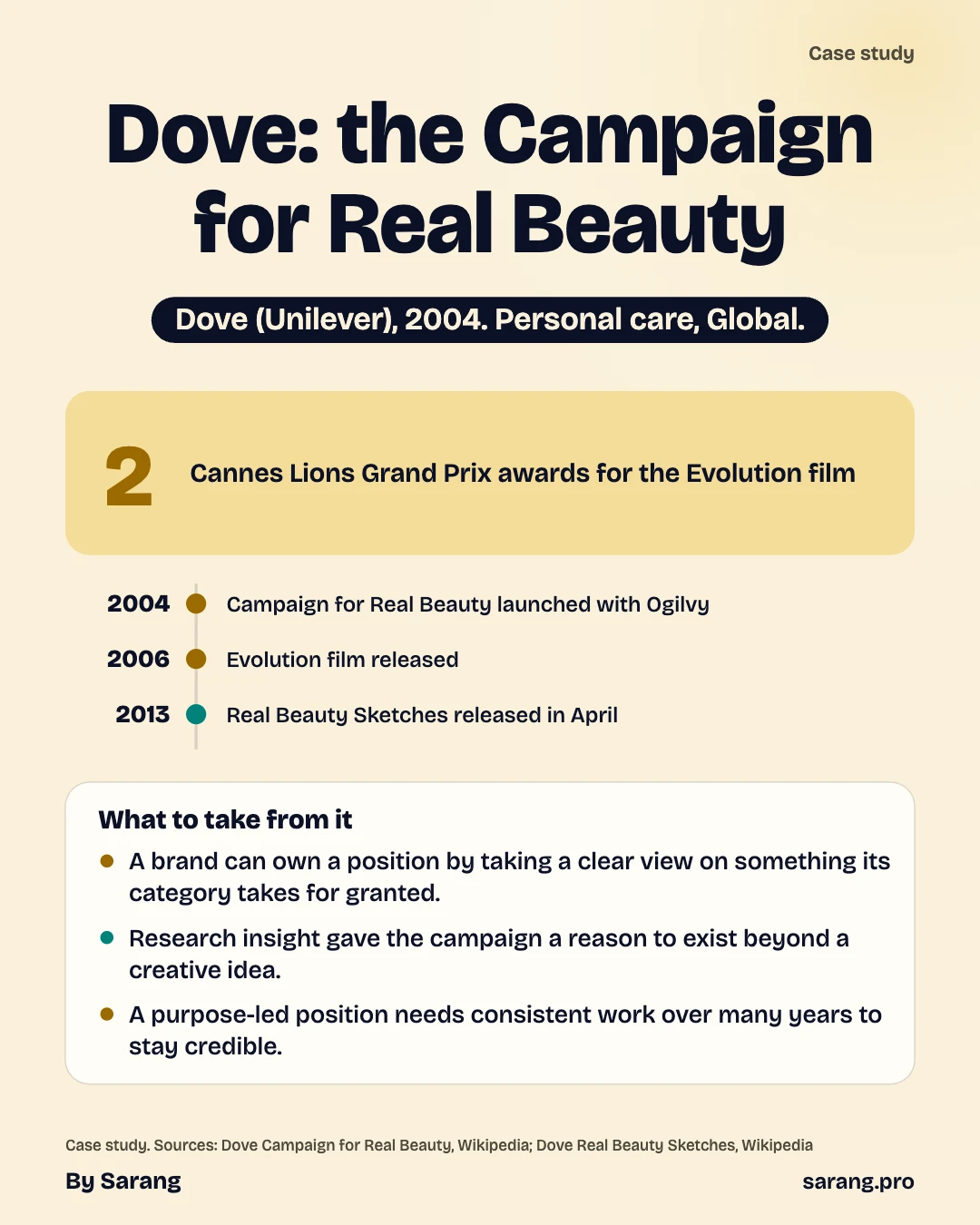
More than 650 million free US media impressions were recorded. Mindshare valued them at $21.4 million, over 150% of the $13 million media budget. Coverage included a New York Times editorial, People, Allure and the Chicago Sun-Times in print, and Today, Ellen, Dr. Phil, Access Hollywood and CNN on television. The Oprah Winfrey Show gave the campaign a six-minute segment. The campaign won four Clio Awards for print and a Cannes Lions award for outdoor work.
Industry recognition
The case study reports that Advertising Age, the New York Times “Consumed” column and the Wall Street Journal praised the campaign, with the Journal calling it groundbreaking. These are comments gathered by the entrant, so they show reputation more than sales effect.
What the numbers can and cannot show
The sales figures belong to a case study entered for an industry award, so the source has an interest in showing success. Sales also rise for reasons other than advertising, including new products and distribution. The case study does not separate the effect of the campaign from the effect of the lotion launches.
Other views
It is still an advertisement
Erin Keane, writing in Salon in April 2013 about Dove’s later “Real Beauty Sketches” film, argued that the campaign was not feminist. In her view Dove sells soap and deodorant by repackaging familiar beauty standards as empowerment, and the film’s message still told women to care whether others find them beautiful. She also objected to the film being treated as a documentary when it is a commercial for Unilever’s products.
The list of five objections
Will Burns, defending the same film in Forbes in April 2013, summarised five objections from an advertising blog: too many conventionally attractive white women, a definition of beauty as thin and young, beauty treated as the yardstick for women, women shown as their own enemies rather than victims of a sexist society, and hypocrisy because Unilever also makes Axe and Slim-Fast. Burns answered each one. He noted that two Black women and one Asian woman appeared in the film, called the Unilever point irrelevant, and argued that Dove is a business, not a moral authority.
The research was paid for by the brand
The 2004 survey was commissioned by Dove, and its authors say so. That does not make the numbers wrong, but a reader should know the sponsor also benefited from the conclusion. A statistic such as “2% call themselves beautiful” depends on the wording of the question and the choice of answers offered.
Later missteps
In October 2017 Unilever apologised after a Dove video on its US Facebook page showed a Black woman removing a T-shirt and turning into a white woman, who then turned into an Asian woman. The company said it meant to show that Dove body wash suits every woman, but admitted “we got it wrong”. Fox Business reported that this was the second Dove controversy in a few months, after bottles shaped like different bodies drew mockery in May 2017, and that a 2011 before-and-after ad had drawn criticism too. It also reported that Unilever had been moving more of Dove’s advertising work in-house as a cost-cutting step.
Reading it through a framework
Positioning
Positioning asks what a brand stands for in the customer’s mind compared with rivals. Dove started as the soap that was gentle, a position that was true but narrow and tied to one product. The campaign gave it a position about attitude: beauty is not limited to one type. Rivals’ ads showed the same narrow ideal, so the space Dove took was empty. The 72% of viewers who said the brand was really different from others suggests the position registered.
The weakness of any attitude-based position is that the brand’s behaviour must match it. Dove’s 2017 video and the Axe comparison show how quickly critics test that match.
Jobs to be done
This framework asks what job a customer hires a product to do. A firming lotion hired on a product claim does the job of changing the body, and rivals offered the same. Dove’s campaign suggested a second job: helping a woman feel she belongs in advertising’s idea of beautiful. The 2004 findings, that 48% of women felt worse about themselves in general when they felt less beautiful, show why such a job might matter to buyers. The tension is that a lotion’s functional job and the emotional job point in different directions, which is the contradiction critics identified.
Since then
Dove has kept the Real Beauty idea going for more than two decades. In 2021 it ran the “Selfie Talk” and “#NoDigitalDistortion” campaigns. In April 2023 the Dove Self-Esteem Project launched a Campaign for Kids Online Safety with Lizzo, Common Sense Media and ParentsTogether Action. It pushed for the Kids Online Safety Act, and a short film, “Cost of Beauty”, told the story of a young woman who developed an eating disorder after exposure to harmful beauty content on social media. Marketing Dive described this as moving from encouraging consumers to pursuing legislation.
In April 2024, to mark 20 years, Dove pledged never to use AI-generated content to represent real women in its advertising, and offered a free “Real Beauty Prompt Playbook” for people who make images with generative AI tools. Its “Real State of Beauty” research reported that 40% of women would give up a year of their life for an ideal look or body, and that almost nine in ten women and girls had seen harmful beauty content online. Unilever said Dove produced 6 billion euros of turnover in 2023 with its highest underlying sales growth in more than a decade, and that the Self-Esteem Project had reached more than 100 million young people.
What to take from it
- A small budget can work if the idea is strong enough to be reported on. Dove’s $13 million media plan produced coverage that Mindshare valued at $21.4 million.
- Research can supply a strategic insight, not only a test of ads. The finding that only 2% of women called themselves beautiful gave Dove its starting point.
- A brand message needs to survive scrutiny. Critics tested Dove against Unilever’s other brands and against its own later advertising, and each lapse drew coverage.
- Results from an award entry should be read with care. The sales gains of 20% and 7.3% are reported by the entrant and do not separate advertising from new products.
- A campaign can be renewed by tying it to new issues. Dove moved from images to social media, legislation and AI as the questions around beauty changed.
Questions to think about
- Can a company that sells beauty products sincerely tell customers they are already beautiful, or does the sales motive always weaken the message?
- Which evidence in this case would you trust most, and which would you want to check independently before using it in a business plan?
- If Unilever’s other brands send different messages about bodies, should each brand be judged on its own, or should the parent company be held to one standard?
- How would you measure whether the campaign changed attitudes among women, as opposed to changing purchases?
Concepts at work
Positioning, jobs to be done and earned media are the three ideas this case illustrates most clearly. Explore them in Insights.
Written from the public sources listed below. Figures are as those sources report them.
Framework
Timeline
- 1957Dove launches in the United States as a soap bar
- 27 Feb to 26 Mar 2004Telephone survey of 3,200 women in ten countries
- Oct 2004Brand tier of the Campaign for Real Beauty begins (case study says October or November)
- Jan 2005Dove Firming Lotion launches (case study says January or February)
- Aug 2005Synovate tracking study of outdoor advertising
- Apr 2013Salon and Forbes argue over the Real Beauty Sketches film
- Oct 2017Unilever apologises for a Dove Facebook video
- Apr 2023Dove Campaign for Kids Online Safety launches
- Apr 2024Dove marks 20 years and pledges not to use AI to represent real women
Recap cards
Tap a card to check yourself.
Sources and credits
- Ogilvy (ARF David Ogilvy Awards): Dove 2007 case study
- Etcoff, Orbach, Scott and D'Agostino for Dove: The Real Truth About Beauty, A Global Report (2004)
- Forbes (Will Burns, 2013): Dove, your sketches idea is more beautiful than your critics think
- Salon (Erin Keane, 2013): Stop posting that Dove ad
- Fox Business (2017): Unilever apologizes for Dove ad
- Marketing Dive (2023): Dove Self-Esteem Project campaign for kids online safety
- Unilever (2024): 20 years on, Dove and the future of Real Beauty
- WFA (2024): Case study, Dove (Unilever) 20 years on