Volkswagen: Think Small and the honest car advert
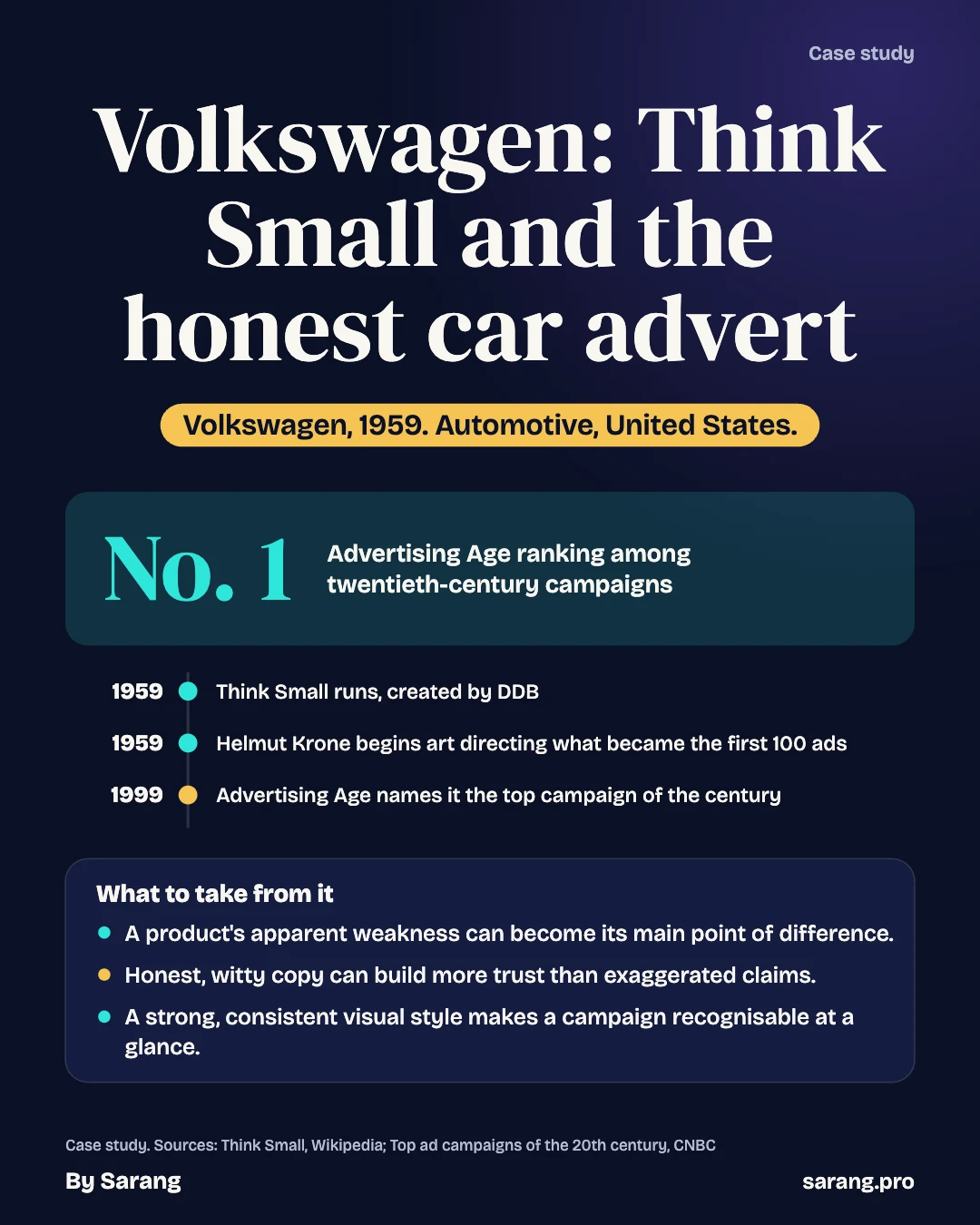
Volkswagen of America gave DDB an $800,000 budget in 1959 to sell a small, plain German car, and the ads that admitted its flaws were named the best campaign of the century by Advertising Age.

- first annual advertising budget given to Doyle Dane Bernbach
- $800,000
- advertising people Carl Hahn interviewed before choosing DDB
- about 400
- Beetles sold in the United States in 1949
- 2
- Volkswagens sold in the United States in 1953
- about 2,000
The situation
In 1959 Volkswagen of America had a product that most American car buyers did not want and an advertising problem that looked impossible. The car was small and slow, and it had no air conditioning. It was also developed under Adolf Hitler’s government, and its country of manufacture had been an enemy little more than a decade earlier. Mental Floss reports that only two Beetles were sold in the United States in 1949, the first year the car was on offer. Classic Car Weekly puts Volkswagen’s American sales at about 2,000 in 1953.
Carl Hahn, the young manager running Volkswagen of America from New York, decided that the usual approach would fail. According to Classic Car Weekly, he interviewed about 400 advertising people before choosing Doyle Dane Bernbach (DDB), and later called the rest “all a bunch of phonies” while describing DDB as “honest”. The first annual budget was $800,000, a figure given by both Classic Car Weekly and Mental Floss. That is a small sum for a national car launch, and it shaped what the campaign had to be.
What DDB produced is now treated as a turning point in advertising. Its “Think small.” print ad, together with the “Lemon” ad that followed, told readers about the Beetle’s size, its plain looks and its flaws. In 1999 Advertising Age ranked the Volkswagen work first in its list of the top 100 advertising campaigns of the century. This case asks why a campaign that admitted weakness worked, what it did for a car that was hard to sell, and what a manager can take from it today.
It also asks a harder question. Advertising did not make the Beetle reliable, cheap to run or easy to repair. Those were product facts. The campaign made them credible, and the argument of this case is that credibility, rather than cleverness, was the scarce resource Volkswagen needed.
Background
A people’s car with a difficult past
The idea of a cheap car for ordinary families was older than the Beetle. Jalopnik points to the Ford Model T of 1908 and the Hanomag Kommissbrot of 1925 as earlier examples. In the 1930s the German government took up the idea. The car became the KdF-Wagen, named after Kraft durch Freude (Strength Through Joy), the state leisure organisation that ran the scheme. A town was built for the project, with a large factory and barracks for the workers. Ferdinand Porsche is credited with the design, with Erwin Komenda doing the body, and the design was settled by 1938. Jalopnik adds that Porsche drew heavily on other designers and firms, naming Edmund Rumpler, Josef Ganz, Mercedes-Benz, Zundapp and Tatra. Volkswagen paid Tatra a settlement of one million Deutsche Marks in 1965.
No civilian customer received a car under the Nazi scheme. During the Second World War the factory made military vehicles, including the Kubelwagen and the Schwimmwagen. After the war the British occupation authorities restarted the plant under Major Ivan Hirst, and British engineers ran it until 1949, when ownership passed to a German government. Heinz Nordhoff, a former Opel employee, took charge and led the company that became Volkswagenwerk AG. The town was renamed Wolfsburg.
How Volkswagen made money before the campaign
By the 1950s the Beetle was a mass-market success in Germany. Mental Floss says Beetles made up about a third of the cars on German roads in that decade. The business model was simple: one basic model, improved a little at a time, built in very large numbers and sold at a low price. Fox News and GoAuto both report that about 21.5 million of the original Type 1 cars were eventually produced between 1938 and 2003, which makes it one of the longest production runs in motoring history. The Beetle also passed the Ford Model T as the best-selling car ever built; Mental Floss dates that to 1972, when about 15 million had been made.
That scale was the strength of the product. A company that makes one car for decades can spread its tooling costs across a huge number of units. The weakness was the American market, where nobody had asked for such a car.
Hahn and the American launch
Carl Hahn was born in 1926, took an economics doctorate at the University of Bern in 1952 and joined Volkswagen in 1954 as Nordhoff’s personal assistant, according to his Boston Globe obituary. He was moved to the export department and then sent to open the American market. He ran Volkswagen of America from 1959 to 1964, toured the country in a Volkswagen bus, computerised the offices and standardised service. The obituary credits him with bringing the company to Madison Avenue by hiring DDB. Hahn went on to join Volkswagen’s main board in 1964, left in a shake-up in early 1973, and returned in 1982 as chairman and chief executive. When he retired at the end of 1992 he named losing American market share as his biggest regret.
The industry
The sources opened for this case do not give market-share tables for the American car market of the late 1950s, so this section describes the position only as far as the evidence allows.
The Beetle stood outside that market in almost every respect. Mental Floss says it cost under $2,000 and that it had picked up unflattering nicknames abroad, including the Flea, the Mouse and the Turtle. The car had no air conditioning, was slow, and was small by American standards. It also came with a reputation problem in a country where many buyers had fought a war against Germany. Mental Floss reports that George Lois, a DDB design director, objected to the account and called the car a “Nazi car”.
Still, the Beetle had commercial advantages. It was cheap to buy and cheap to run. Later ads made much of fuel economy, and Mental Floss lists benefits such as easy pushing if the car ran out of petrol. It is reasonable to infer that a car sold on low running costs depends on dependable servicing, which is why Hahn’s work on standardised service probably mattered as much as the advertising. A cheap car that cannot be repaired nearby is not cheap for long.
The competitive field changed during the 1960s. Mental Floss notes that the Toyota Corolla arrived in the United States in 1968, and that the Beetle’s decline coincided with it. Japanese small cars were now on sale beside the Beetle. The same source puts Volkswagen’s American share at about 5 per cent in 1970 and about 1 per cent by 1990. A plausible reading is that product ageing played a part in the later fall, which no advertising could have prevented, though the sources do not test that.
Advertising was changing too. Mental Floss says Bernbach’s style influenced later campaigns such as Avis’s “try harder” and the Mikey ads for Life cereal. DDB’s billings grew from $25 million to $270 million by the end of the 1960s, according to Mental Floss. That growth shows how much Volkswagen mattered to the agency, and it matters to the question of influence discussed later.
The decision
The decision in front of Hahn and DDB was how to sell a small, foreign, unglamorous car to a market that valued the opposite. The sources show what was done, and they allow a fair reconstruction of the choices that were not made. The alternatives below are framed as the obvious options rather than as documented debates inside the firm.
Option one: sell the car like an American car
The standard approach was to copy the language of the mass market. That would have meant colour, speed, lifestyle imagery and a lavish image of the car. It would have put Volkswagen in direct comparison with products that were bigger, more comfortable and heavily advertised. With a budget of $800,000, Volkswagen could not outspend anyone, and it could not win a contest on the other side’s terms.
Option two: hide or soften the car’s origins and size
A second route was to avoid the awkward facts. Advertisers can say little about where a product comes from, and they can avoid the word small. Hahn’s point in rejecting other agencies, as Classic Car Weekly reports, was about honesty. If buyers could see the car’s size for themselves, avoiding the subject would have looked evasive and might have made the product seem untrustworthy.
Option three: make the weakness the message
DDB took the third route. The car was small, so the headline said so. Mental Floss reports that Julian Koenig wrote the line and that Helmut Krone, the art director, used white space to make the car look smaller still. Mental Floss describes the page as built on a layout known as “Layout A”: about two thirds image and one third copy, with a bold headline. Fonts In Use records Krone saying in a 1968 interview that he kept the layout traditional but made the picture look “naked”, and set the copy in sans serif so that it looked editorial rather than commercial.
The stakes were high for a simple reason. If the approach failed, Volkswagen would have spent a year telling Americans their prospective purchase was small and plain, with no sales to show for it. If it worked, the car would turn its limits into reasons to buy.
What they did
1959 to 1960: Think small
Hahn signed DDB in 1959. The “Think small.” ad, published in 1960, is dated to 1959 by some sources because that is when it was conceived. It showed a small picture of the Beetle in the upper left of a mostly empty white page, with a short headline and body copy in plain sans serif. The campaign had no slogan, and the Volkswagen logo served as the brand mark, according to Mental Floss. Krone told the same source that the layout could be recognised from about 30 feet away. Julian Koenig, the copywriter, is also credited by This American Life, which describes a later dispute between Koenig and a former partner over who had the best ideas. Mental Floss says that Lois and Koenig publicly disputed credit for the campaign.
1960 onward: Lemon
The “Lemon” ad turned the factory’s quality checks into a story. Rita Selden suggested the word, according to Mental Floss. Classic Car Weekly describes the copy: defective cars were removed before they reached showrooms, and one of Volkswagen’s 3,389 quality inspectors, Kurt Kroner, pulled a car because of a blemish on the chrome strip of the glovebox. The closing line was “We pluck the lemons, you get the plums.” For a reader, the effect was to make a very small defect stand for a very strict inspection.
1961 to 1969: a run of confessions
The campaign kept to its method for years. Fonts In Use lists other ads from the run, including “Impossible” in Car and Driver in August 1961, “Ugly is only skin-deep” in 1966 and an automatic stick shift ad in 1968. Classic Car Weekly reports a 1961 ad that showed no car at all, only the line “No point in showing the ’62 Volkswagen. It still looks the same.” It adds that showroom visits reportedly rose as people came to look. The same article describes a 1969 ad that showed the Apollo 11 command module with the line “It’s ugly, but it gets you there.” Mental Floss mentions an ad with the basketball player Wilt Chamberlain saying the car was too small for anyone over seven feet tall.
The operating system behind the ads
The ads sat on top of changes that were not glamorous. Hahn standardised service and computerised the offices, and the Lemon ad depended on a real inspection system. A promise of quality that the dealer network could not keep would have damaged the brand faster than any advertisement could repair it. The decision to advertise honestly therefore carried an obligation to operate honestly.
Britain and beyond
DDB won the British Volkswagen account in the late 1960s, according to Classic Car Weekly, and ran an ad with the comedian Marty Feldman under the heading “If he can make it, so can Volkswagen.” In 1978 Volkswagen withdrew the Beetle from Britain, and its farewell advertisement, headed “Going, going…”, paid tribute to 19 million sales.
What happened
The sources here are better at describing the campaign than at measuring it. No source opened for this case gives a clean before-and-after sales table, and several figures found in popular accounts differ. What can be said is set out below.
Sales and share
Volkswagen’s American sales rose from the single digits in 1949 to about 2,000 in 1953, and sold in the hundreds of thousands in the 1960s. Classic Car Weekly says Volkswagen sold Beetles “by the million” in the United States in that decade. Mental Floss gives 570,000 sales in 1970 and a share of about 5 per cent that year. It is unclear whether that figure covers the Beetle alone or the whole Volkswagen range, so it is treated here as an order of magnitude. By 1990 the same source puts the share at about 1 per cent.
Recognition and reach
Advertising Age named Volkswagen’s “Think Small” work number one in its century list of advertising campaigns in 1999. It placed Avis’s “We try harder” tenth and De Beers’s “A diamond is forever” sixth, so two of the three campaigns profiled in this series sit in the same ranking. DDB’s growth is a further sign of impact: Mental Floss says its billings rose from $25 million to $270 million by the end of the 1960s, though that growth also reflects other accounts won on the strength of this one.
The product’s afterlife
The Beetle outlasted its campaign by decades. The original car stayed in production until 30 July 2003 at Puebla in Mexico, with about 21.5 million built. Volkswagen revived the shape as the New Beetle, designed by the American J Mays, with a launch that created waiting lists, according to Mental Floss. GoAuto says the second generation sold more than 1.2 million units and the third, launched in July 2011, about 500,000. The last Beetle, a coupe in blue, left Puebla on 10 July 2019 and went to the company museum.
Hahn’s verdict
Hahn’s own regret, reported in his obituary, is a useful corrective. He retired in 1992 saying the loss of American market share was his biggest disappointment. An advertising triumph in 1960 did not carry the company through the arrival of Japanese competitors or the shift in buyer expectations.
Other views
Credit and authorship
The campaign’s creative history is contested. This American Life records a dispute between Julian Koenig and a former partner over who deserved credit for some of his best ideas. Mental Floss states that Lois and Koenig publicly argued over credit for Think Small. Anyone retelling the story should treat sole authorship claims with care and credit the Krone and Koenig partnership, with Bernbach supervising, as the sources most consistently do.
The uncomfortable history
Some readers see the campaign as a feat of image management that helped a company with Nazi origins reach the American mainstream. The sources show that the origins were known: Mental Floss notes that critics used the label “baby Hitler” and that Lois objected to the account on those grounds. The advertisements themselves did not address the history; they built trust through plain product facts. Whether that was the right response is a question of values as well as marketing, and the evidence here cannot settle it.
How much was advertising?
Classic Car Weekly says that Volkswagen had already reached about 150,000 sales by 1958 largely through word of mouth, which suggests demand was growing before DDB arrived. A sceptic can reasonably ask how much of the 1960s growth the campaign caused and how much it simply accompanied. A product that was cheap, durable and easy to maintain would probably have found buyers, and the advertising may have widened and sped up that process. The evidence available here cannot separate the two.
A caveat about the numbers
Even basic figures disagree. The initial budget appears as $800,000 in two sources, but other accounts give a lower figure that could not be checked against a primary document. Sales numbers in popular articles often mix the Beetle with other Volkswagen models. Readers should use the figures here as indications, not as audited data.
Reading it through a framework
Positioning
Positioning theory says a brand should occupy one clear place in the buyer’s mind, ideally a place that rivals cannot easily claim. Volkswagen chose the opposite end of the market to Detroit and said so in plain words. The position was small, economical and straightforward. It was credible because the car actually was those things, and because the ads conceded what it was not. Competitors with bigger cars could not copy the position without dropping their own, and the later arrival of Japanese small cars shows what happens when the position stops being unique. By 1968 the Corolla offered a similar promise from a rival maker.
The marketing mix
The four Ps help explain why the advertising worked as part of a system. Product: a single basic car, unchanged on the surface, so a headline about its looks stayed true year after year. Price: under $2,000, according to Mental Floss, which supported the economy message. Place: a dealer and service network built under Hahn, without which the quality claim would have been empty. Promotion: print ads in black and white, designed to be recognised from a distance and to give the reader something to think about. The campaign is famous, but the mix is what delivered sales. Promotion alone, without the other three, would have produced attention without repeat purchase.
Since then
The Beetle has had three lives since the original campaign ended. After the American import business weakened in the 1970s and 1980s, Volkswagen produced the original car in Mexico until 2003. The New Beetle, a retro-styled model designed by J Mays, arrived in the late 1990s and was built at Puebla. Fox News calls it a niche product compared with the original, and reports that the New Beetle and its successor together account for fewer than 2 million cars. The final Beetle was made on 10 July 2019, and Fox News says there were no plans to bring the name back. Volkswagen instead planned an electric I.D. Buzz as its heritage model.
DDB still advertises Volkswagen, according to Classic Car Weekly in 2017. Carl Hahn died in January 2023 at the age of 96, as the Boston Globe reported. Advertising Age’s 1999 ranking is still the way the campaign is usually introduced to students, which may say as much about teaching habits as about the work. The method has also moved well beyond cars: brands now routinely admit a flaw to win trust, a technique that is much harder to execute when the product is not good.
What to take from it
- A weakness that buyers can see for themselves is better admitted than hidden, because the admission makes the rest of the message believable.
- A small budget forces a clear idea. With $800,000, DDB could not outspend rivals, so it had to be recognisable, simple and different from the category.
- Advertising can only promise what the operation delivers. The Lemon ad worked because the inspection system existed, and Hahn’s service standards backed the claim.
- A famous campaign does not protect a company from new competition. Volkswagen’s share fell as Japanese small cars arrived, and its own American chief named the loss as his main regret.
- Be careful with creation stories. The credit for Think Small is disputed, and sales figures vary between sources, so a good analyst checks them before repeating them.
Questions to think about
- Which weaknesses of your own product or service would customers forgive if you named them first, and which would they never forgive?
- Hahn rejected other agencies and chose DDB for its approach. How should a manager judge an agency’s creative idea when the idea looks risky?
- The campaign did not mention the car’s Nazi-era origins. Was that silence a sound commercial choice, an ethical failure, or both?
- If Volkswagen had known that Japanese small cars would arrive in 1968, what should it have done with its advertising and its product in the 1960s?
Concepts at work
This case draws on positioning, the marketing mix and brand trust. Explore them in Insights.
Written from the public sources listed below. Figures are as those sources report them.
Framework
Timeline
- 1938Ferdinand Porsche's Beetle design is settled
- 1949Two Beetles sold in the US; the British-run factory passes to a German government
- 1953Volkswagen sells about 2,000 cars in the US
- 1954Carl Hahn joins Volkswagen as Heinz Nordhoff's assistant
- 1959Hahn leads Volkswagen of America and hires Doyle Dane Bernbach
- 1960Think small and Lemon ads appear (some sources date Think small to 1959)
- 1961The ad with no car says it still looks the same
- 1965Volkswagen pays Tatra one million Deutsche Marks
- 1968Toyota Corolla arrives in the US
- 1972Beetle passes the Model T with about 15 million built
- 1978Beetle withdrawn from Britain
- 1999Advertising Age ranks Think Small first of its century list
- 30 Jul 2003Last original Beetle built at Puebla
- 10 Jul 2019Last Beetle leaves the Puebla line
Recap cards
Tap a card to check yourself.
Sources and credits
- Advertising Age: Ad Age Advertising Century, Top 100 Campaigns
- Mental Floss: How Hitler's Volkswagen Beetle Conquered America
- Classic Car Weekly (via PressReader): Small, ugly and lemon
- Boston Globe: Carl Hahn, VW CEO who brought Beetle to America, dies at 96
- Jalopnik: The Real Story Behind The Nazis And Volkswagen
- Fonts In Use: Volkswagen of America ads, 1960 to 68
- This American Life: Origin Story (episode 383)
- Fox News: Volkswagen marks the end of Beetle production in Mexico
- GoAuto: VW Beetle production grinds to a halt, again