Avis: how admitting it was number two turned a loss into a profit
In 1962 Avis was losing $3.2 million a year behind Hertz, and an advertisement admitting it was only number two came before its first profit in more than a decade.

- Avis loss before the campaign
- $3.2 million
- profit in the following year, its first in over a decade
- $1.2 million
- Hertz and Avis share, per cent, in 1963
- 61 to 29
- Avis revenue, 1962 to 1965
- $25 million to $74 million
The situation
In 1962 Avis was the second-biggest car rental company in the United States and had not made a profit for more than a decade. Hertz led the market. The Star Tribune gives the share of rental business in 1963 as 61 per cent for Hertz against 29 per cent for Avis, and reports that Avis lost $3.2 million in the year before the campaign began. Encyclopedia.com gives the company’s size that year: a fleet of 7,500 vehicles and annual revenue of $25 million.
The company had just been bought by Lazard Freres, the New York investment bank, which moved its headquarters to Garden City, New York. Robert Townsend became president. The firm needed a way to compete with a larger rival that had more cars, more airport counters and more money. It chose Doyle Dane Bernbach (DDB), the agency that was already making its name with Volkswagen. Mental Floss notes that the style of William Bernbach, the agency’s creative leader, also shaped the Avis “try harder” work.
What DDB produced was an advertisement built on an apparent admission: Avis was only number two. The Star Tribune quotes the line as “When you’re only No. 2, you try harder”, with a short, blunt follow-up: “Or else.” Other sources give the wording as “We’re only No. 2. We try harder.” Within a year, the Star Tribune says, Avis moved from the $3.2 million loss to a $1.2 million profit, its first in more than ten years.
This case looks at what lay behind that turnaround, how much of it advertising can claim, and how the idea held up over the following sixty years as the car rental market changed beyond recognition. Its main lesson concerns position: a second-place company chose to say so, and made the fact a promise to customers.
Background
From three cars to the number two spot
Warren Avis, a former Army Air Corps flyer and Detroit car dealer, founded Avis Airlines Rent-A-Car System in 1946. Encyclopedia.com and FundingUniverse both say he started with his savings, profits from his dealership and a $75,000 loan, and opened at Willow Run Airport near Detroit and at Miami Airport. In 1948 the firm dropped “airlines” from its name and expanded into hotels and city locations. By 1954 it had 185 locations in the United States, ten in Canada and one in Mexico, and links with rental firms in Europe and Britain.
Warren Avis sold the business in 1954 to Richard S. Robie, a New England rental operator. Robie introduced one-way rentals and a company charge card, but cash-flow problems forced a second sale. A group of investors including the Amoskeag Company created Avis, Inc. and extended the licensee system to more countries. Revenue in 1956 was $4 million. Control then passed to Lazard Freres in 1962.
Hertz and the unequal contest
In the early 1960s the market had a clear leader. Hertz was the larger company, and the Star Tribune’s figures put its share at about twice Avis’s. MediaShower, a marketing blog that is less reliable than the other sources here, gives similar numbers but is inconsistent about what share Avis held in 1962 and 1963, so this case uses the Star Tribune’s 61 to 29 split as the starting point.
Avis had a structural disadvantage. In a business where customers want a car at an airport counter with no fuss, a bigger network of counters and a bigger fleet are real advantages. The second firm had to offer something different or accept that most travellers would choose the leader by default. A price cut would have squeezed an operation that was already losing money.
The industry
Car rental in the 1960s was a young industry tied to air travel. Avis itself began at airports in 1946, and the Star Tribune says both Hertz and Avis later concentrated heavily on airport sites. In general terms, a traveller stepping off a plane wants a car quickly and has little time to compare firms, so brand and location count for a great deal.
As a general point, the economics of rental reward size: a firm buys cars in volume, tries to keep them rented as often as possible, and gains from many visible locations. That would help explain why a gap between first and second mattered so much, although the sources opened here do not set out the cost structure.
The industry later changed shape. The 2024 annual report of Avis Budget Group describes a field with four main rivals: Enterprise Holdings (Enterprise, National and Alamo), Hertz Global Holdings (Hertz, Dollar and Thrifty), Europcar Mobility Group and Sixt. It also lists local and regional firms and ride-hailing services, which compete mainly for short urban trips. Avis, in the company’s own description, is a premium brand, priced generally above non-branded and value brands, and aimed at commercial and leisure travel.
The Star Tribune explains why the old order broke down. Enterprise overtook both Hertz and Avis. The two older firms had concentrated on airports, which hurt them after the 11 September attacks and in the recession that followed, while Enterprise had built its business in downtown locations and through partnerships with insurers. The article says Hertz had become number two and Avis number three by the time it was written. The Ladders gives a sharper picture for 2017: Enterprise held 44 per cent of the market, Hertz 14 per cent and Avis 10 per cent. Avis, then, had fallen from a 29 or 36 per cent share in the 1960s to a far smaller one, though the two sources may define the market differently.
Regulation and ownership matter less to this story than customer behaviour, but ownership changed often. FundingUniverse lists ITT acquiring Avis in 1965, Norton Simon buying it in 1976 and 1977 for $174 million, several leveraged deals in the 1980s, a sale to an employee stock ownership plan in 1987 for $750 million, HFS paying $800 million for control in 1996, and a public listing in 1997 that raised about $330 million. Every owner inherited the “We Try Harder” line as one of the company’s few distinctive assets.
The decision
Townsend and DDB had to decide how to present a second-place company to travellers. The options below are the obvious ones for a firm in that position. The sources show which was taken, not the internal arguments about it.
Option one: claim equality with Hertz
A challenger can say it is as good as the leader and cheaper or newer. That fits a standard comparative approach, but it asks the customer to believe a claim that the market’s numbers contradict. If Hertz had twice the share, a claim of equal strength would have sounded thin, and a direct comparison would have given the leader free publicity.
Option two: compete on price
Cutting prices would have been the second route. With a $3.2 million loss, Avis had no room to do that for long. The sources do not describe any price-led plan, and the later move to a premium position, which the 2024 report describes, points the other way.
Option three: turn rank into a reason to choose Avis
The route taken accepted the facts and gave them a meaning. If Avis was behind, its staff had more reason to work for each customer. Paula Green, the DDB copywriter who created the wording, later described the approach as radical for its time. The Star Tribune quotes her saying it “went against the notion that you had to brag.” The idea carried a risk. If the service did not improve, the line would invite ridicule. For the campaign to work, the cars, counters and staff had to match the promise, and Townsend’s job was to make that happen.
What they did
1962 to 1963: the campaign
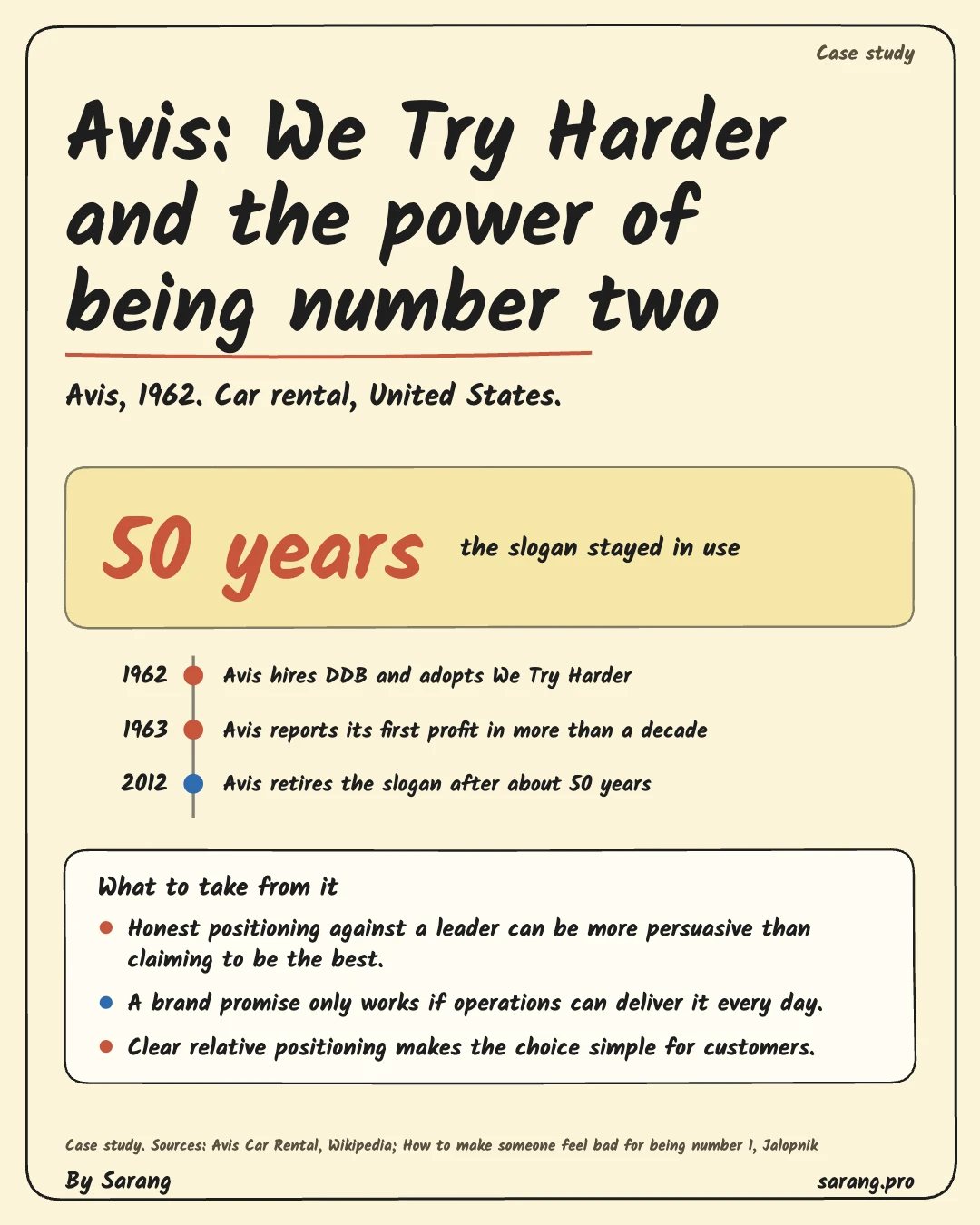
DDB’s advertising began in 1962, though Advertising Age dates the campaign to 1963 in its century list, which may reflect when it became prominent. The core message was the number two admission and a promise of harder work. The Star Tribune credits DDB with embracing Avis’s underdog position rather than trying to hide it. Avis kept the line for about 50 years, according to MediaShower and The Ladders.
Inside the company
An advertising claim of this kind creates an obligation inside the firm. Encyclopedia.com reports that, under Townsend, Avis ran the number two campaign and that the campaign supported strong growth. The sources opened for this case say little about the service changes behind the campaign, so the details cannot be written here. What can be said is that Avis revenue rose from $25 million in 1962 to more than $74 million in 1965, according to both Encyclopedia.com and MediaShower.
1965: ITT
International Telephone and Telegraph acquired Avis in 1965. Winston V. Morrow Jr. became chief executive, and the firm expanded in Europe and Africa. Encyclopedia.com says Avis became Europe’s leading car rental company within eight years of the sale.
1966: Hertz answers
The Star Tribune reports that Hertz ignored the campaign at first, then replied in 1966 when its share was falling. Its first response advertisement said: “For years, Avis has been telling you Hertz is No. 1.” That reply confirmed the Avis premise. It turned the leader into the subject of the rival’s joke.
What happened
The first-year turnaround
The headline result is the change from a $3.2 million loss to a $1.2 million profit within a year, the first profit in more than a decade, as the Star Tribune reports. MediaShower repeats the same figures. The Star Tribune also gives the later share figures: the gap narrowed from 61 to 29 in 1963 to 49 to 36 in 1966, and by 1969 it had settled at 48 to 35. Read as a transfer of share, Hertz lost 12 points over three years and Avis gained 7, which matches the figures The Ladders gives for the three years after the launch.
| Year | Hertz share (%) | Avis share (%) |
|---|---|---|
| 1963 | 61 | 29 |
| 1966 | 49 | 36 |
| 1969 | 48 | 35 |
These shares are those the Star Tribune reports. The article does not say how the market was defined. Because the two firms’ shares sum to less than 100 per cent, other companies held the rest. MediaShower’s account that Avis started with only 10 per cent in 1963 conflicts with the Star Tribune’s 29 per cent. The Star Tribune’s figures are consistent with each other and are used here.
Growth under later owners
FundingUniverse gives revenue of $162 million in 1970 and $673 million in 1979. In the early 1980s management under J. Patrick Barrett revived the “We Try Harder” image. A loss of $50 million in 1982 led to 2,400 job cuts. Since 1984, the source says, Avis earned a higher ratio of profit to sales than Hertz. In 1986 it had about $1 billion in revenue and a 26.2 per cent share of the rental market, and by 1988 the share reached 27 per cent. In 1996 the Avis system had about 4,200 locations in around 160 countries, 16,000 employees and $1.87 billion in sales.
The limits of the idea
It helps to be exact about what the numbers show. Avis gained seven points of share in three years while the leader lost twelve. That is a large shift in a market where customers choose quickly, and it came from a starting point of heavy losses. But the table also shows the gain stopping: between 1966 and 1969 Hertz moved from 49 to 48 and Avis from 36 to 35. The strategy won customers who were open to persuasion, and it then ran into the strength of the leader’s network and brand. Seen this way, the campaign did what a challenger’s campaign can realistically do, which is to close part of a gap, not remove it.
The advertising did not make Avis the leader. The 1966 to 1969 figures show a steadying gap, not a reversal. Later in the century the market redefined itself around other players and other models of rental, and Avis lost its number two position altogether.
Other views
Was it the advertising or the management?
Encyclopedia.com says the campaign supported strong growth under Townsend, and the firm had a new owner and a new president at the same moment. A fair reading is that advertising and management worked together. The sources do not allow a split into percentages. The campaign gave employees and customers a reason to see the firm differently, but a company with poor service could not have sustained the claim.
The leader’s view
The Star Tribune reports that Hertz executives worried that by 1968 Avis might no longer be number two and might need a new campaign. That reflects a real feature of the idea: it works only while the company is behind. A firm that succeeds in becoming the leader loses its main story.
Reliability of the numbers
The most-quoted figures differ. MediaShower itself notes different starting shares for Avis in 1962 and 1963, and gives a final share of 36 per cent in one place and not in another. Sources of this type often repeat each other without checking. Anyone who cites the results should use the Star Tribune’s figures with the caveat that they are reported estimates from the 1960s, not audited statistics.
Later doubts about the slogan
The Star Tribune says Avis dropped the “We Try Harder” tagline the year before its article. The sources opened here do not explain why, so the case does not guess. It is fair to note, as an open question, that a premium-priced brand in third place may have less use for underdog language than a rival chasing the leader.
Reading it through a framework
Positioning
Positioning asks what place a brand holds in the customer’s mind relative to rivals. Avis could not take the top place, so it took a clear and different one: the harder-working alternative. The line turned a fact that customers already knew into a reason to prefer Avis. Because the line only makes sense against a larger rival, the leader was the reference point for the whole campaign. The Hertz reply of 1966 shows that the position was strong enough to make the leader respond. It also shows the risk: a position built on being second becomes awkward if the firm gets close to first, as the Star Tribune says Hertz executives noticed.
Porter’s five forces
Porter’s framework looks at rivalry, buyers, suppliers, entrants and substitutes. The 2024 annual report shows how those forces have changed. Rivalry comes from Enterprise, Hertz, Europcar and Sixt, so the old contest between two firms is now a field of four large groups. Substitutes include ride-hailing, which the report says competes mainly for short urban trips. Buyers can compare prices easily, which pushes firms toward premium or low-cost positions. New entrants, such as Zipcar, whose purchase by Avis the Star Tribune mentions, pressed the traditional model from another angle. In 1962 the main force was rivalry with one larger firm, so a message that dealt with rivalry could carry the whole strategy. Today the same message would have to deal with several forces at once.
Since then
The line stayed for decades. FundingUniverse reports that management in the early 1980s revived it, and MediaShower says it ran for about 50 years. The Star Tribune says Avis dropped it in the year before its article. The company’s position in the market weakened as Enterprise took first place. Hertz and Avis both found that their airport emphasis left them exposed after 11 September and during the recession.
Hertz filed for bankruptcy protection in May 2020, according to The Ladders. In the Star Tribune’s account, Hertz acquired Dollar Thrifty and Avis acquired Zipcar in the same period. In 2024, Avis Budget Group reported revenue of about $11.8 billion and an average global fleet of about 695,000 vehicles, with about 10,250 rental locations worldwide including about 3,800 run by licensees, in around 180 countries. Avis alone had 5,110 locations. That is far from the 7,500 cars and $25 million of revenue of 1962.
The comparison with 1962 is worth pausing on. In that year the whole company had a fleet of 7,500 cars. Avis alone now runs an average fleet of about 695,000 vehicles, and its own filing describes a premium brand sold in more than 5,000 locations. The idea that built the brand’s reputation was a response to a particular problem, a small firm facing a bigger one. The firm that exists now faces a different problem, which is to justify a premium price against Enterprise, Hertz, Europcar, Sixt and, for short trips, ride-hailing apps.
Warren Avis’s business had become a premium brand inside a multi-brand group. The idea of trying harder remains a standard teaching example. The Ladders notes that marketing expert David Angelo named the Avis ads among his three favourites of all time, and Advertising Age placed the campaign tenth in its century list.
What to take from it
- A weaker competitor can turn its rank into a promise, provided the company then behaves in a way that makes the promise true.
- Facts the customer already knows are safe ground for advertising. Avis did not have to prove it was second; it had to give that fact a meaning.
- Advertising results depend on the operation behind them. The Avis turnaround coincided with management changes under Townsend, and the sources do not let anyone separate the two.
- A position based on being behind has a limit. Hertz executives worried about what Avis would say if it became number one, and Avis later fell to third place anyway.
- Check the figures behind a famous story. Several popular accounts of this campaign give different starting shares, and only some are consistent with each other.
Questions to think about
- What would a number two company in your industry have to change inside the business before it could make the Avis promise honestly?
- Hertz waited until 1966 to reply. Was ignoring the campaign a mistake, or the least bad option for a market leader?
- Does the underdog message still work for a company that is now one of four large groups and priced as a premium brand?
- How would you separate the effect of advertising from the effect of new management when judging the 1962 to 1963 turnaround?
Concepts at work
This case draws on positioning, Porter’s five forces and underdog branding. Explore them in Insights.
Written from the public sources listed below. Figures are as those sources report them.
Framework
Timeline
- 1946Warren Avis opens at Willow Run and Miami airports
- 1954Warren Avis sells to Richard S. Robie
- 1962Lazard Freres buys Avis; Robert Townsend becomes president; DDB campaign begins
- 1963First profit in over a decade, $1.2 million (per the Star Tribune)
- 1965ITT acquires Avis; revenue passes $74 million
- 1966Hertz answers with its own ad
- 1976 to 1977Norton Simon buys Avis for $174 million
- 1982$50 million loss and 2,400 job cuts
- 1987Sale to employee stock ownership plan for $750 million
- 1996HFS pays $800 million for control
- 1997Avis Rent A Car lists on the stock market
- May 2020Hertz files for bankruptcy protection (per The Ladders)
- 2024Avis Budget Group reports about $11.8 billion revenue
Recap cards
Tap a card to check yourself.
Sources and credits
- Star Tribune: 'We try harder', the most brilliant ad slogan of the 20th century
- Advertising Age: Ad Age Advertising Century, Top 100 Campaigns
- Encyclopedia.com: Avis, Inc.
- FundingUniverse: Avis Rent A Car, Inc. History
- Avis Budget Group (SEC): Form 10-K for 2024
- MediaShower: Avis marketing
- The Ladders: How to beat your competitors without winning
- Mental Floss: How Hitler's Volkswagen Beetle Conquered America