Patagonia: an advert telling people not to buy its jacket on Black Friday
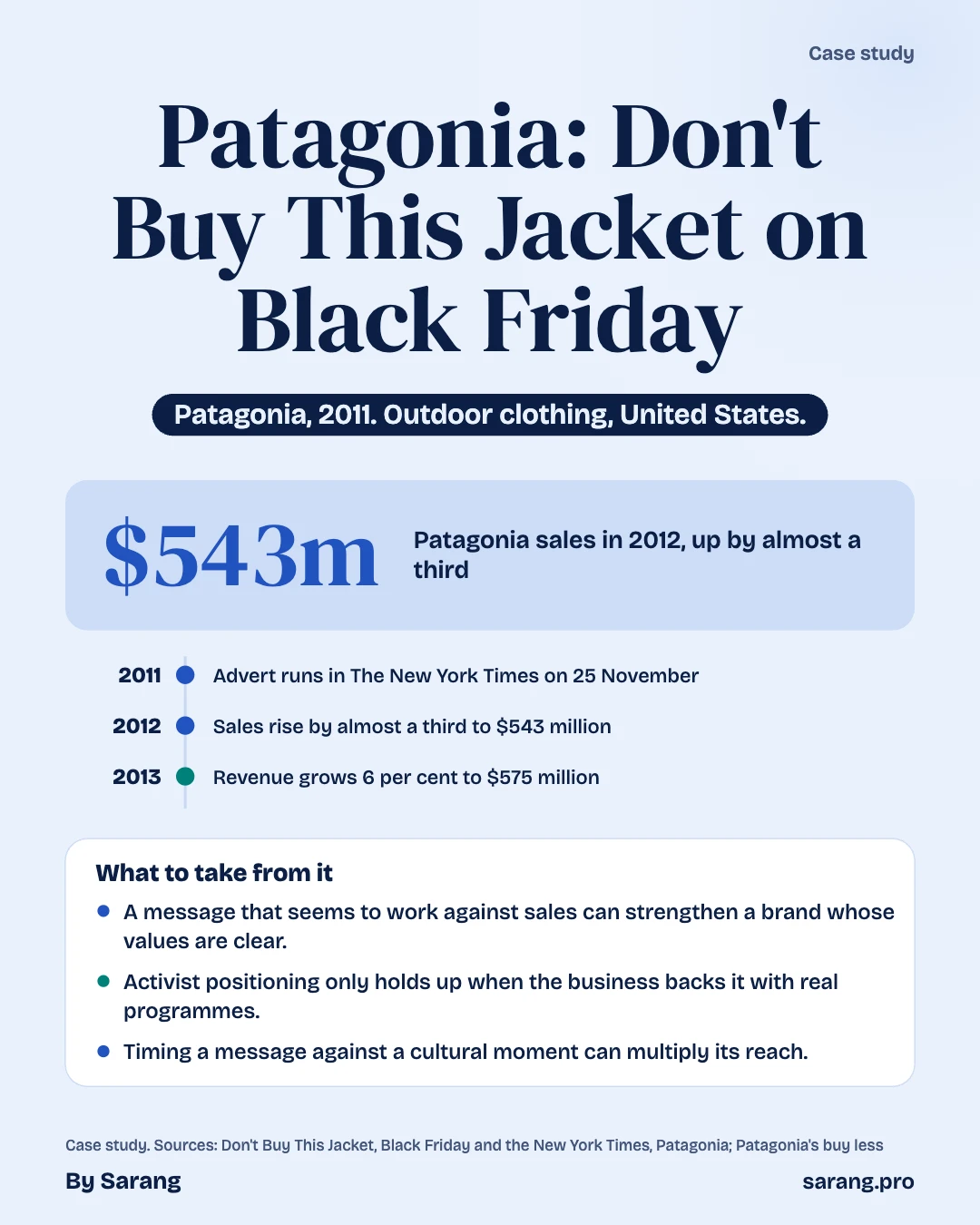
On Black Friday 2011 Patagonia ran a full-page New York Times advert headed 'Don't Buy This Jacket', and the company's sales rose in the year that followed.

- Date the advert ran in The New York Times
- 25 Nov 2011
- Pledge headings: Reduce, Repair, Reuse, Recycle, Reimagine
- 5
- Reported compound annual sales growth
- 14%
- Expected annual sales in 2015, per trade press
- About $750m
The situation
On Friday 25 November 2011, Black Friday, the day that opens the American holiday shopping season, readers of The New York Times found a full-page advertisement from an outdoor clothing company. It showed one of the firm’s best-selling fleeces, an R2, and carried a headline telling people not to buy it. Below the picture, Patagonia set out what it said was the environmental cost of making that single garment, and asked shoppers to think hard before buying it or anything else.
Patagonia used the day to argue for buying less. The company published its own account of the ad on the day it ran. It said the paper was chosen because it is the national paper of record, and the date because Black Friday opens the holiday season. The advertisement was tied to a scheme called the Common Threads Initiative, which asked both the company and its customers to sign up to a short pledge.
The puzzle for a business student is what the company hoped to gain, and what it risked. A seller that discourages purchases looks, on the surface, like a seller that wants lower revenue. Yet the sources point the other way. A 2015 payments-industry article reported that attention from the ad was linked to a significant rise in sales in 2012, and put the firm’s expected annual sales at about $750 million with growth averaging 14 per cent a year. A blog from a communications agency claims sales grew by nearly 30 per cent the following year, though it cites no source, so that figure is treated here as unverified.
This case looks at why a company that made its money from selling jackets chose to run an advertisement against buying jackets, how the idea fitted with forty years of company history, what Patagonia did around the ad, and what the evidence does and does not show about its commercial effect.
Background
From climbing hardware to clothing
Patagonia’s founder, Yvon Chouinard, was born in Maine in 1938 and moved to Southern California as a boy, where he took up rock climbing. According to a profile in Sustainability Magazine, he began making his own climbing gear in 1957 and founded Chouinard Equipment in 1965, which became known for high-quality climbing hardware. His 1972 catalogue carried an essay on clean climbing, which aimed to cut the environmental impact of the sport. The company founded Patagonia in 1973. The same profile says it was designed from the start to address environmental problems rather than add to them.
That origin matters for the 2011 ad. The company did not discover environmental concern as a marketing theme in the 2000s. Its founder had put an essay on clean climbing in a 1972 catalogue, so an advertisement asking customers to think before buying was an extension of an older habit of speaking about environmental cost, on a larger stage. Patagonia’s own account notes that a similar line, “Don’t Buy This Shirt”, had appeared earlier in a catalogue essay.
A record of costly choices
The profile lists a series of decisions that cost money or added difficulty. In 1996 the company moved its whole cotton range to organic cotton within about 18 months, despite the expense and the problem of finding supply. In 2002 Chouinard co-founded 1% for the Planet, an alliance of businesses that pledge one per cent of sales to environmental causes. The company was also one of the first to publish a map of its supply chain, though the profile gives no date for that. These steps gave Patagonia a record that made the 2011 message more believable than it would have been coming from a firm with no history of the kind.
How the company made money
Patagonia sold outdoor clothing and equipment through its own shops, through retail partners and online. The 2015 article counted 32 retail spaces in the United States and 36 abroad, with most sales going through partners and the web. It reported that profits more than tripled after Rose Marcario joined as chief financial officer in 2008. The company was privately held and did not publish accounts in the way a listed firm does, so almost every revenue figure for this period comes from press reports or from the company’s own statements, not audited filings. That limit applies to every number in this case.
The company’s own account stresses useful, durable, timeless products, and the sources opened do not give its prices. That emphasis shapes the logic of the ad: if the product really is built to last, a customer who buys one and keeps it for years is the ideal customer, and a company confident of that can afford to say so.
The industry
Outdoor and apparel retail in 2011
Most clothing companies earn more by selling more items, and Black Friday is the start of a season built around buying. Patagonia’s decision to speak against purchasing therefore ran against the evident purpose of the day.
The sources opened for this case do not give market-share figures for outdoor clothing in 2011, so none are claimed here. What they do show is the position Patagonia held: a private firm with expected sales of about $750 million by 2015, with a customer base that already cared about the outdoors and about where its products came from.
The environmental argument
The ad rested on figures Patagonia supplied itself. In its published account the company states that every garment it makes, including organic or recycled ones, produces greenhouse gas emissions several times its own weight, creates scrap amounting to at least half a garment’s worth of material and takes large volumes of fresh water. These are the company’s claims, not independent measurements, and the page does not show the calculations. They are used here as evidence of what Patagonia said, not as established fact.
The wider point the company made was that even a firm trying to reduce harm per product still adds to total harm if it sells more products. Rick Ridgeway is quoted in the 2015 article saying that companies, including Patagonia, were reducing the environmental footprint of their individual products. The next step in the argument, which the ad stated outright, was that cutting the footprint per item is not the same as cutting the total.
Scrutiny of green claims
Any company that makes an environmental claim invites a check on whether it lives up to it. Patagonia’s account of the ad addresses this directly. It acknowledges the charge that a firm cannot ask for restraint while selling product, and it admits that not every item it makes yet meets its own standard of useful, durable and timeless. Raising the objection itself was a way of pre-empting critics.
The decision
The sources do not describe an internal debate in detail, so this section sets out the obvious alternatives Patagonia faced, framed as alternatives and not as a record of meetings.
Option one: run the usual Black Friday promotion
The default for a clothing firm was a discount campaign. It would have raised short-term volume and matched what competitors did. For Patagonia it carried a cost in brand terms. A company that told customers its products were made to last, and that built a reputation on environmental care, would have looked inconsistent offering the same cut-price pitch as everyone else.
Option two: stay silent that week
Patagonia could have skipped paid advertising on Black Friday and let the holiday pass. That would have avoided any charge of hypocrisy, but it would also have wasted a moment when consumers were primed to think about spending, and when media attention on retail was at its highest.
Option three: an honest-seller message
The path chosen was to use the most expensive and visible slot of the year to deliver a message about consumption itself. Patagonia’s own account says the headline was written to draw readers into the full text and into the Common Threads pledge, so the provocation was a device and the pledge was the point. The pledge had five parts, Reduce, Repair, Reuse, Recycle and Reimagine, and each came with a promise from the company and a responsibility for the customer.
What was at stake
The risk ran in two directions. If customers took the ad at its word and bought less, revenue would fall. If critics decided it was a stunt, the brand would lose the trust that justified its prices. Patagonia’s account answers the second worry by arguing that reducing consumption is necessary, and that a growing business must prove sincerity by making useful, durable goods and by backing the message with action. That answer set the work that followed: the message had to be matched by services that actually reduced the need to buy new.
What they did
The advertisement, 25 November 2011
The ad ran as a full page in The New York Times. It showed the R2 fleece, set the headline across the top and broke down the environmental cost of one of the company’s top sellers, as the 2015 article describes it. The text asked readers to think twice before buying the jacket or anything else from the company. Patagonia published its own explanation of the choice of paper and day on its website on the same date, which later carried notes added in 2022.
The Common Threads pledge
The ad was the front door to the Common Threads Initiative. The pledge had five headings, Reduce, Repair, Reuse, Recycle and Reimagine, and under each the company set a promise of its own and a responsibility for the customer. The sources opened do not list the individual wordings. Patagonia says the scheme later developed into its Our Footprint programme, so the pledge was an early form of work that continued.
Repair and reuse as a service
The most direct way to back “buy less” is to make it easy to keep what you own. The Sustainability Magazine profile dates the Worn Wear programme to 2013. Fast Company reported in January 2021 that Patagonia runs repair services and a buyback scheme that resells used garments, and that clothing too damaged to repair had piled up, which led to a line of upcycled pieces called ReCrafted, launched in late 2019. Prices for ReCrafted items ran from $57 to $231, higher than for new versions of the same items, according to that report.
Patagonia’s current footprint page says the company repaired more than 40,000 garments at its Reno, Nevada, repair centre in 2024. That is a measure of how far repair has become a regular activity, though the page gives no figure for earlier years, so no trend can be drawn from it.
The 2013 Responsible Economy campaign
The 2015 article reports that the company followed the 2011 ad in 2013 with a Responsible Economy campaign, including a graphic that described growth as a dead end. This continued the line of argument: Patagonia was not treating the ad as a one-off but as the start of a public position about how companies should behave.
Stating a purpose
In 2018 the company changed its stated purpose to “We’re in business to save our home planet”, according to Patagonia’s ownership page. That wording moved the environmental goal from a value held alongside profit to the stated reason for the firm to exist.
What happened
Sales and profit
The evidence on commercial results is thin and comes mainly from secondary sources. The 2015 PYMNTS article says the attention the ad drew was credited with a notable bump in 2012 sales, without giving a figure. It places expected annual sales at about $750 million and reports a compound annual growth rate of 14 per cent. A separate communications blog says sales grew by nearly 30 per cent the year after the ad but names no source for the claim.
| Item | What the source says | Source type |
|---|---|---|
| Ad date | 25 November 2011, full page in The New York Times | Company page |
| 2012 sales | Rose significantly, no figure given | Trade press |
| Expected annual sales (2015) | About $750 million | Trade press |
| Growth rate | 14 per cent a year (compound) | Trade press |
| Sales growth claim | Nearly 30 per cent the following year | Agency blog, unsourced |
The honest summary is that sales rose after the ad, that the company’s growth was fast, and that nobody outside the firm can show how much of the rise came from the ad as opposed to the wider brand, new stores, new products, an improving economy or the changes in finance after Rose Marcario joined in 2008, a period in which the 2015 article says profits more than tripled.
Reputation
The 2015 article reports that Harvard Business Review called the buy-less campaign “both genuine and borderline heroic”. That is one commentator’s view, but it shows the kind of reception the ad drew in management circles.
Longer-term effects on the company
Over the following decade the firm kept widening the scope of its environmental work. Its current footprint page reports that over 90 per cent of its products are made in Fair Trade Certified factories, which it says benefit more than 85,000 workers, that preferred materials, including recycled inputs, make up 86 per cent of the Fall 2025 line by weight and that all virgin down is traceable from parent farm to final processing facility. It also says that new styles from Spring 2025 are made without intentionally added PFAS. As of 2023, the same page says, 34 per cent of apparel assembly factories pay workers a living wage on average, which shows how much of the stated aim remained unmet.
The 2022 ownership change
In a letter dated 14 September 2022 Chouinard announced a change of ownership. Under the structure described on the company’s ownership page, the Patagonia Purpose Trust holds the two per cent of equity that carries all the voting stock, and Holdfast Collective, a nonprofit, holds the remaining 98 per cent, all non-voting. Profits left after reinvestment go to Holdfast each year as a dividend, which the page says will be used to fight the environmental crisis. The company remains a for-profit business, a certified B Corp and a California benefit corporation, and it will keep giving one per cent of sales to grassroots environmental groups, which is now written into its charter. Sustainability Magazine reports the company was valued at about $3 billion at the transfer. The headline on the footprint page, “Earth Is Now Our Only Shareholder”, links to the letter.
Other views
The hypocrisy objection
The most common criticism is the obvious one: a company cannot sincerely ask customers to buy less while earning money when they buy. Patagonia raised this itself. Its answer is that the claim is credible only if the products are durable and the actions match the words, and it concedes that not all of its products meet the standard yet. A sceptic may reply that any firm which keeps growing is still adding to production, whatever its intentions. The sources opened for this case do not settle the argument, and the company’s own repair and ownership steps are better read as attempts to address it than as proof it has been answered.
Was it a marketing stunt that worked?
Another reading treats the ad as clever marketing: a headline that guarantees attention, followed by sales growth. An agency blog takes a different line, arguing that results followed because the company was honest, not because the ad was clever. The two views are not easy to separate with the available evidence. What can be said is that the headline did the work of drawing readers, and that the content behind it, the pledge and later services, gave the message weight beyond one day of attention.
Limits of the evidence
Patagonia is private, so no audited accounts show the effect on sales. The figures that circulate come from trade press and commentary. A before-and-after comparison cannot isolate the ad, because the company was already growing, was opening stores, and was changing its financial management. Anyone using this case to argue that advertising of this kind raises sales should say plainly that it is one firm with a strong prior reputation, and that the evidence for cause and effect is weak.
The company’s own caveat
Patagonia states that every garment, even an organic or recycled one, carries a climate cost. That admission is also a critic’s argument against the whole industry. If the claim is right, the only low-impact jacket is the one already owned, and the company’s best contribution is to make owning easier and buying less necessary.
Reading it through a framework
Positioning
Positioning asks what a brand stands for in the customer’s mind relative to rivals. Patagonia sold outdoor clothing to people who valued the outdoors. By taking the position of the company that tells you to buy less, it claimed a spot no mass-market rival could copy without giving up its own business model. The cost was a narrower audience, since a message of restraint will not appeal to all shoppers. The gain was a clear identity. The long history of clean climbing, organic cotton and the 1% pledge meant the position was believable, which is why the ad could be provocative without sounding empty.
Stakeholder mapping
Stakeholder mapping sorts those affected by a decision by their interest and influence. In 2011 the key groups were customers, who were asked to change behaviour, retail partners, who sell the product and might dislike a message against buying, employees, who work for a mission-led firm, and the owner, who held the founding vision. Later stakeholders appear in the ownership design: the Purpose Trust and Holdfast replace a conventional shareholder with a guardian of the mission and a recipient of profit for environmental work. Viewed this way, the 2022 change is the formal end of a conflict that the 2011 ad had already exposed, between a shareholder’s wish for returns and a founder’s stated aim of limiting harm.
Since then
The ideas in the 2011 ad have become part of the company’s structure. Repair and resale run as continuing services, with more than 40,000 garments repaired in Reno in 2024 according to the company. Stated environmental targets appear on the footprint page, with results reported as partial: strong figures on fair trade factories and preferred materials, and a lower figure of 34 per cent on living wages.
The ownership change of September 2022 is the largest step. It turned a private family business into one whose profits go to environmental work by design. The company says it will keep operating as a for-profit firm, so it must still sell clothing to fund the plan. That puts the question raised in 2011 back at the centre: a firm that depends on selling products to pay for its purpose has to keep selling.
The company’s own page on the 2011 ad carries notes added in 2022, so the firm still uses the ad as a reference point. A message that began as a headline was later written into the way the company is owned.
What to take from it
- A message that cuts against a firm’s apparent self-interest can build trust, but only when the company has a long record that makes it believable.
- A provocative headline earns attention, and what keeps it is the substance behind it, here a pledge, repair services and later changes to ownership.
- Companies can answer a charge of hypocrisy by raising it first and admitting where they fall short.
- Outcomes of brand campaigns are hard to measure for private firms, so claims of cause and effect from sales figures should be treated with caution.
- Purpose that lasts has to be built into the structure of the business, as Patagonia attempted with its 2022 trust and nonprofit design.
Questions to think about
- Could a company with no history of environmental action run an advertisement like this one without damaging its reputation? What would it need to do first?
- If sales rose after the ad, how would you test whether the ad caused the rise? What data would you ask Patagonia for?
- Does a for-profit company that depends on selling products have a limit to how far it can argue for buying less?
- Is repair and resale a threat to a clothing firm’s revenue, or a way of keeping customers for longer?
Concepts at work
This case touches brand positioning, stakeholder theory and the idea of a purpose-led business. Explore them in Insights.
Written from the public sources listed below. Figures are as those sources report them.
Framework
Timeline
- 1965Chouinard Equipment founded
- 1973Patagonia founded
- 1996Cotton range moved to organic
- 20021% for the Planet co-founded
- 25 Nov 2011Don't Buy This Jacket advert runs
- 2013Worn Wear programme introduced
- 2013Responsible Economy campaign
- 2018Purpose changed to saving the home planet
- 14 Sep 2022Ownership moved to Purpose Trust and Holdfast Collective
- 2024More than 40,000 garments repaired in Reno
Recap cards
Tap a card to check yourself.
Sources and credits
- Patagonia: Don't Buy This Jacket, Black Friday and the New York Times
- Patagonia: Ownership
- Patagonia: Our footprint
- PYMNTS: Retail Growth By Not Growing
- Sustainability Magazine: Yvon Chouinard, the founder of Patagonia
- Fast Company: Patagonia has had enormous success with upcycled clothing. Could other brands follow?
- Bark Communications: The Black Friday ad that told customers don't buy this