Pepsi Challenge: how blind taste tests against the market leader led to New Coke
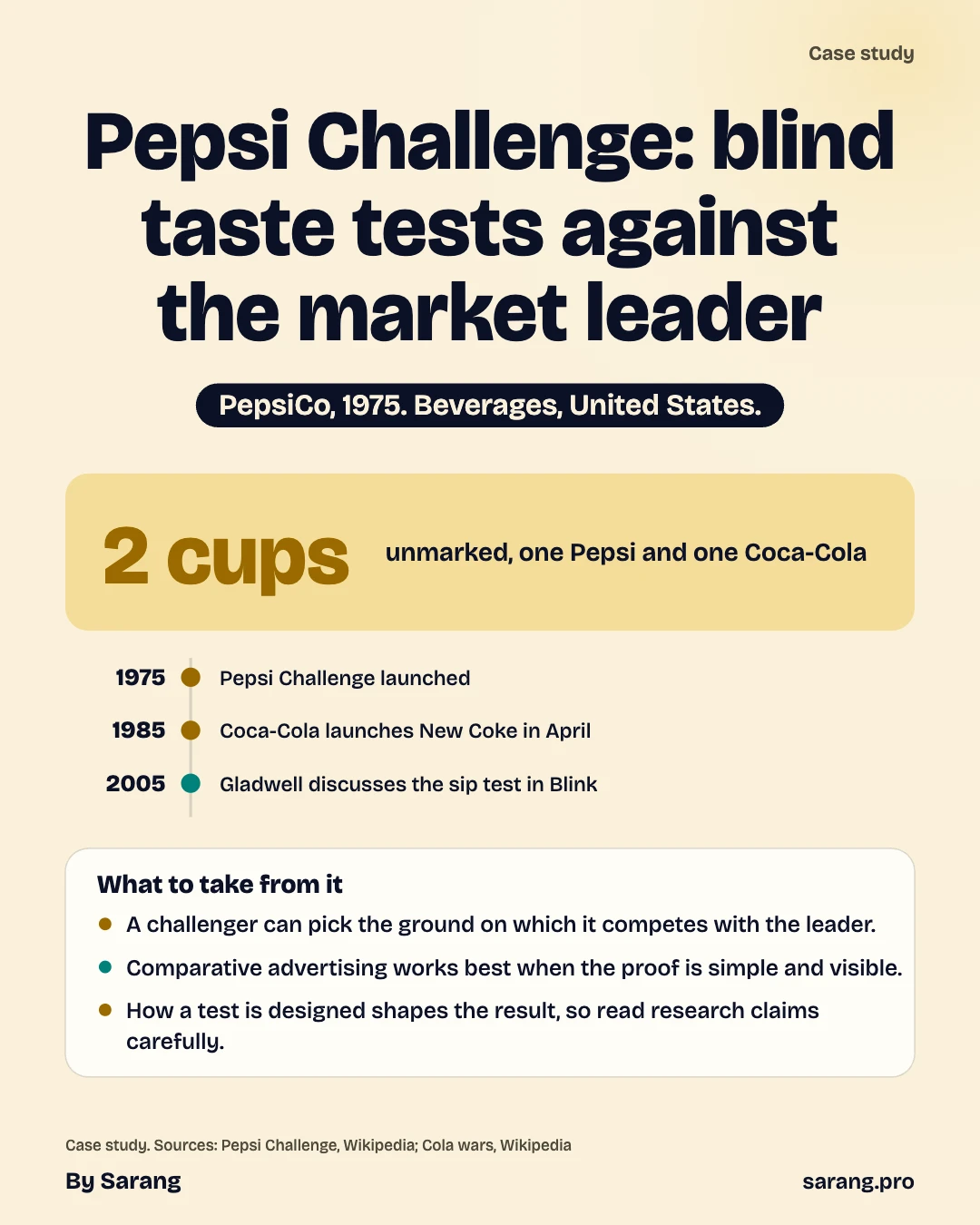
Pepsi turned a blind taste test into a national campaign from 1975, and Coca-Cola replaced its 99-year-old formula in April 1985 before bringing it back 79 days later.

- Year most sources give for the Pepsi Challenge launch
- 1975
- Blind taste tests before New Coke (History.com), about 200,000 in another source
- 190,000
- Age of the Coke formula replaced on 23 April 1985
- 99 years
- From New Coke launch to return of the original
- 79 days
The situation
In the mid-1970s Pepsi was the smaller of the two big American colas and had been for as long as most people could remember. Coca-Cola had held roughly 70% of the market at the end of the Second World War, according to one analysis, and was still the clear leader. Pepsi had one advantage it could prove. When people were given two unmarked cups and asked which they liked better, more of them picked Pepsi.
The company turned that finding into a promotion. Tables went up in shopping centres and malls with two cups on them, one with Pepsi and one with Coke. The shopper tasted both, chose, and was told what they had picked. The idea ran through Pepsi’s television advertising and, in a local launch reported by one historical society, was backed by the claim that half of the people who said they preferred Coke had in fact chosen Pepsi.
The case matters for two reasons. The Pepsi Challenge shows how a simple demonstration can reframe a market leader’s strength as a weakness. It also shows how that demonstration, copied by the leader’s own research, led to one of the best-known corporate reversals in the United States: the launch of New Coke in April 1985 and its partial withdrawal 79 days later.
Background
Two drinks from the late nineteenth century
Coca-Cola was created in 1886 by Atlanta pharmacist John Pemberton. Pepsi-Cola was formulated in 1898 by Caleb Bradham, a North Carolina drugstore owner, under the name “Brad’s Drink”. Both were sold at first with medicinal claims, and early advertising for each argued that its drink had better medicinal properties.
A leader that lost ground
One analysis, by the authors of a study of the cola competition republished by GuruFocus, puts Coca-Cola at about 70% of the market at the end of the Second World War, falling to 30% by 1966 against 20% for Pepsi. The two figures appear to measure different things, and the article does not define them, so the exact fall should be treated with care. The direction is clear in several sources: Pepsi gained steadily in the 1970s and early 1980s.
Pepsi also changed its product. According to an EBSCO research starter, Pepsi quietly reformulated its domestic drink to be sweeter in the 1970s and its share rose. In 1977, the GuruFocus article says, Coca-Cola started a price war to regain share. The authors estimated that Coca-Cola lost four dollars of profit for every dollar Pepsi lost.
The industry
Two firms and a shared market
American soft drinks in this period were dominated by two companies selling similar products through bottlers, supermarkets, vending machines and restaurants. A 2013 Slate article citing Beverage Digest figures gives later shares for the US carbonated soft drink market: Coke 17%, Diet Coke 9.4% and Pepsi 8.9%. That is long after the period of this case, but it shows the lasting order. Coke kept its lead through vending machines and fast-food partnerships, according to The Drum, even as Pepsi did well in supermarkets.
Brand loyalty and the supermarket shelf
A 2013 summary of the cola competition says that by 1983 Pepsi was outselling Coke in supermarkets (a claim attributed there to Snopes). Another account says Pepsi passed Coke in US supermarket sales in 1980, with 29.3% against 29%. The sources therefore differ on the year, and the case uses “around 1980 to 1983”.
The same account says Coke’s sales growth slowed from about 15% a year to about 2% in the late 1970s and early 1980s, and that exclusive Coke drinkers fell from 18% of consumers in 1972 to 12% in 1982, while exclusive Pepsi drinkers rose from 4% to 11%. Those numbers come from a branding blog and are not independently checked here, but they match the direction reported by History.com and EBSCO.
New products from both sides
Coca-Cola introduced Tab in 1963 and Diet Coke in 1982. History.com says caffeine-free versions followed in 1983 and that Coke’s chief executive Roberto Goizueta switched the company to corn syrup from sugar to cut costs. Diet Coke became the world’s third-best-selling soft drink, passing 7-Up. Pepsi’s own revenue in 1984 was reported at $7.7 billion.
The decision
The case contains two decisions, one by each company. Pepsi had to decide how to use a taste advantage. Coca-Cola, seeing the same advantage in its own research, had to decide how to respond.
Pepsi: advertise the taste, or the brand
Pepsi could have continued to advertise lifestyle, youth and celebrity. It chose to put its product in the hands of the public and let them pick. The risk was that the result might not hold. The reward was a claim that sounded like evidence, not advertising. Roger Enrico, PepsiCo’s president, was described by EBSCO as a force behind the later campaign that replaced it.
Coca-Cola: defend, discredit or change the drink
Coca-Cola had at least three options, and the sources show it tried some of each. It could discredit the test. One account says Coke questioned the Challenge, arguing the samples were small and conditions favoured Pepsi, and noted that Pepsi was slightly sweeter, which can sway a quick sip. It could leave the formula alone and compete on brand. Or it could change the drink.
The company’s own taste tests, according to History.com, showed the same preference for Pepsi as the Challenge. In 1982, during the development of Diet Coke, top-secret tests found a sweeter Coke formula beat both Pepsi and the classic Coke. Read together, the Challenge and Coke’s private tests pointed the same way: a sweeter Coke would win a sip test.
Replace the original or add a second drink
The most expensive alternative was between replacing the original and selling a new drink next to it. EBSCO reports that executives considered names such as Coke 100 and Coke Two, and chose to replace the original rather than add a complementary drink. A retained original would have kept the loyal drinkers, but it would also have left two Coke brands to explain.
What was at stake
For Pepsi the stake was the chance to move from second place to a credible claim of preference. For Coca-Cola the stake was a brand that, in Greising’s words as summarised by History.com, had fallen into a malaise, with people loving the idea of Coca-Cola without necessarily drinking it. Losing share slowly is hard to act on. A formula change was a dramatic way to act, and it carried the risk that the one asset the company could not rebuild, a century of familiarity, would be put at stake on the strength of a sip.
The choice also had a financial side. A second brand next to the original would have needed its own marketing and shelf space. Replacing the original would have avoided that cost, though the sources do not say whether cost drove the choice.
What they did
The Pepsi Challenge, 1975 onwards
Most sources date the launch to 1975. The GuruFocus article gives 1974, with earlier research showing respondents preferring Pepsi 58% to 42% and the promotion going national by 1976. A Cal Poly housing news page says it began in Dallas, though that page gives no citations. A local launch in Omaha was held at the Omaha Press Club, and participants received two unmarked paper cups.
Pepsi built television advertising from the results, showing ordinary people reacting to finding they preferred Pepsi.
Moving beyond the Challenge, 1983
EBSCO says Pepsi discontinued the Challenge in 1983 and replaced it with “Pepsi, the Choice of a New Generation”, featuring Michael Jackson. A different analysis says Pepsi ended the Challenge and toned down aggressive advertising around 1985 and 1986. The dates differ, and the case reports both. A branding article says Pepsi signed a $5 million deal with Michael Jackson about two years before New Coke launched.
Coca-Cola prepares a new formula
Coca-Cola ran what was code-named Project Kansas, according to the historical society, and a memo described it as a “bold-stroke attempt for total victory”. Research was extensive. The numbers differ between sources:
| Item | Report | Source |
|---|---|---|
| Blind taste tests before launch | About 190,000 | History.com |
| Blind taste tests in 1984 | About 200,000, in two rounds of 100,000 | Branding Journal |
| Preference for new formula over old | 55 to 45 blind; 61 to 39 when labelled | EBSCO (announced by Donald Keough) |
| Preference for new formula over old | 53 to 47 in both rounds | Branding Journal |
| Research cost | $4 million programme; over $1 million for second round | EBSCO; Branding Journal |
A 1982 survey of 2,000 people in ten cities had found that 10% to 12% of Coke drinkers would be unhappy about a change. EBSCO says executives expected to lose about half of the 12% who said they would be distressed. It also says a focus-group question was flawed because participants assumed they were comparing two drinks rather than facing a replacement.
The launch, 23 April 1985
Coca-Cola announced the change at Lincoln Center in New York. The 99-year-old formula was dropped and stored in an Atlanta bank vault. Goizueta called the new taste “smoother, rounder, yet bolder”, and said “We simply call it the surest move ever made.” Keough said he had never been as confident about a decision. Coca-Cola’s share price fell on launch day while Pepsi’s rose, according to History.com.
Reversal, 11 July 1985
Consumers wrote and telephoned to complain. Estimates of calls differ: History.com puts it at 5,000 a day soon after launch and 8,000 a day by June; the historical society and the Branding Journal give 1,500 a day by June, four times the usual level. Slate reports more than 400,000 complaint letters. A group called Old Cola Drinkers of America claimed 100,000 members. On 11 July, 79 days after launch, the company announced the return of the original as Coca-Cola Classic. Keough said “Our boss is the consumer.”
What happened
Pepsi’s side
Pepsi took advantage. On the day of the announcement, according to EBSCO, it ran full-page newspaper advertisements titled “The Other Guy Blinked”. The historical society recalls a slogan “The Pepsi Challenge is over. Pepsi won.” The sources use different wording and the case does not choose between them. Executives obtained samples before launch, found them unappealing and gave staff a week off, according to Campaign. Slate, citing Time, says Pepsi recorded its fastest year-on-year growth in company history during New Coke’s first month. In 1984, EBSCO says, Pepsi’s share rose 1.5 percentage points while Coke’s fell by one.
Coca-Cola’s side
The company kept New Coke on sale under the Coca-Cola name. It was renamed Coke II in 1990 according to History.com, or in 1992 according to other sources, and was abandoned in 2002. It returned in a very limited run in 2019.
The commercial outcome was less bad than the headlines suggested. EBSCO says that combined sales of the two formulas exceeded the sales of the single original before the change. David Greising, the author of a biography of Goizueta, argues in the History.com article that the episode was a financial success because consumers began to pay attention to the drink again, and Coca-Cola then kept outselling Pepsi. The long-term share figures support the last part: in 2013 Coke, Diet Coke and Pepsi held 17%, 9.4% and 8.9% of the US carbonated soft drink market, and History.com says that in 2010 Coke and Diet Coke each outsold Pepsi for the first time.
The year-by-year picture
| Date | Event |
|---|---|
| 1975 | Pepsi Challenge launched (1974 in one source) |
| 1980 to 1983 | Pepsi level with or ahead of Coke in supermarket sales (sources differ on year) |
| 1982 | Diet Coke introduced |
| 23 April 1985 | New Coke launched |
| 11 July 1985 | Original returns as Coca-Cola Classic |
| 2002 | Coke II abandoned |
The table shows how fast the final act was. Coca-Cola spent years in research and 79 days in the market. Its public reversal then turned a risky launch into a lasting story about listening to customers, which is one reason Greising’s more favourable reading has supporters.
The paradox
The result has a name: the Pepsi paradox. Pepsi wins blind tests, yet Coke sells more. Yglesias, writing in Slate, offers two explanations from other researchers. One is brand: a study led by Read Montague of Baylor College of Medicine found different brain activity when people knew which cola they drank, with Coke preferred in non-blind tests. The other is the sip test. People taste a small amount in a test but drink whole cans or large cups, and sweeter drinks tend to win a single sip.
Other views
Was the Challenge fair
Critics said the test was a poor guide. Yglesias argues in Slate that the sip test favours the sweeter drink. Coca-Cola’s own response was that the samples were small and the conditions favoured Pepsi. Yglesias also argues that Pepsi benefited from making blind tests look like the real measure of taste.
Was New Coke a blunder
Keough, who announced the reversal, said the company’s research “could not measure or reveal the deep and abiding emotional attachment to original Coca-Cola” (History.com). He also said of people who thought the episode was a stunt: “The truth is we’re not that dumb and we’re not that smart.” Greising’s financial-success argument sits against the cost the company paid in goodwill and the effort of answering millions of contacts. The sources give no net figure.
Small samples and small retests
The historical society repeated the test forty years later with 20 people aged 23 to 95. Eighty per cent chose Pepsi. That is a curiosity, not evidence, and it is cited here only to show how a small blind test can still be reported as a headline.
Did the Challenge decide anything
Pepsi did gain share across the period, but it also changed its recipe, signed Michael Jackson and built supermarket strength. A promotion that ran for years alongside those moves cannot be given sole credit. The sources do not isolate it, and the case treats the Challenge as one part of a wider Pepsi push.
Limits of the evidence
The market share data across the period are patchy and come from secondary articles with different definitions. Counts of calls, tests and letters differ. Nothing in the sources lets a reader separate the effect of the Challenge from Pepsi’s sweeter formula, its celebrity advertising or its supermarket strength.
Reading it through a framework
Jobs to be done
The jobs-to-be-done view asks what the buyer is hiring a product to do. A sip in a mall answers one job: which drink tastes better right now. A can on a hot afternoon, a drink at a restaurant or a familiar brand at a family meal answer different jobs. Coke’s reformulation fixed the first job and damaged the others. Keough’s own remark about emotional attachment is an admission that the research measured the wrong job. Pepsi’s Challenge worked in the first job and left the others to Coke.
Switching costs and loyalty
There is no contract in a cola purchase, so formal switching costs are near zero. The costs that matter are habit and identity. The anger of consumers, the stockpiling of the original and the formation of a protest group show that the original had a value that its taste score did not capture. This also explains why Coke could survive losing blind tests for years. Taste mattered less than familiarity, and loyal drinkers took away the replacement and restored the original. For Pepsi, the lesson is the other side of the same point: winning a head-to-head test did not move a loyal base.
Since then
In 2015, forty years after the original, Pepsi relaunched the Challenge on social media with celebrity ambassadors including Usher, Serena Williams and Usain Bolt, according to The Drum. In 2002 Coca-Cola dropped Coke II, and in 2019 it brought New Coke back for a limited time.
The wider order has changed little. Slate’s 2013 figures show Coke and Diet Coke well ahead of Pepsi in the US soft drink market, and History.com says Coke and Diet Coke each outsold Pepsi in 2010.
What to take from it
- A challenger can turn a simple, public demonstration into a credible argument against the leader, as long as the claim is easy to check and the leader cannot answer it.
- A market leader’s own research can point in a direction that is right on the measure and wrong for the business, because the measure leaves out habit, identity and the occasion of purchase.
- Replacing a product that people already own emotionally is very different from adding a new one beside it, and testing a new drink alone cannot show how people will react to losing the old.
- Test methods shape results. A sip test favours sweetness, and a blind test removes the brand, which is exactly what buyers see in a shop.
- Sources disagree on many numbers in this case, so any retelling should say whose number it is.
Questions to think about
- If you were Pepsi in 1975, what would you have done if the Challenge had shown a preference for Coke?
- Coca-Cola’s research found a preference for the new formula but missed the attachment to the old. How would you design research that could find such attachment?
- Keough called the company’s decision to bring back the original a response to the customer. Was that a failure of planning or a flexible response that limited the damage?
- Should a challenger brand keep using a comparison that stops moving the market?
Concepts at work
Three concepts apply here: comparative advertising, switching costs and the gap between stated and revealed preference. Explore them in Insights.
Written from the public sources listed below. Figures are as those sources report them.
Framework
Timeline
- 1886Coca-Cola created by John Pemberton
- 1898Pepsi-Cola formulated by Caleb Bradham
- 1975Pepsi Challenge launched (1974 in one source)
- 1976Challenge goes national, per one analysis
- 1980 to 1983Pepsi level with or ahead of Coke in supermarkets, sources differ
- 1982Diet Coke introduced
- 1983One source says Pepsi replaces the Challenge with the Choice of a New Generation
- 23 Apr 1985New Coke launched at Lincoln Center, New York
- 11 Jul 1985Original returns as Coca-Cola Classic
- 2002Coke II abandoned
- 2015Pepsi relaunches the Challenge on social media
- 2019New Coke brought back for a limited time
Recap cards
Tap a card to check yourself.
Sources and credits
- History.com: Cola wars, Pepsi and the New Coke failure
- History.com: Why Coca-Cola's New Coke flopped (Christopher Klein)
- EBSCO Research Starters: Coca-Cola introduces a new formula
- The Branding Journal: New Coke, a classic branding case study
- Slate: How Coke won the cola wars (Matthew Yglesias, 9 Aug 2013)
- The Drum: 1975, cola wars heat up with launch of Pepsi Challenge
- GuruFocus: Competition demystified, Coke, Pepsi and the prisoner's dilemma
- Historical Society: Pepsi Challenge comes to Midlands Mall
- Campaign: A brief history of the Coke vs Pepsi wars
- Cal Poly Grand Avenue Housing: Pepsi vs Coke, the epic 1975 marketing showdown