Target: a fast Canadian launch that ended in full retreat within two years
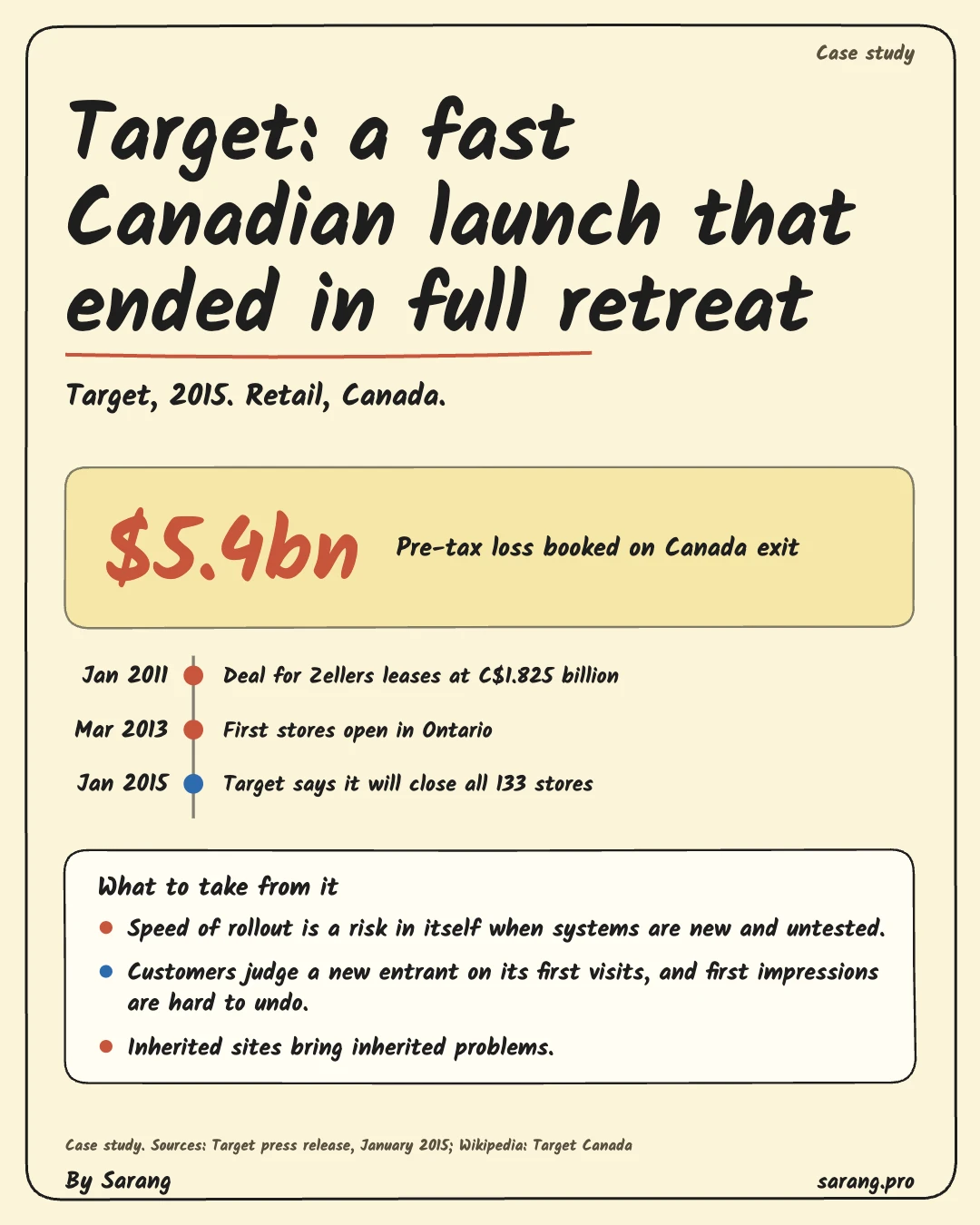
Target paid C$1.825 billion for Zellers leases in 2011, opened 133 Canadian stores from 2013 and shut them all by April 2015, with about US$5.4 billion of expected losses.

- paid for the Zellers leases in 2011
- C$1.825bn
- stores in Canada at the exit
- 133
- employees affected
- 17,600
- expected pre-tax loss from discontinued operations
- ~US$5.4bn
The situation
On the morning of 15 January 2015, Target Canada Co. filed for creditor protection under Canada’s Companies’ Creditors Arrangement Act at the Ontario Superior Court of Justice in Toronto. In Minneapolis the parent company announced that it would stop operating in Canada altogether. Target Canada had 133 stores and about 17,600 employees. It had opened its first store less than two years earlier, in March 2013.
The figures were large. Target said it expected about US$5.4 billion in pre-tax losses on discontinued operations in the fourth quarter of 2014, mainly from writing down its investment in Canada, and about US$275 million more in fiscal 2015. Cash costs of the exit were put at US$500 million to US$600 million. The company offered C$70 million (about US$59 million) to an employee trust, enough to give nearly all staff at least 16 weeks of pay. Brian Cornell, who had become chief executive only months earlier, said Target had been “unable to find a realistic scenario” that would bring Target Canada to profitability until at least 2021.
Target’s shares rose almost 3 per cent on the news, according to the Canadian Broadcasting Corporation. Investors treated the exit as the removal of a drain on a company whose US business was still sound. This case looks at how a retailer with a strong brand, 1,801 stores at home and a careful reputation ended up in that position.
Background
Target in 2010
By the end of 2010 Target operated 1,752 stores in 49 US states, plus its website. It had built its name as a discount chain known for affordable designer collaborations, which the Associated Press dated to Michael Graves in the late 1990s. It had never opened a store outside the United States. It also gave 5 per cent of its income to local communities each year, a pledge it said it would extend to Canada.
In the US, shoppers often saw Wal-Mart as cheaper on staples, according to the Associated Press. Canada offered a new market next door. The Motley Fool later noted that Minneapolis shares much of Canada’s climate and culture, which should have favoured Target.
Zellers and the Hudson’s Bay Company
Zellers was the discount chain of the Hudson’s Bay Company (HBC), and CanadExport later described it as a failed chain. HBC’s executive chairman, Richard Baker, understood that Zellers’ leases were worth more than its trading, according to the account later published by Canadian Business. Wal-Mart was also interested in the leases and then backed out, and Canadian Business reported that Target bid higher because Wal-Mart was involved.
On 13 January 2011 Target announced that it would pay C$1.825 billion for the leasehold interests in up to 220 Zellers sites. The price was to be paid in two equal instalments of C$912.5 million, in May and September 2011. Zellers would sublease the sites and keep trading under its own banner for a time. Target expected to open 100 to 150 Canadian stores in 2013 and 2014, and said renovating the sites would cost more than C$1 billion. Chairman and chief executive Gregg Steinhafel called it “an outstanding opportunity” to extend the Target brand, and the release said it was the first time in the company’s history that it had expanded into a new country’s retail market.
The release also warned that expansion into a country where Target had never operated stores carried risk. It said earnings would dilute before the openings and turn accretive in the first full year of operation.
The industry
A concentrated market
The CanadExport article from the Canadian Trade Commissioner Service named Walmart, Costco, Canadian Tire and Giant Tiger as the dominant names in the value segment, the part of the market Target wanted.
Leases and speed
The Zellers leases shaped the economics. They committed Target to opening stores quickly, because rent had to be paid on sites whether or not they were trading, according to Canadian Business. That created a push to open the whole network in a short time. The company’s plan called for 124 stores and three large distribution centres at about the same time, which the CanadExport piece called “too much at once”, quoting retail adviser Antony Karabus.
Shoppers and expectations
Early reports described high prices, bare shelves and supply chain problems. Prices on some products were well above US prices, according to the Canadian Trade Commissioner Service, and Mandeep Malik of McMaster University told the CBC in 2015 that he thought Target had “overestimated the reception they would get”.
The decision
The decisions Target made between 2010 and 2012 can be framed as three choices. The sources do not give a full internal record, so the options are described as the obvious alternatives, with what the reporting says about each.
Option one: grow from scratch
Target could have opened a handful of stores on new sites, learned from them and then expanded. That would have been slower and would have missed the chance to take over a ready-made network. It is also close to what the Motley Fool and the CanadExport adviser later said should have happened: build distribution first, or start with one or two test stores to expose problems early, as supply chain consultant Marc Wulfraat suggested.
Option two: buy the Zellers leases
This was the choice Target made. The price was C$1.825 billion for up to 220 sites, with a pace set by the leases. Canadian Business reported that Target bid more than it otherwise would have because Wal-Mart was circling, and that the timetable it set was faster than was practical. Steinhafel was reported to have later said that if he could redo the launch he would renegotiate the real estate deal.
Option three: open fewer stores
The 2011 release spoke of 100 to 150 stores in 2013 and 2014, a range that allowed a smaller roll-out. In practice Target planned 124 stores by the end of 2013, according to Canadian Business. The sources do not say that a smaller route was seriously considered.
What the plan assumed
The release said returns should be similar to those of new US stores. Canadian Business reported that Target Canada expected to be profitable within its first year. That assumption is the weakest point in hindsight: a retailer opening hundreds of stores in a new country on a US timetable would have found it hard to meet.
What they did
Buying the leases, 2011
Target closed the Zellers deal in 2011. It also set out to sell its US credit card receivables portfolio, which totalled US$6.7 billion at 30 October 2010. The sale was completed in 2013, according to later references in the company’s 2015 release to the 2013 credit card portfolio sale.
Building the systems, 2011 to 2012
Target chose to buy a new supply chain system rather than extend its US one. According to Canadian Business, the US software could not handle French characters or Canadian dollars, so the company went with SAP, with Accenture as lead consultant (Accenture denied any link to the problems). The warehouse software did not communicate properly with SAP, and the point-of-sale vendor was Retalix. The forecasting tool needed years of sales history, so buyers used optimistic US-based projections.
About 75,000 products had to be entered into SAP. Much of the data entry was done by young merchandising assistants, and some by contractors in India. A “data week” in late 2012 was meant to verify every point by hand; it stretched into two weeks. Target’s own team later estimated that the product data in SAP was accurate only about 30 per cent of the time, against 98 to 99 per cent in the US.
Opening, March 2013
In February 2013, about a dozen senior employees told Tony Fisher, the 38-year-old president of Target Canada, that there were serious supply chain and readiness problems. The stores opened on schedule anyway, starting in March 2013, with Guelph, Ontario, opening on 5 March. Target planned 124 stores by the end of the year.
Problems appeared at once. Shoppers complained on social media about empty shelves. Point-of-sale terminals froze and sometimes gave the wrong change. Meanwhile the three distribution centres, about four million square feet in total, filled up. Automatic replenishment was switched off during the first openings and not fully restored until later in 2013, according to Canadian Business. Target rented extra storage, including a site in Vancouver.
Trying to repair it, 2013 to 2014
CanadExport reported that in August Target announced a partnership with designer Sarah Richardson and a price-match policy, and said it was lowering prices and opening purpose-built stores. The report names Mark Schindele as president of Target Canada, a post he took in May 2014, so the announcement was most likely in August 2014. He named three priorities: in-stock levels, pricing and assortment.
An “in-DC date” misunderstanding came to light in 2014. Target took it to mean the date a product would arrive at the distribution centre, while some large vendors took it to mean the date they should ship, according to Panorama Consulting’s account. An automatic data check was installed in 2014, which a former employee described as “very late in the game”.
Leadership change, May 2014
In May 2014 Steinhafel stepped down, two weeks before Target fired Fisher. Canadian Business said he left after a US$941 million Canadian loss in 2013, a data breach in the US and the troubles in Canada. John Mulligan, then chief financial officer, became interim chief executive and said one key priority was “improving performance in Canada more rapidly”. Schindele, 45, a 15-year Target veteran, took over Canada. In June 2014 Target Canada released an apology video.
Cornell’s review, late 2014 to January 2015
Cornell, an outsider with experience at PepsiCo and Wal-Mart, became chief executive in 2014. The Motley Fool reported that Canada was producing US$627 million in losses before interest and taxes in the year to date. Cornell said holiday trading did not show the step-change in performance Target needed. On 15 January 2015 the company took the decision to leave.
What happened
The wind-down
The wind-down was supervised by the court, with Alvarez and Marsal Canada as monitor and Lazard advising on the sale of real estate. Aaron Alt, previously Target’s treasurer, was named chief executive of Target Canada to run the process. The CBC reported that about US$1.2 billion of debt could come off the books through lease exits, and that the wind-down was expected to take four to five months. Target committed a US$175 million debtor-in-possession loan, subject to court approval.
The last of the 133 stores closed on 12 April 2015, according to a FashionNetwork report on the Walmart purchase. That same report said about 17,000 employees lost their jobs and that the charge in the quarter was US$5.1 billion. Target’s own January release expected US$5.4 billion, so the figures differ, probably because of timing and final adjustments.
Selling the leases
| Date | Event | Value |
|---|---|---|
| March 2015 | 11 leases sold back to landlords Oxford Properties and Ivanhoe Cambridge | C$138 million before tax |
| May 2015 | Walmart Canada buys a distribution centre, 12 store leases and an owned property | C$165 million, plus about C$185 million to renovate |
| May 2015 | Canadian Tire agrees to buy 12 leases | $17.7 million |
Walmart said it would hire about 3,400 associates in British Columbia, Manitoba, Ontario and Quebec. Walmart, the retailer Target had set out to compete with, was among the buyers of its sites.
The cost
The CBC reported almost US$1 billion in losses in the first year, and a Moody’s analyst cited more than US$1.5 billion in total losses. Canadian Business said Target Canada had spent US$7 billion by the time of the bankruptcy filing. These are different measures, and the sources do not explain how the figures relate, so they should not be compared directly. The most reliable company figure is the roughly US$5.4 billion write-down that Target announced, plus the cash exit costs.
Other views
The supply chain view
Most reporting puts supply chain and systems failures at the centre. Panorama Consulting listed a rushed SAP implementation, a team without the necessary functional knowledge, insufficient testing and poor data. That firm sells consulting, so its account carries a bias towards systems explanations, but it matches the detail in Canadian Business: faulty data, systems that did not talk to each other, and empty shelves in stores with full warehouses.
The pricing and brand view
Others pointed to prices. CanadExport and the CBC both said prices were higher than shoppers expected. The Associated Press, writing about the US business in May 2014, said many shoppers saw Target’s staple prices as higher than Wal-Mart’s.
The speed view
Analyst Doug Stephens told the CBC that the supply chain problems were avoidable and that the Canadian shopping experience was comparable to Zellers, the chain Target replaced. Canadian Business suggested that the speed was driven by the leases. Karabus’s phrase was that Target tried to do too much at once.
The investor view
The Motley Fool said the exit removed a financial burden but also meant a lost opportunity. It argued that the pressure was now on Cornell to fix the US online business. Charlie O’Shea of Moody’s called the exit “an admission that it has failed in its attempt to enter a new market”.
Limits of the evidence
Most of the detail about internal decisions comes from former employees speaking to Canadian Business, mostly without names, and Target did not confirm their accounts. Target’s own statements are brief. The sources therefore cannot show who made each decision.
Reading it through a framework
Value chain
Michael Porter’s value chain separates the activities that create a product’s value: inbound logistics, operations, outbound logistics, marketing and service, supported by infrastructure, people and technology. Target Canada’s problems clustered in the support and logistics activities. Inbound logistics failed when distribution centres filled while stores sat empty. Technology failed because the data was wrong. Human resources failed because staff were hired fast and trained for weeks, compared with months in the US. Shoppers felt these back-office failures as bare shelves. The lesson is that the stores a customer sees depend on the activities the customer never sees.
Real options
A real option is the right, but not the obligation, to make a later investment. Opening a few stores first, as Wulfraat suggested, would have kept the option to scale up or stop at low cost. Instead the lease deal turned Canada into a commitment to open 124 stores quickly, with fixed rents and large systems costs. The company had paid C$1.825 billion for sites, so it kept opening. Cornell’s remark that no path to profit existed until at least 2021 shows the cost of that commitment: once the value of waiting disappeared, the only choices were more money or a full exit.
Since then
Target did not re-enter Canada with stores. Canadian Business noted that the company later started a small pilot to ship online orders to Canadian customers, with a website that carried the title “Target loves Canada”. The sources opened for this case do not cover Target’s later Canadian activity or its US performance from 2016 onwards, so this section is brief.
In the short term the exit helped the group. Target said in its January 2015 release that it expected US comparable sales growth of about 3 per cent in the fourth quarter of 2014, up from earlier guidance of about 2 per cent, and that it expected higher earnings in fiscal 2015 and higher cash flow in 2016. Its US business became the only reporting segment. Walmart Canada used the freed sites to expand in the provinces where Target had traded, as described above.
What to take from it
- Speed that is set by a property deal, rather than by readiness, can turn a manageable problem into a national one. Target opened stores because the leases demanded it, even after senior staff reported that the supply chain was not ready.
- Data quality is an operating asset. A system that was fed product data accurate about 30 per cent of the time could not order the right goods for the right store.
- Reputation travels across borders in both directions. Canadians arrived with US expectations of price and choice, and the early shortfalls were remembered after later fixes.
- A phased launch gives a company time to learn. Test stores and a slower roll-out would have exposed the distribution and pricing issues at a lower cost.
- A clean exit can be better than a long decline. Cornell and his team set out a figure for the cost and a date, and the market responded with a small rise in the share price.
Questions to think about
- If Target had bought only the best 30 Zellers sites, what would it have lost, and what might it have learned before expanding?
- Who should have stopped the launch in early 2013 when senior employees reported problems, and what information would they have needed to do so?
- How should a company price in a new country when its home-market reputation is for low prices but its landed costs are higher?
- Was the exit in January 2015 too early, too late or about right, given the sources’ evidence on losses and the forecast of profit by 2021 at the earliest?
Concepts at work
This case shows real options in market entry, the value chain and why back-office activities decide front-of-store results, and the cost of sunk investments in leases. Explore them in Insights.
Written from the public sources listed below. Figures are as those sources report them.
Framework
Timeline
- 13 Jan 2011Target agrees to pay C$1.825bn for Zellers leases
- Feb 2013Senior staff warn Target Canada's president of supply chain problems
- Mar 2013First Target stores open in Canada
- May 2014CEO Steinhafel steps down; Target Canada's president is replaced
- Jun 2014Target Canada releases an apology video
- 15 Jan 2015Target Canada files for creditor protection; exit announced
- Mar 201511 leases sold back to landlords for C$138m
- 12 Apr 2015Last of the 133 stores closes
- May 2015Walmart Canada agrees to buy 12 store leases and a distribution centre
Recap cards
Tap a card to check yourself.
Sources and credits
- Target Corporation: Target Corporation to acquire interest in Canadian real estate from Zellers, 13 January 2011
- Target Corporation: Target Corporation announces plans to discontinue Canadian operations, 15 January 2015
- CBC News: Target exits Canada, 16 January 2015
- CBC News: Tony Fisher fired as Target Canada president, May 2014
- Canadian Business (archived copy): The Last Days of Target
- The Motley Fool: Target's failure in Canada, a cautionary tale for retailers, 16 January 2015
- Canadian Trade Commissioner Service: CanadExport article on Target Canada
- Panorama Consulting: Lessons learned from the Target Canada supply chain failure
- Canadian Grocer: Landlords buy 11 Target Canada leases for $138 million, March 2015
- FashionNetwork: Wal-Mart buys some former Target Canada stores, 14 May 2015