Always: how #LikeAGirl turned a common insult into a film watched 85 million times
Always left its product out of a 2014 film about the phrase like a girl, and it drew more than 85 million views and a Super Bowl slot. Here is what that bought the brand.
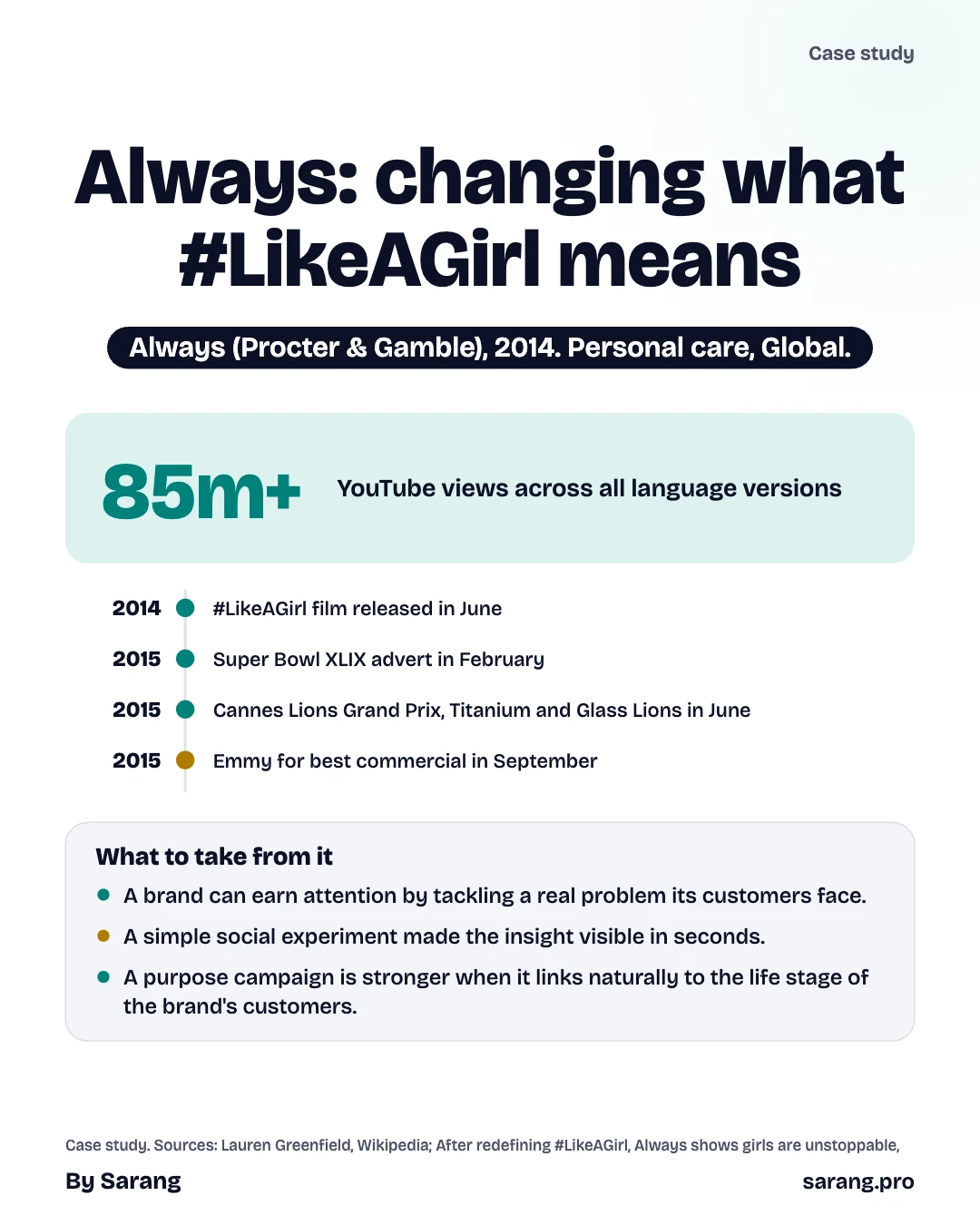
- views of the main film by May 2015
- 85 million+
- online impressions worldwide
- 4.5 billion
- positive association with "like a girl", before and after
- 19% to 76%
- Super Bowl XLIX social mentions, 84% positive
- 400,000+
The situation
On 26 June 2014 Procter & Gamble’s feminine care brand Always put a film on YouTube that contained no product, no price and, in its spoken lines, no brand name. A documentary photographer, Lauren Greenfield, asked adults and boys to run, throw and fight “like a girl”. They flailed and giggled. She then asked girls to do the same, and they ran hard. Over its first few months the film was watched tens of millions of times. By May 2015 Contagious put the figure at more than 85 million views, and the agency’s own measure counted about 4.5 billion impressions worldwide.
The moment of decision came earlier and was less glamorous. Always sold pads and liners to girls and young women. Its agency, Leo Burnett, had found that girls’ confidence falls sharply at puberty, much further than boys’, and is rarely recovered quickly. A film built on that finding would say nothing about absorbency or comfort. It would ask people to stop using a common phrase as an insult. P&G had to decide whether a mass-market consumer goods brand should spend its money on an idea like that, and whether it could expect a return.
The research behind the film gave the idea a number. Leo Burnett’s work found that only 19% of women associated “like a girl” with something positive. After the film, P&G reported that 76% of women aged 16 to 24 said it had changed how they saw the phrase, and that two in three men who watched said they would think again before using it as an insult. The Canadian effectiveness awards later reported higher awareness, higher purchase intent and a return of $2.56 for every dollar spent, though P&G itself declined to publish sales figures.
This case follows the idea from the research insight through the one-day shoot, the online launch, the decision to buy a 60-second slot in Super Bowl XLIX in February 2015, the awards, and the criticism it drew. The question at its centre is a plain one. What does a brand gain by giving up the usual product message, and what does it risk?
Background
A brand with a delicate subject
Always belongs to Procter & Gamble, one of the largest makers of household and personal care goods. The sources opened for this case do not give the brand’s history or its global sales, so this case does not try to retell them. What the sources do show is the category’s habits. A Ms. Magazine writer noted in July 2014 that period-product marketing has traditionally stressed discretion and containment. The industry had long sold to young women by promising that nobody would notice.
That habit made the brief unusual. The client’s request to Leo Burnett, as Contagious reported it, was to support girls’ confidence through puberty and to change the world one girl at a time. The brand was being asked to talk about girls, not products, at the exact age when they were most likely to be choosing a brand for the first time.
The agency and the insight
The work came from Leo Burnett’s offices in Chicago, Toronto and London, with Judy John, then the agency’s chief creative officer in Canada, as a leading voice. The team looked at influences on girls across media, school and the playground. According to Contagious, the phrase “like a girl” kept surfacing. When the team tested it, people, women in particular, responded with personal stories about being on the receiving end of it.
The finding about puberty was the engine of the idea. Confidence drops for girls at that stage much more than for boys, and does not come back easily. The phrase was a small, daily example of why. It also had a practical advantage: everyone already knew it, so the film needed no explanation of the problem.
The director
The agency chose Lauren Greenfield, a photographer and documentary maker, and the author of Girl Culture. Her presence mattered to the tone. The film was shot as a casting session, not as a staged advertisement. Participants were told they were taking part in market research that might become a short film, and they were given no script. The team expected the younger girls to give everything and the older girls and boys to fall back on stereotypes, and that is what the camera caught.
The industry
Advertising that speaks to women’s status
By 2014 a recognisable genre existed. The Week’s Lauren Hansen traced it to Dove’s Real Beauty work, including the “Evolution” film shown during the 2006 Super Bowl. Her list of later examples included Intel’s 2013 “Every girl has the power to change the world”, a Bing video of women at the end of 2013, and Verizon’s 2014 “Inspire her mind”. Andi Zeisler, writing in Salon in July 2014, added Pantene and the toy maker GoldieBlox. Industry commentators grouped these under names such as femvertising and empowertising: advertising built to make women and girls feel capable, designed to be shared.
The economics of earned attention
The campaign’s media budget was small by consumer goods standards. The Strategy magazine report on the Canadian effectiveness awards put paid media at between $1 million and $2 million a year across North America. The plan was to earn attention rather than buy it. A film with no product in it was more likely to be passed on, and a hashtag gave people a simple way to join in. Gloria Steinem was among those who used it in the first weeks, according to The Week.
The platform and the Super Bowl
YouTube was the first stage. The Super Bowl was the second. Adobe’s analysis of social media around the 2015 game, covering more than four million mentions, combined volume, growth, sentiment, spend efficiency and international reach to rank the advertisers. That scoring system rewarded ads that people talked about, which suited a campaign designed for conversation.
The decision
The sources do not describe a formal options paper inside P&G. They do show the choices the team faced, and the shape of the trade-offs can be set out from the facts.
Option one: a product-led film
The obvious route was an advertisement that connected confidence to the product, for example by showing a girl continuing to play sport with confidence because of what she wore. That would have stayed close to the usual brief and made the sales link easier to claim. It would also have turned a message about girls into a message about pads, which the research did not support.
Option two: a social experiment with no product
The team chose to leave the product out deliberately. Contagious reports that the aim was to keep the message emotional and to encourage sharing. The Week noted that the film never names the brand in its dialogue and never says “tampon” or “pad”. The only reference to periods is on-screen text about confidence falling in puberty. The risk was that viewers would remember the film and forget the brand. The Super Bowl version, IBTimes reported, ended with an invitation to join the brand in championing girls’ confidence at its website.
Option three: stay online or go to the Super Bowl
After the online launch the film was already a success on the measures available. Taking it to the Super Bowl meant moving from a free platform to paid television airtime, with a version cut down to 60 seconds. The sources opened do not give the price. IBTimes reported that Always’s global vice president, Fama Francisco, said the brand wanted to take the message to a bigger stage. The film had already shown that the idea worked online. The question was whether it would work in front of a mass audience watching a football game.
What they did
Casting and shooting, spring 2014
Casting used live auditions, video submissions and street casting in parks, according to Contagious. SHOOT reported that the shoot itself took one day, after four to six weeks of preparation and followed by several months of editing. The first cut ran five to six minutes and was trimmed. Running, throwing and fighting were chosen as the actions because they photograph clearly. The Drum’s account, which says the team reportedly spent 16 hours reviewing footage to choose the final cast, also notes that the brand used a case-study approach rather than a product message.
Launch, 26 June 2014
The film went online on 26 June 2014, supported by paid posts on Twitter and Facebook, as Strategy reported. Sources differ on its final length: The Drum gives three minutes, Strategy four. Zeisler wrote in Salon that it passed 10 million YouTube views in its first four days. By 18 July The Week described it as having tens of millions of views.
Super Bowl XLIX, 1 February 2015
A 60-second version ran after Katy Perry’s halftime show during the game between the Patriots and the Seahawks, according to IBTimes. It ended with an invitation to the Always website. Adobe’s ranking, reported by TechCrunch that evening, placed the Always spot first among the Super Bowl advertisers for social buzz, with more than 400,000 mentions and 84% of them positive.
Stronger Together, March 2015
Two months later, for International Women’s Day, Always released a follow-up film called “Stronger Together”. It invited girls to post their own photos, videos, Vines and Instagram pictures, according to Contagious. The aim was to turn viewers into contributors.
Measurement and awards, 2015 and 2016
Always commissioned research six months after the first airing. SHOOT reported that the share of respondents with a positive association rose from 19% before the film to 76% afterwards. The film then collected awards, set out in the next section.
What happened
Reach
| Measure | Figure | Source |
|---|---|---|
| Views of the main film | More than 85 million by May 2015 | Contagious; Strategy |
| Global impressions | 4.5 to 4.58 billion | SHOOT; Strategy |
| Shares | More than one million | Strategy |
| Super Bowl mentions | More than 400,000, 84% positive | TechCrunch (Adobe) |
| Countries reached | More than 150 | The Drum |
Strategy added that earned video views ran at twice the industry benchmark, and that the campaign was the leading brand digital activation around Super Bowl XLIX. Greenfield told SHOOT that about 90 million people internationally had seen the film. Different sources count differently, and The Drum’s 2022 retrospective quotes over 70 million YouTube views, so the figures are best read as a range.
Attitudes and sales indicators
Strategy’s report on the Canadian effectiveness awards gave a set of brand figures. Top-of-mind awareness rose from 77% to 83% overall, and from 49% to 58% among core teenage girls. Purchase intent rose from 42% to 46% overall, and from 40% to 60% among teenagers. Brand equity for Always pads rose 3.3 points, from 38.1% to 41.4%, and brand share rose 1.4 points to 59.6%. The return on investment was $2.56 per dollar spent. Strategy noted that pricing and distribution stayed the same as in the previous year, which makes the lift easier to credit to the communication. Whether every figure refers to Canada alone is not stated clearly in the article.
P&G did not publish sales numbers. Judy John told Contagious that the work had delivered business results, but the company shared no figures with the magazine.
Awards
The campaign took 14 Cannes Lions, including the newly created Glass Lion for Gender Equality and a Titanium Lion, and seven Clios, according to SHOOT. A separate PR entry by MSLGroup also won a Gold Lion in 2015. In September 2015 it won the Emmy for Outstanding Commercial, beating Snickers, Adobe, Budweiser, Gatorade and Nissan, according to the agency’s release. Greenfield became the first individual woman to be nominated as DGA Commercial Director of the Year, as SHOOT reported. The Canadian CASSIES gave it a Grand Prix with two Golds in February 2016. In 2022 The Drum ranked it number 18 in its list of the best ads ever.
Mark Tutssel, Leo Burnett’s global chief creative officer, said of the Emmy that it proved how an idea could have a positive effect on society.
Other views
The commercial question
Critics did not dispute the message. They asked whose interests it served. Simone Lieban Levine wrote in Ms. Magazine that the campaign sat awkwardly with a brand that sold products defined by discretion, and quoted the Daily Beast’s Emily Shire as saying it had nothing to do with the product. She welcomed the film but doubted that Always could separate the empowerment message from selling. In Salon, Andi Zeisler asked what was actually being sold, and argued that the genre avoided harder issues such as pay gaps or factory conditions. She also questioned whether a political movement should be marketed as a consumer brand.
The emotional pull
The Week collected criticism from other quarters. Some called the ad emotionally exploitative. Erin McNeill, who runs a media literacy group, warned that emotional appeals aimed at children can be exploitative because young viewers may not see the profit motive. Amy Jussel of Shaping Youth argued that showing stereotypes in order to challenge them can reinforce them. IBTimes recorded that the Daily Beast critic used the same word, “emotionally exploitative”, about the Super Bowl version.
The defence
Hansen, writing in The Week, took the opposite view. She argued that girl-power messaging is worth having even when the company profits, and suggested praising brands for good content while pressing others to improve. Greenfield said in her SHOOT interview that she valued the social change caused by the campaign more than any award.
Limits of the evidence
Most of the effectiveness figures come from the company, its agency or an awards entry. The 76% figure measures what respondents said about a phrase, not how they behaved. The 19% baseline is described differently across sources: Contagious says women, SHOOT and others tie it to the 16 to 24 group. P&G did not release sales data, so the case for commercial impact rests on brand measures. The Super Bowl airing is dated February 2015 by every source listed here.
Reading it through a framework
Positioning
Positioning is the choice of what a brand stands for in the customer’s mind. Always moved from a functional position, protection and discretion, to a purpose position: the brand that is on the side of girls’ confidence. The evidence for a shift is in the awareness and purchase-intent figures among teenagers, which rose faster than the overall figures. The weakness is also visible. The film avoided the product so completely that the link to the brand rested on one closing line and the website. A purpose position needs repeated action to be believed, and the Stronger Together follow-up and the later calls for girls to contribute their own content were attempts to supply it.
Jobs to be done
This framework asks what a customer is trying to achieve when she chooses a product. A teenage girl choosing pads is partly hiring a product to avoid embarrassment, which fits the category’s emphasis on discretion that Ms. described. The film worked on a neighbouring job: helping girls feel confident while they do things like running and playing sport. Because the two jobs overlap in the same person at the same age, the brand could move from one to the other without needing a new audience. What remained unproven, on the sources available, is whether feeling good about the brand’s purpose made girls more likely to buy it, or whether the improvement came from the greater familiarity the campaign created.
Since then
The sources opened for this case are almost all from 2014 to 2016, with one retrospective from 2022. They show that the campaign went on being cited. The Drum ranked it number 18 among the best ads ever in June 2022, and said the hashtag was still prompting conversation that year. Its entry also describes the film as one of YouTube’s top three ads of the decade, a claim this case reports as the Drum’s. The campaign had also become the example that critics reached for when they wrote about brands borrowing the language of empowerment.
What this research did not find in an opened source is a verified account of Always’s later campaigns, their results, or the brand’s sales since 2016. For that reason the case stops where the evidence stops, and it does not claim to know how the idea performed in the following decade.
What to take from it
- A campaign built on a specific, researched insight, here the fall in girls’ confidence at puberty, gave the creative work a clear job and made it easier to defend inside the company.
- Leaving the product out of the film made it easy to share and hard to dismiss as an advertisement, but it also made the link back to the brand thin, so the follow-up work had to build it.
- A small media budget can go a long way when the idea invites people to take part, as the hashtag and the Super Bowl conversation did.
- Attitude measures such as the move from 19% to 76% are useful evidence, but they are claims about what people say, and they need to be read alongside sales data that the company chose not to publish.
- Criticism arrived from the start and came from people who liked the message. A brand that takes a social position has to expect questions about its motives and be ready to answer them with action.
Questions to think about
- If P&G had required the film to show the product, what would have been gained and what would have been lost?
- Which of the reported figures would you trust most as proof of commercial impact, and what extra evidence would you ask the company for?
- Where is the line between a brand taking a stand and a brand borrowing a movement, and which side of it does this campaign sit on?
- How would you measure whether the phrase “like a girl” has changed in everyday use, rather than in a survey?
Concepts at work
Three ideas from this case are brand purpose, earned media and jobs to be done. Explore them in Insights.
Written from the public sources listed below. Figures are as those sources report them.
Framework
Timeline
- 2014Leo Burnett research finds girls' confidence drops sharply at puberty
- 26 Jun 2014#LikeAGirl film launched online
- 1 Jul 2014Ms. Magazine publishes early questions about the campaign
- 21 Jul 2014Salon publishes Andi Zeisler's critique
- 1 Feb 201560-second version airs in Super Bowl XLIX
- Mar 2015Stronger Together film for International Women's Day
- May 2015Contagious reports more than 85 million views
- 201514 Cannes Lions awarded, including a Titanium Lion
- Sep 2015Emmy for Outstanding Commercial
- Feb 2016CASSIES Grand Prix awarded
- Jun 2022The Drum ranks the film 18th among the best ads ever
Recap cards
Tap a card to check yourself.
Sources and credits
- TechCrunch: P&G's #LikeAGirl Ad Scored The Most Social Buzz During Super Bowl 2015 (1 Feb 2015)
- Contagious: Insight & Strategy: #LikeAGirl (21 May 2015)
- Strategy: CASSIES Grand Prix: Always strikes a chord (12 Feb 2016)
- SHOOT: Emmy win, DGA nomination, 14 Cannes Lions among honors for #LikeAGirl (23 Oct 2015)
- PR Newswire: Leo Burnett's #LikeAGirl Wins Emmy For Outstanding Commercial (15 Sep 2015)
- The Drum: World's best ads ever #18, Always' Like a Girl (14 Jun 2022)
- The Week: Corporate advertisers are hijacking girl power to sell products (18 Jul 2014)
- Salon: Worst sales pitch ever (21 Jul 2014)
- Ms. Magazine: We Heart (and Question): New Commercial from Always (1 Jul 2014)
- IBTimes: Super Bowl 2015 viral girl ad challenging gender stereotypes (1 Feb 2015)