Apple: how Think Different helped bring the company back from the brink in 1997
Apple lost $1.05 billion in fiscal 1997, then launched Think Different with no products shown, and earned $309 million in fiscal 1998 as the iMac sold 278,000 units in six weeks.
- Apple's fiscal 1997 loss
- $1.05 billion
- Microsoft's investment in Apple in 1997
- $150 million
- price Apple paid for NeXT
- About $430 million
- time the agency had to finish the spot after approval
- 17 days
The situation
In the summer of 1997, Apple was losing money, losing customers and losing its place in the story of personal computing. Time reported that under chief executive Gil Amelio the company lost $1.8 billion across its 1996 and 1997 fiscal years, and that attempts to sell Apple to IBM and Sun Microsystems had failed. Apple’s own fiscal 1997 loss was $1.05 billion, according to figures CNN published a year later. One article puts Apple’s share of the PC market at about 3 to 5% in 1997, though it gives no source for the range.
Steve Jobs had been brought back as an adviser when Apple bought his company, NeXT, in December 1996 for about $430 million. By 14 June 1997 he had helped push Amelio out. Lowendmac says he acted as de facto chief executive without the title, while Time calls him interim chief executive. Within weeks he made three moves: a $150 million investment from Microsoft, a drastic cut to the product range, and a new advertising campaign.
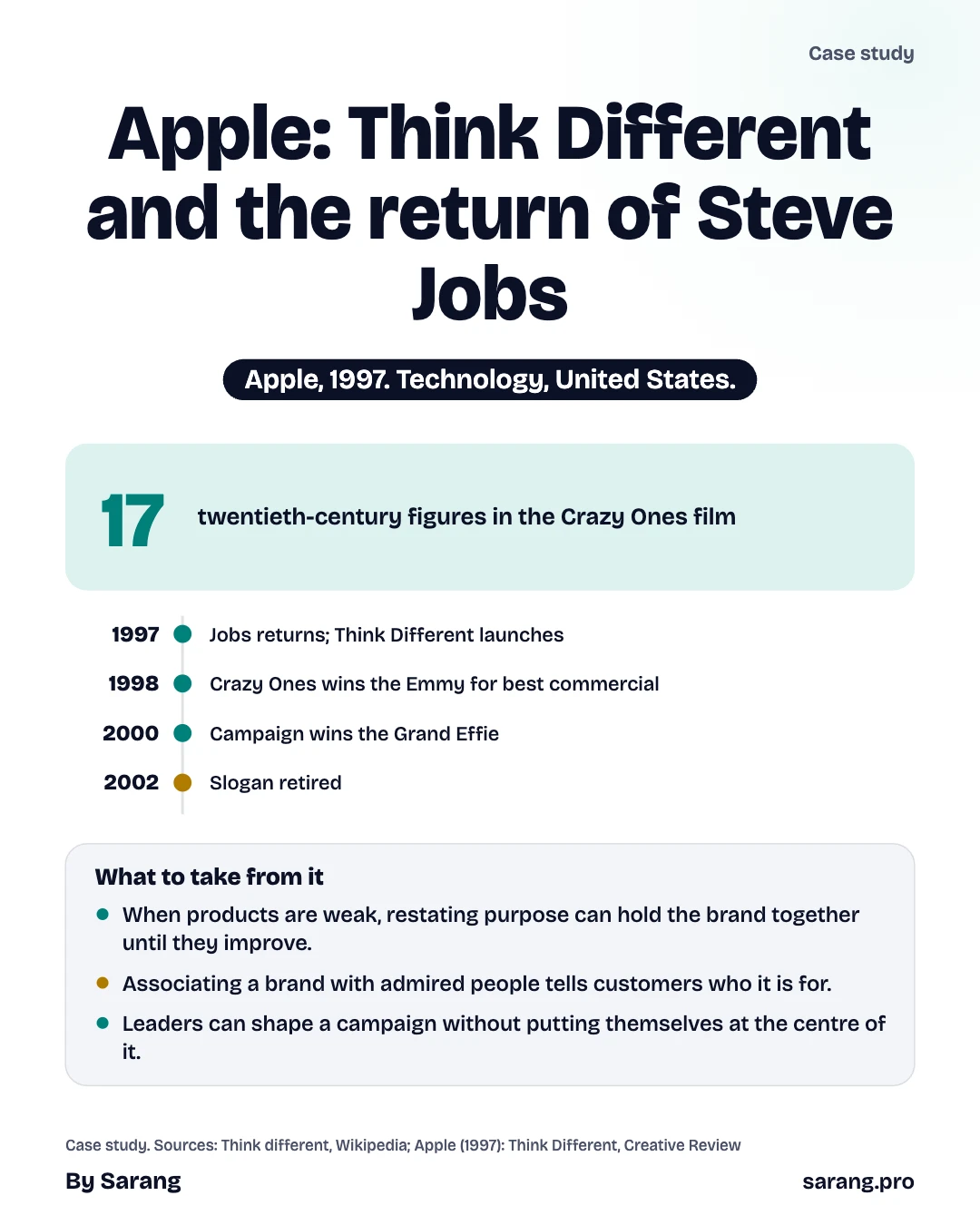
The campaign, “Think Different”, was presented to Jobs on 3 August 1997 and went on air on 28 September. It showed no Apple products. Its aim was to remind people, and Apple’s own staff, what the brand stood for. By fiscal 1998 Apple earned $309 million on $5.94 billion of revenue, its first profitable year since 1995. This case asks how much of that recovery the campaign explains, and how it fitted with the other things Jobs did.
Background
A company that lost its underdog image
Apple was the maker of the Macintosh. By the mid-1990s its public image had weakened. One account says Apple had lost its “David” image and had become a damaged brand next to Microsoft and IBM, which looked like the Goliaths of the industry. Jobs had left the company on 13 September 1985 and stayed away for eleven years.
Expensive projects and failed products
Apple spent more than a billion dollars on the Newton, a handheld device that was unprofitable and unpopular. Between 1995 and 1997 the company lost hundreds of millions of dollars and cut thousands of jobs. Under Amelio it reduced its list of projects from 350 to 50. A substack article says Apple had posted more than $1 billion in losses with 3,800 layoffs, and that it was roughly 90 days from bankruptcy by fall 1996, a claim that comes from one secondary source and is treated with caution here.
The clone problem
Apple had also licensed its operating system to clone makers. One example from the period is the Umax S900 clone, which was cheaper than Apple’s Power Mac and faster, and which embarrassed the company. Britannica says Jobs cancelled Amelio’s clone agreements after returning to lead the company. Cloning gave customers a cheaper route into the Mac platform, but it took sales from Apple’s own machines.
The NeXT purchase
Amelio found that Apple’s internal research had not produced an acceptable replacement for the Mac’s ageing operating system. He bought NeXT for its software, NEXTSTEP. Sources give the price as about $430 million (Time), $429 million (a substack article) or “more than $400 million” (Britannica), so the exact figure differs slightly. The purchase brought Jobs back, and Time notes that every Apple operating system from 2001 onward descends from NeXT’s software.
The industry
A market led by Windows
The personal computer business in 1997 was led by machines running Microsoft’s Windows. A share of 3 to 5% is small, and it left Apple a minor player beside the Windows machines. The sources used here do not give figures for the total market, so Apple’s position is described only in relative terms.
Retail and distribution
Selling a computer that few people buy is difficult. CNN reported in October 1998 that Best Buy had resumed carrying Macintosh computers, which implies the chain had dropped them. The article does not explain when or why that happened, so this case does not date the earlier decision.
The competition for the idea of computing
IBM ran a “Think” advertising line for its ThinkPad. According to the account of Craig Tanimoto, the art director credited with the idea, “Think different” was meant to stand out against that. Apple’s agency chose to answer a rival’s call to think with a call to think differently.
The sources opened for this case do not discuss regulation of the computer industry in this period, so it is left out.
The decision
What was at stake
Time’s account says Apple’s cash could run out and its end was a real possibility. A company in that position has little room for error. Jobs had to decide how much of Apple to keep, which products to sell, and what to say publicly about the company before it had new products to show.
Option one: shrink and sell what was left
The obvious alternative was to treat Apple as a company in managed decline: cut costs, sell assets, and look for a buyer. Time notes that talks to sell Apple to IBM and Sun had already failed. This path was available in principle, though no source shows Jobs weighing it.
Option two: become a software company or build Windows machines
Britannica says Jobs did not build machines running Windows and did not turn Apple into a software-only company. He believed Apple’s own operating system made it uniquely able to innovate. Both alternatives would have reduced Apple’s control of the whole product, which is what made it different.
Option three: rebuild the brand first
Jobs chose to simplify the product range, take Microsoft’s investment, and advertise the brand while new products were still in development. Lowendmac records him telling employees on 30 September 1997 that the brand was one of the most valuable things Apple had going for it. That reasoning treats the brand as an asset to be restored before products arrive.
The agency choice
Chiat/Day was brought back as Apple’s main agency, and Lee Clow became a regular presence on the Apple campus. Apple’s lead time was short: the agency had 17 days after approval to finish a television spot and billboards for Los Angeles and New York.
What they did
June 1997: taking control
On 14 June 1997 Jobs helped push Amelio out. Time says he became interim chief executive while still working at Pixar, and removed board members, cut staff and costs and cancelled dozens of products. In the lowendmac account Amelio had cut 350 projects to 50 and Jobs cut the number to 10.
August 1997: Microsoft
Apple accepted a $150 million investment from Microsoft. Time records that the audience at the 1997 Macworld Expo booed when Bill Gates appeared on a video screen. The deal gave Apple cash and a relationship with the company that dominated the software side of the industry.
Simplifying the range
Jobs simplified the product line into a product matrix. A substack article says he cut roughly 70 products and variations to four, and CNN reports that Apple cut its product families from 15 to four and left printers and the Newton. The two counts use different units, so they do not conflict, but they should not be compared directly.
3 August 1997: the pitch
Lee Clow presented the “Think Different” slogan on 3 August. Jobs first wanted anonymous figures in the ads, then celebrities and thinkers. One account credits art director Craig Tanimoto with inventing the line and pairing it with black-and-white photographs of well-known figures. The account of a former agency creative director, Rob Siltanen, says Jobs’s first reaction to the “Crazy ones” script was harsh. He recalls Jobs calling it a failure, and says it took several rewrites to win him over.
Making the commercial
The campaign began as print. The agency made a mood film set to Seal’s “Crazy”, but a shorter edit with the song would not work, so Siltanen proposed a voiceover script instead, comparing its effect to the film Dead Poets Society, a Jobs favourite. Robin Williams declined to do advertising. Richard Dreyfuss narrated the final spot. Clow suggested that Jobs read the script himself, and Jobs recorded a version. Siltanen says he heard it and thought it too self-serving. The choice between the two was not settled until shortly before broadcast, and the Dreyfuss version ran. The spot became a major hit.
At the pitch, according to the same account, Jobs first said the idea was great but that he could not do it, because putting the Apple logo beside great thinkers might draw press criticism. He then changed his mind and went ahead. The sequence shows a leader weighing the risk of looking presumptuous against the value of the message.
Participants, or their estates, were not paid; money and computer equipment went to charities of their choice. The first rule was that no products would appear in the ads. Jobs personally secured image rights for the print advertisements, calling the Henson and Kennedy families, and travelled to New York to persuade Yoko Ono to allow a photograph of her and John Lennon.
28 September 1997: launch
The campaign appeared on 28 September in print, outdoor and television. Chiat/Day rented hundreds of large sites in New York and Los Angeles. Two days later Jobs held a party at his Palo Alto home for employees to celebrate. Apple later sent posters of figures such as Pablo Picasso, Jane Goodall and Ron Howard to public schools.
What happened
Press and internal reaction
Lowendmac reports glowing press coverage, in contrast to earlier Apple campaigns such as “Power to be your best”. The ads won many awards and developed a cult following. The article gives no sales figures for the campaign, and no source opened here measures its effect on sales directly.
Financial results
| Measure | Figure |
|---|---|
| Fiscal 1997 loss | $1.05 billion |
| Fiscal 1998 net income | $309 million ($2.10 per share) |
| Fiscal 1998 revenue | $5.94 billion |
| Quarter to 25 September 1998 | $106 million profit on $1.56 billion revenue |
| Same quarter a year earlier | $161 million loss |
These figures come from CNN’s report of Apple’s results on 14 October 1998. TidBITS gives the same $106 million quarterly profit, $309 million annual earnings and first profitable year since 1995.
The iMac
The iMac, the egg-shaped one-piece computer, shipped about 278,000 units in its first six weeks. More than 40% of buyers were new to Apple, and 12.5% were Windows users. By the end of 1998 Britannica says it was the highest-selling personal computer in the country. Time says its translucent case was designed by Jonathan Ive.
The cost of the recovery
The recovery had a price in margin. CNN reported that Apple expected gross margin in the next quarter to come in slightly below the 26.8% of the fourth quarter, because of the low-cost iMac and higher marketing spending. The company was choosing volume and awareness over margin for a time. The same report notes that Best Buy resumed carrying Macintosh computers and that Mac OS 8.5 was due to ship on 17 October 1998.
Operations
Inventory fell to $78 million, about six days’ worth, and unit shipments rose 28% year on year. Jobs said Apple had grown faster than the industry that quarter for the first time in nearly five years.
Share price
One branding article says Apple’s stock price tripled within 12 months with no significant new products, then notes the multicoloured iMacs arrived a year later. The claim is not accompanied by dates or a price series, so it is offered as that author’s assertion.
Other views
Who created the campaign
Accounts differ on authorship. Walter Isaacson’s biography of Jobs says Jobs co-wrote the “Crazy ones” commercial and shared credit for the slogan. Siltanen disputes this. He says he wrote the script and that Tanimoto invented the line. Both accounts are reported second hand here.
The campaign was one part of a recovery
The branding article states that “Think Different” was not solely responsible for Apple’s recovery. It says the campaign rallied customers, employees and shareholders during a difficult period and signalled that Jobs’s return had restored Apple’s direction. The cost-cutting, the Microsoft investment, the clone decision and the iMac all came in the same period.
The Microsoft deal was not popular
The investment brought cash and a working relationship with Microsoft, but it was not welcomed by everyone. Time records that the Macworld audience booed when Gates appeared on screen. Loyal customers saw an agreement with the rival they had defined themselves against. Jobs went ahead anyway, which shows how he ranked the company’s survival above the mood of the room.
Analyst scepticism
In 1998 Jim Carlton wrote that the odds were poor that Jobs could do more than “slow the fall”, according to Time. That view turned out to be wrong, but it shows the doubt that existed while the campaign was running.
Limits of the evidence
Much of what is known about how the commercial was made comes from agency insiders and from a biography, and some of these sources contradict each other. The financial data are stronger than the creative accounts, but they do not separate the effect of the campaign from the effects of the iMac and the restructuring.
Reading it through a framework
The BCG matrix
The BCG matrix sorts a company’s products by market growth and market share, and tells managers to feed the strong ones and drop the weak ones. Apple in 1997 had too many products with too little share. The cut from 15 product families to four, and the exit from printers and the Newton, are a textbook response: concentrate spending on a few lines that could win. The matrix does not say which few to keep, which is where Jobs’s judgement about the Mac and its operating system mattered.
The cost of the approach showed up in the figures. Inventory fell to about six days’ worth by late 1998, which suggests fewer products let Apple manage its supply tightly.
VRIO
VRIO asks whether a resource is valuable, rare, hard to imitate and supported by the organisation. Apple’s own operating system, which Britannica says Jobs thought made Apple uniquely placed to innovate, fits the first three tests. The clone makers showed the limit: licensing the system let rivals sell cheaper hardware and weakened the company’s control. By cancelling the clone agreements Jobs reinforced the point that the operating system had to stay inside Apple.
The brand fits too. Jobs’s remark that the brand was among the most valuable things Apple had suggests he treated it as a resource that rivals could not copy and Apple still owned.
One further point from the framework: both tools work best when applied together. The portfolio cut freed money and attention, and the resource view explained what to protect. Without the cut, the brand campaign would have promoted a confusing range. Without the brand campaign, the cut would have left a smaller company that still looked unsure of itself.
Since then
Apple kept “Think Different” until 2002, when it moved to the “Switch” campaign. Jobs dropped the “i” from his interim title in 2000. Time notes that every Apple operating system from 2001, including the systems for the iPhone and iPad, descends from the software bought with NeXT. Time’s obituary-style article, published when Jobs died in 2011, treats the iMac, with its translucent case designed by Jonathan Ive, as the product that made Apple America’s best-selling computer in 1998.
The sources opened for this case end well before 2025, so they do not report Apple’s later financial scale, and this case does not quote it.
What to take from it
- A struggling company can use a brand campaign to reset belief before new products arrive. Apple’s first “Think Different” ads showed no products at all.
- Pairing a message with hard operational changes matters. The campaign ran alongside product cuts, the end of cloning and a Microsoft investment.
- Credit for creative work is often disputed. The accounts of Isaacson and Siltanen differ on who wrote what, so a business student should note the source of each claim.
- Cutting a product range can raise performance. Apple reduced its product families from 15 to four and cut inventory to about six days’ worth.
- Advertising rarely explains a recovery alone. The campaign rallied people, but the iMac and the restructuring produced the profits.
Questions to think about
- Would “Think Different” have worked without the iMac, or was the campaign only believable because a product followed?
- Jobs asked for no products in the ads. When is it better for a company in trouble to advertise a belief instead of an offer?
- How would you test the claim that the campaign contributed to Apple’s return to profit, using only the figures available?
- If you were advising Apple in 1997, would you have kept licensing its system to clone makers?
Concepts at work
Brand identity, portfolio rationalisation and VRIO are the three ideas this case illustrates most clearly. Explore them in Insights.
Written from the public sources listed below. Figures are as those sources report them.
Framework
Timeline
- 13 Sep 1985Steve Jobs leaves Apple
- Dec 1996Apple buys NeXT and Jobs returns
- 14 Jun 1997Jobs helps push out Gil Amelio
- 3 Aug 1997Lee Clow presents the Think Different slogan
- 28 Sep 1997Think Different campaign debuts
- 30 Sep 1997Jobs holds an employee party at his home
- 1998iMac goes on sale
- 14 Oct 1998Apple reports a $309 million profit for fiscal 1998
- 2002Think Different gives way to the Switch campaign
Recap cards
Tap a card to check yourself.
Sources and credits
- Low End Mac: Think Different, the ad campaign that restored Apple's reputation
- Britannica Money: Steve Jobs, saving Apple
- Time: Steve Jobs, 1955 to 2011, mourning technology's great reinventor
- CNN Money (1998): Apple results, fiscal fourth quarter
- TidBITS (1998): iMac propels Apple to $106 million in earnings
- Creative Review: Apple (1997), Think Different
- Branding Strategy Insider: The real story of Apple's Think Different campaign
- Substack newsletter: Apple, how 1997 changed everything