Blockbuster: how a 9,000-store chain ended up in bankruptcy
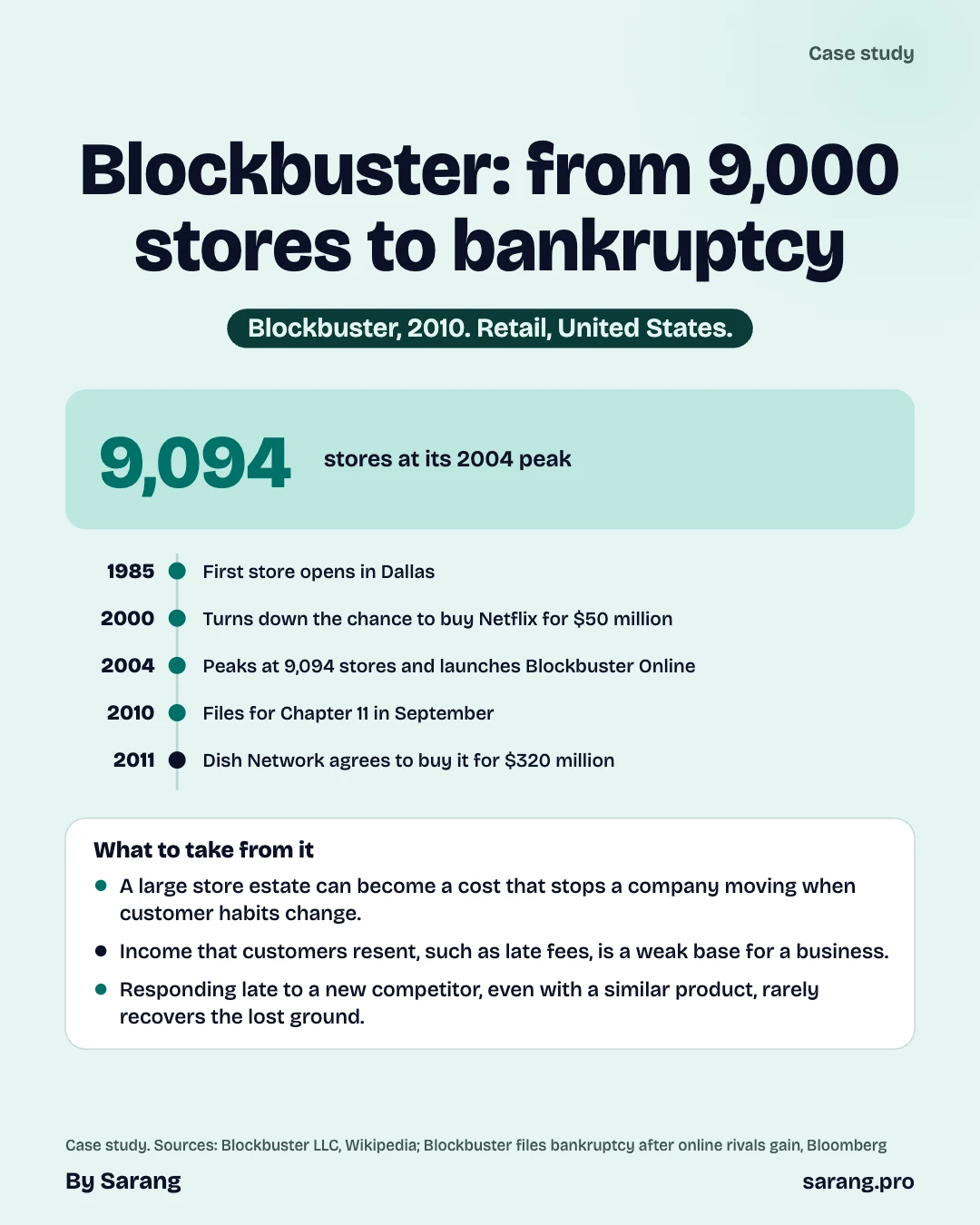
Blockbuster had 9,094 stores and $6.1 billion of revenue in 2004, then filed for Chapter 11 in September 2010 with debts of $1.46 billion and sold to Dish for about $320 million.

- Blockbuster stores at the end of 2004
- 9,094
- revenue in 2004, falling to $4.1 billion in fiscal 2009
- $6.1 billion
- late fees in 2000, 16 per cent of revenue
- $800 million
- net loss in fiscal 2009
- $558.2 million
The situation
On Thursday 23 September 2010, Blockbuster filed for Chapter 11 bankruptcy protection in New York. The company, once the world’s largest movie rental firm, listed assets of about $1 billion and debts of $1.46 billion, according to a report carried by the Washington Times. It employed roughly 25,500 people and said it would keep about 3,300 American stores open while it reorganised.
Six years earlier the picture had been very different. At the end of 2004 Blockbuster had 9,094 stores, revenue of $6.1 billion, and a market value that an Associated Press report put at about $4 billion eight years before the filing. By the time it went to court, that value had shrunk to about $12 million, and the same report said the company had lost more than $4 billion since 2002.
The obvious explanation is that Netflix and streaming killed it. The record is less simple. Blockbuster saw the threat early, built an online rental service, and at times spent heavily against Netflix. It also depended on a fee model that customers disliked, carried large debts, and changed course repeatedly. This case follows those choices from the peak to the auction in 2011, and asks what a market leader can do when its main source of profit is also the thing customers resent.
Background
From one store to a global chain
Blockbuster opened its first store in 1985 in Dallas. David Cook, who had worked in oil and gas software, was the founder. CNN Money’s profile of Cook says he built a distribution system so that new stores could open quickly, with stock matched to local demographics and bar codes tracking about 10,000 films per store. Wayne Huizenga put in about $18 million for voting control, and after disagreements with one of Huizenga’s lieutenants Cook left with about $20 million.
Under Huizenga the chain expanded fast. Viacom bought it in 1994. Fast Company gives the price as $8.4 billion, while the Associated Press says $7.6 billion, so the sources differ. Blockbuster was floated again in 1999, with a valuation of up to $4.8 billion according to Fast Company.
How the stores made money
A Blockbuster store earned from two things: rentals and the sale of films, games and snacks. Rental income was lifted by what the industry called extended viewing fees, known to customers as late fees. The Associated Press reported that Blockbuster collected nearly $800 million in late fees in 2000, which was 16 per cent of its revenue. By 2009 the figure had fallen to $134 million, or 3 per cent.
Those fees were profitable but unpopular, and they linked the company’s results to customer irritation. Fast Company writes that Reed Hastings founded Netflix after a $40 late fee on a rented film. Whatever the truth of that story, Netflix built its offer around the absence of due dates.
The peak
The 2004 annual report shows the company at its largest. Of the 9,094 stores, 7,265 were company-operated and 1,829 were franchised. In the United States there were 5,803, and abroad there were 3,291. About 69.5 per cent of revenue came from the United States. Blockbuster launched its online rental service in the United States in August 2004. By 9 March 2005 it had more than 750,000 online subscribers and set a goal of over two million by the end of the first quarter of 2006. Its in-store Movie Pass scheme had more than 2.1 million subscribers at the end of 2004.
Two years before that peak, in 2002, Blockbuster had posted a loss of $1.6 billion, Fast Company reports. In 2000 it had also turned down a chance to buy Netflix for $50 million and signed a 20-year on-demand deal with Enron Broadband Services.
The industry
The market Blockbuster led was large, but its structure was changing. The 2004 annual report cites estimates that United States home video was worth about $24 billion that year, of which about $16 billion came from sales and about $8 billion from rentals. Rentals made up 68.7 per cent of transactions in 2004, down from 74.1 per cent in 2003. In other words, rentals were already losing ground to sales a year before Blockbuster changed its fee policy.
The company listed its rivals in that report in broad terms: mass merchants such as Wal-Mart, Best Buy and Target; video and game chains including Hollywood Video and Movie Gallery; online rental services, which meant Netflix; supermarkets; and delivery routes such as satellite, cable and video on demand. It added piracy, mainly abroad, and warned that competitive pressure could harm the business.
The rivals were uneven. Movie Gallery, the second-largest rental chain, filed for bankruptcy in February 2010 and closed in August, the Washington Times reported. Redbox kiosks, owned by Coinstar, had nearly 27,000 machines by 2010. Netflix had grown from one million subscribers in 2002 to 15 million in 2010. By that September, the Associated Press put Netflix’s market value at $8 billion, against Blockbuster’s $12 million.
Suppliers were also exposed. When Blockbuster went bankrupt, several film studios were among its largest creditors, including Twentieth Century Fox, Warner, Sony, Disney and Universal.
The decision
Between 2004 and 2007, Blockbuster’s leaders faced a choice about how to respond to Netflix and the shift away from physical stores. The sources do not record a single formal options paper, so the three below are the alternatives that the company’s actions point to.
Protect the stores and the fees
The first option was to defend the store model: keep late fees, keep the stores, and treat online rental as a small add-on. The 2004 report’s numbers explain the pull of this route. Late fees brought in hundreds of millions of dollars. The annual report projected that, had it kept the fees in 2005, they would have contributed $400 million to $450 million in revenue and $250 million to $300 million in operating income.
Match Netflix with an online service
The second option was to copy Netflix by building a subscription service of the same kind. Blockbuster began this in 2004. Fast Company reports that by the end of 2006 Blockbuster’s online service had passed two million subscribers while Netflix had 6.3 million.
Bind the stores and the web together
The third option was to use the stores as an advantage Netflix did not have. Total Access let online subscribers return discs by post or swap them in a store, with no due dates, as the company’s 2009 annual report describes it. The sources do not give its cost per swap. They do record Jim Keyes’s later view of the scheme. Keyes, a former 7-Eleven executive who became chief executive in 2007, said that spending on that one channel was exceeding its returns.
What they did
2004 to 2005: online rental and the end of late fees
Blockbuster Online launched in August 2004. On 1 January 2005 the company ended extended viewing fees in its stores. Its annual report estimated that the fees would otherwise have brought in $400 million to $450 million of revenue in 2005. The campaign, advertised as “no late fees”, drew a legal response. Fast Company reports that 48 states investigated whether the policy was described honestly, and Blockbuster settled for $650,000.
2007: Total Access and a change of chief executive
In 2007 Blockbuster was running Total Access against Netflix. The Associated Press says Carl Icahn, who had bought nearly 10 per cent of the company before joining its board, pushed out the chief executive, John Antioco, that year. Keyes took over, and he rolled back the programme. Fast Company says Blockbuster lost half a million subscribers in a single quarter that year and stopped reporting its subscriber count.
2008 to 2009: diversification and cost cutting
The fiscal 2008 results, published in March 2009, showed revenue of $5.29 billion, down from $5.54 billion the year before. The net loss was $374.1 million, including a $435 million non-cash write-down. Keyes described a plan to “diversify Blockbuster into a multi-channel provider of media entertainment” and to cut general and administrative costs by more than $200 million in 2009.
In 2008 Blockbuster also proposed buying Circuit City but withdrew after criticism, Fast Company reports. Circuit City filed for bankruptcy that November. Keyes told an interviewer the same year that “Netflix doesn’t really have or do anything that we can’t or don’t already do ourselves.”
2010: going concern and Chapter 11
The company’s results for fiscal 2009 were worse. TWICE reported revenue down 20 per cent to $4.1 billion, a net loss of $558.2 million, and same-store sales down 15.6 per cent. The annual report for the year to 3 January 2010 recorded 6,520 stores, down from 7,405 a year earlier, with 718 closed and 17 opened. It carried $975 million in notes, and it said that its results and cash flow raised “substantial doubt” about its ability to continue as a going concern. It named a pre-arranged Chapter 11 filing as one possible route.
In March 2010 late fees came back, according to Fast Company, which says dropping them had been costing the company $300 million of revenue a year. In May Keyes denied that Netflix had caused the company’s troubles and denied that it was heading for bankruptcy. The New York Stock Exchange delisted the shares in early July.
The filing came on 23 September. Under the plan, bondholders would swap nearly $1 billion of debt for equity, noteholders committed $125 million of financing, and non-US operations, franchisees and the NCR-run kiosks were outside the process. Keyes called the filing the best path to rebuild the balance sheet and reposition the business.
2011: the auction
The company then went to auction. In February 2011, Cobalt Video made a $290 million offer that served as the opening bid. On 6 April Dish Network won with a bid of about $320 million, of which it expected to pay about $228 million in cash, Reuters reported. Carl Icahn bid $310.6 million, and lenders led by Monarch Alternative Capital and the South Korean group SK Telecom also bid. Tom Cullen of Dish said Blockbuster would “complement our existing video offerings.”
Blockbuster had 5,600 stores worldwide and 3,300 in the United States at the time of its filing. By the auction it had closed about 900 American stores and planned to close roughly 700 more. Dish described what it was buying as “more than 1,700 store locations.”
What happened
| Year | Revenue | Net result | Stores |
|---|---|---|---|
| 2004 | $6.1 billion | not in sources | 9,094 |
| 2007 | $5.54 billion | loss of $73.8 million | 7,830 |
| 2008 | $5.29 billion | loss of $374.1 million | 7,405 |
| 2009 | $4.1 billion | loss of $558.2 million | 6,520 |
Equity holders were wiped out. The Associated Press said shares would be worthless if the plan went through, and that Blockbuster wanted to cut its debt from nearly $1 billion to about $100 million. The company did not survive in its old form. Dish bought its assets, with a much smaller store base.
By 2013 Alaska had 13 Blockbuster stores, falling to nine by 2016, according to the Anchorage Daily News. The last two Alaska stores stopped rentals in July 2018, which left one in the United States, in Bend, Oregon. That store was still open in April 2020, when Commercial Observer described it trading by curbside service during the pandemic.
Other views
Analysts
Securities analyst Michael Pachter told the Associated Press that Netflix had been “like a buffet” compared with Blockbuster’s model, and that Keyes “just happens to be the captain of the Titanic” who came on board after the company had already hit the iceberg. The point was that much of the damage was done before Keyes became chief executive in 2007.
Academic comment
Stanley Baran, a communication professor at Bryant University, said the company was “slow because they were big, and other competitors were nimble.”
The company’s own account
Keyes said in May 2010 that he did not know where the idea came from that Netflix’s success had contributed to Blockbuster’s problems. The annual reports show a second pressure that Keyes did not stress in that interview: Blockbuster carried nearly $1 billion in notes into the downturn, and a chain with less debt might have had more time to experiment. That is a reading of the figures, not a claim made by the sources.
Limits of the evidence
The sources disagree on some numbers. The sale price to Viacom is given as $7.6 billion by one source and $8.4 billion by another. The company’s value before filing is given as $12 million in one report and $24 million in another. Closures in 2009 appear as 374 company stores in one report and 718 stores in the annual report, which may count different sets of stores. No source opened for this case shows what would have happened if Blockbuster had accepted the $50 million Netflix offer in 2000, and the details of that approach come only from press accounts.
Reading it through a framework
Porter’s five forces
Michael Porter’s model looks at rivalry, new entrants, substitutes, buyer power and supplier power. Blockbuster faced pressure on all five at once. Rivalry came from other chains and mass merchants. New entrants included Netflix and then Redbox. The substitutes were many: satellite, cable, video on demand and piracy were all named in its own report. Buyers could walk away at no cost, and a rental business has little to lock them in. Suppliers, the studios, had bargaining power because they supplied the content and were also among the largest creditors.
The framework helps explain why price and fee changes were so exposed. When buyers have substitutes, a fee that irritates them pushes them to a rival. That is what the “no late fees” experiment tried to fix, at a cost the company projected at $400 million to $450 million a year.
VRIO
The VRIO test asks whether a resource is valuable, rare, hard to imitate and supported by the organisation. Blockbuster’s stores were valuable in 2000 and rare in the sense that no rival had 9,000 of them. They were not hard to replace once content reached homes by post and then by internet, and a large estate is harder to run when rentals fall, since many costs stay fixed (this is an inference, not a figure from the sources). The brand remained well known, and Dish said it wanted to re-establish Blockbuster as a leader in video entertainment.
The online service was valuable but easy to copy in principle, yet Netflix had a head start of several years and more subscribers. Total Access was a better test, because it combined stores and web in a way Netflix could not match. The company’s own spending verdict on that scheme suggests it was valuable in principle and too costly in practice.
Since then
Dish won the auction in April 2011, and what it bought was a small part of what had existed in 2004. Over the following years the number of stores kept falling. By 2013 Alaska alone had 13, and by July 2018 the last two there had stopped rentals, leaving the Bend store as the only one in the United States, according to the Anchorage Daily News. The store was still trading in April 2020.
The author did not find, in sources that could be opened, a verified account of when Dish closed its last company-owned stores, so that date is left out here.
What to take from it
- A revenue stream that customers resent is a weak foundation, because a rival can win by removing it, and late fees went from about 16 per cent of Blockbuster’s revenue in 2000 to about 3 per cent in 2009.
- Seeing a threat early does not protect a company that cannot afford to answer it. Blockbuster launched online rental in 2004 but carried debt of nearly $1 billion into 2010.
- Changing strategy again and again is costly. Blockbuster moved from late fees to none and back, from Total Access to a rollback, and from stores to kiosks, and each change had a bill.
- A large physical estate is an asset when demand is rising and a burden when it falls. The company closed 718 stores in fiscal 2009 and still had 6,520 at the year end.
- Leaders who dismiss a rival in public can be quoted back to them. Keyes said Netflix did nothing Blockbuster could not do itself, and two years later the company was in court.
Questions to think about
- Blockbuster ended late fees in 2005 and brought them back in 2010. Under what conditions would each decision have been right?
- Had Blockbuster bought Netflix for $50 million in 2000, what would it have done with it, and would the stores have survived longer?
- How much of the outcome came from the strategy and how much from the debt carried since the 1990s?
- Which parts of a store estate can be turned into something else when demand falls, and which cannot?
Concepts at work
This case shows Porter’s five forces, resource-based advantage (VRIO), and the cost of a revenue model that customers resent. Explore them in Insights.
Written from the public sources listed below. Figures are as those sources report them.
Framework
Timeline
- 1985First Blockbuster store opens in Dallas
- 1994Viacom buys Blockbuster
- 2000Blockbuster turns down a chance to buy Netflix for $50 million
- Aug 2004Blockbuster Online launches in the US
- 1 Jan 2005Late fees ended in US stores
- 2007Jim Keyes becomes chief executive and Total Access is rolled back
- Mar 2009Fiscal 2008 results show a $374.1 million net loss
- Mar 2010Late fees return
- Jul 2010Shares delisted from the NYSE
- 23 Sep 2010Chapter 11 filing
- 6 Apr 2011Dish Network wins the auction
- Jul 2018Last Alaska stores stop rentals, leaving one US store in Bend, Oregon
Recap cards
Tap a card to check yourself.
Sources and credits
- Blockbuster: Form 10-K for 2004
- Blockbuster: Form 10-K for fiscal 2009
- Blockbuster: Fourth quarter and fiscal 2008 results (via Franchising.com)
- TWICE: Blockbuster facing insolvency
- Fast Company: Blockbuster bankruptcy, a decade of decline
- Washington Times (AP): Blockbuster files for bankruptcy protection
- Southeast Missourian (AP): Blockbuster Inc. files for bankruptcy
- Reuters (via Fox Business): Dish Network wins Blockbuster bankruptcy auction
- Digital Trends: Dish Network wins Blockbuster auction with $320 million bid
- CNN Money: profile of David Cook (2003)



