Boeing: the 737 MAX crashes and a crisis of oversight
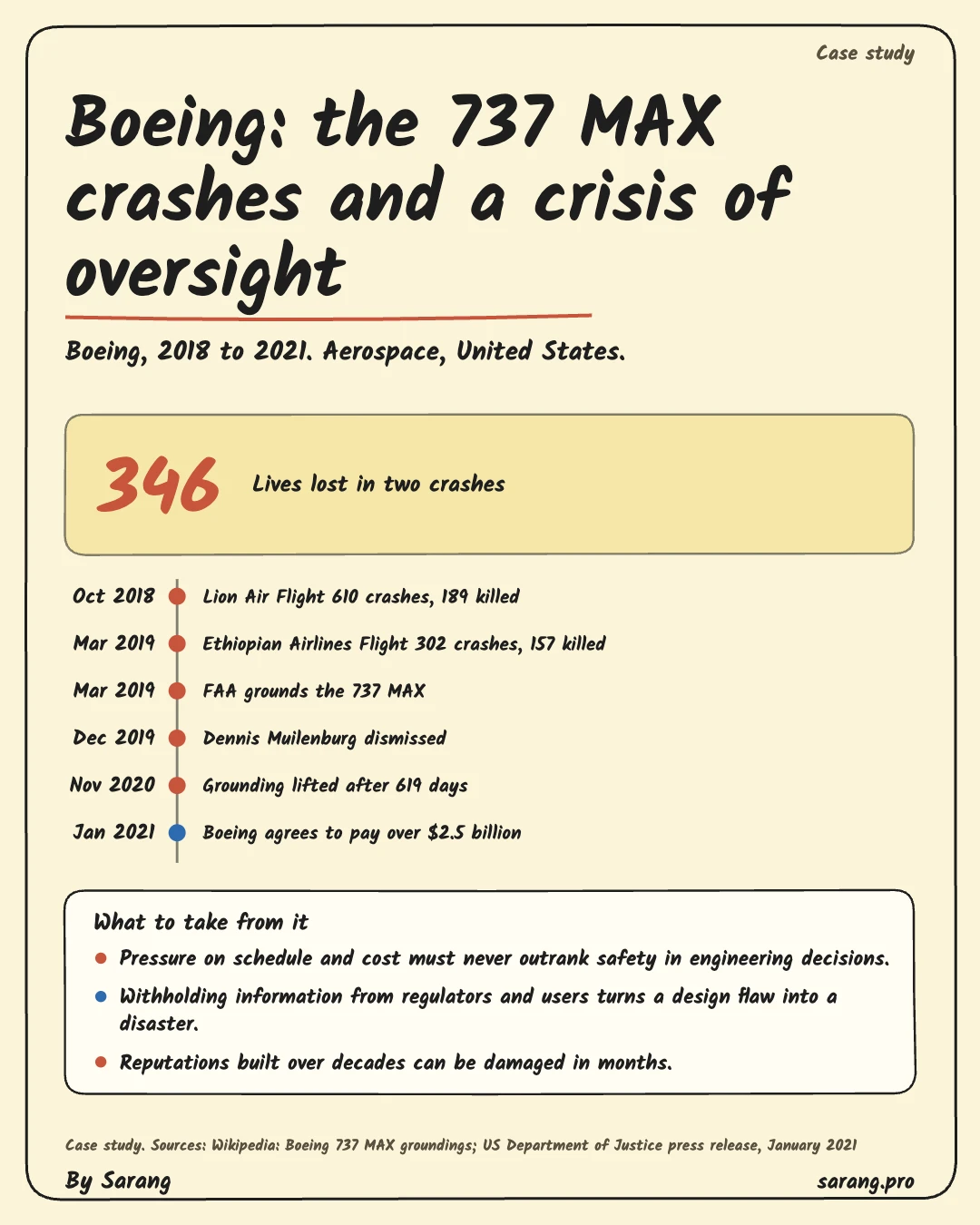
Two 737 MAX crashes killed 346 people in five months, grounded the jet for about 20 months and cost Boeing an estimated $18.6 billion by early 2020.
- people killed in the two crashes
- 346
- length of the grounding (March 2019 to November 2020)
- 20 months
- Boeing's estimated total cost of the crisis by January 2020
- $18.6bn
- Boeing's net loss in 2019, its first annual loss since 1997
- $636m
The situation
On 13 March 2019 the United States grounded the Boeing 737 MAX. Regulators elsewhere had already acted, and within days the whole fleet of delivered aircraft was on the ground. Two brand-new aircraft of the same type had crashed within five months: Lion Air Flight 610 into the Java Sea on 29 October 2018 (189 dead) and Ethiopian Airlines Flight 302 near Ejere on 10 March 2019 (157 dead). In all, 346 people died.
The grounding lasted about 20 months. The US Federal Aviation Administration (FAA) cleared the aircraft to fly again on 18 November 2020. By then Boeing had reported its first annual loss since 1997 (a net loss of $636 million for 2019, against a profit of nearly $10.5 billion in 2018), put its own estimate of the MAX cost at $18.6 billion, dismissed its chief executive, and agreed to a deferred prosecution agreement with the US Department of Justice worth more than $2.5 billion.
The case matters because the failure was not only technical. A flight-control function called MCAS could push the nose down on the strength of a single sensor, and it had been left out of pilot manuals. Investigators and prosecutors asked how a design like that was approved, how the people who knew about it came to say so little, and why the regulator did not catch it. Those are questions about oversight, incentives and culture, which is why the episode is taught in business schools as well as engineering ones.
It also did not end with the 2020 return to service. In January 2024 a door plug came off a 737-9 in flight, and the FAA capped Boeing’s output. The cap was lifted only partly, from 38 to 42 aircraft a month, in October 2025.
Background
A programme born in a race
The US Justice Department’s account says Boeing began developing and marketing the 737 MAX in June 2011. The aircraft was a new version of the 737, which was already the company’s best-known narrow-body family. A House of Representatives committee report in September 2020 described the MAX as the product of a race with Airbus to compete with the A320 Neo, and said management overruled engineers who raised concerns about MCAS while the company hurried to keep pace. Lawmakers suggested that cost-cutting and the wish to reach the market quickly drove the decisions.
A new version of an existing type is cheaper to certify and cheaper for airlines to adopt than a clean-sheet design. Pilots already qualified on earlier 737s could move to the MAX with limited extra training, which was a selling point. The House investigators found that Boeing worked to avoid any requirement for expensive simulator training for MAX pilots. That commercial promise sat behind many later choices about what pilots were told.
How Boeing made its money
Boeing earned most of its income from selling aircraft to airlines and leasing companies, and the 737 was a main source of volume. The figures show how much rested on it. In 2018, the last full year before the grounding, Boeing made a profit of nearly $10.5 billion. A year later it made a loss. When deliveries stopped in April 2019, revenue stopped with them: fourth-quarter 2019 revenue fell 37% to $17.9 billion, well below the $21.7 billion analysts had forecast.
The aircraft entering service
The MAX entered passenger service in 2017, according to the House report coverage. The Justice Department notes that in July 2017 the FAA’s Aircraft Evaluation Group published its final Flight Standardization Board report for the MAX without any information about MCAS. That omission carried into airline manuals and pilot-training materials in the United States, so crews flying the aircraft did not know the system existed.
The industry
Narrow-body competition
The single-aisle jet is the workhorse of airline fleets and the biggest prize in commercial aviation. In the period covered here, Boeing’s main rival was Airbus, whose A320 Neo the MAX was built to match. The sources reviewed do not give market-share figures, so none are claimed here. What they do show is the pressure: the House report coverage describes a company working fast to keep an established customer base from moving to a competitor.
A regulator that delegates
Aircraft are certified by the FAA, but the agency delegates part of the checking to employees of the manufacturer. According to the UPI report on the committee findings, the FAA’s judgement was compromised partly because Boeing staff acted as de facto regulators when checking whether designs met federal rules. The committee also found that Boeing employees authorised to act for the FAA did not disclose information that could have made the aircraft safer. The committee called FAA oversight of the MAX “grossly insufficient”. The same coverage reports a wider conclusion, that the FAA had failed to ensure the safety of the travelling public.
Why airlines care about training
For an airline, pilot training is a real cost: every hour in a full-flight simulator is paid for and every pilot taken off the roster has to be replaced. A type that needs only a short computer course is more attractive than one needing simulator time. When the aircraft returned to service in 2020 the FAA required simulator training, which had not been required when the MAX was introduced. The aircraft’s list price was between $99 million and $135 million, though airlines usually paid less.
The decision
There was no single board meeting at which Boeing chose to do something wrong. The sources describe a run of smaller decisions made under time and cost pressure. This section frames the choices that were open at the points where the record is clearest. The alternatives are the obvious ones, set out for analysis, and the sources do not say that Boeing weighed each one formally.
Tell pilots about MCAS, or leave it out of the manuals
The Justice Department says that in November 2016 two Boeing flight technical pilots learned of an important change to MCAS and did not pass it to the FAA’s Aircraft Evaluation Group. The system then went unmentioned in the July 2017 standardisation report and so in the manuals and training materials. The House committee said Boeing withheld information from the FAA, customers and pilots, including concealing the existence of MCAS from MAX pilots.
The alternative was to describe MCAS in the manuals and to train pilots on it. That might have meant extra training time, which cut against the goal of keeping training to a minimum. The record shows the first path was taken.
Rely on one sensor, or two
MCAS could act on data from a single sensor. Both crashes involved a faulty sensor triggering repeated nose-down commands, according to the CBS report of the November 2020 clearance. The alternative of using two sensors was available, and it became a condition of the aircraft’s return: the FAA required MCAS to use two sensors before the MAX could fly again. The House committee found that this and other design choices rested on faulty design and performance assumptions.
Require simulator training, or avoid it
Boeing sought to avoid simulator training for MAX pilots, according to the Fox Business account of the House report. In January 2020, after the grounding, it agreed to support simulator training before pilots resumed flying. The choice here was between a lower-cost sales proposition and a higher-cost safety margin. The later reversal suggests that the first choice had stopped being tenable.
After the first crash: keep flying or ground
After Lion Air, Boeing began redesigning MCAS. The MAX kept flying until the second crash. An FAA analysis carried out after the first crash predicted 15 more crashes if the software was not fixed, according to the CBS report. The decision to ground came only after Ethiopian Airlines Flight 302, and the FAA grounded the type on 13 March 2019. The alternative, grounding after the first accident, would have been disruptive and costly. The record suggests that the cost of waiting was far higher.
What they did
Grounding, redesign and a change at the top (2019)
Following the March 2019 grounding, Boeing suspended MAX deliveries in April 2019, according to the Transport Topics report on its 2019 results. It spent the rest of the year working on the software. The company’s chief executive, Dennis Muilenburg, was fired in December 2019, and the board chose David Calhoun, a former General Electric and Nielsen executive who had been on Boeing’s board since 2009, to replace him. His first earnings call came on 29 January 2020.
Paying for it (2019 to 2020)
Boeing raised its estimate of the total cost of the MAX crisis to $18.6 billion in the January 2020 results. That included a $2.6 billion pre-tax charge for airline concessions and higher expected production costs, and a further $9.2 billion of estimated extra costs booked in the period. The company was burning cash and had lined up bank commitments for $12 billion of new borrowing. The figures overlap in ways the press reports do not fully untangle, so they should be read as the company’s own running estimates and not as audited totals.
The technical return (2020)
Boeing said, in response to the House report, that its revised design work took more than 375,000 engineering and testing hours and 1,300 test flights. The FAA’s clearance came on 18 November 2020, signed by FAA Administrator Steve Dickson. Under the new rules the FAA, and not Boeing, issues the airworthiness certificate for each new aircraft. Boeing said the software no longer pushed the nose down repeatedly and no longer overrode pilot commands. The Air Line Pilots Association said the engineering fixes were sound. Relatives of the victims remained sceptical.
Settling with the Justice Department (January 2021)
On 7 January 2021 Boeing agreed to a deferred prosecution agreement. A criminal information in the Northern District of Texas charged one count of conspiracy to defraud the United States. The Justice Department said Boeing, through two flight technical pilots, deceived the FAA’s Aircraft Evaluation Group about MCAS. The financial terms were a criminal penalty of $243.6 million, $1.77 billion in compensation to airline customers, and a $500 million fund for the families of the victims, a total of more than $2.5 billion.
What happened
The business results
| Item | Figure | Date |
|---|---|---|
| Net profit, 2018 | Nearly $10.5 billion | Full year |
| Net loss, 2019 | $636 million (first annual loss since 1997) | Reported 29 January 2020 |
| Q4 2019 revenue | $17.9 billion, down 37% | Reported 29 January 2020 |
| Estimated total MAX cost | $18.6 billion | As of January 2020 |
| Orders cancelled or removed from backlog | More than 1,000 | 2020 |
| Aircraft stored by Boeing | About 450 (about 400 were in service at grounding) | November 2020 |
The figures show a company whose main product line was frozen. Deliveries stopped from April 2019 and, with them, the cash that normally followed delivery.
Return to service
American Airlines was the only US carrier to have scheduled the MAX when the FAA cleared it, with a daily round trip between New York and Miami from 29 December 2020. European regulators signalled approval, while Canada and China were still reviewing. The grounding, at about 20 months, was the longest for a US airliner, according to the report that CBS carried at the time.
The committee and the law
The House Transportation and Infrastructure Committee’s majority published its report on 16 September 2020 after an 18-month investigation led by Peter DeFazio and Rick Larsen. At around 240 to 250 pages (outlets give 238 and nearly 250), it blamed both Boeing and the FAA. DeFazio said: “This is a tragedy that never should have happened.” A Senate committee was due to consider an FAA reform bill the next day.
The 2024 door plug
On 5 January 2024 Alaska Airlines Flight 1282, a Boeing 737-9, lost a left mid-exit door plug at about 14,830 feet after leaving Portland, Oregon. One flight attendant and seven passengers had minor injuries, and the aircraft landed safely. Investigators did not find four bolts that should have held the plug in place. The National Transportation Safety Board (NTSB) said the probable cause was Boeing’s failure to provide adequate training, guidance and oversight for manufacturing staff who did not consistently follow the parts-removal process. It named the FAA’s ineffective compliance surveillance as a contributing factor. The NTSB issued 19 recommendations, 11 to the FAA and 8 to Boeing.
Other views
The House majority
The committee’s Democratic majority concluded that the crashes were not caused by a single failure. It described a chain of problems and said the FAA’s oversight was weakened by what it called regulatory capture. Because the report came from the majority only, it should be read as a political document based on a large documentary record, not as a neutral finding.
Boeing’s own account
Boeing said it cooperated fully with the committee, had learned hard lessons, had made fundamental changes and was working to strengthen its safety culture. It pointed to the engineering and test work behind its redesign. The company also settled the criminal case on terms that left the charge deferred, so it did not face a trial on the facts.
Pilots and families
The Air Line Pilots Association said the fixes were sound. Some relatives of the victims said they still regarded the MAX as more dangerous than other modern aircraft. Both positions were reported when the FAA cleared the type, and the sources reviewed do not settle between them.
Limits of the evidence
The sources reviewed include news accounts of the House report, not the full text, so some of the committee’s detailed findings are not repeated here. This case file does not rule on how much weight the official accident reports give to crew actions and training, and readers should consult those reports directly. Cost figures are the company’s estimates or press summaries and differ in how they count compensation, charges and lost orders.
Reading it through a framework
Principal-agent problems and regulatory capture
The FAA is the public’s agent for safety, but it delegated checking to Boeing staff, who were also Boeing’s employees. That is a classic agency problem: the agent’s incentives (schedule, cost, the manager’s approval) differ from those of the principal (safety). The House report’s language about Boeing workers acting as de facto regulators fits the pattern. Information also failed to move upward. The two pilots who knew about the MCAS change in November 2016 did not tell the FAA group, and the July 2017 report went out without it. A regulator that depends on the regulated firm for information is only as good as that firm’s candour.
Stakeholder mapping
Mapping the stakeholders shows who held power and who held information. Airlines wanted a type that needed little retraining. Pilots needed to know what the aircraft would do. Regulators needed accurate disclosure. Shareholders and managers wanted programme speed. Passengers and crews were the group with the greatest exposure and the least say. The Justice Department settlement tried to repair some of the harm to each group: compensation for airlines, a fund for families, a penalty for the public. The stakeholders with the least influence at the start of the programme were those who paid most when it failed.
Cost of quality
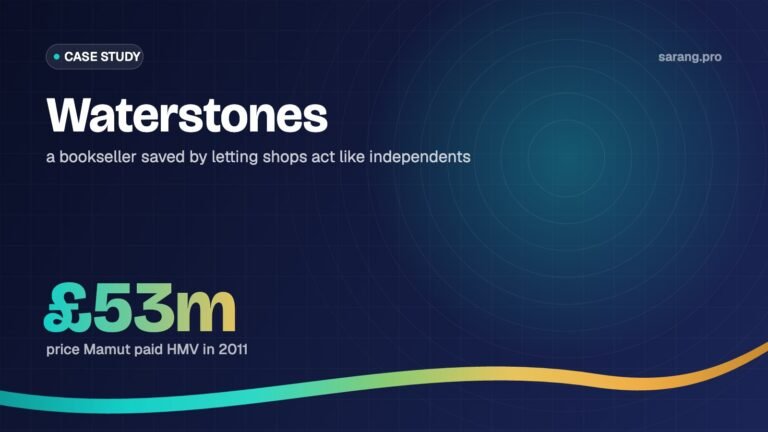
A second lens is the economics of quality. The company saved money in the short run by limiting training requirements and rework. The 2019 and 2020 figures show the other side of the ledger: an $18.6 billion estimated cost, over 1,000 lost orders, and a fine and compensation package above $2.5 billion. The savings were small beside the later losses.
Since then
The 2024 door-plug accident revived the same questions. The FAA capped 737 MAX production after January 2024. Output stayed below the cap in 2024, partly because investigations and a machinists’ strike idled factories for almost eight weeks. Boeing said in summer 2025 that it had reached the cap in the second quarter.
In April 2025 chief executive Kelly Ortberg told a Senate committee that Boeing would not ramp up production if performance did not show a stable system. In September 2025 the FAA gave Boeing back the right to carry out final safety inspections and certify 737 MAX jets, an authority the company had lacked for over six years. On 17 October 2025 the FAA allowed output to rise from 38 to 42 aircraft a month after inspectors reviewed the production lines. The agency said this would not change its oversight. The FAA also sought $3.1 million in fines for alleged safety violations between September 2023 and February 2024.
The NTSB held an investigative hearing on 6 and 7 August 2024 and a public board meeting on 24 June 2025 to determine the probable cause of the Alaska Airlines accident.
What to take from it
- Cost and schedule pressure can enter a safety decision quietly, as a series of small choices about what to document, train or test, and no single meeting need make the final call.
- Delegating checks to the firm being checked saves a regulator money, but it makes the quality of disclosure the weakest point in the system.
- Withholding a fact from a customer or regulator, even if each step looks defensible, can become a criminal matter: Boeing admitted that two employees deceived the FAA group about MCAS.
- The financial cost of a safety failure can far exceed the savings that caused it, here an estimated $18.6 billion in costs against training savings that were never quantified in the sources.
- Recovery from this kind of failure takes years and does not run in a straight line, as the 2024 door-plug accident and the staged lifting of the production cap show.
Questions to think about
- If you led the 737 MAX programme in 2016, what information would you have wanted every pilot, airline and regulator to have, and who would have been responsible for providing it?
- When a regulator delegates part of its job to the firm it supervises, what safeguards would make that arrangement trustworthy?
- Was grounding the aircraft after the first crash a realistic option, and what evidence would a decision-maker have needed to take it?
- How should a company weigh the saving from keeping pilot training short against the risk that a missing piece of information cannot be recovered later?
Concepts at work
This case touches principal-agent problems, regulatory capture and the cost of quality. Explore them in Insights.
Written from the public sources listed below. Figures are as those sources report them.
Framework
Timeline
- Jun 2011Boeing begins developing and marketing the 737 MAX
- Nov 2016Two Boeing pilots learn of a change to MCAS and do not tell the FAA evaluation group
- Jul 2017FAA standardisation report published without any information on MCAS
- 29 Oct 2018Lion Air Flight 610 crashes into the Java Sea, 189 dead
- 10 Mar 2019Ethiopian Airlines Flight 302 crashes, 157 dead
- 13 Mar 2019FAA grounds the 737 MAX
- Dec 2019Chief executive Dennis Muilenburg dismissed
- 29 Jan 2020Boeing reports its first annual loss since 1997
- 16 Sep 2020House committee publishes its final report
- 18 Nov 2020FAA clears the MAX to return to service
- 7 Jan 2021Boeing agrees a deferred prosecution agreement
- 5 Jan 2024Door plug leaves Alaska Airlines Flight 1282
- 17 Oct 2025FAA lets Boeing raise 737 MAX output to 42 a month
Recap cards
Tap a card to check yourself.
Sources and credits
- US Department of Justice: Boeing charged with 737 MAX fraud conspiracy and agrees to pay over $2.5 billion
- Reuters via KSL: US House report, Boeing and FAA failures to blame for 737 MAX crashes
- UPI: Final report, Boeing and FAA made serious flaws and missteps with 737 Max
- Fox Business: US House report blasts failures of Boeing and FAA in 737 MAX certification
- CBS News: FAA clears Boeing 737 MAX to fly again
- CBS News (AP): Boeing posts first annual loss since 1997 as 737 Max costs rise
- Transport Topics: Grounded jet sends Boeing to first annual loss in two decades
- NTSB: Alaska Airlines Flight 1282 investigation
- AP via Arab News: Boeing cleared to increase 737 Max production nearly two years after door plug flew off plane