De Beers: how advertising made the diamond ring the sign of an engagement
From 1938 N.W. Ayer's campaign for De Beers lifted the share of American engagement rings with a diamond from about 10 per cent to about 80 per cent, and the model is now under strain.
- yearly Ayer campaign cost proposed for the first three years
- $500,000
- rise in diamond sales by 1941, per WWNO
- 55%
- share of US engagement rings with a diamond, 1930s to end of century
- 10% to 80%
- Japanese brides with a diamond ring, 1968 to 1981
- Under 5% to about 60%
The situation
In 1938 De Beers had a problem that most cartels would like to have: it controlled most of the world’s supply of rough diamonds, and nobody was buying enough of them. The Marketing Society says De Beers then held about 60 per cent of rough diamond output. Diamond sales had been falling for more than two decades and collapsed in the Great Depression. In America, only about 10 per cent of engagement rings carried a diamond, because the stone was seen as an extravagance for the wealthy.
That year a representative of Sir Ernest Oppenheimer, who chaired De Beers, asked the Philadelphia agency N.W. Ayer & Son whether advertising could raise American diamond sales. WWNO reports that Ayer proposed a campaign costing $500,000 a year for the first three years. Ayer’s own papers, quoted by the Marketing Society, called for “the conception of a new form of advertising”. The aim, in the Marketing Society’s telling, was to make Americans link diamonds with engagement.
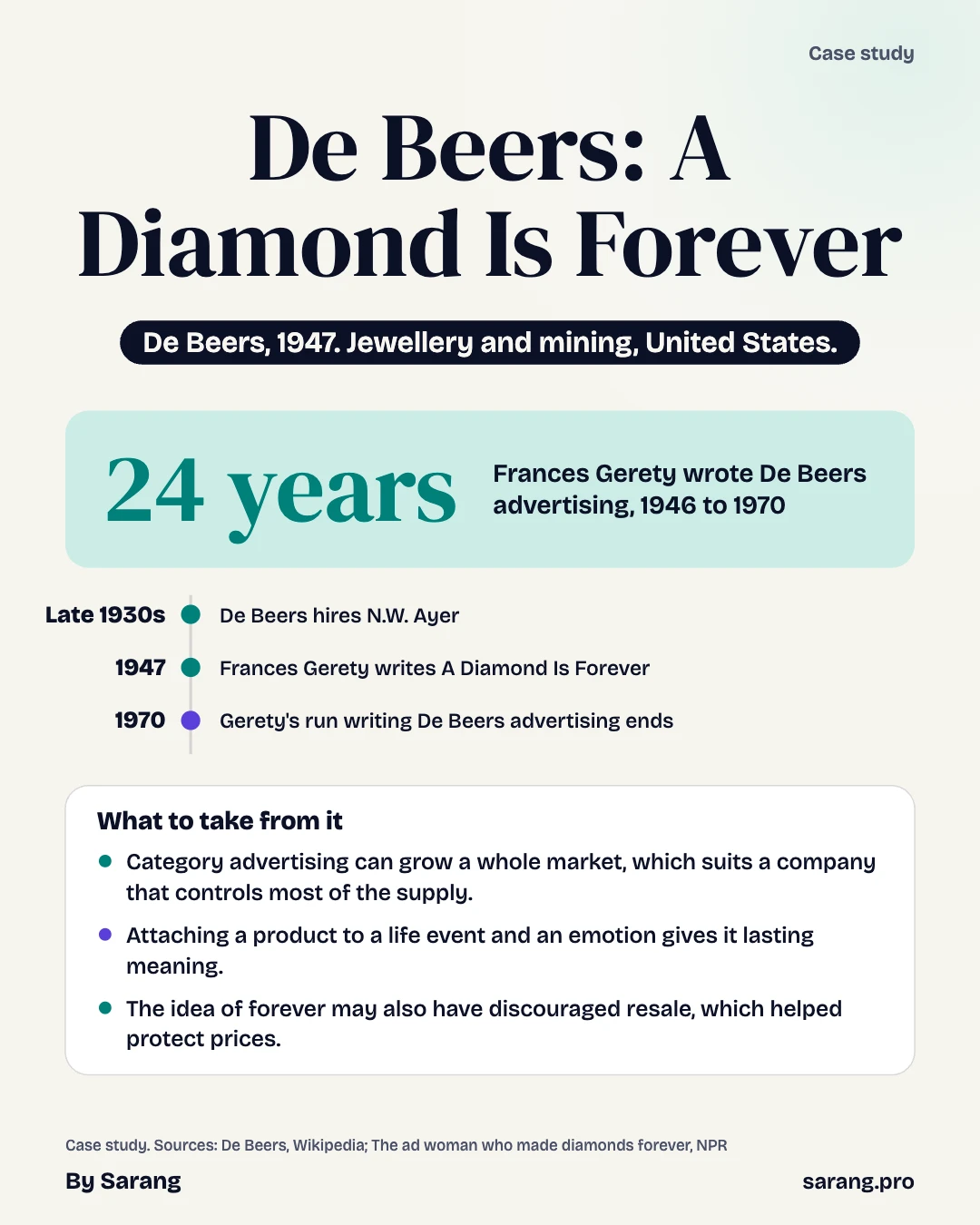
The slogan came later. Copywriter Frances Gerety wrote “A Diamond Is Forever” in 1947, and it appeared in an advertisement in 1948. By the end of the twentieth century, the Marketing Society says, about 80 per cent of American engagement rings contained a diamond, up from about 10 per cent when the campaign began. Advertising Age named the line the slogan of the century in 1999 and ranked the De Beers campaign sixth in its list of the top 100 campaigns.
This case looks at what De Beers decided to do with a dominant supply position and a weak market, how the campaign changed customer behaviour in several countries, and why the strategy has become harder to defend in the 2020s, when lab-grown stones, a falling demand for natural diamonds and a sale of the company itself have all arrived together.
Background
From the Kimberley mines to a supply cartel
Britannica dates the first diamond finds in southern Africa to the mid-1860s, on a farm near Kimberley belonging to the de Beer family. Cecil Rhodes bought a claim at the De Beers mine in 1871, and in 1888 he incorporated De Beers Consolidated Mines. In the mid-1890s he formed the Diamond Syndicate to control how the world’s diamonds were distributed. The syndicate was the forerunner of the Central Selling Organisation (CSO), now known as the Diamond Trading Company.
The control was never complete. Britannica notes that big new mines found near Pretoria in 1902 and in German South West Africa, now Namibia, in 1908 weakened De Beers’s position. Ernest Oppenheimer, who founded the Anglo American Corporation in 1917, gained control of the South West Africa mines in the mid-1920s, created a new syndicate, joined the De Beers board in 1926 and became chairman in 1929. The 1930s brought the Depression, falling demand and the closure of several mines.
How the cartel worked
The economist The writer Edward Jay Epstein, in a study published in 1982, described the arrangement as a cartel that controlled mine output and allocated supply to a select group of diamond cutters. It operated under different names in different places, including the Diamond Trading Company in London, the syndicate in Israel and the CSO in Antwerp. He listed its assets as a large uncut stockpile in London, a cash reserve in European banks and quota agreements with producing countries, and called it the most successful cartel arrangement in the annals of modern commerce as of 1981.
The model has a built-in difficulty. A supplier that controls the market can hold back stones to keep prices up, but it only earns a profit if people keep wanting to buy. In the 1930s the demand side was failing. De Beers could shape supply, but it could not make Americans desire diamonds.
Why the American market mattered
The United States was the largest market for diamond engagement rings, with Japan second in Epstein’s account. NBC News later reported that America represented about half of the worldwide diamond market. It was also the market where De Beers faced legal risk. The company sold in America only through intermediaries, a pattern that dated from shortly after the Second World War, when it was first charged with price fixing, according to NBC News. The campaign was therefore designed and delivered by an American agency on De Beers’s behalf, without De Beers selling to consumers itself.
The industry
The diamond business has an unusual structure. A few mining companies produce the rough stones. A select group of cutters and dealers buys, cuts and sells them on. Retailers sell the finished jewellery. Britannica says that, in the early 2000s, De Beers marketed about 40 per cent of the world’s diamond supply, including industrial stones, which is far below the share it held for most of the twentieth century. The Marketing Society gives about 60 per cent of rough output for the 1930s.
The product has odd economics. A diamond does not wear out, so supply keeps building up in private hands. If buyers resold stones freely, the secondary market would compete with new sales. Epstein concluded that a goal of the cartel’s marketing was to make diamonds “forever” in the sense that they could never be resold. This is his reading, not a De Beers statement, but it fits the promotional logic: a gift for life should not appear on a dealer’s counter.
Competition within the industry came from other producers and, from the late twentieth century, from new rivals. The Britannica entry records that in 1999 De Beers stopped buying diamonds from producers outside its own system, partly to avoid trade in conflict diamonds. The company’s regulatory history was tense in America. NBC News reports that De Beers pleaded guilty in 2004 to a 1994 charge of conspiring with General Electric to fix prices in the $500 million industrial diamond market, and paid a $10 million fine. The charges against General Electric were dismissed for lack of proof. This concerned industrial stones, not jewellery, but NBC News says the case hindered De Beers from doing business in the United States, and the company’s counsel said it had no plans to enter the American retail market directly.
The newest rival is the laboratory. Lab-grown diamonds have the same chemical makeup as mined diamonds. Mining.com notes that they account for a growing share of engagement ring sales, and Rapaport records that De Beers’s own estimate puts the wholesale price decline of lab-grown jewellery stones at about 90 per cent since 2018. The industry’s product has become two products, one scarce and one made on demand.
The decision
In 1938 the question for De Beers was how to build demand for a product it controlled but could not itself sell to consumers. The options below are the obvious ones for a producer in that position. The sources record what was done, not the internal debate.
Option one: advertise a brand
A normal consumer goods firm would promote its own name. De Beers could not do that easily. It did not sell to the public, it worked through intermediaries in America, and its product was a commodity that retailers sold under their own names. In effect, Ayer’s solution was to advertise the diamond as an idea and let the supply chain, not De Beers, collect the sales.
Option two: cut the price
Lower prices would have raised sales in the short run. But cutting prices would have worked against a cartel’s aim of holding them up, and a cheaper diamond might not have looked like a symbol of lasting love. WWNO gives a sense of the price level: a two-carat diamond cost between $900 and $1,750 in 1939. The goal, on this reading, was to change the reason for buying, not the price.
Option three: make a diamond the sign of an engagement
The third route tied the stone to a social ritual. If a diamond ring became the accepted proof of engagement, then every couple that planned to marry became a potential customer. Ayer’s plan, as the Marketing Society explains, had two strands. One was the emotional link between diamonds and romance. The other was a price norm: a man should spend a set amount, which the Marketing Society describes as one month’s salary in the 1930s and 1940s, two months in the 1970s and 1980s, and three months more recently. This was the route chosen.
What they did
1938 to 1941: the first campaign
Ayer began work in 1938. WWNO reports that by 1941 diamond sales in America had risen 55 per cent. According to WWNO, Gerry Lauck of Ayer’s New York office was the first to run an advertising campaign built around fine art. In 1945 a short film called The Magic Stone: Diamonds Through the Centuries began playing in theatres. WWNO says it was seen by more than 15 million people.
1947 to 1948: the line
Frances Gerety joined Ayer in 1942 according to the Marketing Society, or in 1943 according to WWNO, and worked on the De Beers account. The Marketing Society says she proposed “A Diamond Is Forever” at a morning meeting in 1947, and that her all-male colleagues were not impressed and questioned its grammar and meaning. Britannica records that Ayer coined the slogan in 1947. The line first appeared in an advertisement in 1948, and the Marketing Society says it has featured in every De Beers engagement advertisement since. In 1951, the same source reports, Ayer wrote that jewellers said a woman was not considered engaged without a diamond ring. Ian Fleming’s novel Diamonds Are Forever, the fourth James Bond book, followed in 1956.
1960s and 1970s: Japan
The campaign moved abroad. Epstein reports that J. Walter Thompson ran a Japanese campaign for De Beers from 1967 or 1968. The advertisements showed Western-looking women wearing diamond rings while doing things that broke with Japanese tradition, such as mountain climbing and yachting, and presented diamonds as a sign of modern Western values. Fewer than 5 per cent of Japanese brides received a diamond engagement ring when it began in 1968. About 27 per cent did by 1972, roughly half of married women wore one by 1978, and by 1981 about 60 per cent of brides had one. Japan became the second-largest market for diamond engagement rings after the United States.
Adding new customers: the right-hand ring
Britannica notes that in 2001 De Beers began marketing the “right-hand ring” to single women. It is a later variation on the same method, a social ritual that gives a reason to buy. Instead of an engagement, the occasion is a woman’s own purchase.
What happened
Sales and ring penetration
The campaign’s results are best shown in changing habits. In America, the Marketing Society’s figure of about 10 per cent of engagement rings with diamonds before the campaign rose to about 80 per cent by the end of the century. Diamond sales rose 55 per cent in the first three years of Ayer’s work, according to WWNO. In Japan, the share of brides receiving a diamond ring went from under 5 per cent in 1968 to about 60 per cent in 1981, as Epstein reports.
| Market | Year | Share of brides or rings with a diamond |
|---|---|---|
| United States, engagement rings | 1930s | About 10% |
| United States, engagement rings | End of 20th century | About 80% |
| Japan, brides | 1968 | Under 5% |
| Japan, brides | 1972 | About 27% |
| Japan, brides | 1981 | About 60% |
Financial scale
NBC News reports that De Beers had sales of $5.5 billion and earnings of $676 million in 2003. By then the company was a global business, though its share of the world’s rough diamond supply had fallen to about 40 per cent according to Britannica.
Recognition
Advertising Age placed the campaign sixth among the top 100 of the century. The Marketing Society adds that the same publication called the line the slogan of the century in 1999. Gerety, who never married, is reported by WWNO to have struggled with a glass ceiling at Ayer, which did not recognise her contribution until she was much older.
Other views
Credit and the creation story
The accounts of how the slogan was written differ. The Marketing Society describes a morning meeting where it was proposed in 1947. WWNO describes Gerety as about 32 in 1947 and gives the year she joined Ayer as 1943, a year later than the Marketing Society. A retailer of lab-grown diamonds, Clean Origin, tells a late-night story, but it is a seller with a stake in the debate and is not used as evidence here. The cautious summary is that Gerety wrote the line in 1947 and it was first used in 1948.
The cartel and the competition authorities
The campaign was part of a business that regulators and critics saw as a cartel. Epstein called it a cartel and gave details of how it worked. NBC News says De Beers was charged with price fixing soon after the Second World War and later pleaded guilty in an industrial diamond case, and says that American officials had no jurisdiction over the South Africa-based company, which made prosecution difficult. A fair reading is that the advertising created demand in a market where the company also controlled a large part of supply. Whether that helped or harmed consumers is a matter of judgement.
Resale and value
Epstein argued that the aim was to keep diamonds off the second-hand market. For buyers that raises a question: the slogan suggests permanence, but whether a stone keeps its price when resold is a separate matter. The sources opened for this case do not give resale prices, so the case does not answer it.
Evidence limits
Rising diamond use after 1938 cannot be credited wholly to advertising. Postwar marriage rates and incomes also mattered. WWNO says that American weddings soared after the war and diamond prices rose with them. None of the sources allows a clean separation of the campaign effect from the economy, and WWNO does not say who measured the 55 per cent sales rise by 1941, so it should be read as a claim of unknown origin.
Reading it through a framework
The Ansoff matrix
Ansoff’s matrix sorts growth routes by whether the product and the market are new or existing. The 1938 American campaign was market penetration: an existing product sold harder to an existing market, by turning a minority habit into a majority one. The Japanese effort from 1967 or 1968 was market development, the same product taken to a new country with a message adapted to it. Epstein’s description shows the adaptation: the images stressed Western modernity, not tradition. The right-hand ring of 2001 sits closer to product or segment development, with a new occasion for an existing stone. The pattern shows a company that kept looking for new sources of demand because it already had the supply.
Porter’s five forces
Porter’s framework helps explain the current difficulty. For most of the twentieth century De Beers had strong supplier power and faced few rivals, so it could treat demand as the only variable. The new forces are different. Substitutes are strong: lab-grown stones are chemically the same as mined ones and, per Rapaport, their wholesale price has dropped about 90 per cent since 2018. Producers such as Alrosa also feel the strain: Mining.com says its profits fell by nearly 80 per cent. The 2025 decision to close Lightbox, De Beers’s lab-grown jewellery brand, was an attempt to defend the natural product by separating it from the substitute. It marks a shift from controlling supply to defending a distinction.
Since then
De Beers’s parent, Anglo American, said in May 2024 that it would sell De Beers, according to National Jeweler. It is selling its 85 per cent stake, and the Government of Botswana owns the remaining 15 per cent. Anglo prepared a possible stock market listing, and Al Cook, the chief executive of De Beers, said the separation would likely be complete in the first half of 2026.
On 8 May 2025 De Beers announced it would close Lightbox, the lab-grown jewellery brand launched in 2018 with fixed per-carat prices. Rapaport reports that De Beers had already said about a year earlier that it would stop producing lab-grown diamonds for jewellery. Cook said the closure reflected a commitment to natural diamonds and that he expected both the cost and the price of lab-grown stones to fall further in jewellery. The company’s synthetic unit, Element Six, would focus on industrial uses, with operations centralised in Oregon.
The wider market was weak. Mining.com, in a December 2025 report, says De Beers built up about $2 billion of unsold natural stones and announced plans to cut more than 1,000 jobs. Debswana, De Beers’s joint venture with Botswana, announced output reductions of up to 40 per cent for 2025. Botswana supplies about 70 per cent of De Beers’s annual rough diamonds, according to a photo caption in the Northern Miner. Under the Luanda Accord, producers including Botswana and Angola agreed to put 1 per cent of annual diamond revenues into a global marketing campaign for natural stones. That is an echo of Ayer’s 1938 plan, now paid for by producing countries rather than by one company.
On ownership, National Jeweler reports that Botswana’s president, Duma Boko, said his country wanted a controlling stake of more than 50 per cent, and that Angola’s state-run Endiama submitted a fully financed offer for a minority stake, announced on or around 24 September 2025. Mining.com adds that Anglo American later said it would merge with Teck Resources.
What to take from it
- A producer that controls supply still needs demand, and demand can be built by changing what a purchase means, not by lowering its price.
- A campaign can sell an idea for a whole category, and the benefit flows to whoever controls supply, which is why De Beers could fund it while the intermediaries collected the sales.
- The same method can be taken to a new country if the message is adapted. Japan’s diamond ring share moved from under 5 per cent to about 60 per cent in thirteen years, with a message about modern life rather than tradition.
- Control of supply can end up as a weakness when a substitute removes the scarcity. Lab-grown stones cut wholesale prices by about 90 per cent in seven years, according to De Beers.
- Be careful with creation stories and results. Accounts of the 1947 slogan differ on details, and sales figures in popular articles come from the company or its agency.
Questions to think about
- When a company controls most of the supply of a product, is it right for it to spend money creating demand that also helps its intermediaries?
- A diamond is sold on permanence, yet a lab-grown stone is physically identical. What part of the value is the stone and what part is the story?
- Why might the same slogan work in America and fail in Japan, and what did the Japanese campaign change to succeed?
- If you advised a producer today, would you defend natural diamonds as a separate category or compete with lab-grown stones on price?
Concepts at work
This case draws on market development, category creation and substitutes. Explore them in Insights.
Written from the public sources listed below. Figures are as those sources report them.
Framework
Timeline
- 1888Cecil Rhodes incorporates De Beers Consolidated Mines
- 1929Ernest Oppenheimer becomes chairman
- 1938De Beers hires N.W. Ayer to raise American diamond sales
- 1945The Magic Stone film starts playing in US theatres
- 1947Frances Gerety writes A Diamond Is Forever
- 1948The line first appears in an advertisement
- 1956Ian Fleming publishes Diamonds Are Forever
- 1968Japanese diamond engagement ring campaign begins
- 1999Advertising Age names the line slogan of the century
- 2004De Beers pleads guilty in a US industrial diamond price case and pays $10 million
- 2018De Beers launches Lightbox lab-grown jewellery
- May 2024Anglo American confirms it will sell De Beers
- 8 May 2025De Beers announces it will close Lightbox
- Sep 2025Botswana and Angola put forward bids for stakes in De Beers
Recap cards
Tap a card to check yourself.
Sources and credits
- The Marketing Society: A tagline is forever
- WWNO: The ad woman who made diamonds forever
- Edward Jay Epstein: The Diamond Invention, prologue
- Advertising Age: Ad Age Advertising Century, Top 100 Campaigns
- Encyclopaedia Britannica: De Beers SA
- NBC News (Associated Press): De Beers pleads guilty in price fixing case
- Rapaport: De Beers to close Lightbox lab-grown diamond brand
- Mining.com: Diamond crash 2025, market slump meets tech pressure
- Northern Miner: Diamond slump deepens in 2025 as lab-grown bites
- National Jeweler: 2 African countries aim to take stake in De Beers