Duolingo: how game mechanics built a daily habit for 50 million users
Duolingo used streaks, points and short lessons to reach over 50 million daily users in 2025, then chose to put user growth ahead of bookings after a 30% share fall.

- Daily active users during 2025
- 50m+
- Bookings in 2025, the first year above that level
- $1bn+
- Paid subscribers in Q3 2025
- 11.5m
- Daily users with a streak of seven days or more, end of 2024
- 32m
The situation
On 6 November 2025, Duolingo’s share price fell by nearly 30% in a single trading session. The company had just reported a very good quarter. Revenue for the third quarter was $272 million, up 41% on a year earlier and above the $260 million analysts had expected. Total bookings were about $282 million, up 33%. Paid subscribers reached 11.5 million, up 34%. Daily active users stood at 50.5 million. Net income was $292.2 million, though that included a one-off tax benefit of $222.7 million.
Investors sold because of what came next. Guidance for fourth-quarter bookings was $329.5 million to $335.5 million, below the consensus of $344.3 million. And the chief executive, Luis von Ahn, said the company had “clearly shifted priorities toward user growth” in recent months. In plain terms, Duolingo was telling the market that it would ask its learners to pay less and play more.
That decision is the end point of a long experiment in building a habit. Duolingo sells a skill that most people want and few finish. Language learning has a high drop-out rate, so the company has spent over a decade making the daily visit to the app feel like a small game: streaks, points, a green owl who sends reminders. On 26 February 2026, when it reported its full-year figures, it said daily active users had passed 50 million during 2025, that bookings had passed $1 billion for the first time, and that in 2026 it would put user growth ahead of near-term profit. The management guided to bookings growth of 10% to 12%, well under the pace of recent years.
This case asks how game mechanics became the engine of a business, what they cost, and why the company chose in 2025 to hold back from squeezing them for more revenue.
Background
From a translation idea to a language app
Forbes reported in 2019 that work on Duolingo began at Carnegie Mellon University in 2011 and that the app launched in 2012. The early plan was to have learners translate real text as they practised, and to sell the translations. Forbes says the company dropped that translation business in 2014 and then had no revenue for three years. That is a long time to run a company without income, and it explains much of what followed: the product had to attract a very large number of free learners first, and the money had to be worked out afterwards.
Finding a business model
In 2017 Duolingo introduced advertising, using Google and Facebook, and then an ad-free subscription. Forbes gave the revenue as $13 million in 2017 and $36 million in 2018, with a projection of $86 million for 2019. At that point only 1.75% of users paid for the ad-free version, at $84 a year. The article compared this with Rosetta Stone at $120 a year (about 500,000 subscribers) and Babbel at $85 a year (over one million subscribers, with revenue above $115 million). The article put downloads at more than 300 million and monthly active users at nearly 30 million. Duolingo had raised $108 million by then and was valued at $700 million in 2017. Fortune later reported a valuation of $1.5 billion in December 2019.
The key fact in those figures is the ratio. Nearly everyone used the free product, and a small minority paid. The business therefore depended on keeping the free majority coming back, partly because advertising revenue rises with free users’ time in the app, and partly because every active free user is a possible subscriber.
Going public
Duolingo filed for a stock market listing on 28 June 2021, priced it at $102 a share on 27 July, above the range of $85 to $95, and began trading on Nasdaq on 28 July under the ticker DUOL. Fortune reported that the shares opened at $141 and closed the first day at $139.01, a gain of about 36%. Reuters, quoted by Fortune, put the money raised at about $521 million and the value at about $6.5 billion. The company then had about 40 million monthly active users, courses in 40 languages and a gross margin of 70%. It had passed one million Duolingo Plus subscribers in March 2021.
The first annual report as a listed company, for 2021, gives more detail. Duolingo had about 42 million monthly active users at the end of that year. About 6% of them paid for Duolingo Plus. Advertising supplied about 15% of revenue, and the Apple App Store alone about half. Free users saw an advertisement at the end of each lesson. A family plan for up to six people had been launched in 2021 at $119.99 a year.
The industry
A crowded field with weak lock-in
The 2024 annual report describes the competition frankly. Duolingo competes for learners’ time, attention and money with other apps and online platforms, with classroom and offline learning, with language assessment firms and with literacy, maths and music products. The company says there are thousands of free language apps, with free products in at least 50 languages, that many rivals have more resources, and that switching costs are low. Anyone can delete the app tomorrow.
Two gatekeepers
The same report shows how much of the business passes through two companies. In 2024 the Apple App Store accounted for 61% of revenue and 62% of bookings, and Google Play for 20% of each. Duolingo also depends on Amazon Web Services and Google Cloud for computing. Platform fees and the platforms’ own rules limit what Duolingo can do on pricing and on how it reaches its customers.
The economics of habit
In this industry, engagement is the main asset. The 2024 report says advertising revenue depends mainly on the number of free users and the hours they spend, and it lists retaining users and growing engagement as the first risks to the business. The shape of the product follows from that. Lessons are short: Forbes reported lessons of about three minutes. The app is free to start. The reminders fall at the time of day the learner last practised.
Scale in the late 2020s
The company’s size at the end of 2024 gives a sense of scale. It had over 100 million monthly active users and about 830 employees, more than 380 of them engineers, compared with about 140 employees at the end of 2018. About 9% of monthly active users were paying subscribers. Sales and marketing cost $90.5 million in 2024, up from $75.8 million in 2023. The report states that revenue had risen in every quarter since the first quarter of 2018 and that the company had “recently achieved profitability”.
The decision
The sources do not show a single decision meeting, so the options below are framed from what Duolingo said and did in 2025 and early 2026.
Option one: monetise harder
The obvious route to higher bookings is to push more of the free majority towards paying. That can mean more reminders to upgrade, stricter limits on free play, or higher prices. On the February 2026 call, management said that adding such friction would conflict with growth in daily active users. Only about 10% of monthly active users pay, so there was room to convert more. The company judged the cost to the habit too high.
Option two: put the daily habit first
The second route is to protect and grow the number of people who open the app every day, accept slower bookings in the short run, and find other ways to earn from engaged learners. This is the path the company took. Von Ahn’s words in November 2025 and the 2026 plan, with a target of about 20% growth in daily active users and 100 million daily users in 2028 as reported by MarketBeat, set it out. The company said it expected “slower bookings growth and lower profitability” as a result.
Option three: widen the product
The third route, followed alongside the second, is to add subjects. Chess, maths and music are the examples management gave. It also plans to widen access to AI features such as Video Call and Speaking Adventures, while telling investors that this will put pressure on gross margins.
What they did
Build the habit loop, 2012 to 2020
The loop used points, treasure chests and streaks, as Forbes described it in 2019, with a reminder sent at the time of the learner’s previous session and the owl mascot, Duo, appearing as an emoji to prompt return visits. A correct answer triggered a chime and the words “You are correct”. Von Ahn told Forbes: “Our retention is comparable to games.” The 2021 annual report names “Streaks and Leaderboards” as the features that bring learners back daily, and says the company runs hundreds of A/B tests on new product features each quarter, in another passage thousands. The report says learners stay at first because it is fun and later because it works.
Make the streak the unit of value
The 2024 annual report defines a streak as the consecutive days on which a learner completes a lesson. It also gives numbers that show how large the habit has become: about 32 million daily active users at the end of 2024 had a streak of seven days or more, and about 10 million had a streak of 365 days or more. Those learners have something to lose by stopping, which is the central trick of the product.
Use AI to make content faster, 2024 and 2025
In January 2024, as The 74 reports, Duolingo offboarded 10% of its contractors, citing AI. In April 2025 von Ahn sent an all-hands email, posted on LinkedIn, saying Duolingo would become “AI-first” and would largely stop using human contractors to develop courses; full-time staff were not affected. He gave the reason as: “To teach well, we need to create a massive amount of content, and doing that manually doesn’t scale.” AI, he said, had helped create nearly 150 new courses in a year, after 12 years to build the first 100. Fast Company quotes the email as saying that “headcount will only be given if a team cannot automate more of their work”.
Start new subjects: chess
Duolingo launched a chess course in June 2025, after a beta in April. Fast Company reported that it began in September 2024 as a prototype built by two employees who were neither chess players nor engineers, using the AI coding tool Cursor. The beginner plays against an AI tutor called Oscar. Von Ahn said in September 2025 that it had reached “millions and millions of users” within three months. On the February 2026 call, management said chess had reached about 7 million daily active users in under a year.
Shift to user growth, late 2025
After the November 2025 share-price fall, the company confirmed the shift on its February 2026 call. It said it would improve the free learner’s experience, would test adding some Video Call access to its Super tier, possibly with usage limits, and would look at in-app purchases such as avatar customisations. It also announced a share buyback of up to $400 million and a change of finance chief, from Matt Skaruppa to Gillian Munson.
What happened
Growth in users and money
| Date | Users | Paying users | Money |
|---|---|---|---|
| Mid-2019 | Nearly 30 million monthly (Forbes) | 1.75% of users | Revenue $36m in 2018 |
| July 2021 | About 40 million monthly | Over 1 million Plus subscribers (March) | Bookings near $200m in 2020 |
| End 2021 | About 42 million monthly | About 6% of monthly users | Ads about 15% of revenue |
| End 2024 | Over 100 million monthly | About 9% of monthly users | Ads 7.3% of revenue |
| Q3 2025 | 50.5 million daily, 135.3 million monthly | 11.5 million | Revenue $272m for the quarter |
| Full year 2025 | Over 50 million daily | Not stated in sources opened | Bookings over $1bn |
The share of revenue from advertising fell from about 15% to 7.3% between the end of 2021 and the end of 2024, while subscriptions grew. The mix moved from an advertising-supported app towards a subscription business in which the free user is a feeder.
The 2025 backlash
The AI-first email brought a sharp reaction. The 74 reported that users threatened to delete the app and left negative reviews, and one wrote on X: “Duo joins the dark side.” Some were ready to quit after losing streaks of hundreds of days. Fast Company reported on 20 May 2025 that Duolingo had deleted its posts on TikTok and Instagram over a weekend, accounts with about 6.7 million and 4.1 million followers, then returned with a video saying “DUOLINGO WAS NEVER FUNNY. WE WERE.” In a 2 May interview with Bloomberg, quoted by The 74, von Ahn called the reaction a “misunderstanding”, while saying the company was “unlikely to hire contractors” for work AI could do well. In September 2025 he said Duolingo had never done a layoff.
The figures did not show an exodus. Q3 2025 daily users were 50.5 million and paid subscribers rose 34% on the year. Daily user growth did slow, however. MarketBeat’s account of the February call says growth slowed through 2025 and into early 2026, and the November 2025 report says daily users of 50.5 million missed a forecast of 51.2 million. The sources do not show whether the backlash caused the slowdown.
The 2026 reset
For 2026, guidance was bookings growth of 10% to 12%, revenue growth of 15% to 18% and an adjusted EBITDA margin of about 25%. The first-quarter guide was bookings growth of 11%, revenue growth of 25% and a margin of 25.5%. The finance chief said the arithmetic implied third- and fourth-quarter revenue growth below the low end of the full-year range.
Other views
Investors
The market’s reaction in November 2025 shows what many investors wanted: continued fast growth in bookings. The roughly 30% fall, on a quarter that beat on revenue, was a response to the guidance and to the shift in priorities. MarketBeat records a consensus Hold rating among analysts after the February 2026 call. The sources do not give the share price after that date.
Learning experts and users
Critics of the AI-first approach questioned quality. Andy Lucchesi, an AI education specialist quoted by The 74, said: “Language isn’t only structure.” Benjamin Riley, a sceptic of AI in education, questioned whether people would still bother becoming bilingual. Duolingo’s answer, as The 74 reports, is that its AI chatbot, Lily, helped drive a 50% rise in subscriptions; that is the company’s claim and the report does not test it.
The company’s own risk disclosure
Duolingo’s annual report states that its user metrics have not been independently validated, that it depends on Apple, Google, Amazon and Google for key services, and that switching costs are low. Those statements limit how much weight to put on a streak as a form of lock-in: it keeps a learner coming back only for as long as the learner cares.
Limits of the evidence
The sources opened do not give total revenue or net income for 2024 or 2025, and no retention rates. The streak figures come from the company. Nothing here shows how much of the growth in daily users came from game mechanics as against marketing, product quality or the wider interest in learning online.
Reading it through a framework
The hook model
Nir Eyal’s model describes a habit as a loop: a trigger, an action, a reward, and an investment that makes the next trigger more likely. Duolingo’s design fits closely. The trigger is the reminder sent at the time of the learner’s last session, with the owl. The action is a lesson of about three minutes. The reward is the chime, points and treasure chests. The investment is the streak, which grows with each day and is the thing a learner would lose by stopping. The 32 million users with streaks of a week or more, and the 10 million with a year or more, are the loop working. The model also warns about the risk: when a trigger feels like nagging or the reward feels hollow, the loop breaks.
Switching costs
Switching costs are what a customer loses by changing supplier. The company says in its own report that they are low, because a rival app is free and a click away. A streak creates a psychological cost, a small sunk investment that is lost on leaving. The 2025 reports of users who quit after losing streaks of hundreds of days suggest that cost is real but not absolute: the same anger that makes users stay can push them out when trust is damaged. For a company where only about 10% of users pay, the cheapest way to defend revenue is to keep the free base engaged, which is why the 2026 plan puts daily users first.
Since then
As of the sources opened, the latest position is the 26 February 2026 earnings release and call. Duolingo reported over 50 million daily active users, bookings above $1 billion in 2025, a plan to prioritise user growth, a medium-term target of 100 million daily users, and a buyback of up to $400 million. Management also said it would widen AI features and expand into chess, maths and music, and that the AI work would pressure gross margins. The sources opened do not cover the company’s results after that call.
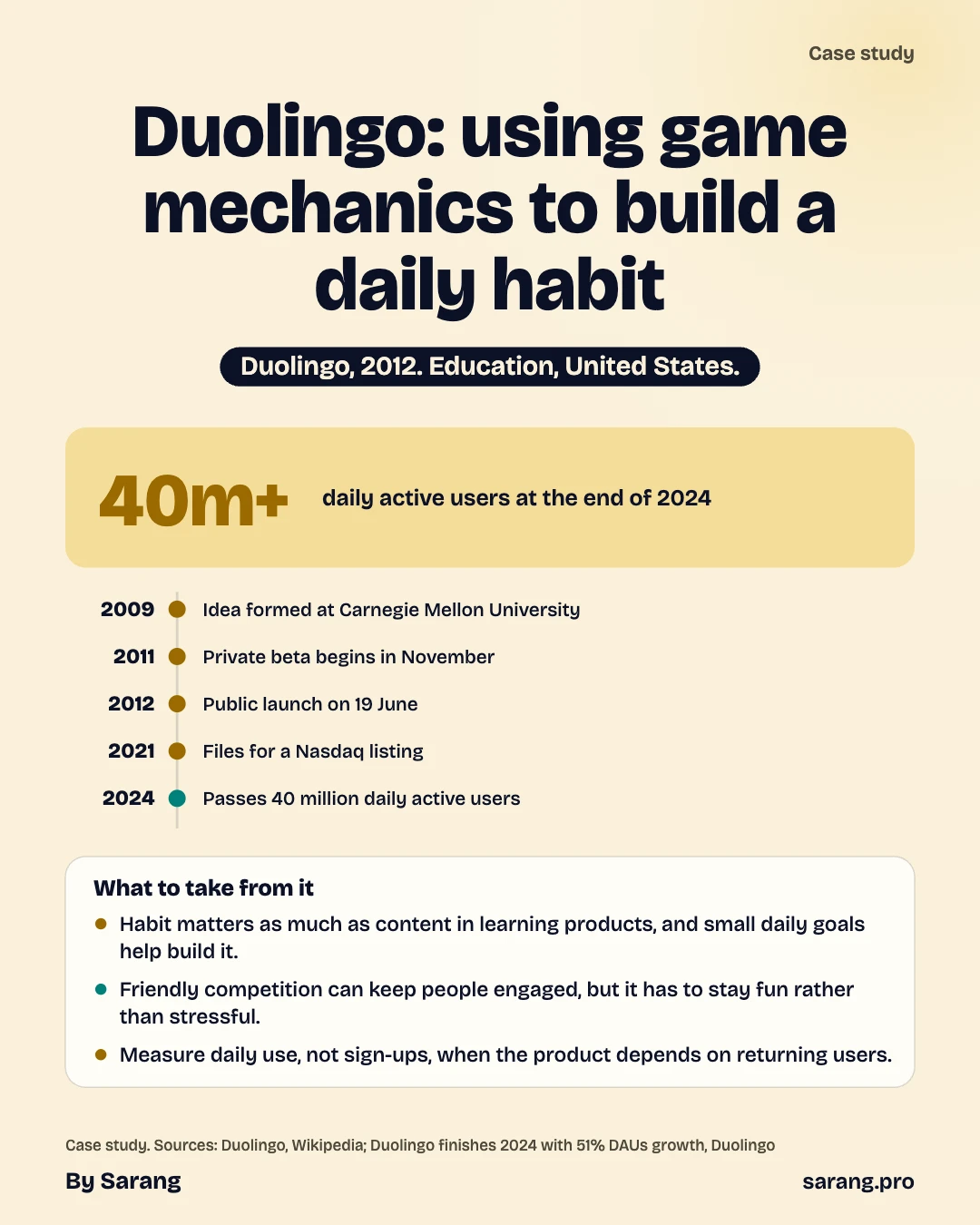
What to take from it
- A free product with a small share of paying users depends on keeping the free majority engaged, so engagement is a financial asset and not only a design goal.
- Game mechanics work best when they are tied to the real goal. Duolingo’s streak rewards the behaviour that produces learning, which is regular practice.
- Rapid testing, with hundreds of A/B tests a quarter according to the 2021 report, lets a company tune a habit in small steps.
- A move to cut costs with AI can be sound for the business and still damage trust with the customers who care most, as the 2025 backlash showed.
- Choosing growth in users over near-term profit is a legitimate strategy, but a listed company has to accept that investors may punish it, as they did in November 2025.
Questions to think about
- At what point does a streak stop motivating a learner and start to feel like pressure? What would you measure to tell the difference?
- Duolingo has about 10% of monthly users paying. If you ran the company, how would you raise that share without hurting daily use?
- Von Ahn’s AI-first memo may have been right for the business and wrong in tone. How should a leader announce a change like that?
- Is the daily active user the right number to steer by, or does it hide whether anyone is learning a language?
Concepts at work
This case draws on gamification, the hook model and switching costs. Explore them in Insights.
Written from the public sources listed below. Figures are as those sources report them.
Framework
Timeline
- 2011Work begins at Carnegie Mellon University
- 2012App launches
- 2014Translation business dropped; no revenue for three years
- 2017Advertising and ad-free subscription introduced
- Dec 2019Valued at $1.5bn
- 28 Jul 2021Nasdaq debut after pricing at $102
- Jan 202410% of contractors offboarded, citing AI
- Apr 2025AI-first memo posted on LinkedIn
- Jun 2025Chess course launched
- 6 Nov 2025Shares fall nearly 30% on guidance and a shift to user growth
- 26 Feb 2026Full-year 2025 results; 2026 plan prioritises daily users
Recap cards
Tap a card to check yourself.
Sources and credits
- Forbes: Game of tongues, how Duolingo built a $700 million business with its addictive language-learning app (16 Jul 2019)
- Fortune: This language learning company soared in its Nasdaq debut (29 Jul 2021)
- Duolingo Inc: Form 10-K for the year ended 31 December 2021 (SEC)
- Duolingo Inc: Form 10-K for the year ended 31 December 2024 (SEC)
- The 74: As Duolingo turns to AI, some users say the language app has joined the dark side (2025)
- Fast Company: Duolingo deletes TikTok posts amid AI backlash, returns with a strange message (20 May 2025)
- Fast Company: How Duolingo vibe-coded its way to a hit chess game (5 Nov 2025)
- Tiger Brokers (republished): Duolingo plunges nearly 30% on weak guidance, CEO prioritises user growth (7 Nov 2025)
- Tiger Brokers (republished): Duolingo Reports Fourth Quarter and Full Year 2025 Results (27 Feb 2026)
- MarketBeat: Duolingo Q4 earnings call highlights (26 Feb 2026)



