Enron: how accounting tricks hid a failing business
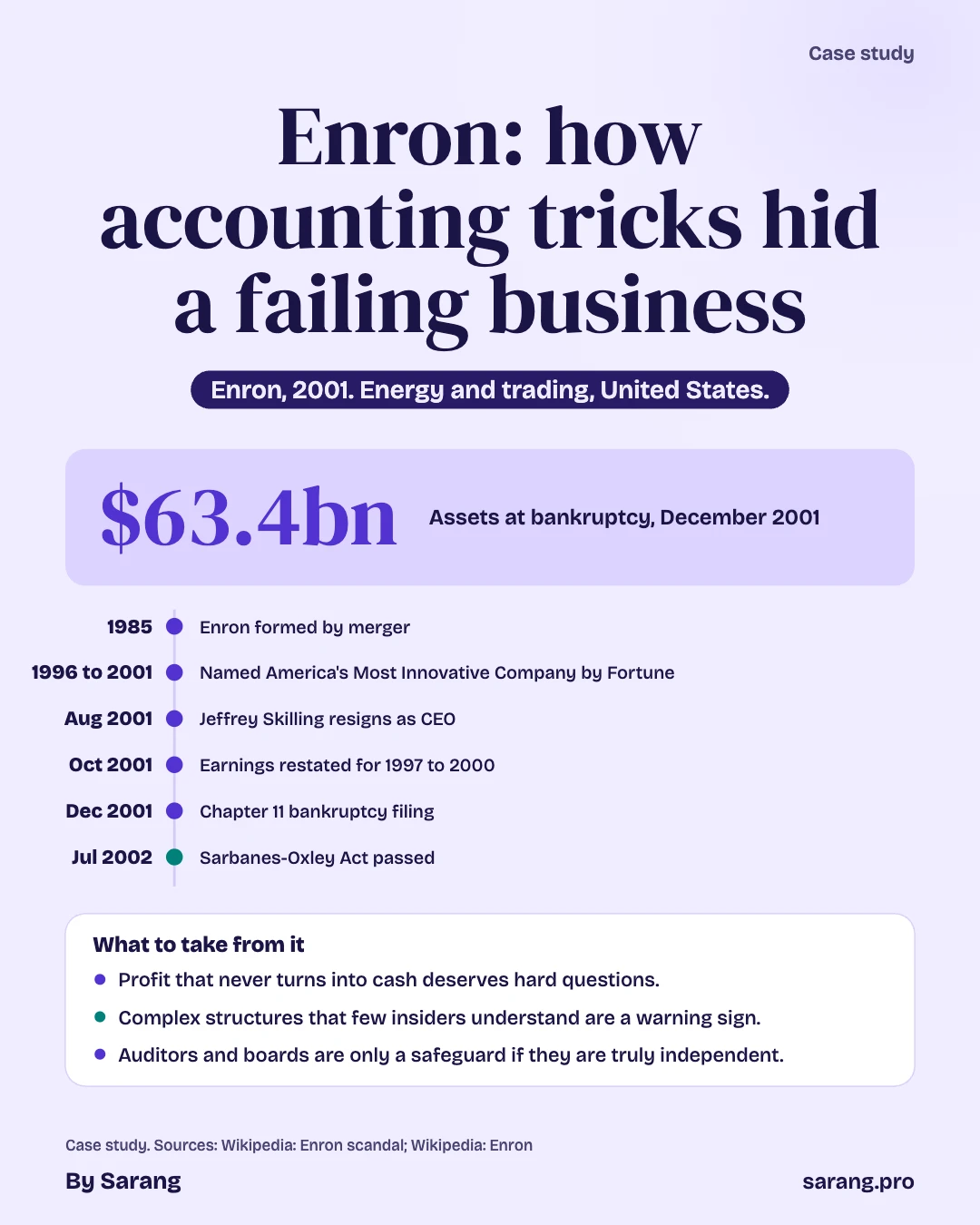
Enron reported $979 million of profit for 2000, yet within a year it had restated its accounts by $586 million and filed for bankruptcy, with nearly half its assets held off its books.

- Enron's 2000 revenues
- $100.8bn
- assets in unconsolidated affiliates, Oct 2000, of $60bn total
- $27bn
- cut to earnings in the 8 Nov 2001 restatement
- $586m
- reduction in shareholders' equity when the Raptors ended
- $1.2bn
The situation
On 2 December 2001, Enron Corporation filed for Chapter 11 bankruptcy protection in New York. Eleven months earlier its shares had traded above $80, and its own annual report for 2000 had shown revenues of $100.8 billion, net income of $979 million and total assets of $65.5 billion. By January 2002 the shares were worth less than 70 cents, according to a Congressional Research Service summary.
The fall took less than two months from the first public sign of trouble. On 16 October 2001 Enron reported a quarterly loss. On 8 November it said it would restate its earnings back to 1997. On 28 November the main credit rating agencies cut its debt to junk grade. Four days later it was in bankruptcy. The company had also just failed to complete a rescue merger with a smaller rival, Dynegy.
What turned a bad quarter into a collapse was not the loss itself. It was the discovery that a large part of Enron’s reported strength rested on transactions with entities that were meant to look independent but were tied to the company, and that some of them were run by its own chief financial officer. Once investors and lenders doubted the accounts, they stopped lending and stopped trading with the firm, and a business that depended on trust could not carry on.
This case follows how Enron built that structure, why the people who might have stopped it did not, and what the collapse changed. It uses company filings, a United States Senate investigation and an SEC complaint, alongside summaries from reference sources.
Background
From pipelines to a trading firm
Enron was formed in 1985 by the merger of Houston Natural Gas and InterNorth of Omaha, Nebraska, which created a company with natural gas pipelines across the United States. The Congressional Research Service reports that its revenues rose from under $10 billion in the early 1990s to $101 billion in 2000, a figure that put it seventh on the Fortune 500.
The reference summary from EBSCO says that deregulation of natural gas transmission weakened the position that the pipeline owners had enjoyed, because it ended their exclusive use of the lines. Chief executive Kenneth Lay moved the company towards other businesses, including telecommunications. Jeffrey Skilling, who had come to Houston as a consultant with McKinsey, urged executives to use the firm’s size to lock in costs and prices through contracts. In 1999 Enron launched EnronOnline, a trading platform that EBSCO says almost every energy company used.
Where the revenue figures came from
Much of the headline growth came from trading, not from owning assets. Britannica explains that Enron used mark-to-market accounting, which meant recording the expected future gains on some trading contracts as income in the period the contract was signed. That makes profits depend on the company’s own estimates of future prices, and it makes cash lag behind reported earnings. A revenue figure of $100.8 billion, impressive as it was, says little on its own about profit, which is why net income is the better measure.
The 2000 annual report
The 10-K for 2000, filed on 2 April 2001, showed 20,600 employees at the end of the year, 754 million shares outstanding, and non-affiliate shares with a market value of about $60.2 billion on 15 February 2001. Net income was $979 million against $893 million the year before. The same report recorded a pre-tax charge of $326 million for an impairment at Azurix, its water business, and noted an agreement to sell Portland General Electric to Sierra Pacific Resources for $2.1 billion. It reported results that looked like those of a profitable and growing company.
The industry
Energy trading and deregulation
Through the 1990s, energy markets in the United States were opened up to competition and trading. A company that could price risk and hedge it had a chance to earn fees on huge volumes. The Congressional Research Service notes that Enron’s energy derivatives markets were largely unregulated, with no reporting requirements, and that legislation in 2000 exempted energy derivatives from the jurisdiction of the Commodity Futures Trading Commission. It adds that there was no evidence at the time of its report that derivatives trading losses caused the collapse. The point is that the field in which Enron operated gave regulators little view into what it did.
Accounting rules for special purpose entities
The accounting rules of the time let a company keep a special purpose entity, a separate legal vehicle set up for a single purpose, off its own balance sheet if an independent third party put in as little as 3 per cent of its capital. That rule was meant for legitimate financing structures. The Senate’s investigation later found that Enron used the mechanism on a very large scale. Its 1999 and 2000 annual reports listed almost 3,000 related entities.
Banks, auditors and analysts
Enron’s work involved the biggest banks. The Congressional Research Service says Citigroup and J.P. Morgan Chase each had investment and commercial banking relationships with Enron and lost money in its collapse, and it notes that a 1999 law had repealed the separation between those two activities. Arthur Andersen acted both as Enron’s outside auditor and as a consultant. The Senate board report, discussed below, found that Andersen also provided internal audit services. Analysts were also slow to react: on 29 November 2001, when the stock had fallen 99 per cent from its high, only two of 11 major analysts rated it a sell.
The decision
There was no single decision to commit fraud that the sources show. There were instead a series of choices about how to report a business that was changing, each of which looked defensible alone. This section describes the main choices and the alternatives that existed.
Option 1: report the business as it was
The straightforward alternative was to consolidate the entities that did business with Enron, show the debt they carried, and let mark-to-market profits and trading revenue speak for themselves. That would have shown lower earnings and higher debt. The Senate subcommittee found that by October 2000 around $27 billion of Enron’s $60 billion of assets, nearly half, were held by unconsolidated affiliates. Reporting these on the balance sheet would have changed how the market saw the firm and how much it had to pay to borrow.
Option 2: use outside partners for real risk transfer
A second alternative was to use truly independent partners to share risk. That was what the structures were supposed to be. But in the structures that mattered the partners were tied to the company, as the SEC later alleged. Enron’s third-quarter filing in 2001 describes two private partnerships, LJM1 and LJM2, formed in 1999, with Chief Financial Officer Andrew Fastow as managing member of their general partners until July 2001. Enron said it believed Fastow had earned more than $30 million from them.
Option 3: use affiliated entities to smooth the numbers
The route Enron took was to use affiliated entities, including LJM and the Raptor vehicles, to take assets and losses off its books and to hedge its own investments with its own shares. In 1999 the board waived its conflict-of-interest rules to let Fastow run LJM, according to the Congressional Research Service. The Senate report says the board first considered LJM1 at a special teleconference meeting on 28 June 1999 that lasted an hour. It approved the Raptor transactions three times in 2000.
The financial pull is easy to see. The Senate report says LJM1 and LJM2 were credited with more than $2 billion in funds flow and over $200 million in earnings for Enron, and the board was told that LJM produced over $2 billion in funds flow in about six months. In Enron’s own account, LJM-related transactions added $618.6 million to pre-tax earnings in 2000.
What they did
1997 to 1999: the first structures
The SEC’s October 2002 civil complaint against Fastow alleged that he secretly controlled an entity called Chewco, which in 1997 bought the interest of the California pension fund CalPERS in a joint venture known as JEDI. According to the complaint, Chewco was kept off Enron’s balance sheet, which overstated net income and understated debt. These are allegations in a complaint, not findings by a court. The complaint also described a deal in December 1999 in which Enron allegedly sold interests in Nigerian barges to a financial institution, allowing it to book about $12 million in 1999 earnings, after Fastow allegedly promised that the institution would be bought out within six months. Roughly six months later, the SEC said, LJM2, which Fastow controlled, bought the interest on pre-arranged terms.
1999 to 2000: LJM and the Raptors
LJM1 and LJM2 were set up in 1999. One early LJM1 transaction involved shares in Rhythms NetConnections, which Enron had bought for $10 million and which were worth about $300 million at the time; the Senate report says LJM1 could pay Enron $50 million in cash. The Raptor vehicles were built to hedge Enron’s investments. The third-quarter 2001 filing says the Raptors hedged $453 million of losses on Enron investments in the first nine months of 2001, and that Enron was obliged to deliver up to 30 million of its own shares to them by March 2005. The SEC complaint alleged that, for one Raptor deal in September 2000, documents were backdated to make it look as if Enron had locked in the value of its Avici Systems stock when the shares hit their all-time high in August 2000.
Summer 2001: warnings
Skilling became chief executive in February 2001 and resigned in August 2001, according to Britannica. Lay returned as chief executive on 14 August. According to EBSCO, on 15 August a vice president, Sherron Watkins, wrote to Lay with concerns about the Raptor and Condor deals and urged an investigation. Outside lawyers at Vinson and Elkins were hired for an internal inquiry and reported that the deals were creative but did not amount to a formal conflict of interest. Fastow sold his LJM interests to Michael Kopper in July 2001.
October and November 2001: the unravelling
On 16 October Enron announced third-quarter results. The Congressional Research Service describes the quarter as its first loss in four years with a $1 billion charge. The company’s own filing, restated, shows a net loss of $644 million, an operating loss of $917 million and investment losses of $768 million. It also recorded a $710 million pre-tax charge for ending the Raptor vehicles, and a reduction of $1.2 billion in shareholders’ equity when Enron bought out LJM2’s interest in the Raptors for $35 million and terminated them. The Senate report instead gives the Raptor termination charge as $800 million, so sources differ on that figure.
Next came the formal steps. The SEC asked for information on 22 October. It opened a formal investigation on 31 October, the day that William Powers Jr. was named to chair a special committee of the board to look into the related-party deals. On 8 November Enron filed to restate its results for 1997 to 2000 and the first two quarters of 2001; the Congressional Research Service puts the cut in earnings at $586 million. Dynegy signed a merger agreement on 9 November. On 12 November Standard and Poor’s cut Enron’s senior debt to BBB-, one notch above junk. The Dynegy deal collapsed after Enron disclosed a further $690 million in obligations tied to its falling credit rating. On 28 November the rating agencies cut the debt to junk. Enron filed for bankruptcy on 2 December.
What happened
Investors and employees
Shareholders lost tens of billions of dollars, the Congressional Research Service says. At the end of 2000, Enron stock made up 62 per cent of the assets in the company’s 401(k) retirement plan, and many employees held higher shares. Those workers therefore lost both their jobs and a large part of their retirement savings.
Inquiries and prosecutions
Nine committees of the House and Senate held hearings. The Justice Department opened a criminal inquiry. Arthur Andersen was indicted in March 2002 for obstruction of justice after Enron-related documents were shredded; Britannica reports that it was found guilty on 15 June 2002 and lost its licence to practise public accounting. Around 2005 the Supreme Court unanimously overturned the verdict because of faulty jury instructions, but by then only about 200 staff remained.
| Person | Outcome reported | Source |
|---|---|---|
| Andrew Fastow, former chief financial officer | Sentenced to six years in prison; released in 2011 | Britannica |
| Jeffrey Skilling, former chief executive | Convicted in 2006; sentenced to 24 years; a later deal reported in 2013 could cut the term to 14 to 17.5 years | NPR; Britannica |
| Kenneth Lay, chairman | Convicted in 2006; died in July 2006 before sentencing; his conviction was later thrown out | IndustryWeek; Britannica |
Law and accounting
The Sarbanes-Oxley Act of 2002 set tough penalties for destroying, altering or fabricating financial records and barred audit firms from providing consulting services to the same clients, Britannica says. The Senate subcommittee’s report on the board, released on 8 July 2002, set out the oversight failures that had allowed the structures to grow.
Other views
The Senate subcommittee: the board failed
The Permanent Subcommittee on Investigations concluded that the board of directors failed its fiduciary duty to shareholders and ignored warning signs over several years. It found that the board knowingly allowed high-risk accounting and approved an arrangement letting the chief financial officer set up and run funds that did business with Enron. It also found that financial ties between certain directors and Enron weakened their independence, and that Andersen provided internal audit and consulting services at the same time as it acted as outside auditor. Directors’ pay of about $350,000 in 2000, the report says, was more than twice the national average of $138,747 for the top 200 companies.
The SEC: individual wrongdoing
The SEC’s complaint against Fastow, filed on 2 October 2002, alleged violations of securities law, including false books and records and aiding and abetting fraud. It sought repayment of ill-gotten gains, civil penalties and a bar on serving as an officer or director of a public company. The SEC itself labelled these as allegations. The same document shows how small some of the sums were compared with the damage: windmill-farm entities that allegedly made about $2.7 million in unlawful profit, a charitable foundation that allegedly received $4.5 million.
A narrower reading: bad investments
The Congressional Research Service said Enron’s problems stemmed mainly from dot-com investments and certain foreign subsidiaries, not from its core energy operations. That reading puts more weight on bad investments than on the accounting. The filings and the Senate report suggest the two were linked, because the structures let weak investments such as Rhythms and Avici hold up reported earnings for a time.
Limits of the evidence
The sources do not agree on every figure. The size of the October 2001 charge appears as roughly $1 billion in one summary, $710 million for the Raptor termination in the company filing, and $800 million in the Senate report. Allegations in the SEC complaint are not proven facts. This case also does not rely on the Powers Report, the board’s own investigation, because the report was not opened for this write-up.
Reading it through a framework
Principal-agent theory and governance
Shareholders are the owners, and managers act for them. Trouble starts when the managers’ interests differ from the owners’ and the owners cannot see what is happening. Fastow ran LJM while he was Enron’s chief financial officer, and Enron said he made over $30 million from it. On one side of those deals he represented Enron; on the other, he had a personal gain. The board, whose job was to watch for this, waived the conflict rules in 1999 and, according to the Senate report, considered LJM1 at a special meeting that lasted an hour. The auditor was paid to consult as well as to audit, which blunted the check that auditing is supposed to provide.
Incentives and the fraud triangle
Fraud researchers describe a mix of pressure, opportunity and rationalisation. Enron had pressure: a share price that the market valued at $60 billion and expected to keep rising. It had opportunity, because the accounting rules let a 3 per cent outside stake keep an entity off the books, and because mark-to-market gave management wide discretion. And the rationalisation was written into the records, in the lawyers’ view that the deals were creative but not a formal conflict. Each element reinforced the others. When the share price weakened in 2001, the Raptor hedges, which depended on Enron’s own shares, became a liability.
Since then
The collapse reshaped corporate regulation in the United States. The Sarbanes-Oxley Act of 2002 tightened rules on financial records and on auditors providing consulting work. Arthur Andersen, once one of the largest accounting firms, was effectively finished by the 2002 conviction even though the Supreme Court later overturned it. Britannica reports that Skilling and Lay were convicted in 2006, that Lay died before sentencing, and that Fastow served six years. In 2010 the Supreme Court threw out one aspect of Skilling’s conspiracy conviction and affirmed the rest, and in 2012 the court declined to hear his latest appeal, according to IndustryWeek. In 2013, NPR reported a deal that could reduce his sentence to between 14 and 17.5 years. The sources opened here do not cover later developments, such as any further changes to accounting rules or the final recoveries of creditors.
What to take from it
- Reported profit and cash are different things, and a business built on mark-to-market estimates needs strong outside checks on those estimates.
- A conflict of interest at the top is a governance problem even when each step looks legal, and a board that waives its own rules removes its own safeguard.
- Off-balance-sheet structures can be legitimate, but when nearly half of reported assets sit in them, as the Senate found for Enron by October 2000, readers of the accounts deserve a clear explanation.
- An auditor that earns consulting fees from the same client has a reason not to disagree, which is why Sarbanes-Oxley separated the two roles.
- Employees who hold their pensions in their employer’s shares carry the same risk twice, as the 62 per cent figure for Enron’s 401(k) plan shows.
Questions to think about
- Which of the safeguards around Enron, the board, the auditor, the banks, the analysts or the regulators, was best placed to stop the structures, and why did it not?
- Where is the line between aggressive but legal accounting and misleading reporting, and who should draw it?
- If you were a director in June 1999 being asked to approve LJM1 in a one-hour call, what would you have asked for before voting?
- How should a company limit the share of employee pensions held in its own stock?
Concepts at work
This case draws on the principal-agent problem, off-balance-sheet financing and the fraud triangle. Explore them in Insights.
Written from the public sources listed below. Figures are as those sources report them.
Framework
Timeline
- 1985Houston Natural Gas and InterNorth merge to form Enron
- 1999LJM1 and LJM2 formed; board waives conflict rules for Fastow
- 28 Jun 1999Board considers LJM1 at a one-hour special meeting
- 2 Apr 200110-K for 2000 filed, showing $979 million net income
- Aug 2001Skilling resigns; Lay returns; Sherron Watkins writes to Lay
- 16 Oct 2001Enron reports third-quarter loss
- 31 Oct 2001SEC opens formal investigation; Powers named to lead special committee
- 8 Nov 2001Restatement of 1997 to 2001 results announced
- 28 Nov 2001Credit ratings cut to junk
- 2 Dec 2001Enron files for Chapter 11
- Mar 2002Arthur Andersen indicted
- 8 Jul 2002Senate report on the board's role
- 2 Oct 2002SEC files civil complaint against Fastow
Recap cards
Tap a card to check yourself.
Sources and credits
- Congressional Research Service (via EveryCRSReport): Enron Corporation collapse, Report RS21135, March 2002
- SEC: Enron Corp Form 10-K for fiscal year 2000, filed 2 April 2001
- SEC: Enron Corp Form 10-Q for the quarter ended 30 September 2001
- SEC: Litigation Release 17762, SEC v. Andrew S. Fastow, 2 October 2002
- US Senate Permanent Subcommittee on Investigations: The Role of the Board of Directors in Enron's Collapse, S. Prt. 107-70, 8 July 2002
- EBSCO Research Starters: Enron bankruptcy reveals massive financial fraud
- Britannica: Enron scandal, Downfall and bankruptcy
- NPR: Enron's Jeffrey Skilling may see sentence reduced, 8 May 2013
- IndustryWeek: U.S. Supreme Court turns down former Enron chief's appeal, 16 April 2012



