Google: a search giant that moved its Chinese search offshore rather than keep censoring
Google launched a censored Chinese search site in 2006, then after a 2009 cyber attack on it and dozens of other firms moved mainland search to Hong Kong.
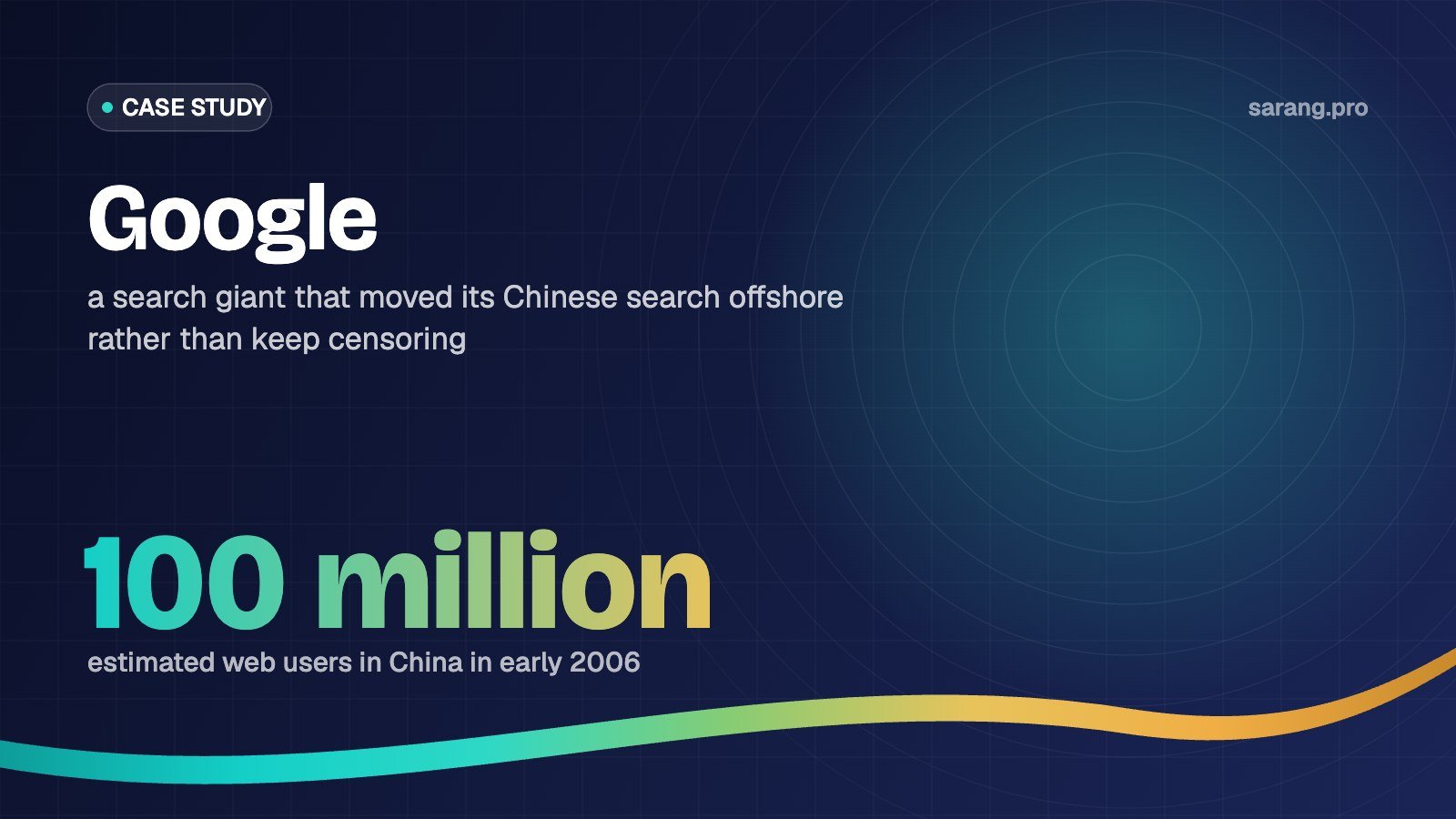
- estimated web users in China in early 2006
- 100 million
- estimated Google China revenue in 2009
- $250m to $300m
- companies McAfee said were breached in the Aurora campaign
- 34
- Google's share of China search ad revenue, end 2009 to Q4 2010
- 35.6% to 23.1%
The situation
On 12 January 2010 David Drummond, Google’s chief legal officer, published a short post on the company’s official blog under the title “A new approach to China”. It said that in mid-December 2009 Google had detected “a highly sophisticated and targeted attack” on its corporate network, originating in China, which had led to the theft of intellectual property. It said at least 20 other large companies had been targeted in the same way. And it said Google was “no longer willing to continue censoring our results on Google.cn”, the Chinese search site it had run for four years under the conditions set by Beijing. Over the following weeks Google would talk to the Chinese government about whether it could run an unfiltered search engine within the law, “if at all”. It accepted that this might mean closing google.cn and possibly its offices in China.
The post added a detail that showed how unusual the step was. The decision, it said, had been taken by Google’s executives in the United States without the knowledge or involvement of its staff in China. Google was putting at risk a business in the largest internet market in the world, where it had built the second-largest search engine, to stop doing something it had agreed to do in 2006.
The money at stake was modest for Google but the market was not. Analysts estimated that Google earned between $250m and $300m in China in 2009, about 1.1% to 1.3% of its gross revenue of $23.7bn. China, though, already had far more internet users than any other country, and the number was rising every year. Google was the clear number two to Baidu, a Chinese company listed on Nasdaq, and by one measure had been gaining ground. The question the January post raised was whether a company that had built its reputation on making information available could keep operating in a country whose government required it to filter that information, after that government’s territory had been used to attack it.
Background
Larry Page and Sergey Brin founded Google in 1998 as a search engine and turned it into one of the most profitable businesses in the world by selling advertisements alongside search results. Advertisers paid when users clicked on their ads, and auctions set the prices. Google’s revenue rose from $10.6bn in 2006 to $23.7bn in 2009 and $29.3bn in 2010. It had 24,400 full-time employees at the end of 2010. Its stated mission was to organise the world’s information and make it universally accessible and useful, and its informal motto, “Don’t be evil”, was widely quoted, by its admirers and its critics alike.
Exhibit 1: Google’s revenue and the estimated size of its China business
| Year | Google total revenue ($m) | Estimated China revenue |
|---|---|---|
| 2006 | 10,605 | n/a |
| 2007 | 16,594 | n/a |
| 2008 | 21,796 | n/a |
| 2009 | 23,651 | $250m to $300m, about 1.1% to 1.3% of gross revenue (Jefferies); “less than 2%” (most estimates, per The Motley Fool) |
| 2010 | 29,321 | About 2% of revenue forecast before the exit (Piper Jaffray) |
Sources: Google Form 10-K for 2010 (revenue); eWeek, January 2010 (Jefferies and Piper Jaffray estimates); The Motley Fool, 26 January 2010. Google did not report China revenue separately, so the China figures are analysts’ estimates.
Before 2006 Chinese users could reach google.com, which was hosted outside China. Their searches passed through the government’s filtering system, often called the Great Firewall, which slowed results and blocked many pages. Google said the service was so degraded that it amounted to giving people no information. In late January 2006 it launched google.cn, a Chinese-language site run from servers inside the country. CNN reported the launch on Wednesday 25 January 2006; some later accounts date it to the following day.
To operate inside China, google.cn removed results that the authorities considered sensitive. ABC News showed the effect at launch. A search for the banned Falun Gong movement that returned a followers’ website on google.com returned nothing similar on google.cn. On google.com, 40 of the top 100 results for “democracy” and “China” were pages blocked in China. A 2002 Harvard Berkman Center study had found that nearly 20,000 sites available in the United States could not be reached from China, including the BBC and The Washington Post.
Google tried to limit the damage in two ways. Results pages told users when information had been removed, as Google already did when it removed results under laws in Germany, France and the United States. And google.cn did not offer Gmail or the ability to create blogs. Andrew McLaughlin, Google’s senior policy counsel, argued that offering “a heavily degraded user experience that amounts to no information” was more at odds with Google’s mission than removing some results.
The industry
China had an estimated 100 million web users at the start of 2006, out of a population of about 1.3 billion, and that figure was expected to reach 187 million within two years. It grew much faster than that. By December 2023 the China Internet Network Information Center counted 1.09 billion internet users, a penetration rate of 77.5%.
Search was the main way those users found information online, and paid search was one of the main ways Chinese companies advertised online. The market leader was Baidu, founded in 2000 by Robin Li and Eric Xu and listed in the United States in August 2005. As a Chinese company it faced none of the reputational pressure that Google faced at home over censorship, and it could build its product and its sales effort around the domestic market alone.
Measuring the market was not simple, and the measures disagreed. Analysys International, a Beijing research firm, tracked share of search advertising revenue. Web analytics firms such as StatCounter and comScore tracked share of searches or page views. The table shows how different the picture looked at the end of 2009, just before Google’s announcement.
Exhibit 2: Google and Baidu in Chinese search, by measure
| Measure and source | Period | Baidu | |
|---|---|---|---|
| Share of search advertising revenue (Analysys International) | End of 2009 | n/a | 35.6% |
| Share of search usage (StatCounter) | July 2009 | 68% | 30% |
| Share of search usage (StatCounter) | End of 2009 | 56% | 43% |
| Share of searches (comScore) | Late 2009 | 64% | 31% |
| Query share (Piper Jaffray estimate) | Late 2009 | 65% | 30% |
| Share of paid search budgets (Piper Jaffray estimate) | Late 2009 | 71% | 26% |
| Share of search advertising revenue (Analysys International) | Q4 2010 | 71.7% | 23.1% |
Sources: eWeek, January 2010 (StatCounter, comScore, Piper Jaffray); PCWorld, January 2011 (Analysys International). The Baidu figure of 71.7% was reported in January 2011 and is given as current at that date.
The structure of the market gave the government unusual power over every player. A foreign company needed an Internet Content Provider licence to run a commercial website in China, and the licence had to be renewed. The authorities could slow or block a foreign site at the border at any time. Rivalry was fierce, with Baidu dominant and several smaller Chinese search engines competing for the rest, but the decisive force in the market was regulatory, not competitive. Buyers, in this case advertisers, could move their budgets easily between search engines. Users could switch with a click, though many had little reason to try a foreign site that loaded slowly or was blocked. For a foreign firm the usual sources of advantage, such as better technology and a global brand, counted for less than local relationships and the regulator’s goodwill.
Politics in Washington also shaped the industry. In February 2006, weeks after google.cn launched, executives from Google, Yahoo, Microsoft and Cisco were called before a House subcommittee on human rights. Google’s vice-president for communications, Elliot Schrage, said self-censorship was “something that conflicts deeply with our core principles”, and acknowledged the inconsistency. Representative Tom Lantos told the companies that China had changed them rather than the other way round and called their conduct “a disgrace”. Representative Chris Smith proposed legislation to restrict what American technology companies could do in China.
The decision
The December 2009 attack changed the calculation Google had made in 2006, for three reasons. It showed that Google’s own systems had been targeted from China. One aim of the attackers appeared to be access to the Gmail accounts of Chinese human rights activists, the very risk Google had tried to avoid by keeping Gmail off google.cn. And Google’s investigation found that the Gmail accounts of dozens of advocates for human rights in China, based in the United States, China and Europe, were being routinely accessed by third parties, most likely through phishing or malware on their own computers rather than through a breach at Google. In the March update Google also cited the blocking of sites such as Facebook, Twitter and YouTube as part of the context.
Google said the attackers had reached only two Gmail accounts, and had seen only account information such as the date of creation and subject lines, not the content of messages. But it had lost intellectual property. Later reports said this included some of its source code.
Three broad options were on the table.
Carry on as before
Google could treat the attack as a security matter, harden its systems, and keep google.cn running under the 2006 terms. That would protect a fast-growing business, keep its staff and advertisers in China, and avoid a confrontation with Beijing. Against it, Google would be continuing to censor results for a government whose territory had been used to attack it and its users. Its argument of 2006, that a censored service was better than none, had been based on the hope that conditions would improve. The 2006 post had promised to “carefully monitor conditions in China”. By its own account they had not improved.
Stop censoring and negotiate
Google could stop filtering and try to agree a way to run an unfiltered search engine within Chinese law. This was the option the January post said Google would pursue. It had the advantage of keeping Google’s position consistent with its stated values while leaving room for a deal. Its weakness was that the Chinese government had shown no sign of accepting it. When Google later described the talks, it said the government had made clear that “self-censorship is a non-negotiable legal requirement.”
Close google.cn and possibly leave China
Google could close the Chinese site, and perhaps its offices. That would end the censorship issue entirely, at the cost of the business, its research staff in China and its relationships with Chinese advertisers. It would also hand the market to Baidu.
There was also a choice about how to act, separate from what to do. Google could have negotiated in private. It chose instead to announce the attack and its change of policy publicly, before talking to Beijing. That raised the political stakes on both sides. It also put the attack on the public record at a time when companies rarely disclosed intrusions, and it prompted others to look for the same malware.
What they did
Going public
Google’s 12 January post named no attacker and did not accuse the Chinese government. Two days later the security firm McAfee published its own analysis, based on malware samples from three to five of the targeted companies. Its chief technology officer, George Kurtz, named the campaign “Aurora”, after a file path on the attackers’ machine. The attackers had used spear-phishing emails and instant messages carrying malicious links, and a previously unknown flaw in Internet Explorer. McAfee said that besides Google and Adobe at least 32 other companies had been breached. Kurtz said the malware had been sent to a small number of senior technical staff with access to source code, not spread widely: “This wasn’t something that got blasted to 300,000 people in a corporation.” The command servers McAfee found were in the United States and Taiwan.
The first Chinese official response was cautious. An unnamed official at the State Council Information Office told Xinhua on 13 January that the authorities were gathering more information, and that “it is still hard to say whether Google will quit China or not.”
Moving search to Hong Kong
The talks did not produce a deal. On 22 March 2010 Google stopped censoring Google Search, Google News and Google Images on google.cn and began redirecting google.cn users to google.com.hk, its Hong Kong site. Mainland users got uncensored search in simplified Chinese, served from Hong Kong, which had its own legal system and no requirement to filter results. Google called this “a sensible solution” and said it hoped the government would respect it, while admitting that access “could at any time” be blocked.
Google said it intended to keep its research and development work in China and to maintain a sales presence there, though the size of the sales team would depend partly on whether mainland users could reach the Hong Kong site. It set up a public page, updated daily, showing which Google services were available in China. It also repeated that all these decisions had been driven and carried out by its executives in the United States, and that none of its China-based employees “can, or should, be held responsible for them”. Results from google.com.hk still passed through the Great Firewall on their way to mainland users, so searches for sensitive terms could still fail. The difference was that the filtering was now done by the state, not by Google.
The licence
The redirect then ran into the licensing system. Google’s Internet Content Provider licence was due for renewal on 30 June 2010. Without it, Google said, “we can’t operate a commercial website like Google.cn” and would “effectively go dark in China”. Officials told Google the automatic redirect was unacceptable and that the licence would not be renewed if it continued.
On 28 June Google changed course. Instead of redirecting users automatically, google.cn would show a landing page with a link to google.com.hk, along with services such as music search and text translation that Google could provide locally without filtering. Google resubmitted its licence application on that basis, saying the approach kept its commitment not to censor results on google.cn and was consistent with local law. It also noted that many Chinese users had been vocal about wanting to keep google.cn alive. On 9 July Google reported that the licence had been renewed.
Dragonfly
The story had a second act. On 1 August 2018 The Intercept reported that Google had been building a censored search app for China, code-named Dragonfly. According to the report, work began in spring 2017 and sped up after chief executive Sundar Pichai met Wang Huning, a senior Communist Party official, in December 2017. The app would have blacklisted sites and search terms about human rights, democracy, religion and peaceful protest, and shown a notice that some results had been removed “due to statutory requirements”. Only a few hundred of Google’s roughly 88,000 employees knew about it.
Several hundred Google employees, many of them senior, signed an open letter against the project. Pichai said later in 2018 that Google was not close to launching a search product in China and, in December, that it had no plans to do so, without ruling it out. On 16 July 2019 Karan Bhatia, Google’s vice-president for public policy, told a Senate Judiciary Committee hearing, in answer to Senator Josh Hawley: “We have terminated Project Dragonfly.”
What happened
Google’s search business on the mainland shrank after the move to Hong Kong. Analysys International put its share of Chinese search advertising revenue at 35.6% at the end of 2009 and 23.1% in the fourth quarter of 2010, although that last figure was 1.5 points higher than in the third quarter. Baidu’s share was 71.7% when those figures were published in January 2011. Measured by search usage the decline was steeper and longer. StatCounter’s data, which tracks page views from a sample of websites, show Google’s share of searches in China falling to low single digits in the years that followed.
The licence renewal meant Google kept a legal presence on the mainland. In March 2010 it had said it would keep its research and development work in China and a sales team there, with the team’s size depending on whether mainland users could reach the Hong Kong site.
The attack itself had wider effects. Google’s decision to go public, and McAfee’s follow-up, showed that dozens of companies had been compromised by the same campaign. Security firms later linked Aurora to a group that Symantec named Elderwood and that others called the Beijing Group. Symantec found the group still active in 2012, running campaigns against defence suppliers, shipping, aerospace, energy and finance companies.
Exhibit 3: Key events, 2006 to 2019
| Date | Event |
|---|---|
| 25 January 2006 | google.cn launches with filtered results; no Gmail or Blogger |
| 15 February 2006 | Google, Yahoo, Microsoft and Cisco questioned at a House human rights hearing |
| Mid-December 2009 | Google detects the attack on its corporate network |
| 12 January 2010 | Google says it will stop censoring google.cn |
| 14 January 2010 | McAfee names the campaign Aurora and reports at least 34 companies breached |
| 22 March 2010 | google.cn users redirected to uncensored google.com.hk |
| 28 June 2010 | Redirect replaced by a landing page; licence application resubmitted |
| 9 July 2010 | Google reports that its licence has been renewed |
| 1 August 2018 | The Intercept reports the Dragonfly project |
| 16 July 2019 | Google tells a Senate hearing Dragonfly has been terminated |
Sources: CNN; NPR; Google blog posts of 12 January, 22 March and 28 June 2010; The Register; The Intercept; SiliconANGLE. The House hearing date comes from the committee’s published record.
Other views
Google’s decision was praised by press freedom groups and many politicians in the United States, but it drew criticism from several directions, and the record supports more than one reading.
Human rights groups had attacked Google’s original entry. Reporters Without Borders, Human Rights Watch and Amnesty International all criticised google.cn in 2006, and members of Congress compared American technology companies’ conduct in China to collaboration with dictatorships. From that point of view, the 2010 decision corrected a mistake that should not have been made, and Google deserved limited credit for reversing a policy it had chosen freely four years earlier.
Business commentators raised a different objection: that Google was dressing up a commercial retreat as a principled stand. Google was a distant second in China and losing the battle for paid search budgets, with Piper Jaffray estimating its share of paid search spending at 26% against Baidu’s 71%. China accounted for perhaps 1% to 2% of Google’s revenue. On this view leaving cost Google little, and the moral framing helped its reputation at home and in Europe. The counter-argument is that the market was growing so fast that its future value was large, that Google had been gaining usage share during 2009 according to StatCounter, and that it gave up a licensed local site that rivals would have been glad to have.
The Chinese government and state media rejected Google’s account. Chinese officials defended internet regulation as necessary for security and social stability, and official sources suggested that the affair was part of a wider American strategy. Chinese users were not of one mind either. Some had criticised Google from the start for helping the government restrict information, while Google said in June 2010 that many users had asked it to keep google.cn alive.
Within Google the Dragonfly episode showed that the 2010 settlement had not been accepted by everyone. Some executives clearly wanted to return to the largest internet market in the world. Some employees saw any censored product as a breach of the company’s values. The Intercept’s source said: “I’m against large companies and governments collaborating in the oppression of their people.” Analysts quoted by SiliconANGLE suggested that political pressure in Washington probably decided Dragonfly’s fate, and one speculated that Sergey Brin’s reservations played a part. Google has not given a detailed public account of why it ended the project.
Finally, there is the question of attribution. Google said the attack originated in China but did not accuse the government. McAfee found no clear indication of the attackers’ language or location in the code. Later research by security firms linked the campaign to a group with suspected state connections, and leaked diplomatic cables reported claims that senior officials had directed it. These claims came from sources that could not be checked independently.
Reading it through a framework
PESTLE analysis
PESTLE sorts the external forces acting on a business into political, economic, social, technological, legal and environmental factors. Applied to Google in China, it shows a market where the economic case was strong but the political and legal terms decided the outcome.
The economic factor pulled Google towards China. The country had about 100 million web users in 2006, forecast to reach 187 million by 2008, and more than a billion by 2023. Search advertising was growing with that audience. Even a distant second place was worth $250m to $300m a year by 2009, by Jefferies’ estimate.
The political and legal factors pushed the other way. Google needed an Internet Content Provider licence to run google.cn, and the licence came with conditions on content. When Google tried to sidestep those conditions with an automatic redirect, the government made clear that the licence would lapse on 30 June 2010, and Google switched to a landing page within days. At home, political pressure ran in the opposite direction, from the House hearing in February 2006 to the Senate hearing in July 2019. Google faced legal and political demands in two countries that could not both be satisfied.
Social factors were mixed. Chinese users had a strong local alternative in Baidu, and many were content with it. Some wanted uncensored search; Google said in June 2010 that many had asked it to keep google.cn alive. Technology cut both ways. The attack showed how intruders could reach a company’s core systems through a browser flaw and targeted phishing. The Hong Kong servers offered a technical route around Google’s own censorship, but the state could still filter or block the traffic at the border. Environmental factors played no material part.
Read together, the factors explain why the 2006 model was fragile. It depended on political and legal conditions that Google did not control, and on the hope that they would change.
Stakeholder mapping
A power and interest grid places stakeholders according to how much power they have over a decision and how much they care about it. In 2006 Google placed the Chinese government, which controlled the licence, firmly in the high-power, high-interest quadrant and managed it closely by accepting its conditions. Chinese users had high interest but little power over the rules, and Google tried to keep them satisfied with removal notices. American lawmakers and human rights groups had high interest and some power over Google’s reputation; Google answered them with testimony and explanations.
The 2009 attack moved several groups. The human rights angle raised the interest of Google’s own employees, of US politicians and of the public. Google’s senior executives in the United States, who took the decision without involving the China staff, appear to have weighed those groups more heavily than the Chinese government. When the government’s power over the licence reasserted itself in June 2010, Google compromised on the form of its workaround but not on censorship.
Dragonfly shows the same grid at work later. Employees, with moderate formal power but very high interest, organised publicly. Senators gained power over the issue once it reached Congress. The project ended. The map makes clear that Google could not satisfy the most powerful stakeholder in China and its most vocal stakeholders at home at the same time, and that over time it chose the second group.
Since then
Google has not offered a domestic search service on the Chinese mainland since 2010, and none of its later attempts reached launch. According to StatCounter, Google’s share of search in China in September 2026 was 1.46%. Baidu led with 46.65%, followed by Microsoft’s Bing at 21.76%. StatCounter’s methods favour some engines over others, and its figures for China differ widely from those of local measurement firms, so these numbers are best read as showing broad position, not exact share.
Baidu remained China’s largest search company and reported revenue of about 133 billion yuan in 2024, according to its annual report. China’s internet population passed one billion by 2023. The sources checked for this case do not give a recent figure for Google’s revenue from Chinese customers, so the size of what remains of its China business is not known from the public record used here.
Relations between Google and Beijing remained tied to wider politics. In February 2025, as part of its response to new American tariffs, China announced an antitrust investigation into Google. No outcome had been reported in the sources checked for this case.
What to take from it
- A market entry that depends on accepting conditions at odds with a company’s stated values can be undone by a single event that makes those conditions impossible to defend.
- In markets where an operating licence can be withdrawn, the regulator’s view of a workaround matters as much as the workaround’s technical design.
- Different measures of market share can tell very different stories, and a company deciding whether to stay in a market should know which measure its revenue depends on.
- Disclosing a cyber attack publicly can raise the cost of a decision for a company, but it can also help other targets find and fix the same intrusion.
- Employees and legislators in a company’s home country can become decisive stakeholders in its foreign strategy, as the Dragonfly letter and the 2019 hearing showed.
Questions to think about
- Was Google right to enter China with a censored service in 2006, given what it knew at the time and the promise in its own announcement to monitor conditions?
- Using Exhibit 1, estimate what share of Google’s revenue China might have represented by 2015 if Google’s China revenue had grown at 30% a year from $275m in 2009 and Google’s total revenue had grown at 20% a year. Does the answer change your view of whether leaving was cheap?
- Exhibit 2 gives Google’s share at the end of 2009 as anywhere between 26% and 43%. Which measure would you use to judge the commercial cost of leaving, and why?
- Would Google have moved its search service out of the mainland in 2010 without the cyber attack? What does your answer say about how companies make decisions that involve their stated values?
- The Chinese authorities accepted a landing page with a link but not an automatic redirect, even though both sent users to the same uncensored site. Why might the form of the workaround have mattered to the regulator?
- If a company today wanted to serve a large market with strict content rules, what conditions should it set for itself before entering, and what would make it leave?
Concepts at work
PESTLE analysis, stakeholder mapping, political risk. Explore them in Insights.
Further reading
Oxford University Press covers this story as a teaching case in Cases in International Business on Oxford Business Trove. The sources below are the public record this page was written from.
Written from the public sources listed below. Figures are as those sources report them.
Framework
Timeline
- Jan 2006google.cn launches with filtered results
- Feb 2006Google questioned at a House human rights hearing
- Dec 2009Google detects a targeted attack traced to China
- Jan 2010Google says it will stop censoring; McAfee names the attack Aurora
- Mar 2010google.cn users redirected to uncensored google.com.hk
- Jun 2010Redirect replaced by a landing page
- Jul 2010Internet Content Provider licence renewed
- Aug 2018The Intercept reports the Dragonfly project
- Jul 2019Google tells a Senate hearing Dragonfly is terminated
- Feb 2025China announces an antitrust investigation into Google
Recap cards
Tap a card to check yourself.
Sources and credits
- Official Google Blog: A new approach to China (12 January 2010)
- Official Google Blog: A new approach to China, an update (22 March 2010)
- Official Google Blog: An update on China (28 June 2010, updated 9 July)
- CNN: Google to censor China web searches (25 January 2006)
- ABC News: Google defends censorship of web sites (January 2006)
- NPR: US internet execs testify to Congress on China dealings (16 February 2006)
- US House Committee on International Relations: The internet in China, a tool for freedom or suppression? (15 February 2006)
- Google Inc.: Form 10-K for fiscal 2010
- eWeek: Google leads US in search as it mulls exit from China (January 2010)
- The Motley Fool: Google's China stand might not be that costly (26 January 2010)
- The Register: Aurora attack follow-up (14 January 2010)
- China Daily: Chinese official response to Google announcement (13 January 2010)
- Christian Science Monitor: Stealing US business secrets, experts ID two huge cyber gangs in China (14 September 2012)
- PCWorld: Google's China search share (January 2011)
- The Intercept: Google plans to launch censored search engine in China (1 August 2018)
- SiliconANGLE: Google says it abandoned Project Dragonfly (17 July 2019)
- StatCounter: Search engine market share in China
- CNNIC: 53rd Statistical Report on China's Internet Development (2024)
- Baidu: 2024 annual report (Form 20-F)
- Wikipedia: China and United States trade war (entry for 4 February 2025, citing Reuters)