Instagram: how a cluttered check-in app became a $1bn Facebook deal
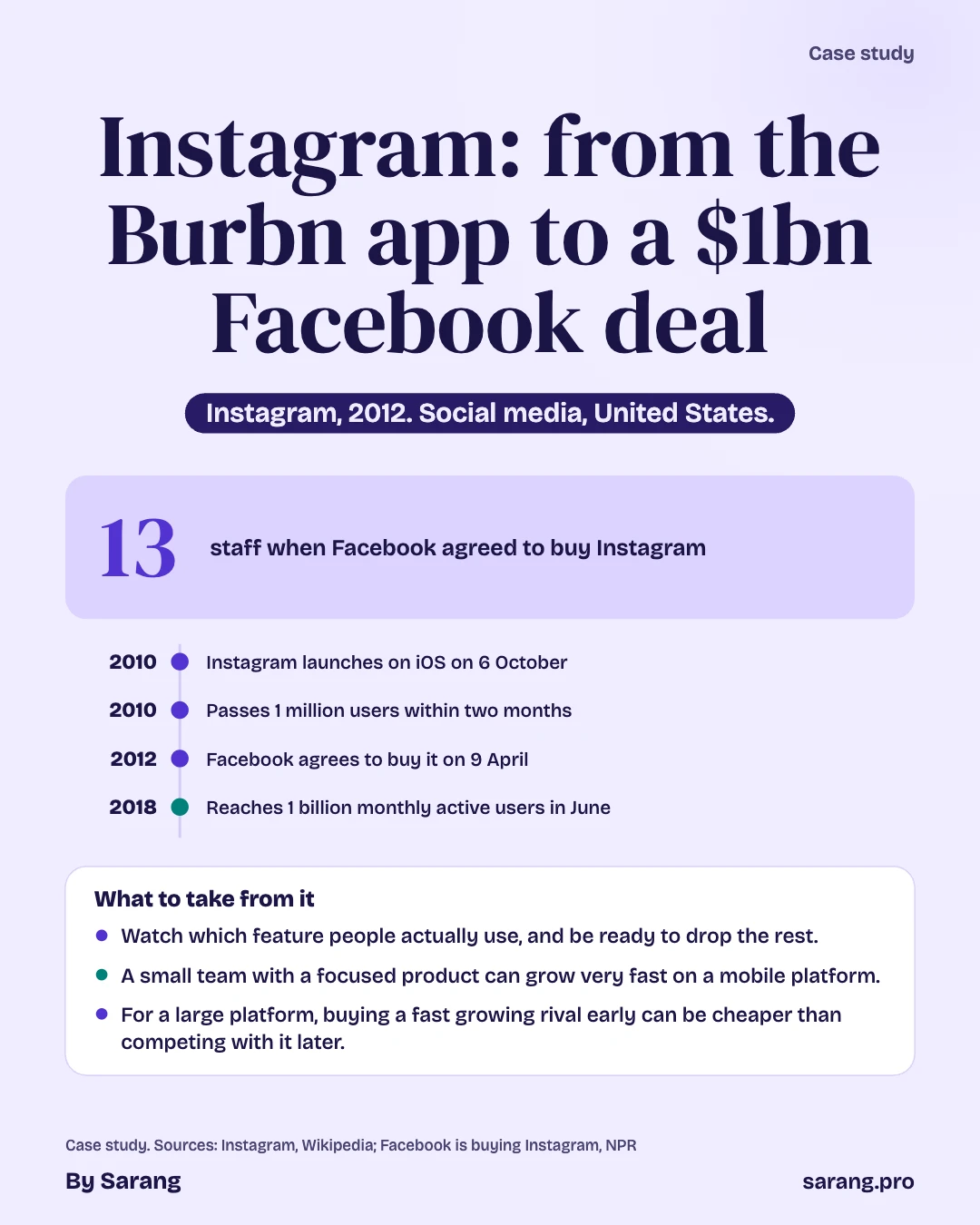
Instagram's founders cut their check-in app Burbn down to photos, launched in October 2010 and sold to Facebook for $1 billion in April 2012 with 13 employees.

- Facebook's price, cash and stock, April 2012
- $1bn
- employees at the time of the sale
- 13
- seed round, March 2010
- $500,000
- Series A at about $20m valuation, early 2011
- $7m
The situation
On 9 April 2012 Facebook announced that it would buy Instagram, a photo-sharing app, for about $1 billion in cash and shares. Instagram had 13 employees, according to Bloomberg and a later account of the deal, up from four a year earlier. It had more than 30 million users, mostly on the iPhone, and it had just launched on Android the previous week. TechCrunch reported on the day that the company had no revenue.
The price was striking for a company that was not yet two years old. Inc. counted 551 days since launch. Bloomberg noted that the sum was about 1% of the valuation Facebook was expected to seek at its flotation. Yet the more instructive part of the story is what Instagram had been before it became Instagram. Its founders, Kevin Systrom and Mike Krieger, had spent about a year building a location-based check-in app called Burbn. It did a lot of things, and it was not growing. They threw most of it away and kept the single feature users liked, which was photos.
This case follows the pivot, the 2012 sale, and what the sale looked like in hindsight, including a federal court ruling in November 2025 on whether Facebook’s purchase of Instagram broke US competition law.
Background
Two founders and a check-in app
Systrom studied at Stanford and worked at Google, including on Gmail and Google Reader, before moving to Nextstop, a start-up that Facebook later bought. He had also been an intern at the podcasting company Odeo. Krieger, also a Stanford graduate, came from Meebo. The two met through Stanford’s Mayfield Fellows programme, and Krieger became Systrom’s first hire and co-founder.
Systrom’s earlier project, Burbn, mixed Foursquare-style check-ins with game-like elements. A September 2010 TechCrunch preview said Burbn was location-based, built in HTML5, and had been in stealth while attracting buzz. TechCrunch’s earlier piece on the pivot, written by an early user of the app, said it let people check in to places, make plans, earn points for time with friends and post pictures. Competitors in the field included Foursquare and Gowalla.
The first money
In early 2010 Systrom met investors from Baseline Ventures and Andreessen Horowitz at a party. Inc. reports that within two weeks of leaving his job he raised $500,000 from the two firms, in March 2010. A separate account says the angel investor Steve Anderson of Baseline started with $50,000 and a requirement for a co-founder, that Andreessen Horowitz put in $250,000 and Anderson matched it, and that Jack Dorsey added $25,000. The figures differ in detail but agree on the size of the first round, about half a million dollars.
Too many features
The company’s first product did not take off. In a later description quoted by Inc., Systrom called Burbn cluttered and overrun with features. TechCrunch reported that the founders spent about a year on the HTML5 app and then on a native iPhone version, and found that version cluttered and feature-heavy too. One account, based on the founders’ later recollections, says that a conversation with a partner at Andreessen Horowitz, who asked what the product actually did, pushed them to drop most of its features. That account also says Systrom had proposed a reset in Krieger’s first week at work, in April 2010, and that they delayed it to finish an iPhone app first. This is a reconstruction from interviews, and it is one version among several.
The industry
Mobile photos in 2010
In 2010 the iPhone camera was good enough to use but its pictures were, in Systrom’s words, “meh”. TechCrunch’s September 2010 preview named the nearest competitors: Hipstamatic, which was ranked number 8 among the top-grossing apps in the App Store at the time, CameraBag, Picplz and Treehouse. All of them offered some form of filter. What they lacked, in the founders’ view, was fast, easy sharing.
The social graph and the platforms
Social networks gave photos a large audience but a clumsy route to it. According to one account, the Instagram founders addressed three problems: slow loading of photos, poor quality from phone cameras, and the tedium of posting separately to several networks. Their answers were a square format, filters, and one-step cross-posting to Facebook, Twitter, Tumblr and Foursquare. Foursquare also supplied the place database for location tags in the early app.
Facebook and mobile
Facebook was preparing for its flotation in 2012 and faced a shift of users to phones. It did not make hardware and depended on other companies’ platforms. Instagram and Twitter were mobile rivals; one account says Facebook had tried to buy Twitter in 2008. TechCrunch reported that Facebook and Google had each approached Instagram several times over the previous 18 months without a deal, and that it had obtained documents the year before for a standalone Facebook mobile photo-sharing app. Facebook was therefore weighing whether to build its own answer or buy one.
Economics
Instagram was a free app, so for its first three years it lived on venture money rather than sales. The funding came in steps: a seed of about $500,000 in March 2010, $7 million in early 2011 at a valuation near $20 million, and a round of $50 million to $60 million at $500 million in April 2012. Advertising only started in feeds in November 2013, after the sale. Each step up in valuation depended on user growth, which is why the founders cared more about reach than about charging for anything. A free product with a fast-rising user count was the kind of asset a larger company could price on strategic grounds,, which fits what Facebook paid for.
Regulation
Facebook’s amended registration statement from 2012 said the closing of the Instagram purchase was subject to closing conditions and regulatory clearance. It listed 22,999,412 shares of common stock as issuable on completion of the acquisition. Regulation mattered little at the time of the deal, but it became important again years later.
The decision
By mid-2010 the founders had a funded company and a product that was not working well. Three paths were open to them. Sources do not show that all three were weighed in equal detail, so the options below are framed as the obvious alternatives.
Option one: keep building Burbn
The founders could have carried on with the check-in and planning app, adding features and trying to compete with Foursquare and Gowalla. That would have meant fighting for the same users with a product that, by the founders’ own account, was cluttered. Systrom told the writer Robert Scoble in November 2010 that “In the long-run we’ll make or break this company based on focus”, a remark that suggests how far they had moved from that route.
Option two: close it and return the money
One account says the investors at Baseline and Andreessen Horowitz encouraged the founders to build a company from the ideas they had, not necessarily from Burbn. Stopping was available, but the sources do not describe it as seriously discussed.
Option three: keep one feature and rebuild around it
The path taken was to ask what made the product unique. At a TechCrunch Disrupt panel in September 2011, Systrom described a day he called “pivot day” and the question he put to himself, which was what single thing made the product unique and interesting. The answer was photos. In August 2010 the founders cut Burbn down to its photo, comment and like features, according to Inc. The new app was built in about eight weeks, and Inc. adds that more than 30 candidate filters were narrowed to 11. They gave it a name combining “instant” and “telegram”.
The choice carried risk. The new product dropped the features that had justified the previous round, and it entered a field with known competitors. What it kept was the part that, in the words of one account, each of the roughly 100 early users loved.
What they did
Build, test and preview
The first test photos went up on 16 July 2010, according to the Spokesman-Review’s timeline. By September, when TechCrunch’s MG Siegler previewed the app, it was an iPhone photo-sharing app with filters, due to launch in the coming weeks as a free download. It offered 11 filters, 7 free and 4 as in-app purchases, with sharing to Twitter, Facebook and Flickr. A News tab showed recent activity and a Popular tab showed the most-liked photos. The team worked from Dogpatch Labs in San Francisco. Systrom told TechCrunch: “We’re not a check-in app, we’re a life-sharing app.”
Launch on iOS
Instagram launched at about 12:15 a.m. on 6 October 2010, according to Inc. Reports on early growth differ in detail. Inc. says it passed 10,000 users within hours and 100,000 downloads in the first week, with 1 million users by mid-December. The Spokesman-Review also puts one million users within two months. Another account gives 25,000 users on day one and 2 million within two months. The sources agree on the broad picture: it grew fast from the first week.
Keep it simple
One account says Krieger built a re-share button but did not release it, to protect the follow model that kept the feed clean. Hashtags arrived in January 2011. By February 2011 Instagram had about 1.75 million members uploading roughly 290,000 photos a day, and it raised $7 million at a valuation of about $20 million, with Benchmark Capital and angels including Jack Dorsey, according to Inc. and the Spokesman-Review. Inc. reports that the company had four employees in early 2011, and Bloomberg reported 4 million users and still only four employees in May 2011.
Scale and Android
By September 2011, when CNN Money covered the Disrupt panel, Instagram had more than 9 million users and was iPhone only. Apple named it its 2011 App of the Year, the Spokesman-Review reports. Inc. gave 15 million registered users in January 2012 and 27 million by March. Android launched on 3 April 2012 and was downloaded more than a million times on its first day.
The sale
The founders were young: Inc. gave Systrom’s age as 28 and Krieger’s as 25 at the time of the sale. Instagram was about to close a round of $50 million at a $500 million valuation in early April 2012. Bloomberg describes a $60 million round led by Sequoia Capital at the same valuation, so the amount differs between sources. According to one account Mark Zuckerberg phoned Systrom before the round closed and offered to buy the company for double its valuation. Facebook announced the deal on 9 April 2012 for $1 billion in cash and stock. Systrom wrote that Instagram was not going away, and Zuckerberg said Instagram would be built and grown independently and that Facebook did not plan to do many more such deals, if any. He described it as the first time Facebook had bought a product and company with so many users. Investors reportedly roughly doubled their money within days, and Systrom was reported to be worth $400 million.
What happened
Independence and growth
Under Facebook, Instagram kept running as a separate brand. The Spokesman-Review timeline shows what followed. Image ads appeared in feeds on 1 November 2013, with video ads about 11 months later. Stories launched in August 2016, and Facebook added a similar feature the following March. The platform had half a million active advertisers in September 2016 and one million by the next March. In June 2020 the paper reported more than one billion monthly users and 50 billion uploaded photos.
| Date | Milestone | Source |
|---|---|---|
| Dec 2010 | About 1 million users | Inc. |
| Feb 2011 | 1.75 million members, 290,000 photos a day | Inc. |
| May 2011 | 4 million users, 4 employees | Bloomberg |
| Sep 2011 | More than 9 million users | CNN Money |
| Mar 2012 | 27 million | Inc. |
| Apr 2012 | More than 30 million, 13 employees | Bloomberg |
| Jun 2020 | More than 1 billion monthly users | Spokesman-Review |
The founders leave
On 24 September 2018 Systrom and Krieger announced that they were stepping down, and Adam Mosseri, a former Facebook executive, became chief executive, the Spokesman-Review reports. The pages opened for this case do not give the founders’ stated reasons.
The deal’s value
Inc. compared the $1 billion price with Google’s purchase of YouTube for $1.65 billion in 2006. That comparison is where sources stop. The pages opened for this case do not include a measure of what Instagram was later worth to Meta, such as revenue by app, so any claim that the deal was a bargain rests on user numbers and reputation rather than on audited figures.
Other views
Skeptics of the price
Inc. noted that Instagram had never earned revenue and had about a dozen employees, and TechCrunch said the same about revenue. Bloomberg set the price at about 1% of the valuation Facebook was expected to seek at its flotation. The pages opened for this case carry little direct criticism of the price at the time, so the sharper challenge came later, from regulators.
Regulators
The US Federal Trade Commission sued Meta in 2020, arguing that its purchases of Instagram in 2012 and WhatsApp in 2014 were meant to protect a monopoly in personal social networking. The FTC sought to make Meta sell both apps. Meta argued the market was wider, taking in short-form video, commerce and private messaging, and it called witnesses from Reddit, X, TikTok and Pinterest. On 18 November 2025 Judge James Boasberg ruled for Meta after a seven-week trial. He wrote that the FTC had to show Meta still held such power now, and found it had not. He accepted that TikTok and YouTube compete with Meta’s apps and said the four platforms had evolved to have nearly identical features. An FTC spokesperson said the agency was deeply disappointed and reviewing its options. Bloomberg Intelligence analyst Justin Teresi said he would be surprised by an appeal, while a Vanderbilt law professor said the focus on the current market rather than 2020 could be an appeal point.
Hindsight
The pivot reads cleanly in retrospect, but the accounts that tell it are mostly the founders’ own and were given after success. Ries himself warned the 2011 panel against vanity metrics such as raw user counts. Instagram’s early numbers were large, yet the sources opened for this case contain no revenue figures, so they cannot show whether the product would have supported itself as an independent business. Inc. also notes that Systrom had no formal computer-science training, which cuts both ways: it shows how far a product-minded founder could go, and it shows how much rested on a very small team.
Limits of the evidence
Early dates and user numbers differ across sources: launch date, day-one users, and the size of the Series B. Some detail comes from founders’ later retellings, which tend to tidy a messy process.
Reading it through a framework
Jobs to be done
The jobs-to-be-done view asks what job a customer hires a product to do. Burbn offered several: check in, make plans, collect points, share pictures. None was clear. Instagram narrowed the job to one: make a phone photo look good enough to share, and share it quickly. The three fixes in the account above map onto that job: a square format for fast loading, filters to improve the picture, and one-step cross-posting to remove the chore. The CNN Money report of the 2011 panel shows the same thinking from the other side: Eric Ries, the author of The Lean Startup, urged founders to hold regular pivot meetings and to judge user commitment above raw user counts.
Network effects
A network effect means each new user makes the product more valuable to the others. Photo sharing with a follow model has this property: more people to follow means more to see, and more viewers means more reason to post. The reported growth, from 1 million users in late 2010 to 27 million by March 2012, shows a product spreading faster than a small team could manage; Bloomberg’s four employees at 4 million users is the same point. Facebook, which had its own network and its own mobile concerns, had reason to buy a network that was growing fast on mobile, where it felt exposed. The court’s later finding that users treat TikTok and YouTube as alternatives is a reminder that network effects do not stop rivals from taking attention.
Since then
By the time of the Spokesman-Review’s June 2020 timeline Instagram had passed one billion monthly users. Systrom and Krieger left in September 2018, and in 2019 Instagram began hiding public like counts, according to the same timeline, because of concern that users fixated on likes. On 18 November 2025 the federal ruling described above went in Meta’s favour, which left the 2012 acquisition standing. Bloomberg Law noted that cases against Google, Amazon and Apple were continuing. No later developments were among the pages opened for this case.
What to take from it
- A product that does many things for few people can be worth less than one that does a single thing for many, and the founders’ choice to cut Burbn down to photos is the clearest example in this story.
- Early users are the best evidence of what to keep, and Systrom’s advice to ask why the people who stay keep using the product is a practical test.
- Speed of sharing and a low barrier to a good-looking result can be a product advantage when the underlying technology, here the phone camera, is common to all competitors.
- Acquirers pay for growth and strategic position as well as revenue; Facebook bought a company with no income because of its users and its place on mobile.
- A deal that looks sound at the time can face antitrust scrutiny years later, and the legal question can change from what a firm bought to how much competition it faces today.
Questions to think about
- What evidence would convince you to cut a product down to one feature, and what would make you keep the rest?
- Was $1 billion a fair price for a company with no revenue, 13 staff and 30 million users? What would you want to see before agreeing?
- How should regulators judge an acquisition made when the target was small, if the market has changed by the time of the case?
- The founders left within six years of the sale. What does that suggest about running a business inside a larger parent?
Concepts at work
Three ideas run through this case: the pivot, jobs to be done and network effects. Explore them in Insights.
Written from the public sources listed below. Figures are as those sources report them.
Framework
Timeline
- Mar 2010Seed round of $500,000 from Baseline Ventures and Andreessen Horowitz
- 16 Jul 2010First test photos posted
- Aug 2010Burbn cut down to photo, comment and like features
- 6 Oct 2010Instagram launches on iPhone
- Dec 2010About 1 million users
- Feb 2011$7m Series A at about $20m valuation
- Dec 2011Apple names Instagram its App of the Year
- 3 Apr 2012Android version launches
- 9 Apr 2012Facebook agrees to buy Instagram for about $1bn
- Nov 2013Image ads begin in feeds
- Sep 2018Systrom and Krieger announce they are stepping down
- 2020FTC sues Meta over the Instagram and WhatsApp deals
- 18 Nov 2025Judge rules for Meta in the FTC case
Recap cards
Tap a card to check yourself.
Sources and credits
- Bloomberg via Business Standard: Instagram goes from 0 to $1 bn in two years, April 2012
- Inc.: The life and times of Instagram, the complete original story, 10 April 2012
- TechCrunch: Distilled from Burbn, Instagram makes quick beautiful photos social, 20 September 2010
- TechCrunch: article on the Burbn-to-Instagram pivot (headline as listed by the site)
- CNN Money: The startup that died so Instagram could live, 13 September 2011
- TechCrunch: Facebook to acquire Instagram for $1 billion, 9 April 2012
- Commoncog: Instagram, the bigger picture
- The Spokesman-Review: How Instagram hit one billion users, 24 June 2020
- Facebook, Inc.: amended Form S-1 registration statement, 2012 (SEC)
- Bloomberg Law: Meta wins FTC antitrust trial over Instagram, WhatsApp deals, 18 November 2025