Kodak: how the inventor of the digital camera ended up in bankruptcy
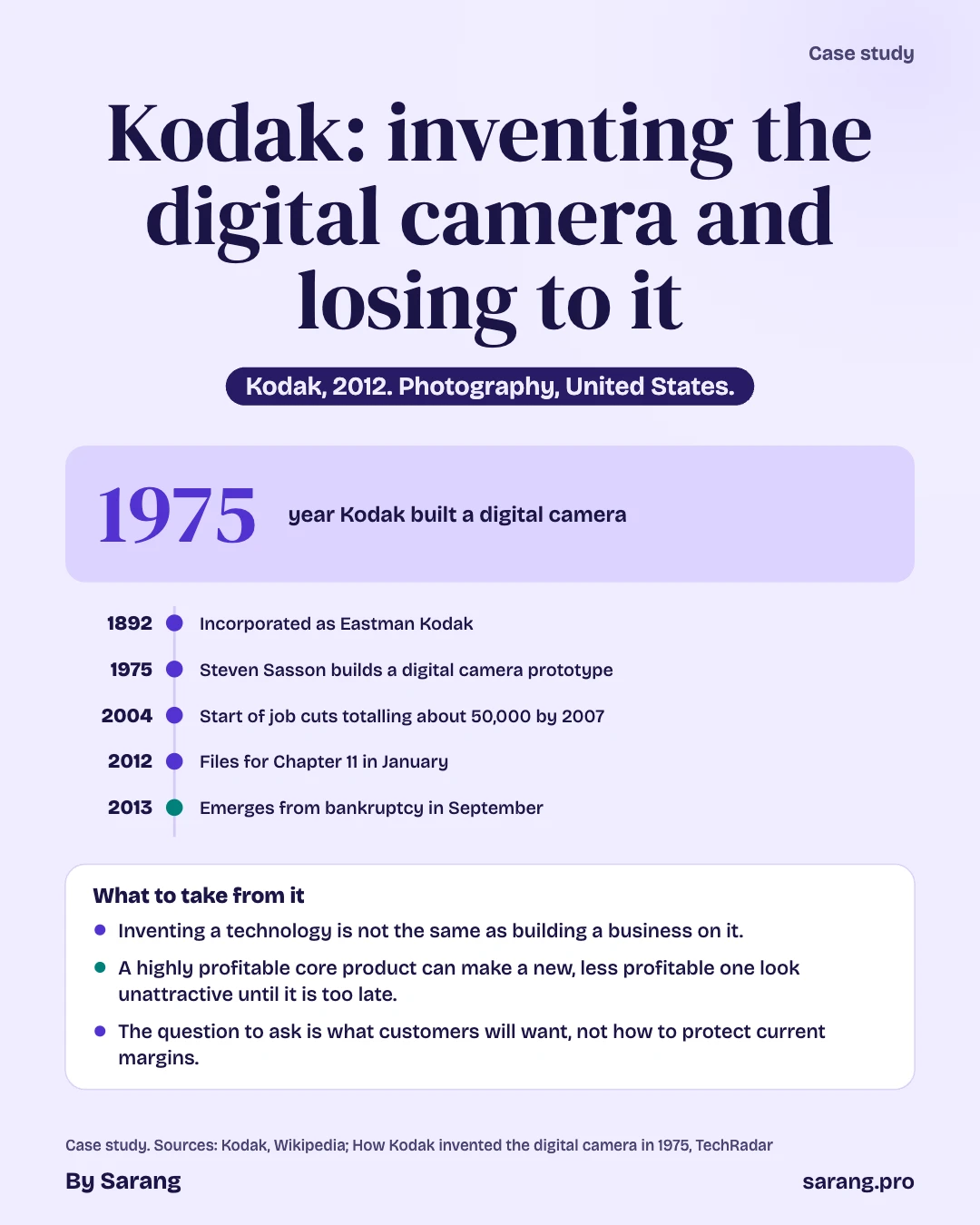
Kodak engineer Steven Sasson built a digital camera in 1975, yet the company that held about 89 per cent of US film sales in 1976 filed for Chapter 11 in January 2012.

- Kodak share of US film sales in 1976
- 89%
- employees at the 1988 peak, against about 17,000 in 2012
- 145,300
- sales in 2003
- $13.3 billion
- fall in US consumer film sales in 2003
- -18%
The situation
On Thursday 19 January 2012, Eastman Kodak filed for Chapter 11 bankruptcy protection in New York. Trading in its shares was halted within minutes of the opening bell after the price fell 35 per cent. The company had arranged $950 million of financing from Citigroup to keep operating, and CNN reported that it listed about $6.75 billion of debts owed to more than 100,000 creditors.
The company’s history made the filing hard to believe. Kodak had supplied the film for 80 Best Picture winners, and in 1969 its camera went with Neil Armstrong onto the moon, according to the Fiscal Times. In 1975 one of its own engineers had built a prototype digital camera. Fifteen years before the filing, its market value had been about $31 billion. By January 2012 it was under $150 million.
The standard summary is that Kodak invented the technology that destroyed it and failed to use it. The record supports part of that and complicates the rest. Kodak did put money into digital, and by 2005 its digital revenue was larger than its traditional revenue in a single quarter. The harder question is why that was not enough. This case looks at the film business that paid for everything, the digital business that replaced it too slowly and with lower margins, and what was left when the company emerged in 2013.
Background
A company built on film
George Eastman founded Kodak in 1888. The Fiscal Times notes that the company introduced the hand-held camera and roll film. The FDTimes notes that Kodak also standardised 35mm film for motion pictures, which gave the industry a worldwide format. In 1976 Kodak held about 89 per cent of United States film sales, the same source reports.
At its peak the company was very large. NBC News reported that Kodak had 145,300 employees at its 1988 peak, and the Fiscal Times says Rochester alone had more than 60,000 at its height.
The 1975 prototype
In 1975, a 24-year-old Kodak engineer named Steven Sasson built a camera that captured images without film. PetaPixel, summarising Sasson’s account to the New York Times, describes a device that weighed 8 pounds, took black-and-white pictures at 0.01 megapixels, saved them to a cassette tape, needed 23 seconds per photo, and could be viewed only by playing the tape on a television set.
Sasson showed it to several executives. By his account, they were not excited. He recalled that they doubted anyone would want to look at their pictures on a television set. They also pointed out that print photography was more than a century old, cheap, and not the subject of complaints. In addition, Kodak dominated the United States photo market and had no wish to undercut its film business. PetaPixel adds that Kodak moved to digital 18 years after the prototype.
Kodak did not abandon the technology. In 1976 Bryce Bayer, working in Kodak’s research laboratories, was granted the patent for the colour filter pattern that most digital sensors still use, the FDTimes records. The author of that piece regrets that Kodak did not turn its sensors into a universal standard.
The economics of the old model
The sources do not give Kodak’s margins, but they show where the business was weighted. In 2003 the company’s sales were $13.3 billion. The photography segment, which included film, paper and cameras, made up $9.2 billion of it, about 69 per cent. Health imaging had $2.4 billion, and commercial imaging $1.6 billion.
The industry
By the early 2000s the market for taking and sharing pictures was changing in several ways at once.
First, the demand for film was falling. In its 2003 annual report Kodak said consumer film sales had dropped 9 per cent worldwide and 18 per cent in the United States, mainly because digital cameras were replacing film. Professional film sales fell 13 per cent. The company expected US consumer film volumes to fall another 10 to 12 per cent in 2004 and worldwide volumes by 7 to 9 per cent.
Second, digital products grew quickly, but the growth did not replace the lost film income. Kodak’s 2003 report showed the shift: consumer digital camera sales grew 79 per cent in 2003, online photo service Ofoto grew 57 per cent and had more than 11 million members, and inkjet photo paper sales grew 32 per cent. These were all growth lines. The results for 2005, described below, show that they did not make up for the fall in film.
Third, the competition was changing. By 2004 Kodak had passed Sony in United States shipments of digital point-and-shoot cameras, NBC reported. That put Kodak in direct competition with electronics firms such as Sony.
Finally, the capital markets turned. NBC reported that credit rating agencies had cut Kodak’s debt to junk status by 2005, which raised its cost of borrowing at the time it needed money to restructure. The CNN report notes that Kodak was removed from the Dow Jones Industrial Average in 2004 and from the S&P 500 in December 2010.
The decision
For three decades the central question at Kodak was how fast to move from film to digital. The sources show three possible stances. The company’s own documents show it changing between them.
Protect film and move slowly
The first option was to hold back digital and protect the film business for as long as it paid. The 1975 executive reaction fits this stance, and PetaPixel states that Kodak did not want to undercut its film sales. This choice made sense in a narrow way, since film was the largest part of the business. Its weakness was that rivals did not wait.
Run film for cash and build digital
The second option was the one Kodak announced in 2003. Its annual report said the strategy had four parts: manage traditional businesses for cash, grow digital offerings, make acquisitions with discipline, and find new growth areas such as electronic displays and inkjet printing. It aimed for a balance between digital and traditional by the end of 2006. The report also said that Kodak had about 63,900 full-time equivalent employees, with plans to cut facility space by about a third.
Reinvent as a different kind of company
The third option was to leave consumer photography and become something else. Kodak talked about this in the bankruptcy filing: chief executive Antonio Perez said the aim was to become a “lean, world-class, digital imaging and materials science company.” The business that emerged in 2013 described itself in a similar way, as a technology company serving imaging for business markets.
What they did
2003 to 2004: the digital turn
In 2003 Kodak recorded restructuring costs and other charges of $557 million. Net earnings from continuing operations fell to $238 million from $793 million in 2002. In January 2004 it bought Scitex Digital Printing and renamed it Kodak Versamark, and in February it agreed to sell its remote sensing and research systems businesses to ITT, which together had about $425 million of sales in 2003. On 10 February 2004 the Chinese government approved its purchase of a 20 per cent stake in Lucky Film.
Daniel Carp, who had led Kodak since 2000, handed over to Antonio Perez on 1 June 2005, with Perez becoming chairman on 1 January after. Perez warned that Kodak had about two years to establish itself in digital photography or risk fading from history. NBC reported that digital made up 41 per cent of sales in 2004, with a target of about 70 per cent by 2007. Digital sales were about $5.5 billion in 2004, and chemical sales were expected to fall from $8 billion to about $6.6 billion.
2005: job cuts and charges
Kodak planned to cut 12,000 to 15,000 jobs by 2007 and reduce its workforce to about 50,000. It reported a first-quarter 2005 loss of $142 million, caused by faster film declines and the cost of the cuts.
The third quarter of 2005 brought a loss of $1 billion, or $3.58 per share, including a $900 million non-cash charge. Total sales were $3.55 billion. Sales in the digital and film imaging segment fell nearly 16 per cent even though digital product sales rose 22 per cent, from $580 million to $708 million. Traditional imaging revenue dropped 20 per cent, from $2.09 billion to $1.66 billion. For the first time in a quarter, digital revenue exceeded traditional revenue. Kodak cut about 2,000 positions in the quarter, with pre-tax charges of $261 million for cost reduction.
2005 to 2011: running out of time
After 2005 the evidence becomes thinner in the sources opened for this case. The CNN report says Kodak’s sales nearly halved between 2005 and 2010 and that it had posted only one full-year profit since 2004. The Fiscal Times says it had not been annually profitable since 2007. The two differ, and the gap may reflect different accounting measures. In 2009 Kodak retired Kodachrome film after 74 years.
In September 2011 Kodak drew $160 million from a $400 million credit line, and Moody’s cut its debt to junk grade. About a month later it warned that it could run out of cash unless it sold patents, raised capital or borrowed. It had $862 million of cash at the end of September 2011.
January 2012: Chapter 11
Kodak filed with its US subsidiaries, while foreign subsidiaries stayed outside the case. At the end of September 2011 the Fiscal Times reports total assets of $5.1 billion and liabilities of $6.75 billion. Kodak had about 17,000 workers, with Rochester employment down to roughly 7,000. It had promised $800 million over the next decade to its UK pension fund. Lazard advised the company, and FTI Consulting’s Dominic DiNapoli became chief restructuring officer.
2012 to 2013: selling patents and restructuring
Kodak hoped to sell about 1,100 digital imaging patents. CNN reported analyst estimates of up to $3 billion. The FDTimes reports Kodak had hoped for $2 billion and that the patents sold for about $525 million.
A New York bankruptcy court approved the reorganisation plan on 20 August 2013, and Kodak announced its emergence on 3 September 2013. It closed a financing agreement for $695 million and obtained $406 million in new equity from unsecured creditors. The Personalised Imaging and Document Imaging businesses went to the Kodak Pension Plan in the United Kingdom, which became Kodak Alaris. Kodak kept packaging, functional printing, graphic communications and professional services, and it said motion picture film remained part of its future, with contracts with six studios.
What happened
| Date | Measure | Figure |
|---|---|---|
| 1976 | US film market share | about 89% |
| 1988 | Employees at peak | 145,300 |
| 2003 | Sales | $13.3 billion |
| 2004 | Digital share of sales | 41% |
| Q3 2005 | Net loss | $1 billion |
| Sept 2011 | Assets / liabilities | $5.1 billion / $6.75 billion |
| Jan 2012 | Market value | under $150 million |
The result was a much smaller company. By the filing in 2012 it employed about 17,000 people, compared with 145,300 in 1988, and the sale of its patents brought about a quarter of the $2 billion it had hoped for. Its shares had fallen almost 90 per cent in the year before the filing, and a UK pension fund took over two of its businesses.
The film business did not vanish. The Sports Video Group reported in September 2013 that Kodak planned to keep motion picture film as a core business, that theatrical exhibition had almost entirely gone digital, and that many filmmakers still preferred to shoot on film. The company said it sold billions of linear feet of film each year.
Other views
The argument that management missed the signal
The 1975 story is the centre of this view. Executives saw a working digital camera and judged it a threat to their film sales. The 2003 report shows that, by that year, the company itself was calling its film-based chemical businesses a source of cash to be managed rather than grown. NBC reported that Kodak acknowledged in 2003 that these businesses were in irreversible decline. That date is about 28 years after the prototype.
The argument that the market was unwinnable
A different reading is that even a faster move would have met a harder problem. Digital products brought new rivals, and Kodak was moving away from a business in which it had held about 89 per cent of the United States market in 1976. Kodak did build a large digital business: $5.5 billion of digital sales in 2004, and a lead over Sony in US point-and-shoot shipments. The company still lost $1 billion in the third quarter of 2005. The sources opened do not allow a clean test of what a different timetable would have produced.
Disagreement within the sources
The sources differ on some points. Kodak’s last annual profit is given as 2004 by one report and 2007 by another. The Malay Mail reports that Kodak sold retail film, photography paper and some 105,000 kiosks on emerging from bankruptcy, while the FDTimes says Paper and Output Systems stayed with Kodak and the personalised imaging business went to the UK pension plan. The patent estimate ranged from $2 billion to $3 billion before the sale. The founding of the company is given as 1888 in two reports and 1880 in another, which describes the start of Eastman’s plate business.
Reading it through a framework
The BCG matrix
The Boston Consulting Group matrix sorts a firm’s products by market growth and market share. Film, with about 89 per cent of the United States market in 1976, was a cash cow: high share, slow growth, large cash flow. Digital cameras and online photo services were closer to question marks and stars: fast-growing, with uncertain returns. The textbook advice is to use the cash cow to fund the growth businesses, and that was Kodak’s 2003 strategy of managing traditional businesses for cash.
The weakness the case reveals is that the cow was shrinking faster than the new businesses grew. Consumer film sales fell 18 per cent in the United States in 2003, while digital camera sales rose 79 per cent. In the third quarter of 2005 the digital and film segment’s gross profit fell 24 per cent, from $745 million to $564 million. A cash cow that shrinks at that pace cannot fund a transition indefinitely.
Stakeholder mapping
Stakeholder mapping asks who holds power and who holds interest. In Kodak’s case the map explains the shape of the bankruptcy. Employees fell from 145,300 to about 17,000. Rochester lost most of its Kodak jobs. The UK pension fund was the largest creditor and received businesses that became Kodak Alaris. Bondholders, whose trustee Bank of New York Mellon had claims above $650 million, and bank lenders held the debt. Retailers such as Walmart, Target and Best Buy appear among the creditors, which shows how widely Kodak’s business reached.
Executives sat inside the system. The stakeholders with the most power in 2003 were those who depended on film, and the ones who would have gained from a faster move to digital, such as future customers, were not yet in the room.
Since then
Kodak emerged on 3 September 2013 as a business-to-business company. Perez described it as serving imaging for business markets. Its film business for motion pictures continued, and the Entertainment Imaging division was described by its president as stable and profitable. Kodak Alaris, owned by the UK pension plan, took over parts of the consumer and document businesses and licensed the Kodak brand for retail photo kiosks, still-camera film and similar uses.
The sources opened for this case do not include Kodak’s results after 2013, so they are not described here. A later account should be checked against the company’s annual filings.
What to take from it
- Inventing a technology does not secure a position in the market that follows. Kodak’s 1975 prototype and the Bayer filter patent of 1976 did not stop the company losing ground to rivals in digital cameras.
- A profitable product can hide the need to change. With about 89 per cent of United States film sales in 1976, Kodak’s film business made delay look reasonable for years.
- Growth in the new product does not always make up for decline in the old one. Digital revenue passed traditional revenue in one quarter of 2005, yet segment gross profit fell 24 per cent and the company posted a $1 billion loss in that quarter.
- The speed of decline matters as much as the direction. Consumer film sales fell 18 per cent in one year in the United States, and Kodak had two years, in Perez’s words, to establish itself in digital.
- Assets often sell for less than hoped. Kodak sought about $2 billion for its patents in bankruptcy and received about $525 million.
Questions to think about
- If you had been an executive in 1975 and saw Sasson’s camera, what would have had to be true for you to back it fully, and how would you have measured those things?
- Kodak’s 2003 plan was to manage film for cash. At what point does managing a business for cash turn into avoiding the decision to leave it?
- Which of Kodak’s stakeholders could have pushed for faster change, and why did they not?
- Is a company that survives as a much smaller business a success or a failure?
Concepts at work
This case shows the BCG matrix, stakeholder mapping, and the problem of cannibalising a profitable product. Explore them in Insights.
Written from the public sources listed below. Figures are as those sources report them.
Framework
Timeline
- 1888George Eastman founds Kodak
- 1975Steven Sasson builds the first digital camera prototype
- 1976Bryce Bayer's colour filter patent; Kodak holds about 89% of US film
- 1988Employment peaks at 145,300
- 2003Annual report sets out a plan to manage film for cash and grow digital
- 2004Digital reaches 41% of sales; Kodak leaves the Dow Jones Industrial Average
- Q3 2005Digital revenue passes traditional revenue; $1 billion net loss
- 2009Kodachrome retired after 74 years
- 19 Jan 2012Chapter 11 filing with $950 million of Citigroup financing
- 20 Aug 2013Court approves the reorganisation plan
- 3 Sep 2013Kodak emerges as a business imaging company
Recap cards
Tap a card to check yourself.
Sources and credits
- Eastman Kodak: Form 10-K for 2003
- PetaPixel: What Kodak said about digital photography in 1975
- NBC News (AP): Eastman Kodak CEO Carp steps down
- Rochester Business Journal: Film's decline remains a drag for photo giant (2005)
- CNN Money: Kodak bankruptcy (2012)
- The Fiscal Times: Kodak files for bankruptcy (2012)
- Malay Mail (AFP): Kodak says it emerges from bankruptcy with tech focus (2013)
- Sports Video Group: Kodak emerges from bankruptcy, film division stable (2013)
- FDTimes: Kodak, what now? (2013)