LEGO: how a toymaker losing $1m a day became the world’s biggest
LEGO lost almost $1 million a day in 2003 and carried debt near $800 million, then cut its range, sold its parks and by 2014 outsold Mattel.
- daily loss reported around 2004
- ~$1m
- debt reported in one 2015 account
- $800m
- employees, 2004 to about 2006 (Fortune)
- 7,300 to 5,300
- LEGO's share of the global toy market per Knudstorp, 2006
- 2 to 3%
The situation
In 2003 the LEGO Group had a problem that few toy companies ever face: it was the best-known brand in its industry and it was close to running out of cash. Sources describe a firm losing almost $1 million a day, with sales on course to fall by around 30% in a single year and debt of nearly $800 million. One account puts the 2003 operating loss at 1.6 billion Danish kroner on sales of 6.8 billion, with debt of about 5 billion kroner. A business with a ratio like that has very little time.
The family that owned it had lost money for years. Private-equity firms were reported to be waiting in the wings. In 2004 the founder’s grandson, Kjeld Kirk Kristiansen, handed the top job to Jørgen Vig Knudstorp, a former McKinsey consultant in his mid-30s who had been at LEGO for only three years. Knudstorp was the first chief executive from outside the family in the company’s modern history, and he described the position as a “burning platform”, a phrase used in one 2015 account of the crisis.
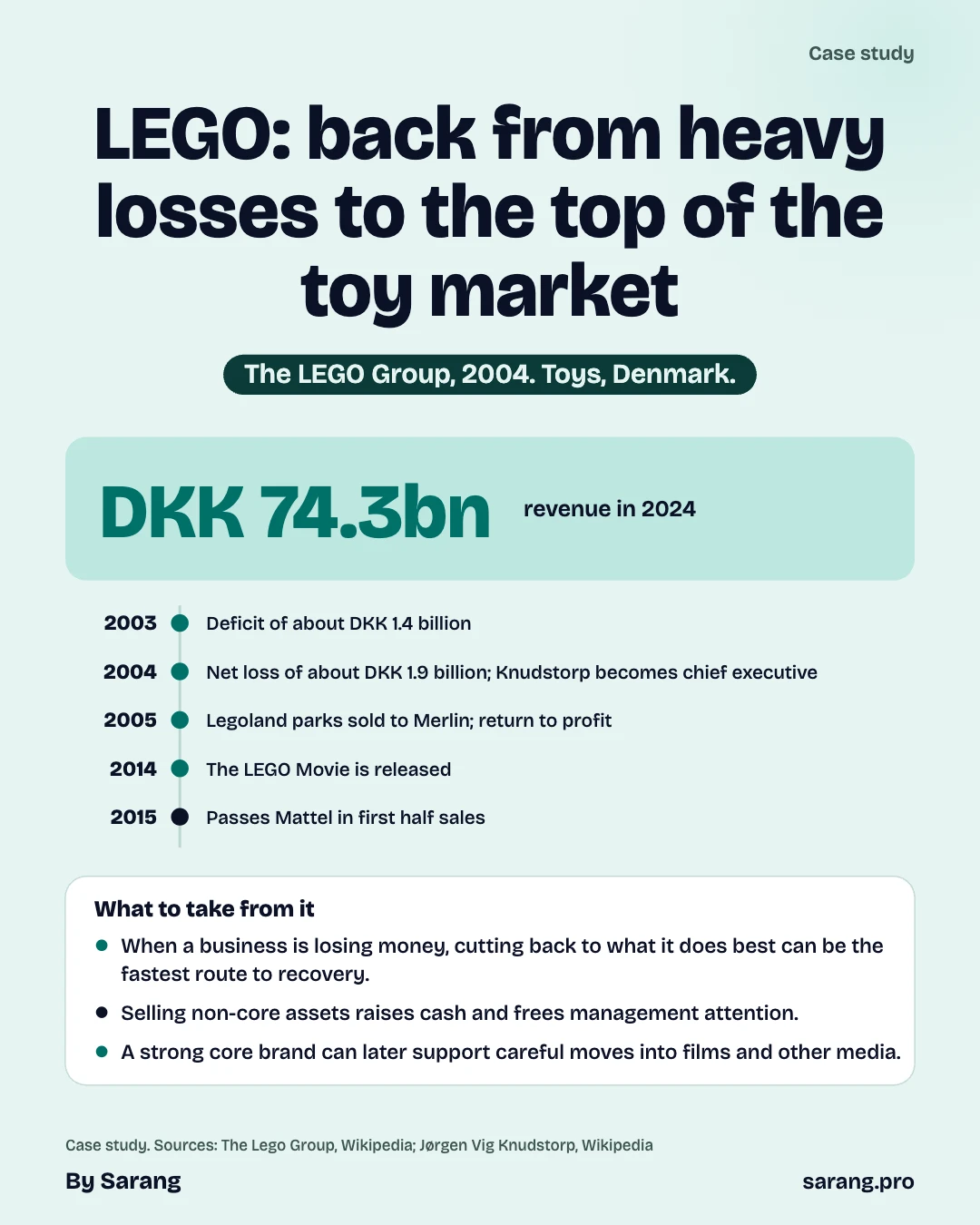
What followed is among the best-documented turnarounds in consumer goods. By the first half of 2014 LEGO reported revenue of about $2.03 billion and was reported to have overtaken Mattel as the world’s largest toy company by sales. In 2024 it reported revenue of DKK 74.3 billion and a net profit of DKK 13.8 billion in a toy market that shrank by 1%. This case follows how the company got from the first position to the second, what it gave up on the way, and where the evidence is thinner than the legend suggests.
Background
From wooden toys to the brick
LEGO was founded in 1932 in Billund, Denmark, by Ole Kirk Kristiansen, and the company remains controlled by his family through the investment vehicle KIRKBI, which one report says owns 75% of the LEGO Group. Plastic interlocking bricks became the core of the business, and the company grew for decades on a simple formula: one standard brick system, sold in sets, with parts that fitted together across product generations.
The slump and the urge to grow
Trouble began in the 1990s. Children were spending more time on video games and personal computers, and a 1993 sales slump led LEGO to triple its product offering. The company first reported an annual loss in 1998, which it blamed on competition from computer games and electronic gadgets. In 2000 it was named Toy of the Century, which in hindsight marked the high point of its reputation rather than the start of a new run of profits.
The response to slower growth was to widen the company’s reach. By 2003 LEGO had moved into theme parks, jewellery, clothing, education centres, interactive video games and film and licensing alliances with Star Wars and Harry Potter. A line of watches and clothing was aimed at young girls. The Star Wars line launched in 1999 after an internal argument about putting the word “war” under the LEGO brand. Duplo, the line for the youngest children, was dropped from the range during the diversification push, according to one report.
How the money was made, and lost
The brick business made money. Much of what was added around it did not. Knudstorp later said the company had been adding three to five business units a year, and he put the damage in plain terms: “I think that’s what nearly killed us.” Fortune reported in 2006 that the culture had a blind spot about money: the attitude among staff was that they were doing great things for children and did not want to be bothered with financial goals. A long-serving LEGO play expert told the magazine that before the crisis money was something people neither worried about nor talked about.
The complexity also showed up in the factory. The number of different elements had grown large, and each had a cost in tooling, storage and logistics. A design team created a small memorial for the discontinued pieces, and one of them, a moustached chef, was among the very few to survive.
The industry
A large market with a small player
LEGO operates in a toy industry that the Toy Association of America put at more than $80 billion in 2010. Knudstorp told Fortune in 2006 that LEGO was a niche product with 2% to 3% of the global toy market, and a 2010 account gave its share as 4.8% in 2009. The company never needed to win the whole market. It needed enough share in construction play for its brick system to pay back its tooling.
Rivals and substitutes
The traditional rivals are the large American toymakers. Mattel, with Barbie, and Hasbro were far bigger than LEGO for most of the period. By 2018 the order had changed: LEGO’s sales of 36.4 billion kroner ($5.5 billion) compared with $4.5 billion at Mattel and $4.6 billion at Hasbro, according to Fortune. In 2023 Mattel reported flat revenue of $5.4 billion, and Hasbro’s revenue fell 15% to $5 billion with a net loss of $1.5 billion, according to the Irish Times.
The bigger competitive pressure in the 1990s and early 2000s came from substitutes. Screens took children’s time, and the toy industry was consolidating around licensed characters and electronics. LEGO’s reply was partly to join in, with computer games and interactive products, and partly, later, to reposition the brick as something that coexisted with screens.
Economics of the brick
A plastic brick business has high fixed costs: moulds, precision, and a large product range to hold in stock. A 2010 report said the defect rate was about 18 faulty bricks per million and output about 19 billion bricks a year. Those numbers reward a firm that keeps a stable, standardised part set. They punish one that multiplies variants, which is what LEGO had done.
Ownership
The family ownership shaped the options. LEGO was private, so there was no stock price to collapse, and it could not raise money easily from public markets. One source says family holdings had lost nearly half a million dollars a day for ten years. That helps to explain why the family brought in an outsider and accepted a plan that cut deeply into Billund, a town of about 6,500 people where LEGO was the main employer.
The decision
By 2004 the board and the family faced a choice about what kind of company LEGO should be. Sources show three broad options. The first two are the alternatives the evidence suggests were in play; the third is the one taken.
Option one: sell the company
One report says private-equity firms were waiting to buy the business. Selling would have ended the family’s control and probably split the brand from its production base. The sources do not describe a formal sale process, so the extent to which this was a live option is unclear. What is clear is that the family chose to keep ownership and to hand the running of the company to an outsider.
Option two: keep diversifying and hope
The company could have continued on the path it had followed since 1993: broaden the range, license more characters, build more attractions. The 2003 numbers argued against it. Growth strategies had produced a sharp fall in sales and a large loss. Knudstorp said later that companies “die from indigestion” because there are so many opportunities, a remark made in the Irish Times in 2010 about overexpansion.
Option three: go back to the core and make the numbers work
The path chosen was to strip the business back to bricks and the play systems built on them, sell what was not central, cut costs hard, and put financial discipline in the middle of the culture. Knudstorp launched a seven-year plan called Shared Vision in 2004. He planned for no growth in the first three years and aimed instead at a large improvement in productivity. He wanted one major development every three to five years rather than several each year.
This was a bet that the brand was strong and the cost base was the problem. It was also a bet that the company could change what it valued. Fortune noted that the top item in the employee mission statement moved from nurturing the child to making money for the company, which was a visible break with the old culture.
What they did
Cut jobs and move production
The first moves were painful. Fortune reported that about 1,000 jobs were cut in Billund and that manufacturing moved to cheaper locations such as the Czech Republic. The Irish Times added Mexico, and reported that almost half of Billund’s local staff lost their jobs and that 1,322 jobs were cut in 2005, leaving 5,302 employees. Worldwide employment fell from 7,300 in 2004 to about 5,300. Other sources give different job-cut totals, from 1,200, almost a quarter of the workforce, to a further 4,500 in a broader programme. The totals depend on the period and the scope of the count, and the sources do not reconcile.
Outsourcing did not all work. The Irish Times reported that handing brick manufacturing to the contract manufacturer Flextronics failed and the partnership ended after two years. LEGO kept the core moulding work in-house afterwards.
Sell the parks and the side businesses
In July 2005 LEGO sold its Legoland theme parks to Merlin Entertainments, a business owned by a Blackstone division, and the family’s investment vehicle later held about 30% of Merlin. Fortune’s 2006 article put the sale price at nearly $500 million, while a 2019 Fortune article gave about £250 million; the two outlets used different currencies and may have counted different things, so the figure should be treated as approximate. The 2019 article said the sale addressed a short-term debt problem and that LEGO avoided bankruptcy by focusing on bricks. Other disposals reported by one source included the video game development unit and several overseas properties.
Cut the range and halve the development time
Product range was reduced sharply. One source says the number of elements was cut by 50% and 30% of product lines were dropped. Development time for new toys was halved, with a target of 12 months from idea to box, according to Fortune. Brick designs were standardised to lower production cost, and new toys had to project a 13.5% profit to go ahead, according to one 2015 account. The point of both rules was to make each launch answer to the numbers before it got to the shop.
Listen to the fans and rebuild the product
The recovery was not only cost control. Fortune reported in 2006 that new lines built on Batman, Star Wars films and Ferrari race cars were connecting with children, and that Mindstorms, a robot-building set with chip-enabled parts and downloadable software, was winning attention. Later, LEGO built a crowdsourcing channel. Proposals needed 10,000 online votes to be considered, and inventors received 1% of the profits from toys that were produced, according to the 2015 account. Sets such as Ninjago, Vikings and Architecture also came during the recovery. LEGO Friends, aimed at girls, was among the initiatives listed when Knudstorp stepped down.
Change how the company is governed
IndustryWeek reported in 2016 that Knudstorp oversaw a shift in financial governance meant to reduce the company’s vulnerability to credit squeezes. The Washington Post reported in 2016 that financial metrics made up less than a third of executive bonus weighting, with the rest based on retail performance and employee ratings. That suggests the finance focus was meant to fund the product rather than replace it.
What happened
Back to profit
The first results arrived quickly, though sources do not agree on the numbers. Fortune reported in 2006 that LEGO earned a net profit of $87 million for 2005 and that revenue rose 12% to $1.2 billion. The Irish Times in 2010 gave 2005 net profit as 214 million kroner with revenue up 3%. The two accounts differ in currency, profit and growth, and the pages used here do not show which is right. Both agree that 2005 was a profit after a loss of more than $300 million in 2004, according to Fortune.
Growth through the crisis years
By 2009 the Irish Times reported net profit of 2.2 billion kroner on sales of 11.7 billion. In the first half of 2014 revenue rose 11% to 11.5 billion kroner and profit rose 12% to 3.6 billion, according to City AM. Knudstorp told the paper that revenue had more than tripled since 2008. The LEGO Movie of 2014 helped; Euromonitor estimated worldwide takings of about $500 million, and a separate account put them near $470 million. The 2015 account said LEGO’s first-half 2014 revenue of $2.03 billion narrowly topped Mattel’s $2 billion.
| Year | Figure | Source |
|---|---|---|
| 2003 | Operating loss 1.6bn kroner on sales of 6.8bn | Irish Times, 2010 |
| 2004 | Loss of more than $300m; 7,300 employees | Fortune, 2006 |
| 2009 | Net profit 2.2bn kroner on sales of 11.7bn | Irish Times, 2010 |
| 2015 | Net profit 9.17bn kroner; revenue 35.8bn kroner | IndustryWeek, 2016 |
| 2018 | Sales 36.4bn kroner; profit 10.8bn kroner | Fortune, 2019 |
| 2023 | Revenue 65.9bn kroner; net profit 13.1bn kroner | Irish Times, 2024 |
| 2024 | Revenue 74.3bn kroner; net profit 13.8bn kroner | LEGO, 2025 |
The rows come from different reports and the sources do not say how each was measured, so treat comparisons across rows with care. Taken at face value, revenue of 35.8 billion kroner at the end of Knudstorp’s tenure and 36.4 billion in 2018 suggest growth flattened in the middle of the decade before the later rise.
The handover
Knudstorp stepped down as chief executive at the end of 2016, aged 48, and moved to chair the new LEGO Brand Group. Bali Padda, then chief operating officer, took over as the first non-Dane to lead the company. Over Knudstorp’s time, revenue grew roughly five-fold between 2005 and 2015, according to IndustryWeek.
Other views
The turnaround was not only a strategy story
Several accounts, including the company-friendly ones, present the sale of the parks as the thing that bought time. The 2019 Fortune article said the sale solved the short-term debt crisis. If that is right, the later growth sat on top of a financing fix, not only on better products, and the sources do not allow us to separate the two.
Human cost
The reports on jobs are matter-of-fact. Almost half of Billund’s local staff lost their jobs, in a town where LEGO was the main employer. Fortune reported that about 1,000 blue-collar workers remained in Billund in 2006 while the company scouted factories in Eastern Europe. A reader who sees the turnaround as a model should weigh that cost against the survival of the remainder.
Outsourcing did not always work
The Flextronics episode is a reminder that part of the recovery was trial and error. The Irish Times reported that the contract ended after two years. The plan was not a clean sequence from diagnosis to success.
Limits of the evidence
Most of the detailed accounts come from interviews with Knudstorp and from media features. LEGO is privately held, so the figures are those it chooses to publish, and the sources used here give different totals for jobs, profit and the parks sale. A 2015 account and a second summary also differ on whether the cuts were 1,200 or 4,500. A careful reading would need the company’s own annual reports for each year, which were not among the pages opened for this case.
Reading it through a framework
Ansoff matrix
The Ansoff matrix sorts growth into four routes: sell existing products in existing markets, sell existing products in new markets, build new products for existing markets, or move into new products and new markets. Between 1993 and 2003 LEGO leaned hard on the last two. Parks, clothing, jewellery and games were new products in some cases for new customers. Diversification is the riskiest route because the company has to learn the product and the customer at once, and the 2003 losses are what that looked like in practice. The recovery went the other way, deepening the core: new themes on the existing brick system, which is product development for the existing market, and later growth through new regions, which is market development. Knudstorp told the Irish Times in 2010 that the core business was the most exciting part, which fits this reading.
Value chain
Porter’s value chain looks at the activities a firm performs, from design and manufacture to marketing and service, and asks where margin is made. LEGO’s value sits in design, the moulding precision behind it, and the brand. Theme parks and clothing sat outside those activities. The restructuring shortened design time to 12 months, cut the number of parts to lower cost in manufacturing and logistics, and moved some production to cheaper sites. The crowdsourcing channel added a new input to design. The Flextronics failure is also readable here: handing over a core activity tied to quality did not pay.
Since then
In June 2019 a group of KIRKBI, Blackstone and the Canada Pension Plan Investment Board offered £6 billion, including £1.2 billion of debt, for Merlin Entertainments, which would give the LEGO owners control of the parks again. KIRKBI already held about 30% of Merlin, Fortune reported. In 2018 LEGO had been the world’s largest toy maker by sales.
The recent years have been less smooth. In 2023 LEGO’s revenue rose 2% to DKK 65.9 billion and net profit fell 5% to DKK 13.1 billion, which the Irish Times called the slowest growth since 2017, in what Niels Christiansen described as the most negative toy market in more than 15 years. LEGO said it outperformed the wider sector by 10 percentage points. In 2024 it reported record results: revenue of DKK 74.3 billion, up 13%, operating profit of DKK 18.7 billion and net profit of DKK 13.8 billion, with the toy market down 1%. LEGO also reported more than 87 million players in LEGO Fortnite and 840 products in its 2024 range, which compares with the sharply reduced range of the mid-2000s. No 2025 results were among the pages opened for this case.
What to take from it
- A beloved brand does not protect a company from poor economics; LEGO’s reputation was at its peak in 2000 while its finances were weakening.
- Diversification away from what a firm does best can destroy value quickly, and the repair is often to cut variety and complexity before adding anything new.
- An outsider with inside knowledge can change a culture: Knudstorp had three years at LEGO and a consulting background, and he moved the stated priority from the child to the company’s survival.
- Financial rules, such as a minimum projected profit for each new toy, can coexist with creativity if they are applied to the choice of projects and not to the play itself.
- Selling assets can buy time, but lasting recovery needs a product people want, and LEGO’s later growth came from themes, films and partnerships built on the core brick.
Questions to think about
- Which of LEGO’s side ventures in the 1990s and early 2000s might have succeeded under different management, and what test would you have used to decide?
- The sources disagree on job cuts, profits and the price of the parks. How would you decide which numbers to trust before presenting this case to a board?
- Knudstorp chose no growth for the first three years. When is it right for a leader to give up growth to rebuild margins?
- How should a company weigh the human cost of a turnaround in a town that depends on it for work?
Concepts at work
Three ideas run through this case: the Ansoff growth matrix, the value chain and the turnaround playbook of retrenchment before growth. Explore them in Insights.
Written from the public sources listed below. Figures are as those sources report them.
Framework
Timeline
- 1932Ole Kirk Kristiansen founds LEGO in Billund, Denmark
- 1993Sales slump leads LEGO to triple its product offering
- 1998First annual loss reported
- 2000Named Toy of the Century
- 2003Operating loss of 1.6bn kroner on sales of 6.8bn
- 2004Jørgen Vig Knudstorp becomes chief executive; Shared Vision plan begins
- Jul 2005Legoland parks sold to Merlin Entertainments
- 2005Return to profit; 1,322 jobs cut, leaving 5,302
- 2009Net profit of 2.2bn kroner on sales of 11.7bn
- H1 2014Revenue of about $2.03bn, narrowly ahead of Mattel
- End 2016Knudstorp steps down; Bali Padda succeeds him
- Jun 2019Offer of £6bn for Merlin Entertainments announced
- 2024Revenue of DKK 74.3bn, net profit of DKK 13.8bn
Recap cards
Tap a card to check yourself.
Sources and credits
- Fortune (CNN Money): One brick at a time, June 2006
- The Irish Times: Another brick in the wall, 27 August 2010
- Grant Thornton: Rebuilding LEGO, the ultimate toy story, January 2015
- City AM: Lego towers over Mattel in battle to become the biggest toymaker, September 2014
- IndustryWeek: Lego CEO steps down in historic shift at billionaire-owned firm
- Fortune: Legoland owner Merlin to be taken private, 28 June 2019
- The Washington Post: Brick by brick, the man who rebuilt the house of Lego, December 2016
- Gunnercooke: Lessons from the Great Comebacks, LEGO
- The Irish Times: Lego hit by slowest growth for seven years, 12 March 2024
- The LEGO Group: record results in 2024, March 2025