Microsoft: Satya Nadella moves the company from Windows to the cloud
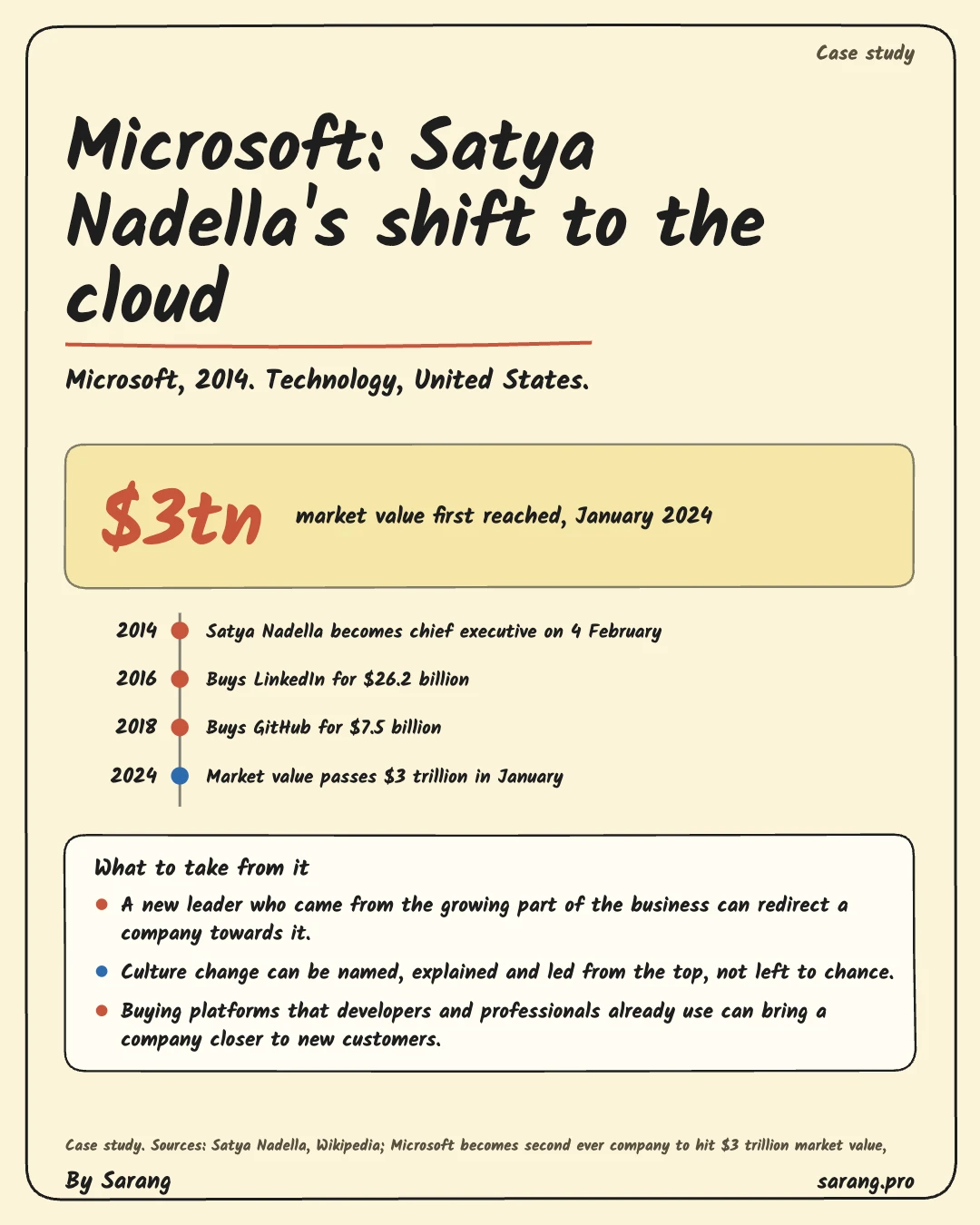
After 18,000 job cuts in July 2014, Nadella made cloud services Microsoft's core; Azure passed $75 billion in revenue in 2025 and market value rose from about $314 billion to over $3 trillion.
- Jobs cut in July 2014, about 14 per cent of staff
- 18,000
- Price of Nokia's phone business
- $7.3 billion
- Commercial cloud annual run rate, FY2014
- $4.4 billion
- Market value on 30 Nov 2018, ahead of Apple
- $851.2 billion
The situation
On 17 July 2014, five months into the job, Microsoft’s new chief executive, Satya Nadella, announced the largest layoffs in the company’s 39-year history: up to 18,000 jobs, about 14 per cent of the workforce. The figure was roughly double what analysts had expected. About 12,500 of the cuts were tied to the Nokia handset business that Microsoft had bought in April for $7.3 billion, and the previous record had been about 5,800 jobs in 2009.
The company was not in trouble on paper. A few days later it reported revenue of $86.83 billion for the financial year to June 2014, up 12 per cent, and net income of $22.07 billion. Yet the layoffs were a signal that the strategy of his predecessor, Steve Ballmer, who had pushed Microsoft to make its own phones and tablets, was being reversed. Nadella said the company had to change its culture for a “mobile-first and cloud-first world”. At the same results, he reported that commercial cloud revenue had doubled again to a $4.4 billion annual run rate.
That run rate was small beside the main products. Windows and Office still produced most of the company’s income. The decision was whether to bet the company’s future on subscription cloud services, selling them to business customers, and give up on consumer hardware. The numbers since then are the case for the bet. In the 2025 financial year Microsoft reported revenue of $281.7 billion and net income of $101.8 billion. Its Azure cloud platform passed $75 billion in yearly revenue, up 34 per cent. Market value went from about $314 billion in 2014 to more than $3 trillion by early 2024.
Background
A company built on Windows and Office
Through the 1990s Microsoft was the most valuable technology company in the world, driven by Windows and the boom in personal computers. Its income came from licences: manufacturers paid to install Windows on PCs, and businesses paid for Office and server software. Customers who already ran Microsoft PCs and servers tended to stay with the company, a pattern that analysts later pointed to as an advantage when it moved into the cloud.
Missing the shift to mobile
By the early 2010s the picture had changed. Press coverage from 2018 describes a company that had seemed headed for obscurity after major failures in mobile computing. Apple and Android dominated smartphones, and Microsoft’s Windows Phone never gained traction. Ballmer announced he would resign, and a month later he announced the Nokia deal, which was completed on 25 April 2014 after Nadella had become chief executive in February. An analyst quoted in the AP report on the layoffs, Scott Kessler of S&P Capital IQ, said the Nokia purchase was not one Nadella had agreed or negotiated.
The state of the business in 2014
The financial year to June 2013 had produced revenue of $77.8 billion and net income of $21.86 billion. A year later revenue was $86.83 billion and operating income $27.76 billion. The company was profitable. The Nokia unit was not: in the final quarter of the 2014 financial year it brought in $1.99 billion in revenue and had an operating loss of $692 million, which cut earnings by 8 cents a share. AP also reported that Nokia handset sales had fallen 29 per cent in the final quarter of 2013, and that both Surface and the Nokia device units were losing money.
The industry
PCs in decline, cloud in demand
The market Microsoft had dominated was shrinking at the edges. A 2024 profile credits Nadella with overseeing the decline of the devices division amid record drops in PC shipments. Meanwhile business customers were buying computing as a service rather than owning servers. Azure and Office 365 were both growing more than 100 per cent a year in 2014, according to the company’s chief operating officer at the time, Kevin Turner, and its finance chief, Amy Hood, said customers’ use of Azure storage had doubled and use of compute had tripled in the year.
Rivals in the cloud
Microsoft was not first. Amazon Web Services held 32.8 per cent of the cloud infrastructure market in 2019, according to the research firm Canalys, against 14.6 per cent for Microsoft and 9.9 per cent for Google. So Microsoft was a clear second in a market where Amazon led. A Forrester analyst quoted by Reuters in July 2019, Chris Voce, said Microsoft’s hybrid cloud strategy had gone down well with enterprises because it was a more realistic and flexible approach. Hybrid here means running some workloads in a customer’s own data centres and some in the cloud.
Consumer and corporate customers
The competitor in consumer technology was Apple. An analyst, Roger Kay, said Nadella had ceded the consumer business to Apple and focused on corporate customers and the cloud. The same 2018 report noted that Apple still earned most of its revenue and profit from the iPhone, and another analyst, Bob O’Donnell, said smartphone sales had peaked. In other words, the field Microsoft left was a hard one to win, and the one it moved into suited its existing customer base.
The decision
Nadella inherited a company with three commitments that pulled in different directions: Windows and Office, which made the money; devices, which Ballmer had bet on; and cloud services, which were growing fast from a small base. The sources do not show a single decision meeting, so the options below are the obvious alternatives, framed as such, and the account of what Nadella chose comes from his statements and the company’s actions.
Option one: keep the devices strategy
Microsoft could have kept investing in its own phones and tablets, using the Nokia purchase to build a third mobile platform. This was the course Ballmer had set. The case against it was in the numbers: Nokia’s quarterly operating loss, the 29 per cent fall in Nokia handset sales in late 2013, and the losses at Surface. The case for it was that giving up on mobile meant accepting that Apple and Android would hold the main way people used computers.
Option two: protect Windows and Office licences
A second route was to defend the existing licence business, treating cloud services as a threat to be slowed because they could replace licences with lower recurring fees. This would have kept profits steady for a while. It would also have left the field to rivals such as Amazon, which already offered cloud computing. The 2014 results show the tension: Windows volume licensing and Windows Pro licences both rose 11 per cent in the quarter, so the old business was still healthy.
Option three: go cloud-first and reduce the hardware
The course Nadella chose was to put the cloud and subscription software first, cut the Nokia workforce and focus on a smaller number of Windows Phone products. Stephen Elop wrote to Nokia staff that Windows Phone sales would be driven through lower-priced Lumia devices. The Android-based Nokia X line, launched in February 2014, was reversed, and the cheaper Asha phones were largely abandoned. Michael Turits of Raymond James called this a serious strategy move away from hardware.
What was at stake
The stake was the company’s relevance. If most business computing moved to the cloud and Microsoft was not a major supplier, the Windows franchise would lose its anchor. If it moved quickly, it could carry its customers with it. Nadella framed it as a question of culture. In a blog post a week before the layoffs he said Microsoft had to change and evolve its culture, and in his memo on the cuts he said the changes would let the company “become more agile and move faster”.
What they did
February 2014: a new chief executive
Nadella took over from Ballmer in February 2014. One 2024 profile notes that Azure began under Ballmer. That matters, because the cloud business was not created from nothing in 2014: it was a product already growing, which the new chief executive made the centre of the company.
July 2014: the layoffs and the Nokia reset
The July announcement did two things at once. It cut 18,000 jobs and closed Xbox Entertainment Studios, a two-year-old unit in Santa Monica, and it reset the Nokia business around fewer products. Microsoft expected charges of $1.1 billion to $1.6 billion over the next four quarters, of which $750 million to $800 million was for severance and related benefits. After the cuts it would employ about 109,000 people, around 10,000 more than before the Nokia purchase.
2014 to 2015: unwinding Nokia
Business Insider’s analysis of Microsoft’s filings says Nadella unwound the failed Nokia acquisition, writing off billions of dollars and laying off thousands of staff. The write-off is described only in general terms in the sources used here, so no figure is given. A 2018 report says Microsoft exited its Windows Phone business after buying Nokia’s device unit, and analysts there said the mobile failure helped by forcing Microsoft to work with rival operating systems.
2016: LinkedIn and a wider product base
Microsoft acquired LinkedIn in 2016, and the 2018 report notes that revenue had become more spread across Windows, Office, cloud services, Xbox, Bing, Surface and LinkedIn. In 2019 the company’s productivity unit credited double-digit growth at LinkedIn and Office 365 for a 14.3 per cent revenue rise to $11.05 billion in a quarter. The GitHub purchase, for $7.5 billion, followed. Early fears that Microsoft would stifle open source did not come true, according to a 2024 profile, and the platform kept its developer community of 100 million.
2023: AI and OpenAI
Microsoft invested more than $10 billion in OpenAI and released several Copilot products in 2023. Bing reached 100 million daily users for the first time in March 2023, which the 2024 profile links to interest in AI. Nadella said Microsoft would bring AI to every layer of the technology stack.
What happened
Market value
The share price and market value moved sharply upwards. On the last trading day of November 2018, Microsoft closed with a market value of $851.2 billion, ahead of Apple’s $847.4 billion, and took back the title of the world’s most valuable company for the first time since 2010. The report said that was roughly three times the value when Nadella took over. Microsoft passed $1 trillion for the first time in April 2019, and a 2024 profile says it had passed $3 trillion by early 2024.
| Date | Figure |
|---|---|
| 2014 (start of tenure) | Market value about $314 billion |
| 30 November 2018 | $851.2 billion, ahead of Apple |
| April 2019 | Above $1 trillion for the first time |
| Early 2024 | Above $3 trillion |
Cloud growth
In the quarter to June 2019, Azure revenue grew 64 per cent, down from 89 per cent a year earlier and 73 per cent in the previous quarter. Microsoft does not disclose Azure’s revenue in absolute terms for that period, but its intelligent cloud unit earned $11.4 billion, against an expected $11.0 billion. Total revenue for the quarter was $33.72 billion, up 12 per cent, and net income $13.19 billion, up from $8.87 billion a year earlier. The company signed a cloud deal worth more than $2 billion with AT&T in the same week.
By the 2025 financial year, Microsoft was disclosing more. Azure had passed $75 billion in revenue, up 34 per cent, and Microsoft Cloud revenue in the final quarter alone was $46.7 billion, up 27 per cent. Nadella described cloud and AI as the driving force of business transformation across every industry.
Profit
Full-year figures show how much the company grew. Revenue of $86.83 billion in the 2014 financial year compares with $281.7 billion in 2025, and net income of $22.07 billion with $101.8 billion. Both were up by roughly a factor of three to five over eleven years.
The cost
The change had costs. The layoffs were large, the Nokia deal was written down, and the devices side shrank. The 2024 profile also lists projects that did not work out. The Tay chatbot was shut down after 16 hours in 2016 when users flooded it with discriminatory content. HoloLens, which Nadella called the new desktop, drew little consumer interest, and a $22 billion 2021 army deal was reduced to about $165 million by spending cuts in Congress.
Other views
Analysts at the time
Reaction to the 2014 cuts was mixed. Daniel Ives of FBR Capital Markets said Microsoft needed to be a leaner and meaner technology giant over the coming years. Scott Kessler said the deal was not Nadella’s and that painful cuts seemed somewhat appropriate. Shares closed up 1 per cent at $44.53 on the day of the announcement and were up about 19 per cent for the year.
Credit and luck
Analysts quoted in 2018 credited patience, diversification and a willingness to drop failing ventures. A separate observation is that Nadella built on assets Microsoft already had. Business customers on Microsoft PCs and servers tended to stay with it, and Azure had begun under Ballmer. How much of the result is due to the strategy and how much to a customer base that was already in place cannot be settled from these sources.
Ethics and competition
The 2024 profile records criticisms. A $480 million contract in 2018 to supply HoloLens devices to the US Army sparked protests inside the company, which Nadella defended in 2019. After Sam Altman was removed and then reinstated at OpenAI in November 2023, the UK Competition and Markets Authority opened an initial review of the relationship with Microsoft. Nadella called it a pro-competition partnership. The same piece suggests the military-use question could add pressure on him as AI work grows.
Limits of the evidence
Microsoft did not disclose Azure’s absolute revenue in 2019, so growth rates are the only guide for that period. Market value reflects investor expectations as well as results, and the 2018 comparison with Apple partly reflects Apple falling about 20 per cent over eight weeks. The Reuters piece also notes that some of the Windows strength in mid-2019 came from customers upgrading from Windows 7 and PC buyers stocking up before possible tariffs, which are one-off effects.
Reading it through a framework
BCG growth-share matrix
The BCG matrix sorts businesses by market growth and market share. In 2014 Windows and Office were the large, established earners that funded the rest. Phones were a low-share business in a market led by Apple and Android, and the Nokia numbers (a quarterly operating loss of $692 million on $1.99 billion of revenue) are what the matrix would flag for exit or heavy reduction. Azure and Office 365 were fast-growing, with growth above 100 per cent, but with a smaller share than Amazon in the cloud, which is the position that calls for investment. Nadella’s moves line up with that reading: cut the weak unit, keep the earners, fund the growing one. The limit of the matrix is that it treats units as separate, whereas Microsoft’s cloud sales relied on the Windows and Office customer relationships.
Switching costs
Switching costs explain why Microsoft’s customers were willing to follow it into the cloud. Business customers already on Microsoft PCs and servers tend to stay with it, and a hybrid approach, which Voce of Forrester called realistic and flexible, let them move part of their computing without leaving the company’s tools. In consumer phones there were no such costs, since users had no reason to leave iPhone or Android for Windows Phone, and developers wrote apps for the larger platforms first. The same framework shows the risk: the AI and cloud bets depend on those business relationships holding as rivals compete for the same customers.
Since then
The financial results kept rising. In the 2025 financial year, which ended on 30 June 2025, Microsoft reported revenue of $281.7 billion, up 15 per cent, and net income of $101.8 billion, up 16 per cent. Azure passed $75 billion in revenue. Microsoft Cloud revenue in the fourth quarter alone was $46.7 billion.
The strategy moved towards AI. The company invested more than $10 billion in OpenAI, put Copilot into its products, and in 2024 a profile described Nadella’s plan as a joined-up, long-term vision built on cloud, AI and a growing services portfolio, which had reduced the company’s reliance on consumer demand. The competition regulator’s interest in the OpenAI relationship shows that the next phase attracts scrutiny of its own.
What to take from it
- A company can be profitable and still be on the wrong strategy, and the 2014 results showed rising profit while the Nokia unit lost money.
- Reversing a predecessor’s large acquisition quickly, at the cost of 18,000 jobs and billions in charges, freed the company to put its effort into the cloud.
- Existing customer relationships are a strong asset when moving to a new product, because business customers on Microsoft products tended to stay with the company.
- Growth rates fall as a business gets larger, as Azure’s did from 89 per cent to 64 per cent in a year, so the useful question is whether the absolute numbers keep rising.
- A turnaround rests on culture as well as strategy, which is why Nadella spoke about changing culture before he spoke about products.
Questions to think about
- Microsoft’s profits were rising in 2014. What evidence would have convinced you, as a board member, that a change of direction was needed?
- Was leaving consumer hardware the right call, or did it hand Apple and Google control of how people reach software?
- How much of Microsoft’s recovery do you attribute to the new strategy, and how much to customers and products it already had?
- What lessons from this case apply to a smaller company with a profitable legacy product and a fast-growing but small new one?
Concepts at work
The BCG growth-share matrix, switching costs and business model change all appear in this case. Explore them in Insights.
Written from the public sources listed below. Figures are as those sources report them.
Framework
Timeline
- Feb 2014Satya Nadella succeeds Steve Ballmer as chief executive
- 25 Apr 2014Nokia devices purchase completes for $7.3 billion
- 17 Jul 2014Microsoft announces 18,000 job cuts
- 22 Jul 2014FY2014 revenue $86.83 billion; cloud run rate $4.4 billion
- 2016LinkedIn acquired
- 30 Nov 2018Microsoft passes Apple as most valuable company
- Apr 2019Market value passes $1 trillion for the first time
- Jul 2019Azure growth 64 per cent in the June quarter
- Mar 2023Bing reaches 100 million daily users
- Nov 2023OpenAI leadership crisis draws UK regulator review
- Jul 2025FY2025 revenue $281.7 billion; Azure above $75 billion
Recap cards
Tap a card to check yourself.
Sources and credits
- Business Insider India: Satya Nadella transformed Microsoft in 6 years
- ITPro: How Satya Nadella's first decade at Microsoft took it from tech giant to undisputed industry titan
- Malay Mail: The empire strikes back, Microsoft returns to the top of the world
- TBS News: Microsoft shares hit record highs, powered by growing cloud sales
- Microsoft Investor Relations: FY25 Q4 press release
- The Spokesman-Review (AP): Microsoft plans 18,000 layoffs
- The Jakarta Post: Microsoft to cut 18,000 jobs over next year
- Microsoft SEC filing (8-K, FY2014 results press release)
- eWeek: Robust cloud demand lifts Microsoft's fourth quarter
- 24/7 Wall St: Microsoft earnings got pounded by Nokia losses