Netflix: moving from DVDs by post to streaming, and the 2011 price shock
In July 2011 Netflix raised prices by up to 60 per cent while moving customers from discs to streaming, lost subscribers, and then dropped its Qwikster plan within weeks.
- monthly price for discs plus streaming after July 2011, up from $9.99
- $15.98
- US subscribers at the end of June 2011
- 24.6 million
- share price after the Qwikster announcement, about 53 per cent below the peak
- $143.75
- Netflix revenue in 2011, up from $2.16 billion in 2010
- $3.20 billion
The situation
On 12 July 2011, Netflix told its customers that the plan most of them used was about to change. Until then, a subscriber could rent discs by post and also stream films online for one low monthly price, $9.99. From September, the two services would be priced separately at $7.99 each. Anyone who wanted both would pay $15.98, a rise of 60 per cent.
The company had reasons to feel confident. In the quarter ending June 2011 it reported 24.6 million subscribers in the United States, 1.8 million more than the quarter before, and revenue of $788.6 million. Net income was $68.2 million. Its share price had climbed from about $50 in early 2009 to more than $300 in early July 2011.
Then came the reaction. Customers cancelled in large numbers. On 18 September, Reed Hastings, the co-founder and chief executive, emailed members and posted online. His first line was “I messed up. I owe you an explanation.” In the same message he announced that the disc-by-post business would be split off and renamed Qwikster. By the Monday after, the share price had dropped to $143.75, and the company’s market value was about 53 per cent below its peak, a loss of roughly $8 billion.
The episode is often remembered as a blunder over a price rise and a silly name. It is better read as a company trying to move its own customers out of a profitable business and into a different one, while the first business was still paying the bills. This case looks at why Netflix tried to do that, how it went wrong, and what it shows about changing a business model from the inside.
Background
Starting with discs
Netflix was incorporated in Delaware in August 1997 and floated on the stock market in May 2002. It began as a way to rent DVDs by post. A widely told story, repeated by Fast Company, has Hastings returning a copy of Apollo 13 six weeks late and facing a $40 late fee, which pushed him towards a business with no due dates. Whatever the exact origin, the model was built around that idea: a monthly fee, no late charges, and discs delivered in red envelopes. The first disc shipped in 1998, and Netflix later said its most-ordered title over the life of the service was The Blind Side.
Winning against the stores
The firm was small at first. Fast Company reports that Blockbuster turned down several chances to buy Netflix for $50 million in 2000. Netflix recorded its first annual profit in 2003: $6.5 million on revenue of $272 million. Blockbuster launched its own online rental service in 2004, and Hastings told analysts that Blockbuster had thrown “everything but the kitchen sink” at Netflix. By December 2006 Netflix had 6.3 million subscribers and Blockbuster’s online service had just over two million.
Annual revenue grew from $1.36 billion in 2008 to $1.67 billion in 2009 and $2.16 billion in 2010. At the end of 2010 Netflix had about 20 million subscribers, of whom 18.3 million paid. A subscriber base of that size, paying monthly, gave the company a steady and predictable income.
The first move into streaming
Streaming began in a modest way. On 16 January 2007 Netflix introduced “Watch Now” as an extra for people on disc plans. Quartz reports that it offered about 1,000 titles, roughly 1 per cent of the 70,000 on disc. The standard $5.99 plan came with six hours of streaming a month, the picture quality was well below that of a DVD, and the company spent about $40 million on data centres and first licences.
Over the next four years the offer grew. By the 2010 annual report, most subscribers watched more titles by streaming than by disc. The same filing said DVD shipments had still grown by 9.7 per cent in 2010 but were expected to be flat or to fall in later periods. The company relied on Amazon Web Services for computing and on content delivery networks such as Level 3 to get video to televisions, games consoles, Blu-ray players and phones.
The industry
Home video in the late 2000s was crowded, and the economics of each route were different.
Physical stores had been the centre of the market. Blockbuster alone had 9,094 stores at the end of 2004. By September 2010 it had gone into Chapter 11 bankruptcy, with debts of more than $900 million. Its collapse is covered in a separate case, but it mattered here because it showed that a business built on physical outlets could lose most of its value within a few years.
Kiosks were the new low-price option. The Associated Press reported that Redbox ran about 26,900 machines by mid-2010, and Netflix’s own annual reports named Redbox and Blockbuster as rivals in the category of disc rental outlets and kiosks.
Online video was the fastest-growing area, and also the most crowded. The 2011 annual report lists cable and satellite providers with on-demand and “TV Everywhere” products, for example HBO GO, along with online services such as iTunes, Amazon, Hulu Plus, LOVEFiLM and YouTube. Each of these could bid for the same film and television rights.
Streaming had a different cost structure from discs. A disc service pays for postage, packaging, warehouses and disc purchases, and those costs rise with every rental. A streaming service pays for content licences, usually on multi-year fixed-fee terms, and then adds customers at a low extra cost. That second structure is more profitable at scale, and far riskier if licences are signed and customers do not arrive. At the end of 2010 Netflix had committed to more than $1.2 billion in such licensing, and in the second quarter of 2011 alone it added $613 million of streaming content to its library, up from $192 million in the first quarter, with the unpaid portion adding $420 million to its content liabilities.
The postal service was a further limit on the old model. Netflix said in its annual report that it relied solely on the United States Postal Service. First-class postage rose to 45 cents on 22 January 2012, and the service had announced plans to close many processing sites and end next-day first-class delivery, which would slow every disc.
The decision
By mid-2011 the question facing Hastings was how fast to push customers from discs to streaming, and how to charge for the change. The sources show three broad options, though Netflix did not publish them as a list. They are framed here as the alternatives open to the company.
Keep the bundle and let customers drift
The company could have left the $9.99 plan as it was. Discs and streaming would both continue, and customers would use streaming more as the library improved. The attraction was calm. The drawback was cost. Each disc rental carried postage and handling charges, while the streaming library was growing more expensive each quarter. A bundle that included both meant paying for two delivery systems from one price.
Charge for both and make streaming the default
The second option was to price the services separately. The shareholder letter of July 2011 set out the numbers. About 75 per cent of new subscribers were already choosing streaming-only. The letter said that DVD shipments had “likely peaked.” Streaming-only stayed at $7.99, DVD-only fell to $7.99 from $9.99, and anyone who wanted both paid $15.98. In the apology, Hastings said he had feared for five years that Netflix would fail to move from discs to streaming, and he cited AOL’s dial-up business and Borders bookstores as companies that had not become great at the new thing their customers wanted.
Separate the two businesses
The third option, added in September, was to put the disc business into a separate brand and website. The July letter had already said that DVD would run as its own division under Andy Rendich and that Netflix had no intention of selling it. Qwikster was the next step: a distinct name, a distinct site, and a plan to add video game rentals. The reasoning, as described by Columbia professor Brett Gordon in the Associated Press report, was to protect the Netflix name as physical discs declined.
The cost of this option was friction. About 12 million customers used both services and would now need two websites for queues and billing.
What they did
July 2011: the price change
The new pricing was announced on 12 July 2011 and took effect for each subscriber at renewal from September. The letter to shareholders was confident. It said domestic operating margin was 16.3 per cent, above the company’s 14 per cent target, and it forecast around 22 million streaming subscriptions, 15 million DVD subscriptions and 25 million subscribers in total by the end of September, with about 12 million using both.
September 2011: the apology and Qwikster
On Sunday 18 September, Hastings emailed members and posted a video and a blog entry. ABC News reported that he apologised for not explaining the changes personally and said the company had lacked humility. He added that a fuller explanation would not have changed the price rise, but it would have been the right thing to do. The Associated Press quoted him as saying he had “slid into arrogance” over the pricing.
In the same message he announced that the disc service would become Qwikster, led by Rendich, and add game rentals. Streaming would keep the Netflix name. He wrote that the future was streaming, which he described as quicker, available anywhere and cheaper for the company.
Warnings and ridicule
Netflix had already warned investors that it expected 600,000 fewer subscribers at the end of September than at the end of June. It also said fewer than 10 per cent of its roughly 24 million US customers would hold DVD-only plans by then. ABC reported nearly 10,000 public replies to the blog and video within a few days, most of them negative. The name was widely mocked online.
Reversal
The 2011 annual report records the outcome without using the name Qwikster. It says that Netflix announced a plan to rebrand the disc service and separate its website, then retracted the plan after a very negative reaction and significant cancellations. The disc service stayed inside Netflix. The price split remained.
Rebuilding
The company raised $200 million by selling shares in November 2011. It expanded streaming to Latin America and the Caribbean in September 2011 and to the United Kingdom and Ireland in January 2012, and told investors it would not launch further countries until it reached global profitability. The annual report warned of large losses on international streaming in 2012.
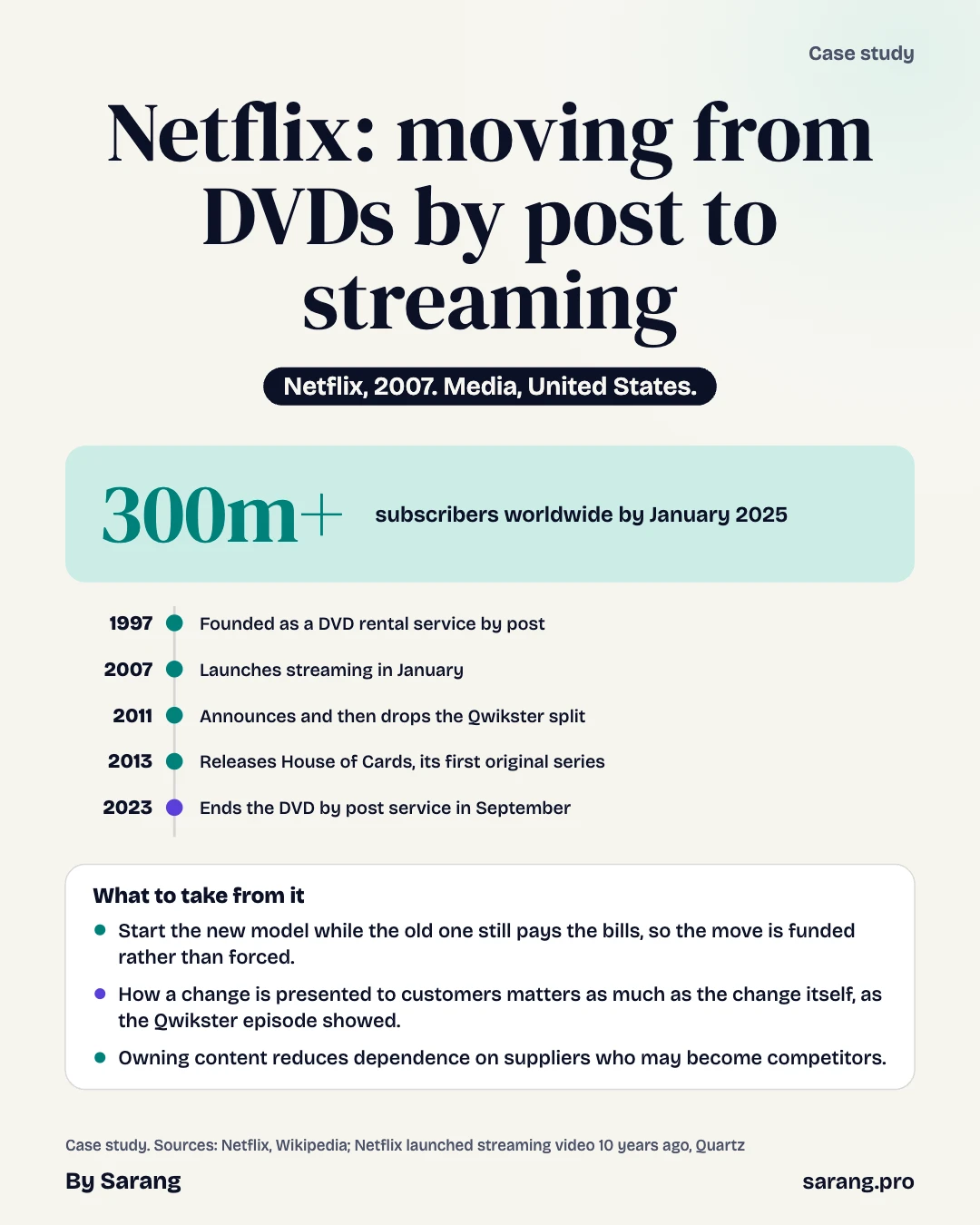
It also began to commission its own programmes. Quartz reports that Netflix began producing originals in 2013, starting with House of Cards, and released full seasons at once.
What happened
The damage was real but short. Netflix lost subscribers in the third quarter of 2011, and the share price fell by about half from its summer high. The 2011 annual report states that domestic unique subscribers returned to growth in the fourth quarter.
| Measure | 2009 | 2010 | 2011 |
|---|---|---|---|
| Revenue | $1.67 billion | $2.16 billion | $3.20 billion |
| Subscribers at year end | not in sources | 20.0 million | 26.3 million |
Revenue rose by 48 per cent in 2011, and the company added 6.2 million unique subscribers over the year. At the end of 2011 Netflix had 20.2 million paid domestic streaming subscribers and 11.0 million paid domestic DVD subscribers. Total domestic streaming subscriptions, including free trials, stood at 21.7 million, and there were 1.9 million streaming subscriptions abroad, of which 1.4 million paid.
The disc business then shrank. Ten years after the streaming launch, Quartz reported that Netflix had about 87 million subscribers and only about 4.3 million disc customers, and that it planned to spend about $6 billion on content that year. TV shows had grown to about 27 per cent of the library and had overtaken films in viewing.
On 18 April 2023, Netflix said it would wind down its disc service, DVD.com, and ship its last discs on 29 September 2023. It said the business “continues to shrink.” Ted Sarandos said the company wanted to “go out on a high” and credited the red envelopes with paving the way for streaming.
Other views
Customers and consultants
The loudest criticism came from customers. ABC quoted one writer who said “This may be the end of it for me.” Consultant John Tschohl told the Associated Press that Netflix was “not listening to its customers at all.” The common complaint was not about streaming itself. People were paying more, and now had to manage two accounts to watch a film.
Hastings himself
Hastings accepted the criticism on communication, and in the apology he linked the failure to humility. He did not retreat on the strategy. The 2011 annual report, written after the retraction, still described streaming as its main growth area and expected disc shipments to be flat or lower.
Limits of the evidence
The sources disagree on how many people left. ABC reported about 600,000 customers quitting, and the Associated Press repeated the company’s warning of 600,000 fewer subscribers by the end of September. The company’s annual report speaks of “significant cancellations” without a figure in the sections available to the author. Nor can the sources say how many of those who left would have gone anyway as rival services launched.
The sources also do not settle whether the split itself was the mistake or only the way it was announced. The numbers in the July letter suggest the company was already steering customers to streaming, and the 2011 annual report shows streaming subscribers growing through the crisis.
Reading it through a framework
Disruptive innovation
Clayton Christensen’s theory describes how a cheaper, simpler product enters at the bottom of a market and improves until it takes over. Streaming in 2007 fits the early stage: 1,000 titles, poor picture quality, and a service that sat inside the disc plan as a perk. It did not match a DVD, but it removed the wait. By 2010 most subscribers watched more by streaming than by disc.
The theory also predicts the difficulty. The incumbent business, here Netflix’s own discs, earns the profit, and the people in it have reasons to protect it. Netflix tried to disrupt itself, which is rare. The July price change aimed to stop the disc business subsidising a streaming service that customers wanted more. What the framework does not explain is the tone. A firm can be right about the direction and wrong about the pace, which is what the reaction suggests.
Ansoff matrix
Igor Ansoff’s grid sorts growth options into four: sell existing products to existing markets, existing products to new markets, new products to existing markets, and new products to new markets. Netflix’s moves in 2011 touch three of the four.
Streaming for existing disc customers was a new product for an existing market, and it carried the most risk to the old revenue. Streaming in Latin America in September 2011, and in the UK and Ireland in January 2012, was an existing product in new markets. The later move into original programmes, starting with House of Cards in 2013, was a new product for the same viewers. The annual report’s note that further international launches would wait for profitability shows the company weighing the cost of the second move against the first.
Since then
Netflix kept its disc service until 2023 after the Qwikster reversal, but it never regained its place at the centre of the company. By 2017 the disc customer base was a small fraction of the streaming one, and in April 2023 the company announced that it would send its last discs that September.
The streaming side moved into original series. Quartz traces the start of Netflix originals to 2013 and describes the release of whole seasons at once as the start of binge-watching as a habit. By 2017 the company’s share price had reached $135.40, a record at the time.
The author found no figure for Netflix’s current subscribers in the sources opened for this case, so none is given here.
What to take from it
- A company can be right about where its market is heading and still lose customers by the way it moves them, because most customers judge a change by their own bill and their own routine.
- Netflix’s own disclosures showed that the old business was still growing while the new one was taking over, which is the hardest time to change a model, since there is no crisis to explain it.
- Content licences are fixed costs paid in advance. Netflix committed more than $1.2 billion by the end of 2010 and added $613 million in a single quarter in 2011, so it needed subscribers to keep paying for streaming at a price that covered it.
- Splitting a service into two brands makes sense on an internal chart and can feel like a loss to a customer who has to log in twice. The test of a reorganisation is how it looks from the customer’s side.
- A public apology does not reverse a decision. Hastings said the price rise would have happened anyway, and the company kept the price split while dropping the new name.
Questions to think about
- Netflix said disc shipments had “likely peaked” while the disc business was still profitable. When should a company start moving customers away from a profitable product, and who should decide the pace?
- If Netflix had announced the split with a single login and a clear explanation, would the cancellations have been smaller, or would the price rise alone have caused them?
- Blockbuster had a similar choice between stores and online rental. What did Netflix have, in 2011, that Blockbuster lacked in 2007, and how much of it was luck?
- How would you measure whether the 2011 episode cost Netflix more than it gained?
Concepts at work
This case shows disruptive innovation, the Ansoff matrix, and switching costs in the customer’s eyes. Explore them in Insights.
Written from the public sources listed below. Figures are as those sources report them.
Framework
Timeline
- Aug 1997Netflix incorporated in Delaware
- 1998First disc shipped
- 2000Blockbuster turns down a chance to buy Netflix for $50 million
- May 2002Netflix floats on the stock market
- 16 Jan 2007Watch Now streaming begins
- Sep 2010First international launch, in Canada
- 12 Jul 2011Separate pricing for discs and streaming announced
- 18 Sep 2011Hastings apologises and announces Qwikster
- Q3 2011Net loss of domestic subscribers
- Jan 2012Streaming launches in the UK and Ireland
- 2013First Netflix originals begin, starting with House of Cards
- 29 Sep 2023Last discs shipped
Recap cards
Tap a card to check yourself.
Sources and credits
- Netflix: Form 10-K for 2011
- Netflix: Form 10-K for 2010
- Netflix: Letter to shareholders, Q2 2011
- ABC News: Netflix CEO apologizes for price increase, announces Qwikster
- Associated Press (via Phys.org): Netflix says it's sorry, then creates new uproar
- Quartz: Netflix launched streaming video 10 years ago
- Fast Company: Blockbuster bankruptcy, a decade of decline
- The Scotsman: Netflix to end DVD-mailing subscriptions after 25 years
- Washington Times (AP): Blockbuster files for bankruptcy protection



