Nokia: how the world’s largest phone maker ended up selling its handset business to Microsoft
Nokia sold 437.1 million devices in 2007 and held 38% of the market, yet in 2013 it sold its handset business to Microsoft for EUR 5.44 billion.
- devices sold by Nokia in 2007
- 437.1 million
- Nokia's device market share in 2007
- 38%
- Nokia net sales in 2007
- EUR 51.1 billion
- estimated smartphone share in Q1 2011, down from 41% a year earlier
- 26%
The situation
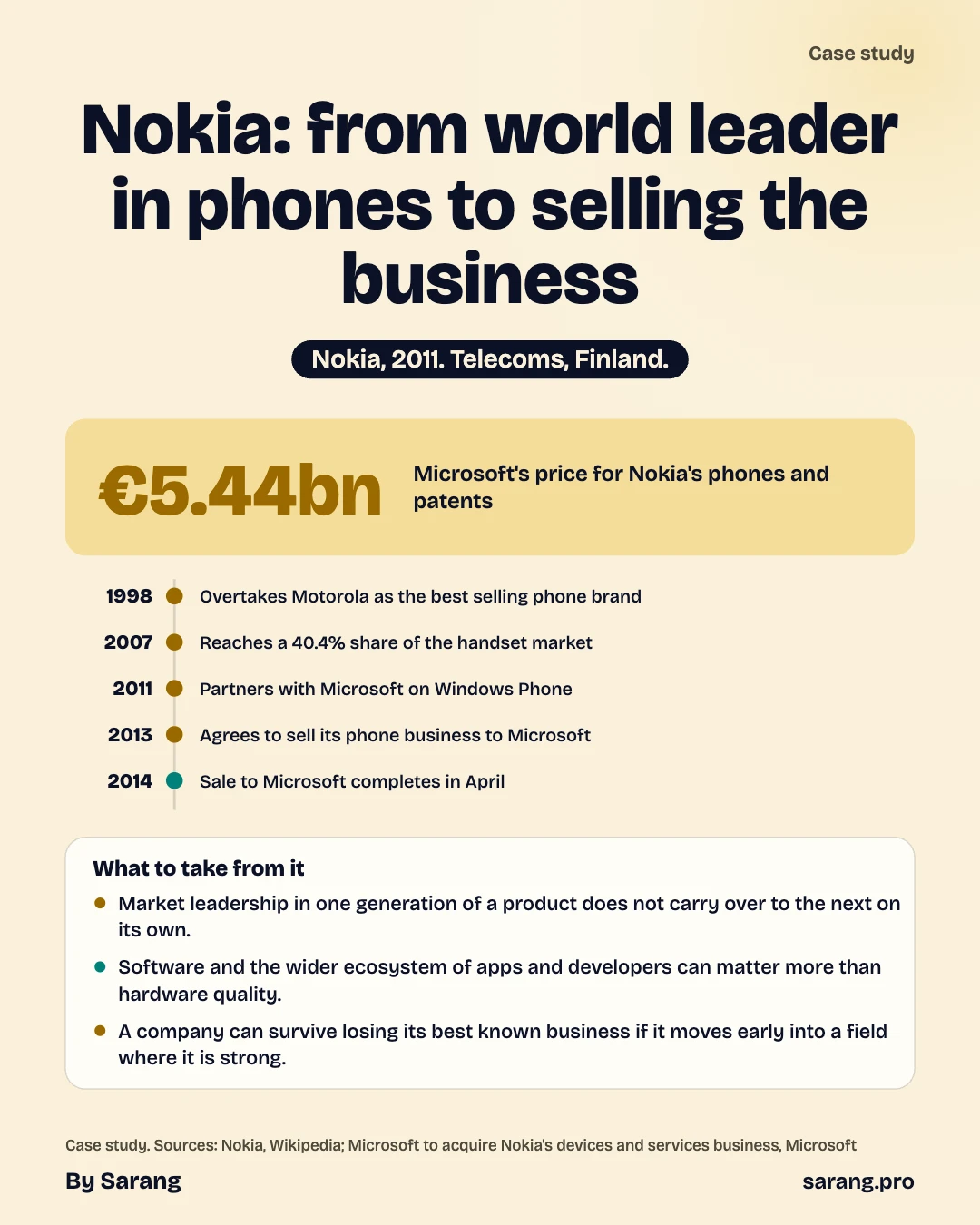
On 3 September 2013, Nokia and Microsoft announced that Microsoft would buy substantially all of Nokia’s Devices and Services business and license its patents, for a combined EUR 5.44 billion in cash: EUR 3.79 billion for the devices business and EUR 1.65 billion for the patent licence. About 32,000 people, 4,700 of them in Finland, were due to move across when the deal closed. The part of Nokia being sold had produced EUR 14.9 billion of sales in 2012, almost half of the company’s total.
Six years earlier the picture had been very different. In 2007 Nokia sold 437.1 million mobile devices, about 38% of everything the industry shipped that year, and reported net sales of EUR 51.1 billion and an operating profit of EUR 8.0 billion. By the second quarter of 2013 it was shipping 7.4 million Lumia smartphones, the Windows Phone range it had staked its future on in 2011, alongside 53.7 million cheaper handsets. Its chief executive, Stephen Elop, was on his way to Microsoft. Its chairman, Risto Siilasmaa, was stepping in as interim chief executive.
This case follows the route between those two moments. It asks why a company with the largest share of the handset market, a profit margin above 15% and a record year in 2007 ended up selling the business that had made it famous. It also asks whether the decision at the centre of the story, to give up on its own smartphone software and adopt Microsoft’s, was the cause of the fall or a response to a fall that had already happened.
Background
A volume leader at the top of its game
Nokia’s results for 2007, published in January 2008, were the best in its history by most measures. Net sales rose 24% to EUR 51.1 billion. Operating profit rose 46% to EUR 8.0 billion, a margin of 15.6%, and net profit was EUR 7.2 billion. The company proposed a dividend of EUR 0.53 a share, up from EUR 0.43. Nokia’s own estimate put industry volumes at about 1.14 billion devices, up 16%, with Nokia’s share at 38% for the year (36% in 2006) and 40% in the fourth quarter alone.
The money came mostly from handsets. The Mobile Phones unit made EUR 25.1 billion of sales and EUR 5.4 billion of operating profit, a margin of 21.7%. A second unit, Multimedia, made EUR 10.5 billion of sales and EUR 2.2 billion of profit, and Enterprise Solutions added EUR 2.1 billion of sales. The joint infrastructure business with Siemens, Nokia Siemens Networks, was a different story: EUR 13.4 billion of sales and an operating loss of EUR 1.3 billion for the year, with a EUR 2.0 billion annual cost-saving target still to be reached.
Scale, and a falling price per phone
Two features of the 2007 figures matter later. First, Nokia was already a large seller of smartphones in the way the industry then defined them. It shipped 60.5 million “converged devices” that year, out of about 122 million for the whole industry, and its Nseries multimedia range alone accounted for about 38 million units. Second, the average selling price of its devices had fallen from EUR 96 in 2006 to EUR 86 in 2007, and it was EUR 83 in the fourth quarter. Nokia’s profit came from selling a very large number of devices at a falling price per unit, backed by its own manufacturing and distribution reach. That model works while volume grows faster than price falls.
The same release shows the plan for 2008. Nokia expected industry volume to grow about 10% and said it aimed to increase its own share. Nothing in the document hints at the position it would be in three years later.
The software Nokia depended on
Most of Nokia’s smartphones ran Symbian, which Elop’s memo later described as a midrange platform. Nokia’s smartphone volume lead was large, but it was a lead in a market that was about to change what a smartphone was for.
The industry
The mobile phone industry of 2007 sold on hardware, price and operator relationships. Handset makers designed phones, operators sold them, usually with a subsidy, and software was a feature of the phone. Nokia’s strengths fitted this system: scale in components, a worldwide retail and operator network, and a brand that reached from rich markets to low-income ones.
Apple’s iPhone, unveiled in January 2007 and shipped in the United States that June, treated the phone as a computer with an app and service layer on top. The Nokia memo of February 2011, discussed below, puts numbers on what followed. Apple’s share of the segment of phones priced above 300 dollars went from 25% in 2008 to 61% in 2010. Google’s Android, which had launched just over two years before the memo was written, had drawn in developers, service providers and hardware makers, moved from the high end into the middle of the market, and was heading toward phones under 100 euros. By the time Elop wrote, Android had overtaken Nokia in smartphone volumes.
The low end was under attack too. The memo said Chinese manufacturers could launch cheap devices far faster than Nokia could develop them. In other words, the bottom of the market was becoming a commodity just as the top was becoming a platform business.
Regulation touched the story mainly at the end. The Microsoft transaction needed Nokia shareholder approval and regulatory clearances, and it was set to close in the first quarter of 2014, with an extraordinary general meeting called for 19 November 2013.
The decision
Olli-Pekka Kallasvuo was chief executive when the 2007 results were published. By late 2010 Stephen Elop had taken over. The question he faced was how a business that still shipped more phones than anyone should respond to a market that no longer rewarded volume alone. The financial position was not yet desperate. In the fourth quarter of 2010 Nokia reported net sales of EUR 12,651 million and an operating profit of EUR 884 million. But its estimated smartphone share had fallen from 41% in the first quarter of 2010 to 31% in the fourth, and by the first quarter of 2011 it was 26%.
Option one: fix Symbian and MeeGo
Nokia had two software bets of its own. Symbian was the established system, and MeeGo was the intended high-end successor. Elop’s memo was blunt about both. Symbian, he wrote, had proven non-competitive in leading markets such as North America. MeeGo, which Nokia had hoped would win the high end, was moving so slowly that at the current pace Nokia might have only one MeeGo product on the market by the end of 2011. The memo also said Nokia had lacked accountability and leadership, and that it was not innovating or collaborating fast enough.
Option two: Android
The obvious alternative was to adopt Android, which was winning developers and hardware makers. Business Insider’s later account says Elop rejected it because Nokia would struggle to stand out among many Android makers. The same article reports that Nokia had at some point planned to move from Windows Phone to Android, but the passage names no source for this, so it stays as reported, not confirmed.
Option three: Windows Phone
The third path was to hand the smartphone software to Microsoft and compete on hardware, design, imaging and distribution. A press report from 10 February 2011, a day before the announcement, said a software deal bringing Microsoft’s Windows Phone 7 to Nokia handsets was reportedly on the table. Nokia would give up control of its own software and gain a partner. The Windows Phone system, by the market study quoted earlier, held a small share of the market at the end of 2006, and the path depended on Nokia’s hardware and reach building that share.
The choice was between control of a weak platform and dependence on a partner’s platform. It was also a choice about timing. Whichever path was taken, Symbian volumes would have to run down while a new range was built, and Nokia would have to sell phones that customers already knew were being replaced.
What they did
The burning platform memo, February 2011
On or around 8 February 2011 a memo from Elop to staff reached the press and was later confirmed as genuine by sources cited in the reports. Its central image was a burning platform, a case where staying put is more dangerous than jumping. Its line “Nokia, our platform is burning” became the best-known sentence in the company’s history. The memo set out the Apple, Android and low-cost problems and told staff that the strategy would be announced on 11 February.
The Microsoft partnership, 11 February 2011
Nokia announced that it would adopt Windows Phone as its primary smartphone platform. Its report for the first quarter of 2011 describes a transition expected to take about two years, with Symbian remaining on sale in the meantime, and says the Smart Devices and Mobile Phones units were created as separate business units from 1 April 2011. Microsoft later said the two companies had been partners since February 2011. The first Windows Phone range was the Lumia.
Microsoft also paid Nokia for its support of the platform. Nokia received a first quarterly payment of 250 million dollars in the fourth quarter of 2011.
Restructuring, 2012
Through 2012 the company cut costs while the Symbian business shrank. The third-quarter 2012 report records EUR 454 million of restructuring charges and related items in Devices and Services in that quarter alone. Cumulative charges for the division had reached about EUR 1.4 billion, with about EUR 1.8 billion expected by the end of 2013. The group had 130,050 employees at the end of 2011, down from 132,427 a year earlier.
The sale to Microsoft, 2013 to 2014
The September 2013 announcement set the terms already given. Microsoft also offered Nokia EUR 1.5 billion in convertible notes in three tranches of EUR 500 million, whether or not the deal closed. Nokia kept its patent portfolio and licensed it to Microsoft for ten years with an option to extend for ever. It also kept its mapping business, HERE, and Microsoft became a licensee of that platform under a four-year licence. Elop became an executive vice president of Devices and Services in the structure that would move to Microsoft.
Microsoft’s chief executive, Steve Ballmer, called the transaction “a win-win for employees, shareholders and consumers of both companies”. Nokia’s chairman said it was the best path forward for Nokia and its shareholders.
What happened
The numbers after the decision
| Measure | Figure | Source period |
|---|---|---|
| Device volume and share | 437.1 million units, 38% share | Full year 2007 |
| Smartphone share (estimate) | 41%, then 31%, then 26% | Q1 2010, Q4 2010, Q1 2011 |
| Smartphones shipped | 77.3 million, down 25% | Full year 2011 |
| Smart Devices volume | 6.3 million, of which about 2.9 million Lumia, down 63% on the year | Q3 2012 |
| Group net sales | EUR 38.659 billion, then EUR 30.176 billion, down 22% | 2011, 2012 |
| Group operating result | Loss of EUR 576 million (non-IFRS profit of EUR 78 million) | Q3 2012 |
The 2011 total of 77.3 million smartphones fell 25% from the year before, while feature phones were 339.8 million, down 3%. One outlet put the group’s operating loss for 2011 at about 1.4 billion dollars, against an operating profit of about 2.74 billion dollars in 2010.
The third quarter of 2012 was the weakest quarter among the filings opened for this case. Net sales were EUR 7,239 million, down 19% on the year, with an operating loss of EUR 576 million. Smart Devices volume fell 63% year on year, and the filing blames mainly lower Symbian volumes. Gross cash was EUR 8,779 million and net cash EUR 3,564 million, so the company was not close to running out of money, but operating cash flow was negative by EUR 429 million in the quarter.
For the whole of 2012, one trade report puts net sales at EUR 30.176 billion, down 22% from EUR 38.659 billion. In the fourth quarter Nokia shipped 15.9 million smartphones by its own definition: 9.3 million Asha full-touch phones, 4.4 million Lumia and 2.2 million Symbian. Devices and Services net sales were EUR 3,854 million, down 36% on the year before. By region, Greater China fell 79%, while North America rose 270% to EUR 196 million from a very small base.
The outcome for the business
Lumia was growing, from 2.9 million in the third quarter of 2012 to 4.4 million in the fourth and 7.4 million in the second quarter of 2013. It was not growing fast enough to replace what Symbian and the feature phones were losing. Microsoft paid EUR 5.44 billion for a business that had generated EUR 14.9 billion of sales in 2012. Its announcement said the deal would close in the first quarter of 2014, and a later trade report says it closed in 2014; no primary source for the exact completion date was available.
For shareholders, the sale left a smaller and different company. Nokia kept its network infrastructure business, its mapping business and a patent portfolio. For employees, the 32,000 transferring to Microsoft included 18,300 in manufacturing, assembly and packaging.
Other views
It was too late
The loudest criticism is of timing. A later Business Insider article argued that by the time Microsoft bought Nokia, the opportunity had gone. The Nokia figures support part of that reading. The share fall started well before Elop arrived: from 41% in the first quarter of 2010 to 31% in the fourth. Elop’s memo itself said that Apple’s share of the segment above 300 dollars had risen from 25% in 2008 to 61% in 2010 and that Android had already overtaken Nokia in smartphone volumes.
The announcement made things worse
A second line of argument is that announcing a two-year transition away from Symbian told customers and operators to stop buying it, while Lumia was not ready. Nokia’s own filing links the 63% fall in Smart Devices volume in the third quarter of 2012 mainly to lower Symbian volumes. That fits the argument, though it does not prove that the announcement, as opposed to competition, caused the fall. The sources used here cannot separate the two, and none of them tries to.
Microsoft’s side
Microsoft did not keep the business for long as a going concern. Business Insider reports that Microsoft wrote off the entire value of the acquisition; the size of the write-off could not be checked against a primary filing and is listed as unverified.
Limits of the evidence
Market share figures in this case come from Nokia’s own estimates and from third-party trackers, which differ. One account places Nokia’s peak smartphone share in the third quarter of 2007 and another has a company-wide device share peak in the fourth quarter. Where they differ, Nokia’s own filings are used.
Reading it through a framework
Network effects and platform competition
A smartphone operating system is a two-sided market. The more users a platform has, the more worthwhile it is for developers to build for it, and the more apps there are, the more attractive it is to users. The memo describes exactly this loop for Apple and Android: developers, service providers and hardware makers were drawn in. Symbian had the largest share at the end of 2006 but, by Elop’s account, it lacked the apps and experience of the newer systems. Windows Phone started with a small base and so faced the same loop in reverse. Nokia’s bet was that its hardware and distribution could build that base fast enough. With 2.9 million Lumia in a quarter against a market of hundreds of millions, the bet had not worked by late 2012. Network effects also explain why a third platform struggles: developers have limited resources and build first for the two largest.
VRIO: resources that stopped being valuable
The VRIO test asks whether a resource is valuable, rare, costly to imitate and exploited by the organisation. In 2007 Nokia’s sheer scale, 437.1 million devices and a 38% share, was valuable and rare. By 2011 the memo suggests the valuable part had shifted. Cheap devices from Chinese makers, launched faster than Nokia could respond, suggest that the ability to make a phone was no longer rare. The software platform, which had become the valuable resource, was one in which Nokia had fallen behind. Selling the devices business to Microsoft while keeping patents, maps and network infrastructure can be read as a sorting of resources: keep those that were still valuable and rare, sell the part whose main advantages had been imitated or overtaken.
Since then
The Microsoft deal was announced in 2013 and was due to close in the first quarter of 2014. By May 2016 Microsoft was selling on the remaining Nokia feature phone business. Microsoft wrote off the value of the business, according to Business Insider, though the amount could not be verified. On 18 May 2016 Microsoft announced that it was licensing the Nokia brand for ten years to HMD Global, a newly formed Finnish company, and selling the remaining feature phone assets to FIH Mobile, a Foxconn subsidiary. The price was not disclosed. Nokia would take a board seat and set brand requirements. HMD said it would invest 500 million dollars over three years in developing and promoting products. The new Nokia-branded phones were to run Android, the system Elop had passed over in 2011.
Nokia itself became a network company. Its website in October 2026 describes it as a technology leader in mobile, fixed and cloud networks, with products in radio access, optical, IP and data centre networking. In the same month it announced a sale of one enterprise business to Aurelius, a trial of commercial AI-native radio networks with SoftBank in Japan and an AI platform for telecom operators built with Nvidia. It published its third-quarter 2026 interim report on 22 October 2026.
What to take from it
- A leading share and a high margin can hide a weakening position, because both measure what customers did in the last year and not what the next generation of customers will want.
- When a market changes from selling products to running a platform, the number of developers and users matters more than unit volume, and a company with the most units can still be on the wrong side of that change.
- Announcing a long transition between an old and a new product can cut sales of the old one before the new one can replace them, so the order and speed of the announcement are part of the strategy.
- Giving up control of core software to a partner trades risk for dependence: Nokia gained a partner with resources but lost the ability to set the pace of its own product.
- Selling a business can leave the seller healthier than keeping it, since Nokia kept patents, maps and networks that went on to define the company.
Questions to think about
- Which signals in Nokia’s 2007 results, if any, could a board have read as warning signs, and what would it have done differently in 2008?
- If Nokia had adopted Android in 2011, what would it have needed to do to stand out from other Android makers?
- How would you test whether the announcement of the Windows Phone plan caused Symbian sales to fall, or whether they would have fallen anyway?
- Was selling the devices business a failure of strategy, or a sound exit from a market where the company had lost its advantage?
Concepts at work
This case touches network effects, platform strategy and resource-based advantage (VRIO). Explore them in Insights.
Written from the public sources listed below. Figures are as those sources report them.
Framework
Timeline
- Jan 2008Nokia reports record 2007: sales EUR 51.1 billion, 437.1 million devices, 38% share
- 2008Apple's share of phones above 300 dollars is 25%, as Elop's memo later states
- 2010Apple's share of that segment reaches 61%; Nokia smartphone share slides from 41% to 31%
- Feb 2011Elop's burning platform memo reaches the press (around 8 Feb)
- 11 Feb 2011Nokia and Microsoft announce a partnership, with Windows Phone as Nokia's main smartphone platform
- 1 Apr 2011Devices and Services splits into Smart Devices and Mobile Phones units
- 2011Smartphone shipments fall 25% to 77.3 million
- Q3 2012Group operating loss of EUR 576 million; Smart Devices volume down 63%
- 2012Group net sales fall 22% to EUR 30.2 billion
- 3 Sep 2013Microsoft agrees to buy Devices and Services for EUR 3.79 billion and license patents for EUR 1.65 billion
- 18 May 2016Microsoft licenses the Nokia brand to HMD Global and sells feature phone assets to FIH Mobile
- Oct 2026Nokia describes itself as a network technology company, with AI-native radio trials under way
Recap cards
Tap a card to check yourself.
Sources and credits
- Nokia (SEC Form 6-K): Fourth quarter and full year 2007 results
- Nokia (SEC Form 6-K): Q1 2011 interim report
- Nokia (SEC Form 6-K): Q3 2012 interim report
- Microsoft News Center: Microsoft to acquire Nokia's devices and services business, license Nokia's patents and mapping services
- FutureFive: Nokia CEO: our platform is burning
- The Next Web: Nokia's 2011 by the numbers
- Telecom Lead: Nokia's Q4 income down 20%, full-year revenues dip 22%
- Business Insider India: By the time Microsoft bought Nokia, it was way too late
- Engadget: Nokia-branded phones and tablets return with HMD Global and FIH Mobile (18 May 2016)
- Nokia: company website, about us (page as loaded in October 2026)