Starbucks: how Howard Schultz came back to reset a business that grew too fast
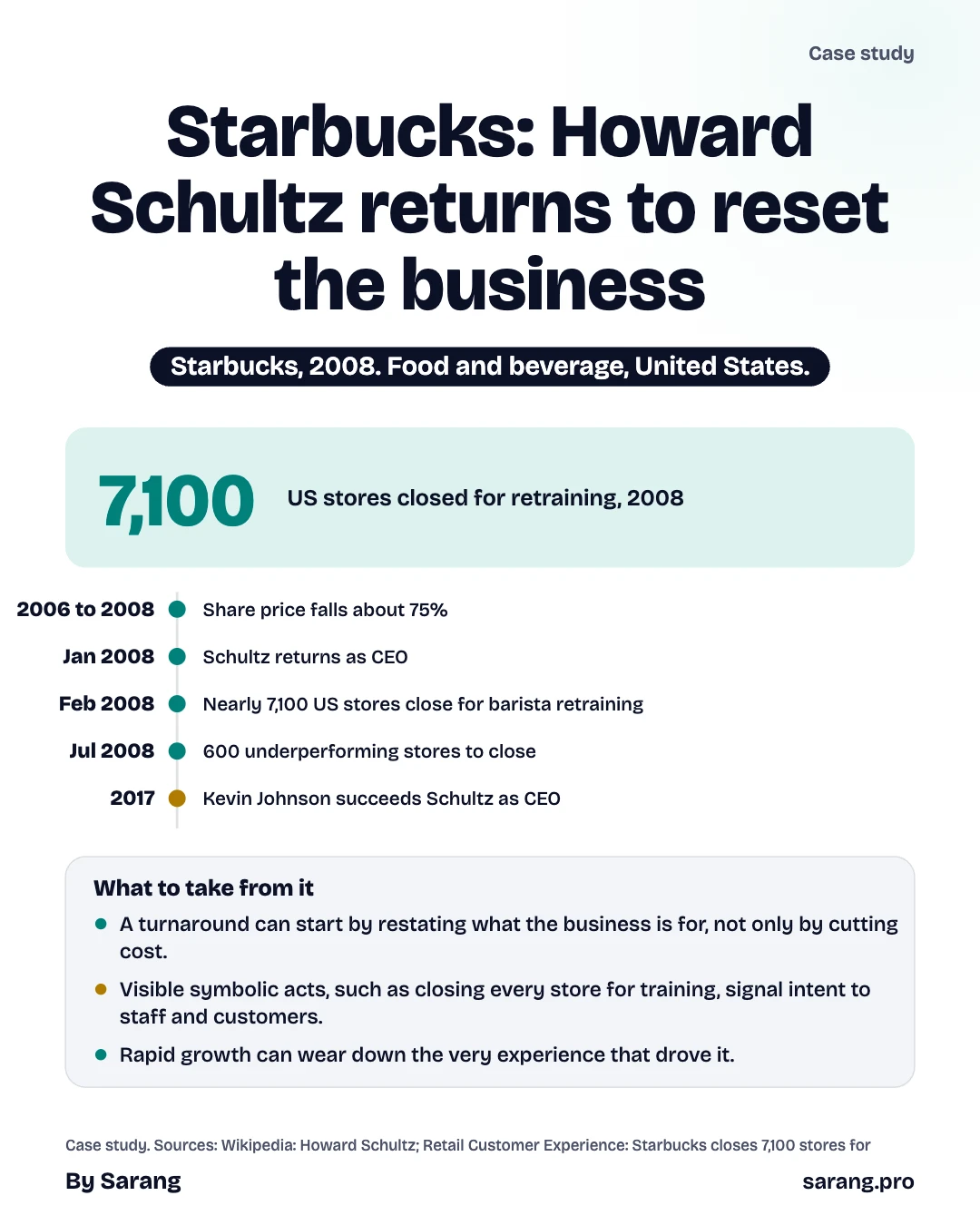
Howard Schultz took back the chief executive role on 7 January 2008, after shares halved in a year, then closed about 800 US stores and cut $580 million of costs.
- share price at close on 7 January 2008
- $18.38
- US stores closed for retraining, February 2008
- 7,100
- staff retrained in three hours
- 135,000
- US stores in the closure plan
- about 800
The situation
On Monday 7 January 2008, Starbucks announced that its chairman, Howard Schultz, would take back the job of chief executive with immediate effect. He replaced Jim Donald, who left the company. The announcement came as the share price had fallen by about half over the previous year, according to the Associated Press. The shares closed at $18.38 that day and rose $1.31 in after-hours trading once the news was out. Time later put the rise at 8%.
The company was large and still opening shops at speed. The AP counted more than 15,000 stores worldwide and reported plans to open 2,500 in the financial year, 1,600 of them in the United States, about six a day. Its long-term goal was 40,000 stores. Yet traffic in American stores was falling, shoppers were cutting back as house prices dropped and fuel cost more, and Dunkin’ Donuts and McDonald’s had launched their own better-quality coffee. Time reported that in the quarter to September 2007, traffic at established US stores fell 1% for the first time ever, and the next quarter it fell 3%.
Schultz had run the company from 1987 to 2000 and then stayed on as chairman. This case looks at what he did after he came back: slowing openings, closing shops, retraining staff, cutting costs and trying to rebuild what he called the emotional connection with customers. It also looks at what the numbers show about whether the reset worked.
Background
From four shops to a global chain
Starbucks’ own announcement of 7 January 2008 gives the outline. Schultz joined in 1982 as director of operations and marketing, when the company had four stores. He bought the company in August 1987. It went public in June 1992. Time reported that at the flotation it had 140 stores and then grew its store count by 40% to 60% a year. Under Schultz the company was among the first in North America to offer health care and stock options, called Bean Stock, to eligible employees, who the company called partners. By 2008 it had a significant and growing presence in 43 countries.
The sources differ slightly on when Schultz first became chief executive. The 2008 announcement says 1987 to 2000, while a 2022 CNBC report says 1986 to 2000. The difference does not affect the story.
The years of fast growth
In 2000, Time reported, Orin Smith became chief executive with Schultz staying on as chairman. Smith’s years added automated Verismo espresso machines, which Time said sped up drink preparation by 40%, and drive-through windows. Donald was promoted from president of the North American division and became chief executive in March 2005 when Smith retired, according to the AP.
Under Donald, Time reported, the stores added books, movie promotions and oven-warmed breakfast sandwiches. The sandwiches brought about $35,000 to an average store’s $1 million in annual sales. Frappuccinos made up about 15% of sales. The company’s business was growing fast, and each new store was meant to add to it.
How the business made money
The company earned most of its revenue from stores that it ran itself, and some from licensed stores. The 2009 annual report shows the split at the end of that year: 8,832 company-operated stores and 7,803 licensed stores, 16,635 in all. Net revenues in the 2007 financial year, which ended on 30 September 2007, were $9.41 billion, and operating income was $1.05 billion, a margin of about 11.2%.
The industry
The 2009 annual report describes the competition as quick-service restaurants and specialty coffee shops, with growing direct competition from large American quick-service chains and from established companies in international markets. Customers choose mainly on product quality, service, convenience and price. In 2008 the AP named the pressure directly: Dunkin’ Donuts and McDonald’s had launched gourmet coffee lines and were taking some of Starbucks’ customers.
Starbucks’ position was unusual because it sold a premium product. A cup cost more than a rival’s, so it depended on shoppers feeling the extra was worth it. A Bear Stearns analyst, Joseph Buckley, told Time that the customer base had grown so broad that the company was no longer recession-proof. David Palmer of UBS said consumers were getting bored with Frappuccinos, which in his view explained the weak summer of 2007. Some analysts also questioned in January 2008 whether Starbucks had saturated certain markets, as the AP reported without naming them.
Behind this sat the economy. The AP linked the weak traffic to falling home values and higher fuel prices. The 2009 results that follow show how deep the slump became: consolidated comparable store sales fell 3% in the 2008 financial year and 6% in 2009.
The decision
What was at stake
The board had to decide who should lead the company and what it should do. The shares had halved. The business had grown faster than the organisation that ran it. And the premium it charged had to be defended in a weaker economy. The sources show the board’s choice, but they do not describe the alternatives it considered, so what follows sets out the obvious options as such.
Option one: stay the course with Donald
The company could have kept its leader and its plan of opening 2,500 stores in the financial year. In November 2007 it had already scaled back US openings slightly, the AP noted. But the traffic figures were negative, and the share price was signalling that investors saw a problem that a small trim would not solve.
Option two: appoint an outside executive
The board could have brought in a manager from another chain. The sources do not report that it considered this. Time quoted an Ohio State academic, Rüdiger Fahlenbrach, who argued that founder chief executives can push through bold changes because employees accept them more readily. This is general evidence from research rather than a statement about what the board thought.
Option three: bring back the person who built the brand
The board chose Schultz. Craig Weatherup, chairman of the nominating and governance committee, called him “the architect of the Starbucks brand”. Michelle Gass, then head of global strategy, told Time: “Howard, frankly, is the only person who could do what we needed to do.” Schultz told the AP that he was returning “for the long term”. The risk was that a returning founder would simply repeat the formula that had stopped working. Online critics noted that Schultz had never left, since his office sat next to his successor’s, as Time reported.
What they did
7 January 2008: five priorities
The announcement listed Schultz’s agenda. First, improve the US business by focusing on the in-store experience, new products, store design and partner training. Second, slow US openings and close some underperforming stores to refocus on the profit of each store. Third, rebuild emotional connections with customers and restore ties to coffee, brand, people and stores. Fourth, realign and slim down the organisation and move resources to the activities that create value. Fifth, speed up international growth and profit, moving some capital from US stores to overseas. A statement also promised to keep health care for all full-time and part-time partners. Schultz said there would be “no one-shot solutions or overnight fixes”, according to QSR magazine.
30 January 2008: fewer openings, 100 closures
Time reported that on 30 January the company said it would close 100 underperforming stores and cut its US store openings for 2008 to about 1,175, down 34%. It also dropped breakfast sandwiches in North America and stopped reporting comparable store sales. The figures are for a different period from the AP’s 1,600, and the sources do not reconcile them.
26 February 2008: 7,100 stores close for three hours
On a Tuesday evening, starting at 5:30 pm, the company closed its US company-operated stores for three hours to retrain staff in making espresso. NBC News counted 7,100 stores and about 135,000 employees. Time dated it to 26 February and said about 4,000 licensed stores stayed open. Schultz wrote in a memo that “we will revisit our standards of quality”. NBC noted that the company had also recently cut 600 positions and dropped its hot breakfast sandwiches.
Rebuilding the store experience
Time listed a series of steps meant to restore the sense of craft. The company restored the smell of fresh coffee in stores and opened a farmer support centre in Rwanda. Time also described free latte upgrades for registered card holders, which it said could cost 30 to 70 cents a drink. Martin Coles, the chief operating officer, said of the cost: “We believe it’s worth it.” He also said the rate of change was “far and away faster” than anything he had experienced in the last few years.
1 July 2008: about 600 closures
The company announced it would close about 600 underperforming US stores, including 100 already announced. About 70% of them had opened since the start of the 2006 financial year. It expected to open fewer than 200 new US company-operated stores in fiscal 2009. Pre-tax charges were estimated at $328 million to $348 million, made up of about $200 million of asset write-offs, $120 million to $140 million of lease costs and about $8 million of severance. Schultz said the company had always aspired to put its people first and that these decisions were necessary to strengthen the US store portfolio. In January 2009 the plan was extended, and the 2009 annual report puts the US total at about 800 stores.
2009: cost cutting and new products
By April 2009 the company said it had saved about $195 million in the first half of the year and set a full-year target of $500 million. The 2009 annual report puts the actual figure at about $580 million, through store closures, headcount reductions, in-store efficiencies and supply chain changes. It also refers to a multi-channel marketing campaign and to the launch of VIA, a soluble coffee product, as part of the plan.
What happened
The slide first
The first year after the return was worse before it was better. The table below sets out the numbers from the 2009 annual report.
| Financial year | Net revenues | Operating income | Operating margin | US comparable sales |
|---|---|---|---|---|
| 2007 | $9,411.5 million | $1,053.9 million | about 11.2% | +4% |
| 2008 | $10,383.0 million | $503.9 million | about 4.9% | -5% |
| 2009 | $9,774.6 million | $562.0 million | about 5.7% | -6% |
The margins are calculated from the figures the report gives. Net earnings were $672.6 million in 2007, $315.5 million in 2008 and $390.8 million in 2009. Operating income halved in 2008 and stayed far below the 2007 level in 2009, even as costs came down.
The depth of the slump in 2009
In the second quarter of the 2009 financial year, which ended on 29 March 2009, the company reported that revenues fell 7.6% to $2.33 billion. Comparable store sales fell 8%, with transactions down 5% and the average ticket down 3%. Operating income on a reported basis was $40.9 million, a margin of 1.8% against 7.1% a year earlier. Without restructuring charges of $152.1 million the figure was $193.0 million, a margin of 8.3%, against 8.4%. This suggests that the business before one-off charges was holding its margin while sales fell, which was the aim of the cost programme.
Closures and restructuring
The 2009 annual report says restructuring charges were $332.4 million in the 2009 year against $266.9 million in 2008. Of the roughly 800 US stores in the plan, 205 closed in 2008 and 566 in 2009. In Australia, 61 stores closed in 2008. About 100 further closures were planned abroad, of which 41 were done in 2009. Company-operated stores fell from 9,217 at the end of September 2008 to 8,832 a year later, with US stores down from 7,238 to 6,764.
Cash and recovery
By the end of the 2009 year the picture had improved on several measures. Operating income rose to $562.0 million, a margin of 5.7%, and earnings per share to $0.52 from $0.43. Cash flow from operations was $1.4 billion against $1.3 billion. Capital spending fell to $446 million from $985 million. Short-term borrowings, $713 million at the start of the year, were repaid in full. Sales were still lower than in 2008: revenue fell 5.9%, and consolidated comparable store sales were down 6%.
The sources I opened stop at the 2009 financial year for company results, so this case does not report later annual figures.
Other views
The returning founder
Time reported the mood of the time as celebratory, with Howard Behar, a former head of international and board member, saying “It’s a time for reinvention”. Not everyone agreed that the return itself was the answer. Some posts on a coffee gossip website, Time noted, were sceptical, pointing out that Schultz had never really left the company because his office sat next to his successor’s.
The economy or the company
The evidence points both ways. Falling house prices and higher fuel costs hit shoppers, as the AP said. But rivals’ coffee offers and the questions about saturation, and the Frappuccino fatigue noted by UBS, point to causes within the coffee market. The 2009 annual report shows consolidated comparable sales still negative after the reset, so the sources cannot separate the cycle from the company’s own errors.
People, closures and the cost of change
The closures cost jobs. NBC reported 600 positions cut by February 2008, and the July 2008 plan eliminated full-time and part-time retail positions, though the company said it expected to place many affected employees in nearby stores and gave no total. The 8-K said the stores were chosen because they lost money at store level and had no foreseeable path to acceptable returns. About 70% had opened since the start of fiscal 2006, so they were mainly products of the rapid expansion rather than older shops. Critics could fairly say the company was undoing its own mistakes at employees’ expense, and the sources do not give any account from the staff affected.
Limits of the evidence
Much of the detail in the early months comes from press accounts and company announcements. The Time article gives analysts’ views, while the later numbers come from company filings. The sources I opened do not include independent studies of whether the three-hour retraining changed customer behaviour.
Reading it through a framework
Ansoff matrix
The Ansoff matrix sorts growth into four routes: sell existing products to existing markets (penetration), existing products to new markets (market development), new products to existing markets (product development) and new products to new markets (diversification). Before 2008 Starbucks relied on penetration by opening more US stores, which the AP reported at six a day, and on product development with books, movies and sandwiches. The traffic figures suggest the first route had reached its limit in the US. Schultz’s agenda shifted the weight: slower US store growth, more effort on the core product and its quality, and more weight on market development, since shifting capital overseas was one of his five priorities. VIA, the soluble coffee, was a later product development move. The matrix helps to show that the reset was a change of emphasis across routes and not a retreat from growth.
McKinsey 7-S
The 7-S model asks whether strategy, structure, systems, shared values, style, staff and skills are aligned. Schultz’s agenda touches most of them. Strategy changed from rapid openings to unit profit. Structure and systems appear in the instruction to realign and slim down the organisation. Skills and staff appear in the retraining of 135,000 employees in espresso making. Shared values appear in his language about trust and emotional connection, and his repeated commitment to health care for all partners. Style is the personal element: a founder returning and writing memos about quality. The model shows why the reset was broad: a single change, such as a new product, would have left the other six elements as they were.
Since then
Schultz stayed as chief executive until 2017, according to CNBC, and Kevin Johnson took over. In March 2022 CNBC reported that Johnson would retire after five years as chief executive, and that Schultz would return as interim chief executive for a third time, for a salary of $1, until a permanent successor was found. Johnson had joined the board in 2009, became president and chief operating officer in 2015 and chief executive in 2017. CNBC said he led the company through the pandemic, revamped the loyalty programme, adapted store formats for digital ordering and expanded in China, its second-largest market. Shares rose nearly 50% during his time as chief executive.
The same report described a new challenge. About 140 stores in 26 states had petitioned the National Labor Relations Board to unionise, according to Starbucks Workers United, and six had voted in favour. A group of 75 investors had asked the company to adopt a neutrality policy toward organising efforts. The reset of 2008 had stressed the partner relationship, and this episode tested it again.
The sources I opened do not cover events after 2022, so later changes of leadership are not described here.
What to take from it
- Fast growth can hide a drop in quality for a while, and the first sign may be falling traffic in shops that have been open for years.
- A turnaround often costs more in the short run than the problem did, as the 2008 operating income of $503.9 million, down from $1,053.9 million, shows.
- Slowing expansion and closing weak sites can protect the core brand, but the closures fall on the staff, and a company should account for that openly.
- Retraining 135,000 people at once was expensive, and it signalled that the company treated product quality as the main issue.
- Separating cyclical causes from company errors is difficult, and the sources show comparable sales still falling in 2009 after the main steps were taken.
Questions to think about
- Would an outside chief executive have made the same decisions in 2008, and what might have been different?
- Closing 7,100 stores for three hours had a cost. What evidence would show that it was worth it?
- The company stopped reporting comparable store sales in 2008. The 2009 annual report reports them again. What does a pause like that do for managers and for investors?
- How would you tell whether falling traffic comes from a recession, from rivals or from the company’s own mistakes?
Concepts at work
This case draws on the Ansoff matrix, the McKinsey 7-S model and turnaround leadership. Explore them in Insights.
Written from the public sources listed below. Figures are as those sources report them.
Framework
Timeline
- 1987Schultz buys the company; chief executive until 2000
- Jun 1992Starbucks goes public
- Mar 2005Jim Donald becomes chief executive
- 7 Jan 2008Schultz returns as chief executive; shares halved in a year
- 30 Jan 2008100 closures announced; US openings for 2008 cut to about 1,175
- 26 Feb 20087,100 US stores close for three hours of espresso training
- 1 Jul 2008About 600 US closures announced; charges of $328 million to $348 million
- Jan 2009Closure plan extended
- 29 Mar 2009Q2 comparable sales down 8%; restructuring charge $152.1 million
- 27 Sep 2009Fiscal 2009 ends: operating income $562.0 million, cost savings about $580 million
- Mar 2022Schultz returns as interim chief executive for a third time
Recap cards
Tap a card to check yourself.
Sources and credits
- Starbucks: Form 8-K, board announces initiatives and Schultz as CEO (7 Jan 2008)
- Spokesman-Review (Associated Press): Starbucks reinstates Schultz (8 Jan 2008)
- QSR Magazine: Schultz returns as Starbucks CEO (Jan 2008)
- Starbucks: Form 8-K, store closures announcement (1 Jul 2008)
- NBC News: Starbucks to close all U.S. stores for training (Feb 2008)
- Time: Starbucks looks for a fresh jolt (2008)
- Starbucks: Form 8-K, second quarter fiscal 2009 results (29 Apr 2009)
- Starbucks: Form 10-K for fiscal 2009
- CNBC: Starbucks CEO Kevin Johnson is retiring, Howard Schultz returns as interim chief (16 Mar 2022)



