Tesco: Fresh & Easy and a costly attempt to crack the US
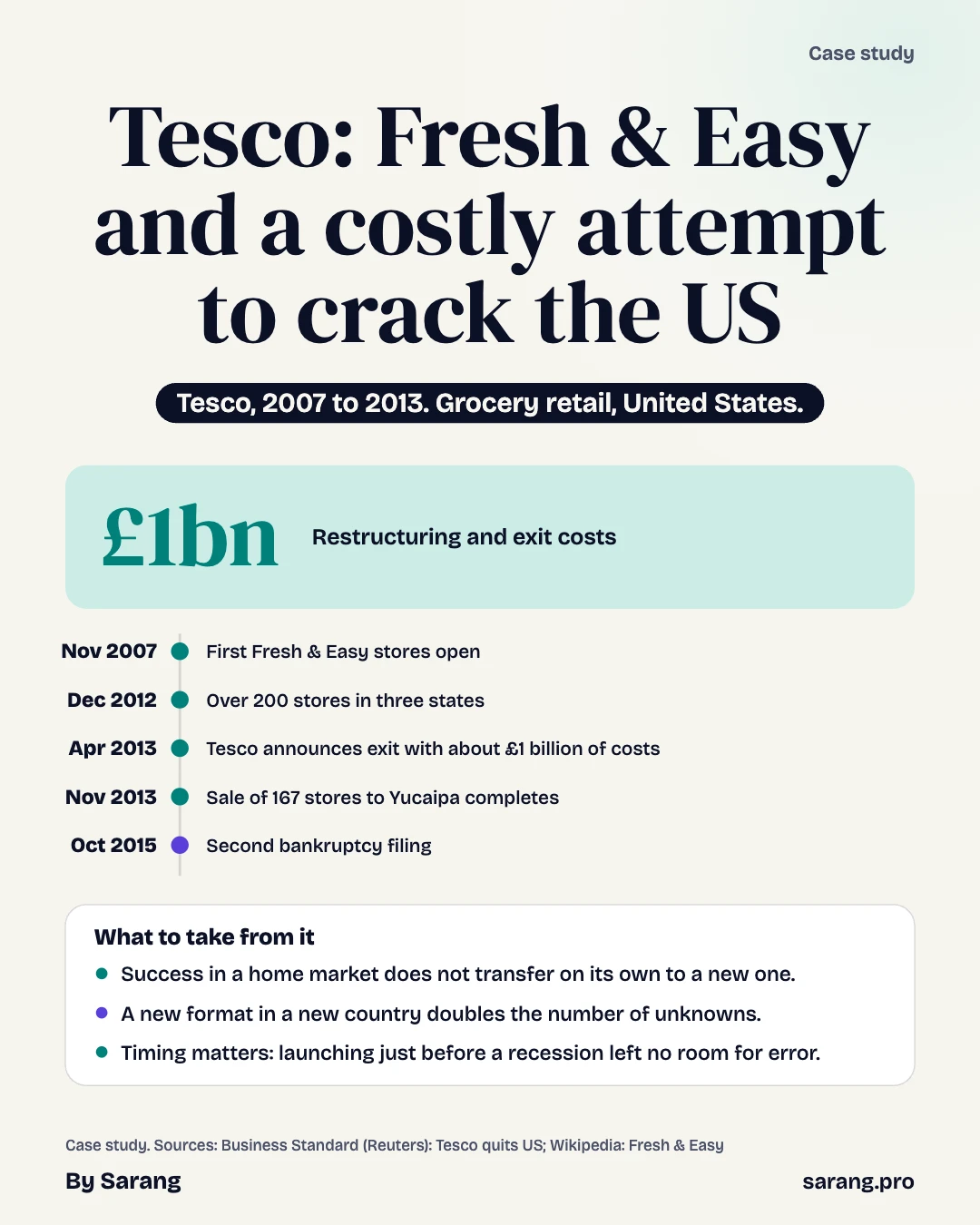
Tesco opened Fresh & Easy in the US in 2007, took a 1.2 billion pound hit when it quit in April 2013, and its buyer closed the last stores in 2015.
- hit to profit after tax, April 2013
- 1.2bn pounds
- stores at the time of the exit decision
- ~200
- cash cost of the sale to Yucaipa
- 150m pounds
- typical store size
- 10,000 sq ft
The situation
In April 2013 Philip Clarke, chief executive of Tesco, announced with the company’s full-year results that the review of its American business had ended in a decision to leave the United States. The business was Fresh & Easy Neighborhood Market, which then ran about 200 small stores in California, Arizona and Nevada. Tesco said the exit would cut its profit after tax by 1.2 billion pounds: 169 million pounds of trading losses and about 1 billion pounds of non-cash items, mainly asset write-downs and provisions for leases it would no longer use.
It was a rare setback for a retailer that had been one of the strongest in the world. Tesco was the third-largest retailer globally, behind Wal-Mart and Carrefour, according to the Harvard Business School’s Working Knowledge site in 2010. In its home market it held about 30 per cent of UK grocery sales, well ahead of Asda at 17 per cent, according to Just Food in December 2012. Inside Retail Australia described the American loss as part of Tesco’s first annual profit decline in almost two decades.
The exit came in two stages. In September 2013 Tesco agreed to sell 150 of the stores to the investment firm Yucaipa, and the sale completed on 26 November 2013. In October 2015, under Yucaipa’s ownership, the chain announced that it would close all 97 remaining stores. This case follows how a company with an exceptional record in one country spent about six years and more than a billion pounds failing in another.
Background
Tesco under Terry Leahy
Tesco’s growth was led for more than a decade by Sir Terry Leahy, who retired as chief executive in March 2011. The company held a strong UK position and grew abroad, mainly through joint ventures in Eastern and Central Europe and Southeast Asia, according to John Quelch of Harvard Business School. Japan was a possible exception.
The American plan
The American effort began in 2005, according to a 2013 report in CSP Daily News, when a small Tesco team reportedly posed as Hollywood film producers to keep the plan secret. Clarke told the BBC in April 2013 that the research behind the plan dated from 2004 and 2005. HBS dates the entry to 2006, and Just Food reports that the first Fresh & Easy store opened in November 2007, in California, Nevada and Arizona.
The concept was not a copy of a British supermarket. The stores were about 10,000 square feet, roughly one-fifth the size of a standard supermarket, and sold about 4,000 items, with roughly half sold under Tesco’s own labels. Leahy described the aim as “the perfect store for the American consumer in the 21st century”. Quelch gave Tesco credit for not taking a “me-too” approach. To learn about American shoppers, Tesco sent 50 of its British executives to live with California families.
The original ambitions
Early plans were large. Canadian Grocer reported in 2011 that the initial plan called for more than 220 locations, that the chain opened more than 60 stores in its first nine months, and that it aimed to reach 400 stores by 2013. Tesco had set a five-year plan to reach profit, due in 2011, according to HBS, and later pushed that date back to 2013. Canadian Grocer described the offer in 2011 as private-label goods without artificial colours or flavours, everyday low pricing, and no coupons or loyalty card.
The industry
A crowded American grocery market
Quelch described the United States as an “unusually competitive and cluttered market” where differentiation is essential. The nearest benchmark for scale was Wal-Mart. MediaPost, citing Planet Retail and the Los Angeles Times, contrasted Fresh & Easy’s stores of about 10,000 square feet with Wal-Mart supercentres of about 182,000 square feet. A new chain with a small store had to win on something other than range or price breadth.
Private-label goods were a feature of the American market, though a smaller one than in Britain. Just Food, citing SymphonyIRI, reported that private label made up about 18 per cent of total US packaged food sales. Fresh & Easy’s roughly 50 per cent share of own-label items was far higher than the market norm, which meant that brand-conscious shoppers saw fewer familiar names.
How Americans shop
Quelch argued that California’s car culture favours weekly shopping trips, which weakens the case for small neighbourhood stores, particularly in suburbs. Stores sat in driving-oriented cities where larger competitors were close by, according to the CSP report. A format built on frequent walking trips to a small shop met a population that mostly drove to a large one.
The economy
Timing made things worse. Just Food noted that Lehman Brothers collapsed about ten months after the first store opened. Canadian Grocer said the recession hit Fresh & Easy hard because its stores were concentrated in Las Vegas, Phoenix and suburban California. Tesco closed or paused some stores: it planned to close 13 stores in Arizona, Nevada and parts of California in 2010 until local economies recovered.
The decision
Tesco faced a decision more than once. The first was whether to keep investing, the second whether to leave, and the third how. Sources describe the final choice in some detail but give less insight into earlier debate, so the earlier options are framed as the obvious alternatives.
Option one: keep going and fix it
This was the policy for most of the period. Tesco made midcourse changes, according to Quelch: it added signage, repainted stores in pastel colours, allowed coupons, extended hours and increased weekly price specials. It added 600 items to the range. The company hoped scale would spread fixed distribution costs. In February 2011, Canadian Grocer quoted Clarke, who was about to succeed Leahy, saying there was “no need to carry out some big strategic review”. Canadian Grocer also put the loss at US$150 million on US$390 million of sales in the period it covered, or 38 cents on each dollar.
Option two: stop expanding and review
By late 2012 the pressure had changed. Just Food reported that the UK, which provided almost two-thirds of Tesco’s trading profit, was under strain. Tesco was spending 1 billion pounds to revitalise the UK business from January 2012, and its UK grocery share was down on the year in the 12 weeks to 25 November. CSP reported that Clarke halted new store openings in October 2012 and began a strategic review two months later. Clarke said the task was “not to re-test the theory of entry but to test whether the time is right to exit”.
Option three: sell or close
When the review ended, Tesco could sell the chain whole, sell it in pieces or close it. CSP said Aldi, which owns Trader Joe’s, was considered a likely buyer and that many observers expected a piecemeal sale. MediaPost, citing Planet Retail and the Los Angeles Times, named other possible buyers, including Aldi Sud, Family Dollar, Dollar General and drugstore chains. The April 2013 announcement said the stores would stay open during the sale. The eventual outcome was a sale to an investment firm rather than a retailer.
What they did
The launch, 2007 to 2008
Tesco opened the first store in November 2007. The format used self-service checkouts almost everywhere: according to a fan site cited by Just Food, all but two of the 199 stores had only self-service checkouts at the end of 2012. Tesco prepacked produce and fitted out the stores in a stark style. Quelch noted that prepacked produce and the stark concrete-floor design clashed with consumer expectations. Greenfield building and British expatriate managers limited the company’s access to local retail expertise, including on site selection, and some stores were on the wrong side of the road for commuters.
The recession and the slowdown, 2008 to 2010
The economy turned within a year. In 2010 Tesco planned to close 13 stores temporarily while opening 19 new ones in California. At that time it had roughly 160 stores and still aimed to reach 400 by 2013, opening about one a week.
The change of chief executive, 2011
Clarke took over from Leahy in March 2011. Tim Mason, a long-serving Tesco executive, ran Fresh & Easy. Clarke had said in 2011 that there was no need for a strategic review. By the end of 2012, with about 199 stores open, he had stopped openings and started one. Quelch had earlier raised the question of how long the board would tolerate losses.
The exit, April to November 2013
Tesco announced the decision in April 2013. On 10 September 2013 it agreed a sale to YFE Holdings, an affiliate of Ron Burkle’s Yucaipa Companies. The buyer took 150 stores, about 4,000 employees and the chain’s distribution and production facilities in Riverside, California, according to The Grocer. Tesco lent Yucaipa 80 million pounds, secured against the Riverside site. Another 50 stores were to close. Clarke called the sale the “best outcome” for shareholders and an “orderly and efficient exit from the US market”. The sale completed on 26 November 2013, according to City AM, and cost Tesco about 150 million pounds: the 80 million pound loan and 70 million pounds of closure costs.
Under Yucaipa, 2013 to 2015
Retail TouchPoints reported that Yucaipa had acquired the chain after a bankruptcy filing in 2013. It closed 50 of its 167 stores in March 2015 and 14 more in July. On 22 October 2015 the company said it would close all 97 remaining stores, citing in a statement that it was “unable to obtain financing and the liquidity necessary” to fund the business. The Associated Press reported that about 3,000 employees would lose their jobs.
What happened
The financial result
| Date | Item | Figure |
|---|---|---|
| 2010 | Reported loss on sales (Canadian Grocer) | US$150m on US$390m |
| Apr 2013 | Hit to profit after tax | 1.2bn pounds (169m trading losses, about 1bn non-cash) |
| Nov 2013 | Cash cost of the sale | About 150m pounds (80m loan, 70m closures) |
| Oct 2015 | Stores closed by Yucaipa | All 97 remaining |
The sources give no single number for the total Tesco spent in the United States over its life. The 1.2 billion pounds is the charge Tesco took in 2013, which included write-offs of earlier investment.
What happened to the stores and staff
Clarke said more than 4,000 jobs would be protected by the sale. Inside Retail Australia reported that the chain employed more than 5,000 people, including 1,300 at the Riverside sites. In the end the protection was partial and short, since the new owner closed the chain two years later. The sources give different counts of what Yucaipa bought: Tesco’s 2013 statements spoke of 150 stores, while the 2015 reports referred to 167 stores, so the counts differ.
The wider group
The US exit came with other retrenchment. The Grocer reported that Tesco announced in October 2013 plans to fold its 134 Chinese stores into a joint venture with China Resources Enterprise. Just Food said the UK business was under pressure at the same time. Tesco had the resources to absorb the American loss, as Quelch noted in 2010, but the loss arrived when management attention was also needed at home.
Other views
The analysts
Edouard Aubin of Morgan Stanley cited a narrow product range, no bakeries at first, stores that were too cold, weak flower departments, price-focused marketing and a late loyalty-card rollout. Natalie Berg of Planet Retail said Tesco “underestimated how Americans shop” and called the stores too clinical. Clive Black of Shore Capital said Tesco had not done its homework on what Americans wanted.
The marketing view
Allyson Stewart-Allen of International Marketing Partners told the BBC that the chain “just didn’t look like an aspirational product” and was confusing to Americans. Quelch raised the risk of confirmation bias: the research may have looked for evidence supporting a strategy chosen in advance.
The company’s account
Clarke said it was never easy to walk away from something and, asked about the venture on the radio, said he would rather not talk about it. He framed the decision as one about timing and resources, not about the idea having been wrong. Fresh & Easy’s communications director in 2011 had said the key to the chain was simplicity.
The home-market view
Just Food’s December 2012 commentary was headlined as arguing that UK travails were central to Tesco’s US U-turn. On that reading the decision reflected priorities at home as much as results in America. The UK supplied almost two-thirds of trading profit, Tesco was investing 1 billion pounds in it, and its grocery share was slipping in the weeks to 25 November 2012. Money and management time spent on a loss-making American chain competed with that effort.
Limits of the evidence
Several of the points above come from analysts and commentators who had no inside view, and from a media column that gathers press commentary. Tesco has not published a detailed account of what it learned. The numbers on trading losses come from different years and from different publications, so they are not on one consistent basis.
Reading it through a framework
The Ansoff matrix
The Ansoff matrix sorts growth options by whether the market and the product are new. Selling more of the same product in a home market is the safest. A new market with a new product is called diversification, and it is the riskiest. Fresh & Easy was close to that corner. The United States was a new market for Tesco, and the format was a new small-store concept with a high share of own-label goods, in stores about one-fifth the size of a standard supermarket. Tesco’s strong record elsewhere came mostly from joint ventures with local partners, while in the United States it built alone, from scratch, with British managers. Taking on both new market and new product without a local partner meant that every assumption had to be right the first time. Quelch made this point about the pace of scaling.
Jobs to be done
This framework asks what job a customer hires a product to do. A neighbourhood store does the job of a quick top-up shop close to home, for people who walk. In California, the main grocery job was a weekly trip by car for a basket of familiar brands, according to Quelch’s argument. Fresh & Easy offered a quick fresh-food stop but sat in suburbs where the car was the default. The stark design, prepacked produce and self-service checkouts did the job of speed, but the sources suggest shoppers wanted more familiar brands, bakeries and staff. The match between the job and the format was weaker than the concept assumed.
Since then
Fresh & Easy no longer exists. After the Yucaipa sale in 2013 the chain tried to continue, closing stores in 2015 and then shutting the rest. The sources opened for this case do not carry a full account of what happened to the real estate or the brand after the closure.
Tesco’s wider history after 2013 lies outside the sources used here. What they do show is a pattern in 2013: a retreat from the United States and a move into a joint venture in China, at a time when the UK business needed attention. Retail TouchPoints, summarising the 2015 closure, said shoppers had not embraced the chain’s format of prepared foods and private-label brands in smaller stores, which echoes the concerns analysts raised in 2013.
What to take from it
- A format can look sound on paper and still fail the local job. Fresh & Easy offered small stores, own-label food and self-service to shoppers who often drove to large stores and wanted known brands.
- Success in one setting does not transfer without a local test. Tesco’s record abroad came mostly from joint ventures, but in the United States it built alone with British managers.
- Extending the timeline hides the problem rather than solving it. The profit target moved from 2011 to 2013 while losses ran on, and the exit came only when UK performance weakened.
- Timing and scale interact. A recession arriving within a year of launch, and a plan to open stores at pace, left no slack for learning.
- An exit is also a design problem. By selling most stores to an investment firm, Tesco kept the loss to about 150 million pounds in cash for the sale, but the new owner could not keep the chain going.
Questions to think about
- If Tesco had bought an existing American chain instead of building from scratch, what would it have gained and what might it have lost?
- When a company extends its break-even date from 2011 to 2013, what evidence should a board ask for before agreeing?
- How much of the format failure was avoidable by testing a few stores first, and how would the company have known the test was a fair one?
- Was selling to an investment firm a better exit than a piecemeal sale to rivals, and for whom?
Concepts at work
This case shows the Ansoff matrix and the risk of diversification, jobs to be done in retail formats, and the difference between entering a market alone and through a local partner. Explore them in Insights.
Written from the public sources listed below. Figures are as those sources report them.
Framework
Timeline
- 2005Tesco starts secret research on a US entry
- 2006Tesco announces plans to enter the US
- Nov 2007First Fresh & Easy store opens in California
- 2010Tesco closes 13 stores and aims for profit by 2013
- Mar 2011Philip Clarke succeeds Terry Leahy
- Oct 2012Tesco halts new store openings
- Dec 2012Strategic review of the US business begins
- Apr 2013Tesco announces the US exit and a 1.2bn pound charge
- 10 Sep 2013Tesco agrees to sell 150 stores to Yucaipa
- 26 Nov 2013Sale completes
- Oct 2015Remaining 97 stores to close
Recap cards
Tap a card to check yourself.
Sources and credits
- CSP Daily News: Fresh & Easy finished
- Just Food: Comment: UK travails central to Tesco's US U-turn, 6 December 2012
- HBS Working Knowledge: Tesco's Stumble into the US Market, 25 October 2010
- Canadian Grocer: For Fresh & Eash, the heat is on, 17 February 2011
- MediaPost: Fresh & Easy finally gets it right, and exits, April 2013
- City AM: Sale of Fresh & Easy puts end to Tesco US dream, 27 November 2013
- The Grocer: Tesco completes sale of Fresh & Easy to Yucaipa
- Inside Retail Australia: Tesco exits US, 10 September 2013
- Retail TouchPoints: Fresh & Easy to close all 97 stores, October 2015
- ABC7 (Associated Press): Fresh & Easy grocery chain to shutter all of its stores, 22 October 2015



