Tesla: how the 2006 master plan reached the Model S
Tesla's 2006 plan said a sports car would fund a cheaper one; the Model S arrived in June 2012 after a $465 million government loan, Daimler's investment and heavy losses.

- Planned Roadster price in the 2006 master plan
- $89,000
- Roadsters sold by 31 December 2009
- 937
- Department of Energy loan to Tesla, announced June 2009
- $465m
- Accumulated deficit at 30 September 2009
- $236.4m
The situation
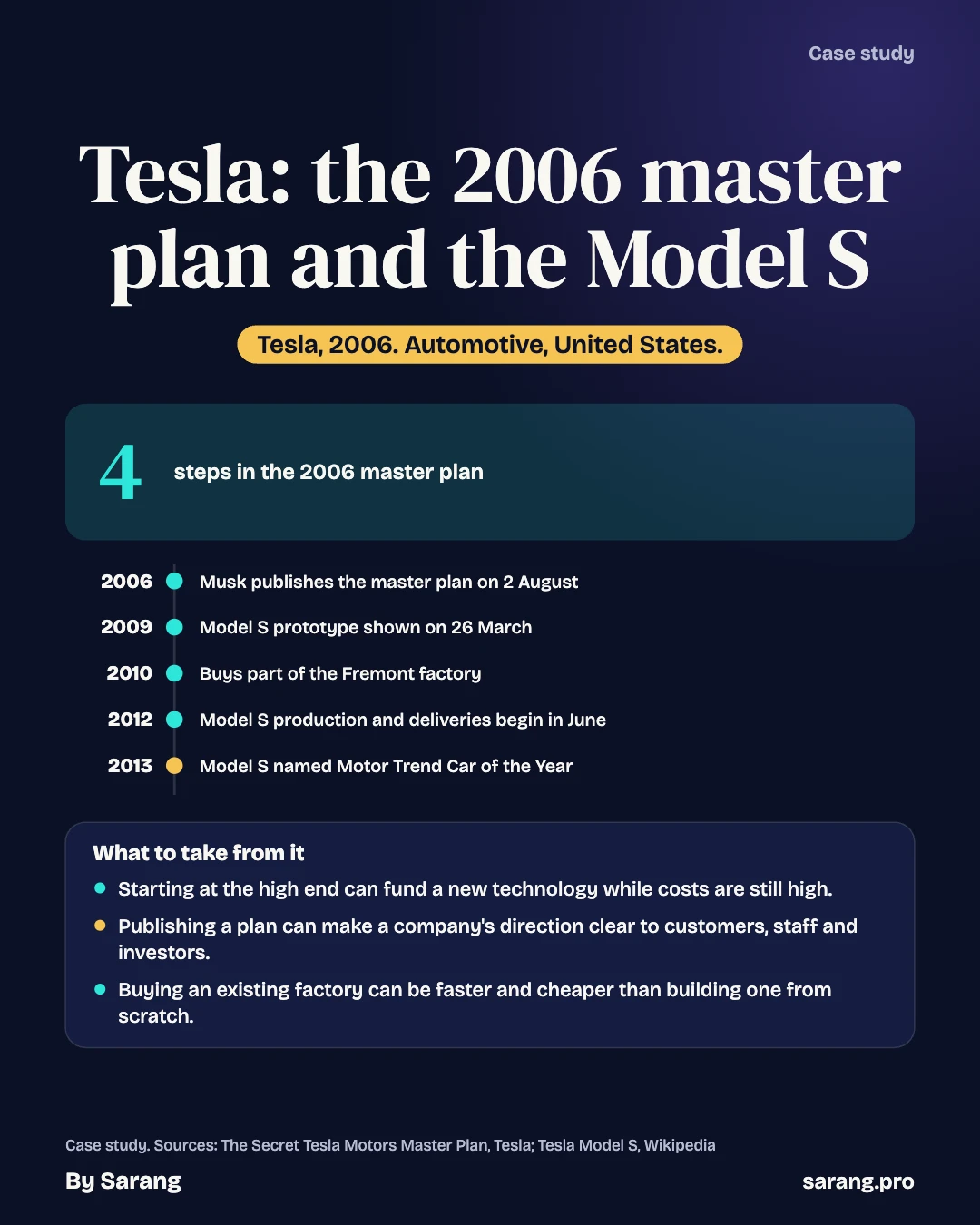
On 2 August 2006, Elon Musk published a short post on Tesla’s website with the title “The Secret Tesla Motors Master Plan (just between you and me)”. The plan had four steps. Build a high-performance electric sports car, the Roadster, priced at about $89,000. Use the money from it to build a four-door family car priced at roughly half the Roadster. Use the money from that to build a third, cheaper model. And provide zero-emission electric power generation options, such as solar systems co-marketed with SolarCity. The company’s stated purpose, the post said, was to speed the move from a “mine-and-burn” hydrocarbon economy to a solar electric one.
Six years later, on 22 June 2012, Tesla delivered the first Model S to customers at its factory in Fremont, California, about a month ahead of the date it had announced. The base price was $49,900 after a $7,500 federal tax credit. The top battery, 85 kWh, had an EPA range of 265 miles. More than 10,000 people had reserved a car. Tesla’s targets were 5,000 cars by the end of 2012 and 20,000 in 2013.
The numbers behind that day were less comfortable. In the second quarter of 2012 the company reported revenue of $26.7 million and a net loss of $105.6 million. It held $266 million in cash resources, of which $33 million was still to be drawn on a loan from the US Department of Energy. Production was about five cars a week in June. Step two of the plan had arrived, but not in the way the post of 2006 implied: the sports car had not paid for it.
This case asks how a company that had sold a little over 2,300 cars managed to launch a mainstream sedan, who paid for it, and what the plan did and did not predict. It treats the master plan as a strategy document to be tested against the record.
Background
The plan as written
The 2006 post is short and specific. According to the text on Tesla’s site, the Roadster was designed to outperform petrol sports cars of the Porsche and Ferrari kind and to be twice as energy efficient as a Toyota Prius. The post said early buyers of the Roadster would help pay for development of the cheaper models, because free cash flow would go back into research and development. It claimed that, with a natural gas grid as the baseline, the Roadster emitted about 12.6 grams of carbon dioxide per kilometre against about 35.8 for a Prius, and that a rooftop or carport solar system could generate about 50 miles of electricity a day. The author argued that a driver covering under 350 miles a week would be “energy positive” for personal transport.
The logic is a price ladder. Start with a buyer who will pay a lot, use the revenue to lower cost and learn manufacturing, then move to buyers who pay less. The post named no dates for steps two and three, and no amounts.
The Roadster years
Tesla’s S-1 filing, dated 29 January 2010, gives the first record of how step one went. As of 31 December 2009 the company had sold 937 Roadsters to customers in 18 countries, mostly the US and Europe. The car went from 0 to 60 mph in 3.9 seconds and had an EPA-tested range of 236 miles. Revenue was about $14.7 million in 2008 and about $93.4 million in the first nine months of 2009, much of it from filling reservations taken in earlier years.
The same filing shows the cost. Net losses were $30.0 million in 2006, $78.2 million in 2007 and $82.8 million in 2008, and $31.5 million in the first nine months of 2009. The accumulated deficit was about $236.4 million at 30 September 2009. The company said it expected losses to continue until Model S deliveries began, which it did not expect before 2012. In 2009 MIT Technology Review and NBC News each reported that Tesla had delivered about 500 Roadsters so far, at prices of $100,000 to $109,000 or more. The S-1 count of 937 by the end of 2009 is a later date and a larger number, which is consistent with a rise through the second half of the year.
The industry
When the plan appeared, the idea of a mass-market electric car from a start-up was widely doubted. The industry’s own plans, as MIT Technology Review described them in 2009, were modest: Ford, Nissan and Coda were planning electric cars with a range of about 100 miles, while the smallest battery option on the Model S was to offer 160 miles. Nissan intended to sell an electric car in the US the following year, built in Japan until a plant in Smyrna, Tennessee opened in 2012.
Government support shaped the field. The US Department of Energy’s Advanced Technology Vehicles Manufacturing programme, a $25 billion fund signed into law in 2007, lent money to carmakers building more efficient vehicles. On 23 June 2009 the department announced loans of $5.9 billion to Ford, $1.6 billion to Nissan North America and $465 million to Tesla. A federal tax credit of $7,500 on electric cars sat on top of this, and Tesla’s Model S price of $49,900 was quoted net of it.
The economics were hard. A new sedan needed a factory, tooling, a battery supply and a sales network. Tesla also sold directly rather than through franchised dealers, and its own S-1 listed state sales regulations on distribution as a risk. Daimler, the German carmaker, became a partner and a minority shareholder. NBC News reported in 2009 that Daimler had paid $50 million for a stake of about 10 per cent in May, and that Aabar Investments, an Abu Dhabi fund, bought part of it. Under the Daimler relationship, Tesla agreed to supply up to 1,000 battery packs and chargers for a trial of the Smart fortwo electric car in five European cities, with shipments beginning in November 2009, according to the S-1. The filing also noted that Daimler planned to make its own lithium-ion batteries by 2012, which cast doubt on the value of that business.
The decision
By 2009 Tesla had to decide how to reach step two. The plan said the Roadster would pay for it. The numbers said otherwise: the Roadster was loss-making at the company level, and a sedan factory would cost far more than a sports car’s cash flow could cover.
Option one: wait for Roadster profits
This was the plan’s literal reading. It would have meant a slow, small sedan programme, or none, because the Roadster’s accumulated deficit exceeded $236 million by the end of September 2009. Tesla predicted in 2009 that its Roadster division would be profitable that year, MIT Technology Review reported, but profit on one car line was not enough to fund a new factory.
Option two: raise outside money for the sedan
This meant selling shares to strategic investors, taking government debt and later listing on a stock exchange. The S-1 shows the company preparing the last of these: it described a Model S volume production plan for 2012 and a target of up to about 20,000 cars a year. A listing carried its own costs, including the disclosure of losses.
Option three: partner with an established carmaker
Daimler’s investment and battery-pack contract were a partial version of this. A fuller version, in which a large manufacturer built or financed the car, would have given up control of the product and the brand.
What the company chose
Tesla combined the second and third options. It used Daimler’s money, a government loan of $465 million and a public listing, and kept the sedan under its own name. The master plan’s wording, “use the money from the Roadster”, turned out to be a statement of direction, not of financing.
What they did
March 2009: the Model S is unveiled
NBC News reported that the Model S was unveiled in March 2009. The company expected a price of $49,900 after the federal rebate, a range of up to 300 miles, sales from late 2011 and a long-term goal of about 20,000 vehicles a year. It already had over 1,000 reservations.
May and June 2009: Daimler and the Department of Energy
Daimler’s $50 million came in May. On 23 June the Department of Energy announced a loan of $465 million. MIT Technology Review reported that $100 million was to go to a plant making electric powertrains, with Tesla planning to sell them to other carmakers, and the rest to engineering and building the Model S. NBC gave the split as $365 million for the Model S and $100 million for a California powertrain plant expected to employ 650 people. The S-1 later gave the final split: about $101.2 million for the powertrain facility and about $363.9 million for the Model S facility. The loan documents were signed on 20 January 2010, and funds could be drawn over up to three years against milestones.
January 2010: the S-1
The S-1 made Tesla’s finances public. It reported about 2,000 Model S reservations as of 31 December 2009, each backed by a refundable deposit of at least $5,000. It also set out the loan’s conditions: Tesla had to spend up to $33 million plus any overruns of its own money, put 50 per cent of net offering proceeds into a dedicated account, and accept limits on debt, liens, dividends and asset sales.
2010 to 2012: building the car
The sources opened for this case do not describe the factory purchase or the pre-production build in detail, so this account stays with what the company reported at launch. On 22 June 2012 the press release said deliveries began at the Fremont plant, a month early, with battery options of 40, 60 and 85 kWh. The company ran 22 company-owned stores and galleries, planned four more for summer 2012, and offered a “Tesla Personal Delivery” option. Test drives of more than 5,000 were planned over 45 days. Europe was due early in 2013 and Asia in mid-2013. Musk said in the release: “Today we achieved our goal with an exceptional car.”
July 2012: the shareholder letter
The company’s Q2 letter, dated 25 July 2012, put the ramp in plain terms. Reservations stood at more than 11,500 at the quarter end and about 12,200 by the letter. Production was about five cars a week in June and had roughly doubled by late July. Tesla kept its target of 5,000 Model S deliveries for 2012, with about 500 in the third quarter and the balance in the fourth, and revenue guidance of $560 million to $600 million. It expected free cash flow breakeven around the fourth quarter, an automotive gross margin turning positive just before the end of the third quarter, and 20,000 deliveries in 2013 with a gross margin target of 25 per cent.
What happened
The Q2 2012 numbers set the baseline, and the table shows how the sources track the programme over time.
| Date | Measure | Source |
|---|---|---|
| 31 Dec 2009 | 937 Roadsters sold; about 2,000 Model S reservations | S-1 |
| 9 months to 30 Sep 2009 | Revenue $93.4 million; net loss $31.5 million | S-1 |
| 22 Jun 2012 | First Model S deliveries; over 10,000 reservations; over 2,300 Roadsters delivered | Tesla press release |
| Q2 2012 | Revenue $26.7 million; net loss $105.6 million; $71 million drawn from the DOE loan | Q2 shareholder letter |
| Feb 2014 | DOE loan repaid in full, nine years early; company valued at about $30 billion | Vice |
The S-1 and the Q2 letter show a company still losing heavily as Model S deliveries began. The six-month net loss in 2012 was $195.5 million, and long-term debt had risen to $431.8 million. The letter said $71 million of the loan was drawn in the quarter. The hoped-for turn came later. By February 2014, according to a Vice report, Tesla had repaid all $465 million in government loans nine years early, the Model S at $65,000 outsold its Mercedes rival and the company was valued at about $30 billion. The $65,000 figure in that report is higher than the $49,900 launch price, which assumed the tax credit; the sources do not say which version each number describes.
Supply and execution had limits. In November 2013 CNBC reported that the Model S had suffered its third battery fire in a week and that shares had fallen more than 20 per cent over the previous month. Musk told the network that the car had five times less fire risk than the average petrol car and that there had never been a serious injury or death. The shares were still up more than 300 per cent for the year, the best performer on the Nasdaq 100, and one analyst, Efraim Levy of S&P Capital IQ, had a sell rating with a price target of $140 on valuation grounds.
The Electrek summary says Tesla delivered on the plan “for the most part” with the Roadster, Model S and Model 3. It lists Master Plan Part 2, published in 2016, with four goals: solar roofs with integrated battery storage, a wider range of electric vehicles, self-driving capability and cars that earn money when not in use. A third plan was announced in a tweet on 17 March 2022 and published as Master Plan Part 3 on 5 April 2023, with a path to a sustainable energy economy.
Other views
The plan did not describe how the cars were paid for
The most direct criticism of the “master plan” story is that the record does not support the version in which the Roadster paid for the Model S. The S-1 shows net losses every year and an accumulated deficit above $236 million. The Model S programme was paid for by a $465 million government loan, a $50 million Daimler investment and, shortly afterwards, a share offering. The post’s phrase about using money from the sports car is best read as a statement of order and purpose, not of sources of funds. The plan gives no sources of funds, so the sources here cannot show whether outside capital was expected from the start.
Targets and timing slipped
The company’s own documents show how timings moved. In 2009 MIT Technology Review reported the Model S could reach the market by 2011 at a base price of about $50,000, and NBC reported late 2011. The S-1 in January 2010 said volume production in 2012. The first deliveries came in June 2012. The 2009 target of 20,000 cars a year was repeated in 2012 as the figure for 2013. Slippage of this kind is normal in car programmes, but it matters when a plan is presented as a clean sequence.
Reliance on subsidies
The $49,900 price depended on a $7,500 federal tax credit, and the loan was government-backed credit, although the sources opened do not state its rate. Critics of government support for car makers would point to this, and Tesla’s early repayment is the supporters’ reply. Both can be true: the loan helped, and the company paid it back.
Valuation and safety questions
The November 2013 report shows an analyst with a sell rating on valuation and a run of fires that Musk argued were rare. Musk himself, CNBC noted, had warned in August and October that the stock was overvalued. The sources here do not settle whether the fires were a major safety issue or a heavily reported rarity, only that the company disputed the framing.
Reading it through a framework
Price skimming and the market ladder
Price skimming means launching at a high price to buyers who value the product most, then lowering the price as cost falls and the market widens. The master plan is a skimming plan with three rungs: an $89,000 sports car, a sedan at about half that, and a cheaper model after it. The facts fit. The Roadster sold at $100,000 or more in 2009, the Model S launched at $49,900 after the tax credit, and Vice put the next car at a $35,000 sticker. The strategy carries risks the plan did not mention. Skimming needs enough buyers at the top to learn from, and the Roadster’s 937 sales by the end of 2009 were a small base. It also needs the second product to be ready in time, and the S-1 shows the company expecting no significant Model S deliveries before 2012.
Stakeholder mapping
Tesla’s route to the Model S depended on several parties whose interests differed. Government, through the Department of Energy and the tax credit, wanted domestic production of efficient vehicles and set conditions: milestones, a requirement to spend its own money, and limits on dividends and debt. Daimler wanted battery technology for its Smart car and a stake in a leading electric start-up, and planned its own batteries by 2012. Aabar Investments, the Abu Dhabi fund, bought part of Daimler’s stake. Customers put down refundable deposits of $5,000, which signalled demand. Franchised dealers, who would normally sell cars, were a stakeholder that Tesla bypassed, which created the regulatory risk named in the S-1. Mapping the parties by power and interest shows why the Roadster could not have been the only source of funds and why the government and Daimler carried so much weight in 2009.
Since then
Within two years of the Model S launch Tesla had repaid its government loan in full. The Electrek summary describes the later plans: Master Plan Part 2 in 2016 added solar roofs with storage, a wider model range including a pickup, a compact SUV and a heavy-duty truck, and self-driving cars. By that account every planned vehicle except a high-density urban transport had been unveiled, though several were not yet in production. Part 3, published on Tesla’s site on 5 April 2023, proposes a path to a sustainable energy economy through electrification and sustainable electricity generation.
The sources opened for this case do not give reliable figures for Tesla’s deliveries and revenue after 2013, so those are left out. Readers who need them should take them from Tesla’s own investor filings.
What to take from it
- A published plan is a statement of direction, and the record may show different funding from the one the plan implied; Tesla’s Model S was paid for by loans and investors, not by Roadster profits.
- Starting at the top of a market gives a company time to learn, but it needs enough early customers and enough money to reach the next product.
- Government support and strategic investors can decide whether a capital-hungry plan succeeds, and they come with conditions that shape the company.
- Launch dates and prices slip; Tesla’s Model S moved from a 2011 target to a June 2012 delivery, and its published price depended on a tax credit.
- Repaying a government loan early, as Tesla did, changes how an arrangement is judged, but it does not remove the questions about how the company got there.
Questions to think about
- If the Roadster did not fund the Model S, was the master plan misleading, or was it a sensible statement of intent? What would you want from a plan like this to judge it?
- Which stakeholder in Tesla’s 2009 position held the most bargaining power, and what did each get in return?
- How would the story change if the Department of Energy loan had not been approved in June 2009?
- Price skimming works when the first buyers are plentiful. How could a company test that before committing to a second product?
Concepts at work
Three ideas run through this case: price skimming, stakeholder mapping, and the gap between strategy as stated and strategy as financed. Explore them in Insights.
Written from the public sources listed below. Figures are as those sources report them.
Framework
Timeline
- 2 Aug 2006Musk publishes the four-step master plan
- 31 Dec 2009937 Roadsters sold, per the S-1
- Mar 2009Model S unveiled; over 1,000 reservations
- May 2009Daimler pays $50 million for a stake of about 10 per cent
- 23 Jun 2009Department of Energy announces a $465 million loan
- 20 Jan 2010DOE loan documents signed
- 29 Jan 2010Tesla files its S-1 with the SEC
- 22 Jun 2012First Model S deliveries at Fremont
- 25 Jul 2012Q2 letter: net loss $105.6 million, reservations about 12,200
- Nov 2013Third Model S fire; shares fall more than 20 per cent in a month
- Feb 2014DOE loan reported repaid in full, nine years early
- 5 Apr 2023Master Plan Part 3 published
Recap cards
Tap a card to check yourself.
Sources and credits
- Tesla: The Secret Tesla Motors Master Plan (just between you and me) (2 Aug 2006)
- Vice: In 2006, Elon Musk had a secret plan to mainstream electric cars (Feb 2014)
- Electrek: Tesla master plan overview
- MIT Technology Review: Tesla receives key funding for electric sedan (23 Jun 2009)
- NBC News: Abu Dhabi fund joins Tesla Motors investors (2009)
- Tesla Motors: Form S-1 (29 Jan 2010)
- Tesla Motors: Tesla delivers world's first premium electric sedan (22 Jun 2012)
- Tesla Motors: Q2 2012 shareholder letter (25 Jul 2012)
- CNBC: Tesla recall interview with Elon Musk (Nov 2013)