Toyota: building a production system around flow and quality
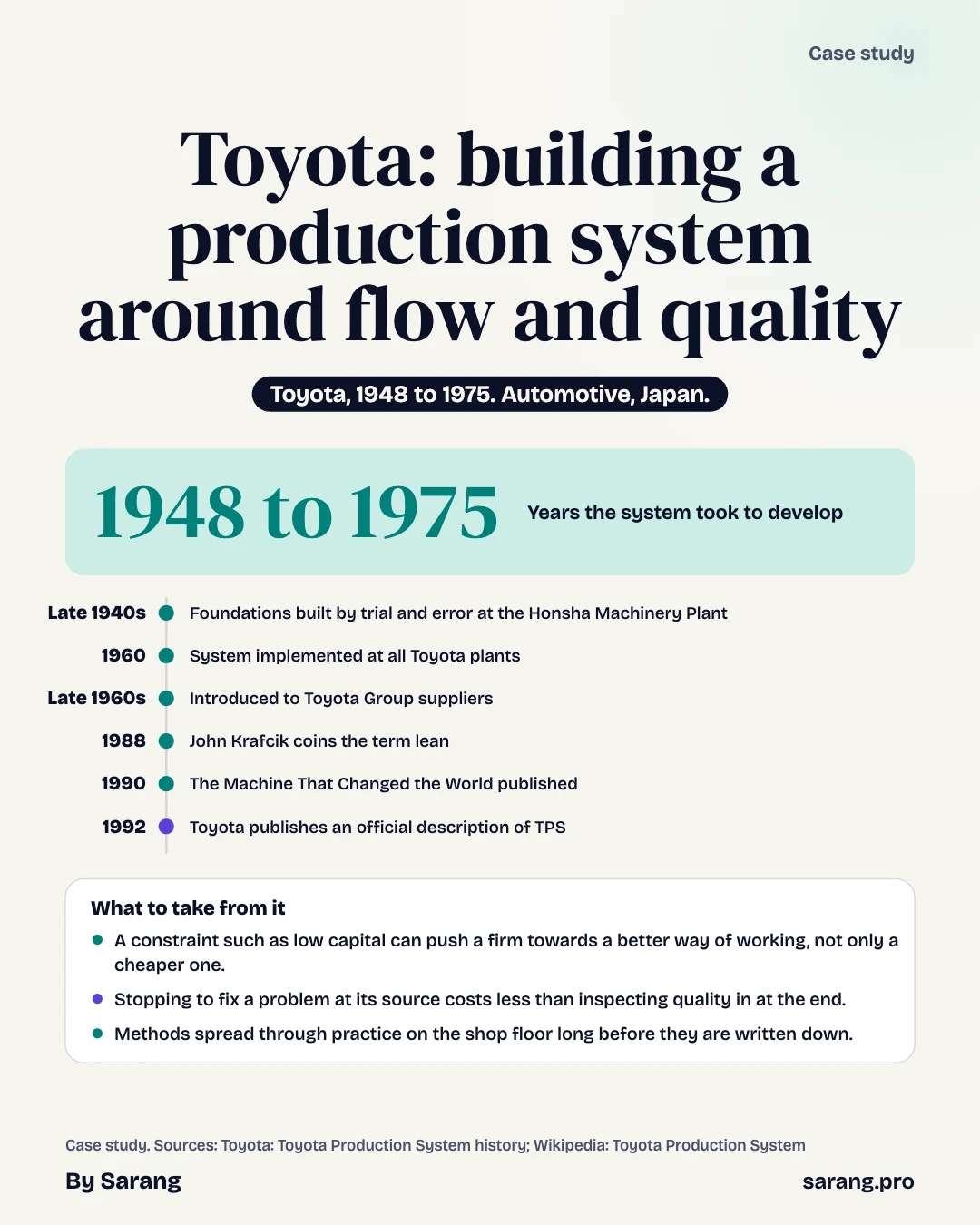
Toyota built a system of just-in-time production and line-stopping quality control after a 1950 crisis cost 2,146 jobs, then tested it in a 1984 joint venture with GM.
- company loss, 16 Nov 1949 to 31 Mar 1950
- 76.52 million yen
- jobs lost in the 1950 reconstruction
- 2,146
- NUMMI capital, split equally by Toyota and GM in 1984
- $200 million
- vehicles a week built at NUMMI on average
- 6,000
The situation
In the spring of 1950 Toyota Motor Co. was close to collapse. Between 16 November 1949 and 31 March 1950 its accounts showed a loss of 76.52 million yen. Prices for iron and steel had risen by about 30 per cent in January 1950, after a similar rise the previous autumn, while the price of cars stayed under government control until April. The company asked for 1,600 voluntary retirements, a 10 per cent pay cut for everyone who stayed, and the closure of two Tokyo plants. The union went on strike. When the memorandum was signed on 10 June, 2,146 people had left, the founder of the car business, Kiichiro Toyoda, had resigned as president, and 5,994 staff remained.
Out of that crisis, over the next two decades, came the way of working now called the Toyota Production System, or TPS. Taiichi Ohno began to develop it in the machine shops at the Koromo Plant in the late 1940s. It rests on two ideas: make only what is needed, when it is needed, in the quantity needed; and stop the line the moment something goes wrong so that a defect never travels on to the next stage. Toyota describes the aim as removing waste completely, shortening lead times and delivering vehicles quickly, cheaply and with high quality.
This case follows the system from its roots in a weaving business, through the 1950 crisis, to its export to California in 1984 and the strain on it in 2010, when Toyota recalled about 8.5 million vehicles and its president told the US Congress that the company had grown faster than its people. It is a story about how a management method is built, what it needs around it to work, and what happens when the conditions change.
Background
From looms to cars
Toyota began as a textile machinery business. Sakichi Toyoda (1867 to 1930) invented looms, and two of his devices matter for this story. In 1896 he produced a device that stopped a loom automatically when a weft thread broke. In 1924 came the Type-G automatic loom, the first to change shuttles without stopping. Toyota’s own account says he was moved by a wish to spare his mother long hours of manual weaving at night. The principle that a machine should detect a fault and halt itself, so that no one has to stand and watch it, became the root of the later idea called jidoka.
His son Kiichiro Toyoda (1894 to 1952) took the family into cars. He travelled overseas in 1929 to study American machine and motor industries, and in 1933 Toyoda Automatic Loom Works set up an automotive division. Toyota Motor Co., Ltd. was established on 28 August 1937, and the Koromo Plant (renamed the Honsha Plant in 1959) began production on 3 November 1938. Toyota dates the launch of its Just-in-Time system to 1938. Kiichiro also applied the chain conveyor, which had been used on an automatic loom assembly line completed in 1927, to body assembly at Koromo. He is credited with the line that a complete car cannot be built if even one part is missing, a short statement of why parts must arrive in step with each other.
War and a small base
Production grew slowly. Annual output in Japan reached 10,000 units in 1939, and cumulative output reached 100,000 only in 1947. During the war Toyota was designated a munitions manufacturer and Koromo built military trucks; about a quarter of its facilities were destroyed by air raids. After the war the workforce fell from about 9,500 to about 3,700. Koromo, laid out so that work ran from metal fabrication through parts assembly, painting and body assembly, could make about 2,000 vehicles a month.
That scale mattered. Toyota in the late 1940s was a small producer in a small market, making a range of vehicle types in modest numbers. The American approach of long production runs of identical products depended on volumes Toyota did not have.
Taiichi Ohno
Taiichi Ohno was born in 1912 in Dalian, China, graduated in mechanical engineering in 1932 and joined Toyoda Automatic Loom Works. He moved to Toyota Motor in 1943 and in 1946 was put in charge of Machine Shops 2 and 3 at Koromo, where he began developing the system. In 1948 he started work with Eiji Toyoda on ideas to raise productivity and cut waste. He joined the board in 1954, made his first visit to the United States in 1956, became executive vice president in 1975 and left Toyota in 1978, the year his book on the system appeared. He died in 1990, aged 78. Toyota and the Lean Enterprise Institute both credit him with leading the development of the system from the 1950s into the 1960s, with Eiji Toyoda backing him.
The industry
Postwar Japan offered a car maker little room for error. Steel and other materials were scarce and, as 1949 and 1950 showed, their prices could move sharply while car prices were fixed. Toyota’s own history notes that the focus on cutting waste mattered because raw materials were short. The domestic market was small, which made the large-batch, large-stock methods of American makers hard to copy.
The Honsha Plant account makes the link directly: applying the Just-in-Time principle reduced waste and costs at a time when materials were scarce. A car has more than 30,000 parts, many made by business partners, so any method that tied production to actual demand had to reach out to suppliers as well as to Toyota’s own plants. Lean.org dates the spread of the system through the supply base to the 1960s and 1970s.
In the 1980s the industry’s competitive question changed. Japanese car imports into the United States were held down by voluntary restraints, and US local content legislation was gaining ground. American makers such as General Motors were struggling to build small cars profitably; GM relied on Isuzu and Suzuki for compacts, whose volumes were too small. These pressures set up the joint venture described below. By 2008 Toyota had overtaken GM as the world’s top-selling carmaker, and in 2009 it sold 7.8 million vehicles and employed about 320,000 people.
The decision
What was at stake in 1950
The financial crisis forced a choice about what kind of company Toyota would be. It could cut deeply and hope the market recovered; it could keep its range of vehicles and look for volume; or it could find a way to make small numbers of varied vehicles at a cost close to that of mass producers. Sources do not record these as formal options on a board paper, so this is a framing of the choices open to the company rather than a quotation of what it considered.
Option one: copy the American mass producer
The obvious route for a manufacturer in the 1950s was to build large batches of identical parts, hold stock between stages, and accept some defects as an inevitable cost. This relies on volume. Toyota’s volumes in 1950 were tiny against American plants, and the company had just lost money on its stock and wage bill. Holding inventory ties up cash, and Toyota had very little.
Option two: cut costs by cutting people
The company did cut people, and that was painful. Toyota proposed 1,600 voluntary retirements, closed the Shibaura and Kamata plants and cut pay by 10 per cent. Yet cuts alone do not make a car cheaper to build once the crisis has passed. They reduce the bill without changing how work is done.
Option three: change how work flows
Ohno’s route, backed by Eiji Toyoda, was to remove waste inside the process. Toyota’s own account names three kinds: muda (waste), mura (inconsistency) and muri (unreasonable demand on people or machines). Making parts only when the next process needed them avoided stock and the cash it consumed. Stopping the line at a fault avoided carrying defects forward. This was the option that did not need volume to start working, and it also lent itself to being tested a little at a time, in one machine shop, before being spread.
It had a cost too. A system with little stock leaves no cushion, so every delay and every defect shows up at once. It also asks a lot of workers and suppliers, who must be able to stop work and to raise problems. Those demands shaped much of what followed.
What they did
Rebuilding after 1950
The 1950 settlement left Toyota smaller and with new leadership. Kiichiro Toyoda announced on 25 May that he accepted responsibility and would resign, and Toyota’s records give 5 June as the date he and two other senior officers left. On 18 July an extraordinary shareholders’ meeting saw all officers resign, with Taizo Ishida, president of Toyoda Automatic Loom Works, becoming president of the car company. Kiichiro died on 27 March 1952, aged 57. Toyota’s histories differ slightly on when the dispute began: one gives notice on 7 April and action from 9 April, another gives 11 April; both put the end at 10 June.
Toyota Motor Sales Co., Ltd. was set up in April 1950 as a separate company, though the same history says the situation deteriorated further afterwards. In 1955 the company launched the first-generation Crown, described as Japan’s first truly domestic passenger car.
Just-in-Time and the pull system
Just-in-Time, as Toyota presents it, is production synchronised across plants so that parts are made when, where and in the quantity needed, at the pace of sales. Each step holds minimal stock. The next process takes what it needs from the previous one, and the previous one replenishes only what was taken. The tool that carries these signals is the kanban, a card or other marker that authorises a process to make something or tells a handler to move it. A downstream process draws a full container from an upstream store, and the card travelling back upstream tells that process to make one more container. No parts should be made or moved without a card, which keeps the system a true pull system.
Jidoka and the andon
The second pillar, jidoka, is often put as “automation with a human touch”. Machines or workers stop the line when they detect a problem, and workers can pull a cord to light an andon board that alerts staff. Because machines can stop themselves, people are freed from watching them. Toyota’s page adds a point about sequence: do the work by hand first, then automate it. Quality is built into each step rather than inspected in at the end.
Kaizen and standard work
Lean.org describes TPS as drawn like a house, with the two pillars supported by standardised work and kaizen, run through the plan, do, check, act cycle. Toyota says that all staff pursue daily incremental improvement. In a later study of more than 40 plants over four years, Steven Spear and Kent Bowen argued that the system was highly scripted yet flexible, and that each specification works as a hypothesis tested by doing. They gave four rules in use: how people do their work, how they work with each other, how production lines are built, and how people learn to improve. They noted that it had developed over about 50 years and had never been formally written down.
Export to California, 1984
In 1981 talks between Toyota and Ford broke down, and GM proposed an alliance. After meetings between GM chairman Roger Smith and Toyota’s Masayuki Kato and Eiji Toyoda, the two companies agreed in February 1983 to use GM’s closed Fremont plant in California. A provisional approval from the US Federal Trade Commission followed in December 1983. In February 1984 NUMMI (New United Motor Manufacturing Inc.) was set up with each side putting in half of $200 million, and Tatsuro Toyoda as president. The terms gave an equal board and a Toyota-appointed president.
Toyota’s gains were large-scale local production in the world’s biggest car market with relatively little investment, plus experience of local production under trade friction. Some divisions inside Toyota worried about handing production know-how, and a leading model, to a competitor, and working with the United Auto Workers was a major concern. Over 85 per cent of the workforce were former GM Fremont employees. Toyota began training them in Japan in the spring of 1984, in groups of 30, and the first car, a yellow Chevrolet Nova, came off the line in December 1984.
What happened
NUMMI as a test
The Fremont plant had been one of GM’s worst. According to a 2015 account by This American Life, about one worker in five stayed home on a normal day, thousands of grievances were filed, and cars were found with parts missing or fitted wrongly. Under NUMMI the same people, with Toyota’s methods, produced cars with defect rates among the best in the United States. Any worker could pull an andon cord: the first pull called a team leader, and the line stopped only if the problem was not fixed in time. The plant built about 6,000 vehicles a week on average over two shifts and nearly 8 million vehicles over its life. The programme drew on the same workforce and the same plant that had failed under GM.
| Measure | GM Fremont (before 1982) | NUMMI (1984 to 2010) |
|---|---|---|
| Absence | About 1 worker in 5 on a normal day | Fell sharply |
| Line stops | Rare; stopping risked dismissal | Any worker could pull the andon cord |
| Output | Estimated to need about 50 per cent more workers | About 6,000 vehicles a week |
Toyota also learned. It drew lessons on labour relations, training, plant set-up and logistics that informed its later US plants, whose employees were all newly hired. Harvard Business Review wrote in September 2009 that Toyota learned a lot from NUMMI and GM much less, and noted that the plant never made money.
Growth, and the 2009 and 2010 recalls
By 2008 Toyota was the world’s largest carmaker. Then the strain showed. In early 2010 it recalled about 8.5 million vehicles worldwide. Al Jazeera, reporting on 25 February 2010, said at least five US deaths had been linked to unintended acceleration, with 29 other fatal crashes under examination, and that a federal grand jury had subpoenaed internal documents. Toyota also reported a record annual loss of $4.4 billion, which the same report attributed to the financial crisis.
On 24 February 2010 Akio Toyoda, who had become president in June 2009, told a US House committee that the company had grown faster than it had developed its people and organisation. He said Toyota’s priorities had always been safety, then quality, then volume, and that “These priorities became confused.” He said recall decisions had been made by a division in Japan that lacked the customer view, and promised outside advisers, a US quality centre and a product safety executive.
The end of NUMMI
GM pulled out of NUMMI in 2009 as it went through bankruptcy. On 27 August 2009 Toyota announced it would end production by March 2010, its first factory closure. The last car, a Corolla, was built on 1 April 2010 and about 4,500 people lost their jobs.
Other views
Scripted, but flexible
Spear and Bowen’s central claim cuts against a common reading of TPS as a toolbox. They argued that kanban, quality circles and similar practices had spread widely, with GM, Ford and Chrysler all launching their own Toyota-style programmes, yet few copies matched the original. Their explanation was that the underlying rules were implicit and had never been written down, so imitators copied visible tools without the habits of testing and learning behind them.
Copying risk inside Toyota
Toyota’s own history records that some people in the company worried about NUMMI giving a competitor both know-how and a leading model. The comparison with GM’s slower uptake in the HBR piece suggests the worry had some basis for the model but not for the method: knowing how the system works did not bring GM the same results.
Limits of the recall evidence
The 2010 recall had several causes in public debate, and sources differ. Toyota’s president pointed to growth outpacing people and a recall process that sat too far from customers. Al Jazeera reported that around 70 per cent of unintended acceleration complaints remained unexplained, according to Toyota’s US sales head Jim Lentz, and the US Transport Secretary Ray LaHood said Toyota’s Japanese executives had been “safety-deaf” when he took office in 2009. The evidence is not enough to say that TPS itself caused the failures; it is enough to say that the organisation around the system had slipped from its own order of priorities.
The human cost of lean
The system’s demands on people and its thin stocks have drawn criticism elsewhere, and the sources in this case do not give figures on stress, injuries or supplier burdens, so that argument is left out here rather than guessed at.
Reading it through a framework
Value chain and waste
Porter’s value chain asks where in a firm’s activities cost and value arise. TPS attacks cost inside operations and inbound logistics: muda, mura and muri are all located in how materials and people move. Pull production linked operations to sales, since output follows the pace of sales, and jidoka built quality control into each step rather than a final inspection. The 2010 recall suggests a limit: strong operations did not protect Toyota where the weak link was in service and the handling of customer complaints, which sat in a separate division in Japan.
Resource-based view (VRIO)
Barney’s VRIO test asks whether a resource is valuable, rare, hard to imitate and supported by the organisation. TPS is valuable because it cuts waste. It was rare in the 1950s and 1960s. It was hard to imitate because, as Spear and Bowen found, the rules were implicit and took about 50 years to develop. It was organised around, through daily kaizen involving all staff. NUMMI is the test: GM had the tools, the training access and even the plant, yet took much less from the venture than Toyota did. The 2010 testimony shows the fourth condition can weaken when growth outruns the people and organisation that carry the system.
Since then
Toyota became a larger company than the one that was almost lost in 1950. Its corporate profile gives its founding as 28 August 1937 and, as of 31 March 2026, 73,133 employees at the parent and 390,927 on a consolidated basis. Toyota Honsha, the old Koromo Plant, now has 1,940 staff, builds engine and transmission parts and fuel cell stacks, and its stated role is to trial new technologies and methods before sharing them with other plants.
Akio Toyoda’s promises in 2010 included a stronger role for regional decisions and an outside quality advisory group. Beyond what appears in the sources listed, this case does not claim to measure how far they changed results. The method itself has outlived its authors: Ohno was inducted into the Automotive Hall of Fame in 2022, and the system is still described by Toyota in the same terms of waste, pull and stopping to fix problems.
What to take from it
- A method often grows out of a constraint: Toyota had little cash, little volume and scarce materials, and designed a system that did not need much of any of them.
- Stopping work to fix a problem is cheaper than carrying the defect forward, but only if people are trusted and equipped to stop it.
- Tools can be copied faster than habits. GM could see kanban and andon cords at Fremont and still gained less from NUMMI than Toyota did.
- Low stock exposes every weakness at once, which is useful when the organisation is ready to respond and costly when it is not.
- Growth can outrun the people and structures that carry a system; Akio Toyoda’s own statement in 2010 was that priorities had become confused.
Questions to think about
- Which parts of TPS would still work for a company with plentiful cash and large volumes, and which belong to the conditions of 1950?
- Why did the same workforce at Fremont perform so differently under a different management system, and what does that suggest about where the problem lay?
- If a firm runs with almost no stock, what should it hold in place of inventory to cope with a shock?
- How would you check, from outside, whether growth is outrunning an organisation’s ability to keep its standards?
Concepts at work
Lean operations, pull versus push production, and organisational capability. Explore them in Insights.
Written from the public sources listed below. Figures are as those sources report them.
Framework
Timeline
- 1896Sakichi Toyoda devises an automatic stop for weft breakage
- 28 Aug 1937Toyota Motor Co., Ltd. established
- 3 Nov 1938Koromo Plant starts production
- 1946Ohno takes charge of Machine Shops 2 and 3 and begins developing the system
- 10 Jun 1950Labour dispute settled after reconstruction plan
- 1956Ohno's first visit to the United States
- Feb 1984NUMMI set up with GM at Fremont
- Dec 1984First car built at NUMMI
- 27 Aug 2009Toyota announces NUMMI closure
- 24 Feb 2010Akio Toyoda testifies to US Congress
- 1 Apr 2010Last car built at NUMMI
Recap cards
Tap a card to check yourself.
Sources and credits
- Toyota Motor Corporation: Toyota Production System
- Automotive Hall of Fame: Taiichi Ohno
- Toyota Motor Corporation: 75 Years, labor dispute of 1950 (item 6 c)
- Toyota Motor Corporation: 75 Years, labor dispute of 1950 (item 6 d)
- Toyota Times: The history of Toyota's Honsha Plant
- Toyota Motor Corporation: The beginnings
- Lean Enterprise Institute: Kanban
- Harvard Business Review: Decoding the DNA of the Toyota Production System
- Toyota Motor Corporation: 75 Years, the GM joint venture
- This American Life: NUMMI transcript



