Toys “R” Us: a leveraged buyout and a debt it never escaped
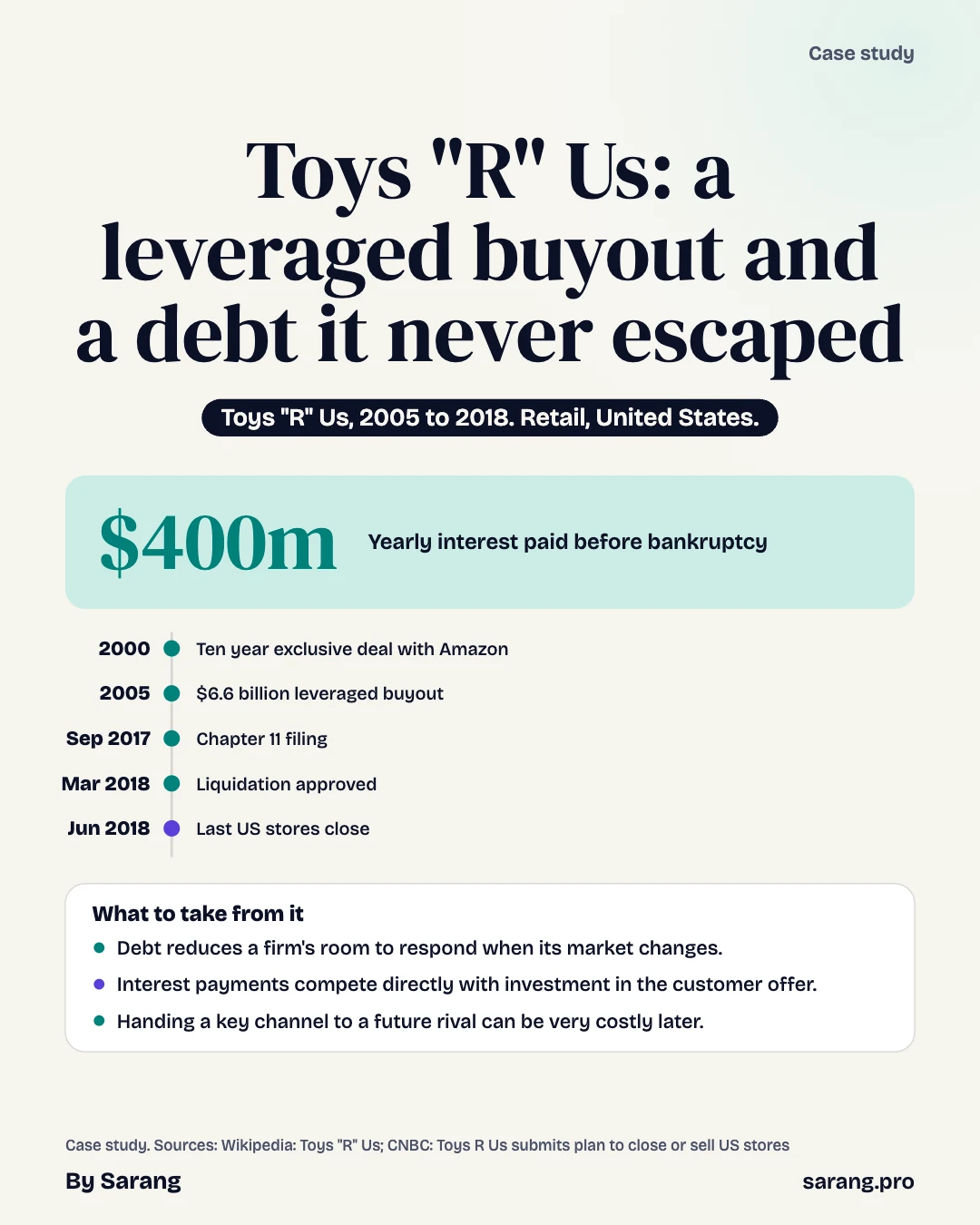
A $6.6 billion buyout in 2005 left Toys "R" Us with roughly $5 billion of debt and $400 million a year in interest, and by 2018 all 735 US stores were in liquidation.
- price of the 2005 leveraged buyout
- $6.6bn
- debt left on the company (sources range from $5bn to $5.5bn)
- $5.2bn
- approximate annual interest bill
- $400m
- share of US toy revenue held by the chain
- 15%
The situation
In September 2017 the American toy retailer Toys “R” Us filed for Chapter 11 bankruptcy protection. It was the largest US retail bankruptcy since Kmart in 2004. The company carried about $5 billion of debt, a legacy of a $6.6 billion leveraged buyout in 2005, and its interest bill was roughly $400 million a year. It had spent about seven months trying to win relief from lenders without a plan or a deal in hand, and suppliers, afraid of not being paid, had begun to ship less.
The filing was meant to buy time to restructure. It did not. By March 2018 the company was liquidating its US business: 735 stores and about 33,000 jobs were affected. In Britain the business went into administration in February 2018, with 3,200 employees at risk. A chain that had held about 15% of US toy sales ended its life as a national retailer within six months of filing.
The case is a standard study in how debt shapes strategy. The buyers had paid for the company with borrowed money and put that debt on the company itself, so every year it had to find cash for lenders before it could spend on stores, prices or websites. Commentators disagree on how much blame belongs to that debt and how much to Amazon, Walmart and the changing way families shop. The evidence points to both, and this case sets out where the sources agree and where they do not.
Background
From baby furniture to toy superstore
One online history of the company, which should be treated with care because it is a general-interest site, says Charles Lazarus founded a business called Children’s Supermart in Washington, D.C., in 1948, selling baby furniture and cribs, and renamed it Toys “R” Us in 1957 with a self-service, supermarket-style layout. The same source says the chain grew quickly in the United States in the 1970s and 1980s on volume buying and discounts, and began international expansion in the mid-1980s in Canada and Britain. A British local newspaper dates the UK business to 1985, when it opened with five stores, and says it later grew through large out-of-town warehouse sites.
One account in the Anadolu Agency report on the 2018 closure notes that Toys “R” Us had been a public company for several decades before investment firms took it private in 2005. A student analysis from Nova SBE says the 1990s were strong for the chain, supported by a loyal customer base, and that low-priced competitors multiplied in the early 2000s.
The 2005 buyout
In 2005 Bain Capital, KKR and the property company Vornado Realty Trust bought Toys “R” Us for $6.6 billion. Fortune and Investing.com both give the debt left on the company as about $5.2 billion, and Fortune put the interest at around $400 million a year. Other reports vary: the Nova SBE analysis says about $5.5 billion, and NBC News and Entrepreneur say about $5 billion. The In These Times article, which argues that private equity caused the collapse, says the three buyers put in $1.3 billion of their own money and borrowed the rest, citing Bloomberg, and says that the buyers’ acquisition debt was pushed onto the company’s own books, raising its obligations to $7.6 billion, citing the Washington Post. These two claims come from an advocacy piece quoting other outlets and are not confirmed by the primary sources opened for this case.
The Nova SBE piece says the company owned real estate, which gave the deal extra security for lenders. Fortune’s author makes the point that the damage began in 2005, “long before e-commerce started pinching profits of brick and mortar stores”, a direct quotation worth testing against the figures below.
How it made money
Toys “R” Us sold toys and baby goods through large stores, mainly under the Toys “R” Us and Babies “R” Us names. At the start of 2018 it had more than 800 US stores across both brands, according to Fortune. Worldwide it ran about 1,600 stores, according to Investing.com, and the Financial Times, as reported by In These Times, put the number of countries at 38. When the liquidation was announced, Mattel and Hasbro each relied on it for about 10% of their revenue, per Reuters as reported by NBC News.
The industry
Competitors with other reasons to sell toys
The Nova SBE analysis names Walmart, Target and Amazon as rivals competing on discounted toys, convenience and lower prices. For those sellers, toys are one category among many and can be priced to bring shoppers through the door. A specialist has to cover the cost of its own large stores from toys alone. The Fortune article says the chain held 15% of US toy revenue, which makes it a big specialist but not a dominant one.
The Amazon relationship
The Nova SBE piece says Toys “R” Us outsourced its e-commerce business to Amazon early on and calls this an imprudent deal. The sources opened do not give the terms or dates of that arrangement, so it is treated here as one analyst’s view. Reports on the 2017 and 2018 closures do cite online competition as a factor. The UK administrators’ coverage names competition from online retailers such as Amazon, a poor Christmas and a smaller-store format that came too late.
Whether the market itself shrank
Commentators disagree on whether toys as a market declined. Mark Dunbar, writing in In These Times, argues that the global toy market grew and that the company would have been substantially profitable without its debt payments. He rejects explanations based on industry decline, a weak website or prices. Dunbar’s piece reports a 2016 loss of $29 million, citing the Washington Post. Other writers cited in the same article blamed industry decline or the company’s website and prices, and Dunbar disputes them. The truth in this case is probably mixed, and the sources reviewed do not carry the full financial statements needed to decide.
Who stood to lose
The toy makers were exposed too. When the liquidation was announced, Mattel shares fell 2.4% to $13.84 and Hasbro’s slipped 0.43% to $88.15, according to Anadolu Agency. The chain mattered to them as a place where a new product could be seen and bought by parents, and its collapse removed a large buyer.
The decision
For the owners, the decisive choice came in 2017, when debt was due and cash was short. The sources describe several routes that the company tried or could have tried. Each is framed here as an option, and the reports do not say how the board ranked them.
Restructure debt out of court
Investing.com reports that the company spent about seven months trying to obtain debt relief before filing. It looked for at least $200 million to last until January and negotiated a sale-leaseback of its real estate with a group of term-loan creditors, but accounting issues and a tight timeline blocked a deal. It also sought financing from bondholders in its international affiliates, but the terms were too expensive. The company planned to report earnings on 26 September but never reached that date as a solvent business.
File for Chapter 11
The company filed on a Monday in September 2017, a few days after news reports on 6 September that it was considering bankruptcy. Suppliers had cut shipments for fear of non-payment, which sped up the filing. On the next day, the court approved borrowing of more than $2 billion so the company could pay suppliers and stock holiday merchandise. The aim was to keep the stores open through Christmas and then agree a restructuring with creditors.
Sell or close stores to reduce size
In January 2018 the company announced 180 closures, according to Fortune. This was a smaller version of the choice that came later: shrink to a size the debt could support, or give up. The reports do not describe an analysis of how many stores would be viable at the existing debt load.
Liquidate
The holiday season of 2017 did not produce enough cash. Chief executive Dave Brandon blamed a poor holiday season and said vendors and shoppers “will all live to regret what’s happening here”, in remarks reported by Entrepreneur from Business Insider. He also said vendors had cut shipments over the holiday period and shoppers went elsewhere. Faced with that and a restructuring that needed a sound base, the company chose to wind down its US business and sell what it could.
What they did
2005: the buyout
The owners bought the company for $6.6 billion and left it with debt in the region of $5 billion to $5.5 billion, depending on the source. In These Times reports a failed attempt at an initial public offering between 2010 and 2013, citing BizJournals, and says Vornado later wrote its investment down to zero. These points come from an advocacy source quoting local business press and are not confirmed elsewhere.
2017: trying to avoid court
From early 2017 the company looked for relief on its debt, as described above. A Bloomberg-sourced report in Investing.com notes that about $1 billion of the debt was a term loan. With no deal in sight, the company prepared for the court route.
September 2017: Chapter 11
The filing came with no reorganisation plan and no agreement with creditors. The next-day court approval of more than $2 billion in borrowing kept the company trading. The first aim was to get through the holiday trading season.
January to March 2018: closing the business
In January 2018 the company announced 180 closures. Then, in mid-March 2018, it told staff it would sell or close its US stores. Reports differ on the date. NBC News says Wednesday, Entrepreneur says staff were told on Wednesday 14 March with papers filed on Thursday 15 March, and Anadolu Agency gives 16 March. The reports agree on the substance: 735 US stores, up to 33,000 jobs, and gift cards honoured for only 30 days. Senator Chuck Schumer wrote to the Federal Trade Commission to urge that gift cards be redeemed for cash.
The company said it might keep about 200 top US stores open by combining the US business with Canada, whose 82 stores were to stay open for the time being. That plan was not agreed in the sources reviewed.
February to March 2018: the UK
In Britain, Moorfields Advisory partners Simon Thomas and Arron Kendall were appointed joint administrators of the UK arm, which had 106 stores and concessions and 3,200 employees. An earlier rescue plan, a company voluntary arrangement, would have closed 25 stores but failed. The administrators cited years of losses, the lack of a buyer as a going concern, a poor Christmas and the weight of the US parent’s troubles. Stores stayed open with clearance discounts, some at half price. Online ordering stopped. Later in March the company said it would close all UK stores; Entrepreneur reports a plan to close about 100 stores over six months.
What happened
The outcome in numbers
| Item | Figure | Date |
|---|---|---|
| Buyout price | $6.6 billion | 2005 |
| Debt after the buyout | About $5 billion to $5.5 billion (sources differ) | 2005 |
| Annual interest | About $400 million | Reported 2017 |
| US share of toy revenue | 15% | Fortune, 2018 |
| US stores at start of 2018 | More than 800 | Fortune, 2018 |
| Closures announced | 180 | January 2018 |
| US stores in liquidation | 735 | March 2018 |
| Jobs affected, US | Up to 33,000 | March 2018 |
| UK employees at risk | 3,200 | February 2018 |
What was lost
A national retailer that had survived for roughly 70 years was gone as a US store chain within about six months of its bankruptcy filing. Sellers of toys lost a major outlet. Mattel and Hasbro, each with about 10% of revenue tied to the chain, saw their shares drop.
Where the evidence points
The reports agree on the sequence. Debt came first, from 2005. Competition from Walmart, Target and Amazon followed. A shortage of cash and a failed debt negotiation came in 2017. A poor holiday season, with vendors holding back goods, ended the attempt to trade through. Fortune’s author calls Amazon an easy scapegoat and argues that 2005 debt did the initial damage and online commerce the final push. That reading fits the order of events but cannot be tested precisely without the company’s accounts.
Other views
Private equity as cause
Mark Dunbar of In These Times argues that the buyout structure, and not market forces, drove the failure. He says the roughly $400 million a year of interest could have gone on lower prices, a better website or higher pay. This is an advocacy position, and it relies on figures quoted from other outlets.
The Fortune view
Fortune’s account shares the view that debt started the problem, and also gives weight to e-commerce as the last push. It is a more balanced reading of the same events.
The company’s own explanation
Chief executive Dave Brandon pointed to the poor holiday season and to suppliers and shoppers moving away. This is the explanation of a manager in the middle of a liquidation and should be read as such. It does not address why the company was short of cash when the season began.
Operational and strategic arguments
The Nova SBE analysis stresses operational and financial problems that became evident after 2008, and says expected improvements did not materialise. It also calls the Amazon outsourcing deal imprudent. The UK administrators’ coverage raises a smaller-store format that came too late. Both treat the failure as, at least partly, a strategic one: the company was slow to adapt to changes in how people shopped.
Limits of the evidence
Debt totals differ between $5 billion and $5.5 billion, the date of the liquidation announcement differs between 14 and 16 March, and some of the figures on the buyout structure come from advocacy writing. Primary documents such as the company’s annual reports and bankruptcy filings were not available to open. No source reviewed shows what the company would have earned with a different capital structure, so the counterfactual cannot be tested.
Reading it through a framework
Capital structure and the cost of financial distress
Debt has a benefit and a cost. It lets owners put in less of their own money, so a successful business earns them a larger return on a smaller stake. The cost is a fixed claim on cash that must be paid whatever trading looks like. With about $400 million a year going to lenders, Toys “R” Us had less room to cut prices, rebuild its website or redesign its stores. Distress costs then appear before bankruptcy: suppliers cut shipments, lenders refuse terms, and expensive financing is the only kind left. The company met each of these in 2017. The framework predicts that a business with thin margins and a heavy debt load is most exposed to a bad season, and the holiday trading of 2017 fits.
Porter’s five forces
Porter’s framework asks who holds power in the industry. Toys “R” Us faced strong rivals in Walmart, Target and Amazon, which could use toys to attract traffic. Buyers had low switching costs: a parent can buy the same product from another seller. Suppliers were not weak, since Mattel and Hasbro could send goods elsewhere, and in 2017 suppliers’ decision to cut shipments directly hurt the company. The threat of substitutes, online sales in particular, was growing. On these points the framework shows a specialist retailer squeezed from several sides, which would have made even a lightly indebted business hard to run. The debt made the squeeze fatal.
Since then
The brand returned in a smaller form. A general-interest history says Doug Putman bought the Canadian chain in 2019 and that the intellectual property moved to Tru Kids Brands, a company formed by former executives. According to a CNN story republished by ABC7 in July 2022, Tru Kids had acquired the brand in a liquidation sale and opened stores in New Jersey and Texas, which closed in early 2021 because of the pandemic. WHP Global later bought the brand from Tru Kids.
In 2021 Macy’s and the brand agreed a partnership to sell toys online and in shops within 400 department stores. By July 2022 the plan was to put a shop in every US Macy’s within a few months, with sizes from about 1,000 to 10,000 square feet. Macy’s said its toy sales were 15 times higher than in the period before the partnership. The same history says WHP Global announced plans for airport and cruise-ship stores in 2023 and for standalone stores in 2024, and early in 2025 announced about 30 new US stores. It also reports that Canadian operations were cut to one store in Quebec in December 2025. These later items come from one aggregator and have not been checked against primary sources.
What to take from it
- Debt put on a company by its buyers is a fixed annual cost that the business must cover before it spends on stores, prices or technology.
- A balance sheet that works in a good year can fail in one bad season, because suppliers and lenders react to risk before the company runs out of cash.
- Competition from rivals that treat the product as one category among many is hard for a specialist to match, particularly when its own costs are fixed.
- Outside explanations such as Amazon are easy to reach for, but the order of events suggests that internal financial choices left the company too weak to respond.
- A brand can outlive the company that built it, but the value that survives is the name, not the stores, staff or supplier relationships.
Questions to think about
- If you had been a lender in 2005, what debt level for a toy retailer would you have judged safe, and what information would you have wanted?
- How much of the failure belongs to the buyout and how much to the market, and what evidence would settle it?
- Should a retailer with fixed store costs have matched rivals on price, or tried to differentiate on experience and range?
- Who bears the cost when a leveraged company fails: owners, lenders, suppliers, staff or customers holding gift cards?
Concepts at work
This case touches debt and financial distress, Porter’s five forces and switching costs. Explore them in Insights.
Written from the public sources listed below. Figures are as those sources report them.
Framework
Timeline
- 1948Charles Lazarus founds the business that became Toys "R" Us (per one general history)
- 1985UK business opens with five stores
- 2005Bain Capital, KKR and Vornado buy the company for $6.6bn
- Sep 2017Suppliers cut shipments and the company files for Chapter 11
- Jan 2018Company announces 180 store closures
- Feb 2018UK arm enters administration, 3,200 jobs at risk
- Mar 2018US liquidation announced, 735 stores and up to 33,000 jobs
- 2019Brand rights move to Tru Kids Brands
- 2021Macy's shop-in-shop partnership begins
- Jul 2022Brand set to appear in every US Macy's under WHP Global
Recap cards
Tap a card to check yourself.
Sources and credits
- Fortune: Toys R Us bankruptcy, why
- Investing.com: How $5 billion of debt caught up with Toys R Us
- In These Times: How private equity killed Toys R Us
- NBC News: Game over as bankrupt Toys R Us files for liquidation
- Entrepreneur: Toys R Us will close or sell all of its US stores
- Anadolu Agency: Toys R Us to shutter all US stores
- Express & Star: 3,200 jobs at risk as ailing Toys R Us goes into administration
- Nova SBE (Medium): Toys R Us, playtime's over
- ABC7 New York (CNN): Toys R Us making a comeback, will soon be in every Macy's
- WebProNews: Toys R Us from 1948 origins to bankruptcy and 2025 revival



