YouTube: Google buys a video site for $1.65 billion after 20 months
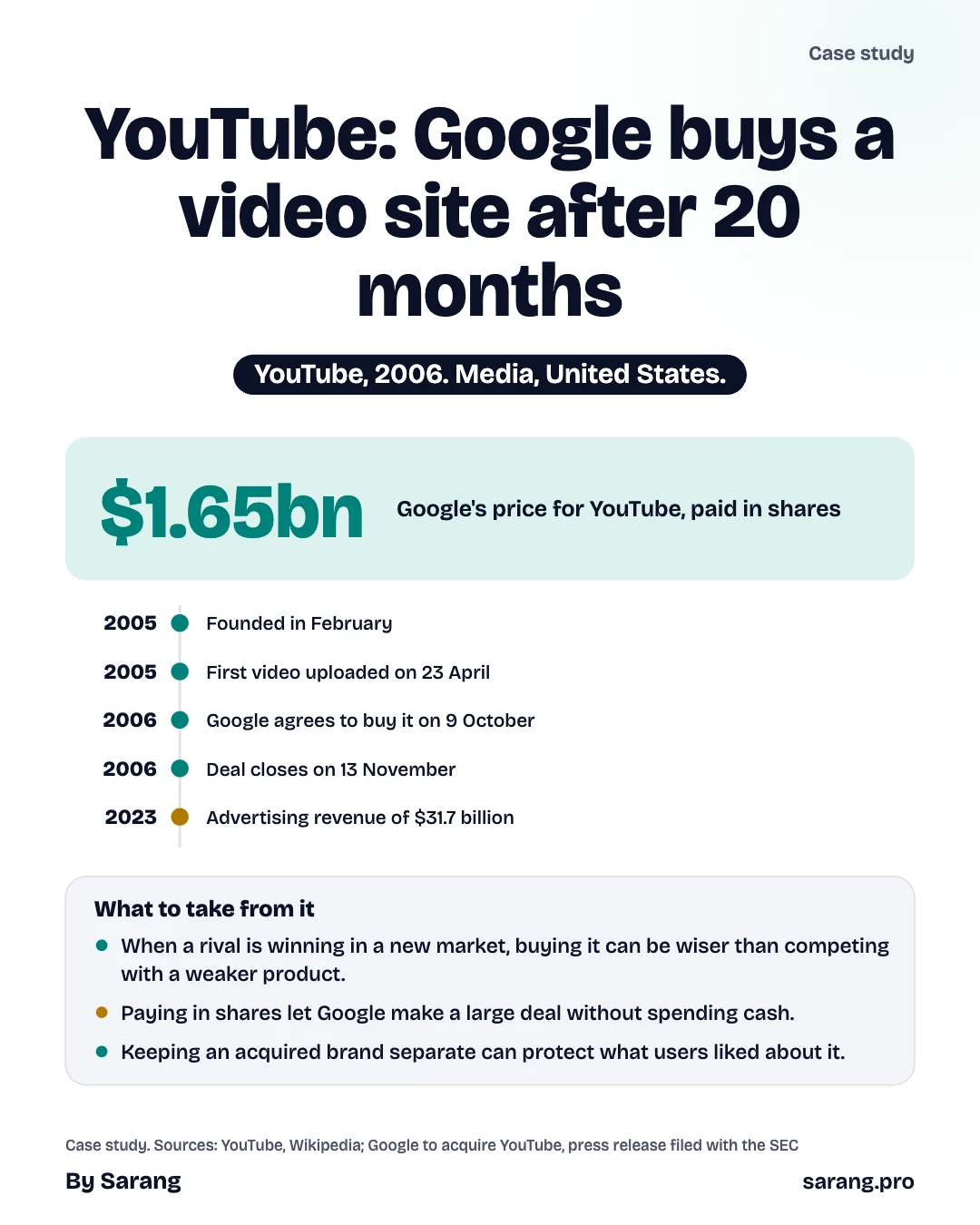
Google paid $1.65 billion in stock for YouTube in 2006, when the site was 20 months old and served 100 million views a day, and then fought a $1 billion lawsuit for seven years.
- headline price, announced 9 Oct 2006
- $1.65 billion
- daily video views at announcement
- 100 million+
- new videos uploaded per day
- 65,000
- of equity held in escrow for one year
- 12.5%
The situation
On 9 October 2006 Google announced that it would buy YouTube for $1.65 billion in Google shares. YouTube had been founded in February 2005, so the company was about 20 months old. Google’s own release said the site served more than 100 million video views a day and took in 65,000 new videos every day. It did not give a figure for users, and it said nothing about profit. YouTube would stay in San Bruno, California, keep its brand and keep its staff.
The deal closed on 13 November 2006. Google issued 3,217,560 shares of Class A stock and made a further 442,210 shares issuable through restricted stock units, options and a warrant. Twelve and a half per cent of the equity was held in escrow for a year to cover claims under the purchase agreement. Because the price was fixed in dollars and the share count was set from Google’s average closing price over the 30 trading days to 9 November, the value moved after signing. TechCrunch reported that at Google’s closing price on 13 November, $481.03, the package was worth about $1.775 billion to YouTube’s shareholders.
The price was large for a company so young, and the sources are clear that the money was a bet on audience, not on revenue. The release spoke of a “compelling media entertainment service” and a “next-generation platform for serving media worldwide”. Neither phrase described a business model. The harder question sat in the background: much of what people watched on YouTube had been uploaded by people who did not own it. Within five months a media group would sue for more than $1 billion over exactly that.
Background
A site built for sharing, not for selling
YouTube was a video hosting site that let anyone upload a clip and share a link to it. By the autumn of 2006 the volume was visible in Google’s release: the daily views and daily uploads quoted above. The chief executive was Chad Hurley, who was also a co-founder. VentureBeat, in a later piece on the PayPal sale, notes that the YouTube founders Hurley, Steve Chen and Jawed Karim all came out of PayPal, which links this case to the eBay and PayPal deal of 2002.
What the sources say about money
None of the sources used here gives audited YouTube revenue for 2006. A blog commenter cited a figure of about $15 million for the year, attributed to a Morningstar article, but that article could not be checked, so the figure is left out. The safe reading is that YouTube was valued on traffic and growth. Google’s own announcement framed the logic in terms of users, content owners and advertisers, in that order, and promised a service for all three.
Google at the time
Google paid in its own stock, which closed at $481.03 on 13 November 2006, so almost no cash left the company at closing. Google funded about $15 million to YouTube between signing and closing, and the headline price was reduced by that amount before the share count was set. Paying in shares also meant YouTube’s holders took on the risk that Google’s price would move, and the 12.5 per cent escrow meant part of their proceeds stayed exposed to legal claims for a year.
The industry
Who owned the content
Two economies met on YouTube. One was free, user-made and fast: clips that cost nothing to upload and could be watched at once. The other was slow and costly: television series and films financed by licence fees, advertising and box office. Google’s announcement spoke to both, naming users, content owners and advertisers. The tension between them is what the rest of the case is about.
Online video in 2006 sat between two groups. Users uploaded clips, many of them home-made. Large media companies owned the programmes and films that users liked to share. Viacom, whose brands include MTV, Comedy Central, VH1 and Nickelodeon, later said that its programming had been watched more than 1.5 billion times on YouTube. Whatever the exact count, the claim shows how much of the site’s draw came from material professional studios paid to make.
The legal frame
The US Digital Millennium Copyright Act, in the section known as 512, gives online services a safe harbour from liability for infringing material uploaded by users, provided they remove it promptly after a proper notice and meet other conditions. The Electronic Frontier Foundation’s case page describes the dispute as a test of whether those safe harbours would still protect a platform like YouTube. The case therefore mattered well beyond the two companies: a ruling against YouTube could have changed the cost of running any site that hosts what its users upload.
How rivals reacted
After the purchase, Google struck licensing deals with Sony BMG and Warner Music Group, a point Viacom cited when contrasting those talks with its own. Viacom said its negotiations with Google were unproductive. Google said Viacom had itself been interested in buying the site and had started partnership talks early in 2006. Court papers unsealed in March 2010 added a claim from Google that Viacom’s staff and marketing partners had themselves posted clips of its shows and films to YouTube while objecting to the practice in public. Those are Google’s allegations, reported by PCWorld, and Viacom disputed the reading.
The decision
The sources do not record Google’s internal options. What follows frames the obvious alternatives to buying, as alternatives, and marks where evidence is thin.
Buy now at a high price
This is what Google did. The case for it, on the sources, was audience: 100 million views a day was a large number in October 2006, and Eric Schmidt’s statement stressed that both companies put users first. The risk was that buying the site also meant buying its legal exposure, and the 12.5 per cent escrow shows the parties thought about that.
Compete without buying
Google could have tried to win viewers with its own offering. The sources used here do not describe Google’s own video service in 2006, so how far this was tried is unknown. The cost of this route is time, and a service built around licensed material would have lacked the user-made clips that were the site’s draw.
Partner or license
Media companies preferred licences to lawsuits, at least to start with. Viacom had proposed a content-partnership arrangement early in 2006, according to PCWorld, and the talks ran for months. A licensing route would have given Google clean rights to some programming but left it dependent on studios who were also negotiating with its rivals.
Wait
Waiting would have let the legal position clarify first. It also risked letting another company buy YouTube. Viacom, according to Google, had tried and failed to buy it in 2006. The sources say nothing about other bidders beyond that remark, so the cost of waiting stays a judgment, not a recorded fact.
What they did
9 October 2006: announcement
Google said YouTube would run independently, keep its brand and community, and stay in San Bruno with all its employees. Hurley said the partnership gave YouTube the flexibility and resources to build a next-generation media platform.
13 November 2006: closing
The deal closed as described above. Schmidt said the companies were excited to begin collaborating and linked the deal to better content quality and new business opportunities for partners. Hurley said the community would remain the most important part of YouTube. John Battelle, a technology commentator, called YouTube a “social video search darling” and predicted that people would soon be searching for “that YouTube thing”. His remark shows one early reading of the purchase: as a search and discovery play as much as a media one.
Early 2007: licences and a mass notice
Google signed music licences with Sony BMG and Warner Music Group. On 2 February 2007 Viacom sent a single takedown notice covering about 100,000 videos. According to MediaPost, YouTube removed nearly all of them by the next business day. That fast response became part of the later legal argument, because it supported the claim that the service acted when told.
13 March 2007: the lawsuit
Viacom filed in the US District Court for the Southern District of New York, seeking more than $1 billion and an order stopping Google from sharing about 160,000 unauthorised clips. It alleged “massive intentional copyright infringement” and argued that a model built on traffic and advertising from unlicensed content was illegal. Google said it removed material on notice, that Viacom had uploaded promotional material itself, and that Viacom could not say which uploads were unauthorised.
2008 onward: filters
MediaPost reports that from 2008 YouTube’s filters began blocking Viacom’s clips, and describes this as central to the later dispute. The details of the technology are outside what my sources cover.
What happened
The case, in order
| Date | Event |
|---|---|
| 2 Feb 2007 | Viacom sends a notice covering about 100,000 videos; removed by next business day |
| 13 Mar 2007 | Viacom sues for more than $1 billion |
| 18 Mar 2010 | Court unseals documents; both sides cite internal messages |
| 23 Jun 2010 | District court grants summary judgment to YouTube |
| Apr 2012 | Second Circuit revives the suit but narrows Viacom’s theories |
| Apr 2013 | District court again rules for YouTube |
| Mar 2014 | Parties settle before the second appeal is argued |
The table draws on the Electronic Frontier Foundation timeline, Insurance Journal and MediaPost. The Second Circuit asked the lower court to consider whether Google had been “willfully blind” to infringement, and in 2013 Judge Louis Stanton found Viacom had not shown enough evidence of that.
The cost and the settlement
MediaPost reports that as of 2010 Google had spent $100 million on the case, according to its chief financial officer Patrick Pichette. The settlement came after seven years and three court rulings. The terms were not disclosed, and Re/code reported, as quoted by MediaPost, that no money changed hands. The joint statement said the deal “reflects the growing collaborative dialogue between our two companies on important opportunities”. Santa Clara law professor Eric Goldman said the rulings did almost nothing to speed the resolution of safe-harbour disputes.
What the settlement meant
The ending is easy to over-read. Google won two district court rulings, but the Second Circuit in 2012 sent the case back, so the legal route was neither short nor certain. Settling before the second appeal was argued meant that no higher court ruled on the questions Viacom had raised after 2013. For platforms the safe harbour stayed in place, but the boundaries of “willful blindness” were left to later cases, which these sources do not cover.
The stock
Insurance Journal gave Google’s share price on the settlement day as $1,194.67 at 9:35 a.m. New York time. The closing price in November 2006, per TechCrunch, was $481.03. The two prices come from different outlets and from a period before Google’s later changes in share structure, so the comparison is rough. Even so, shares issued at about $447 to $481 were worth far more by 2014, which suggests the sellers did well from the stock component of the deal. Sources do not tell us what proportion they kept.
What the sources do not give
No source used here gives an audited figure for YouTube’s advertising income in the years after the purchase, and no company disclosure on whether the acquisition paid back. A reader who wants that should check Alphabet’s annual reports directly.
Other views
Viacom
Viacom said the unsealed documents supplied evidence that YouTube “intentionally operated as a haven for massive copyright infringement”. It also said internal communications showed the company planned to profit from infringement, and cited a founder’s message saying YouTube needed to “steal” videos because they make “our traffic soar”. PCWorld reports these as Viacom’s characterisations of messages that the article does not reproduce in full, so they should be read as claims in a legal filing.
Google’s argument was that the safe harbours protect services that remove unauthorised material after notice, and that rights owners are better placed than platforms to police their own works. YouTube’s chief counsel, Zahavah Levine, made this case, as PCWorld reports. Google also said Viacom switched to a “strong-arm approach” after its own attempt to buy the site fell through. Viacom did not accept that account.
Reading the rulings
The EFF, which filed briefs supporting YouTube, argued that Viacom was wrong to say YouTube lost its protection by inducing infringement. Its case page is advocacy, so it is a view from one side. The earlier district court ruling of 23 June 2010 and the 2013 ruling both favoured YouTube, yet the 2012 appeal ruling shows the judges did not accept every part of Google’s argument.
Commentators and the limits of the evidence
A blogger, Fabrice Grinda, wrote soon after the suit that his main worry about the deal had been copyright, not valuation, and that he expected traditional media to settle for a large sum plus a licensing deal. In the end the parties announced a collaboration and no payment. A commenter on the same post reported that Google had set aside $500 million for legal issues, with no source given. That claim is unverified and it is not relied on here.
The court rulings are a limit in themselves. They turned on specific facts, such as whether YouTube knew of particular clips, and the Second Circuit narrowed rather than rejected Viacom’s theories. Eric Goldman’s comment shows that legal commentators did not see the case as a clean victory for platforms.
Reading it through a framework
Real options
Buying YouTube can be read as buying an option on a market that Google could not yet price. Google paid a fixed sum in stock, but the real expense was the lawsuit and its $100 million legal bill by 2010, a small fraction of the price. The 12.5 per cent escrow worked like insurance against the worst early outcomes. Had the courts removed the safe harbour for video sites, the option would have expired worthless; the Second Circuit’s narrowing of Viacom’s theories and the 2013 ruling kept it alive.
Network effects
The case for paying so much with so little revenue rests on network effects. Each new uploader gave viewers a reason to visit, and each new viewer gave uploaders a reason to post, which is consistent with the 100 million daily views the release cites. A second effect cut against it: the same effect made the unlicensed material more valuable, since Viacom said its content had been watched more than 1.5 billion times. The platform grew on the very content that created the legal risk, and Google’s task afterwards was to turn disputed content into licensed content, as the Sony BMG and Warner deals started to do.
The two framework readings fit together. The option was worth holding only if the network effect could be made to pay, and the network effect could only be made to pay if the legal position held. That is a useful way to see why Google accepted a lawsuit as part of the price.
Since then
The legal question that dominated the first years has faded from the sources. What replaced it is a different problem: a platform at huge scale has to keep rights holders on side by agreement as well as by process. The licensing deals with Sony BMG and Warner Music Group in 2007 and the film rental deal around 2012 are early signs of that path. The settlement statement itself talked of collaboration, not of winners and losers.
The Viacom case ended in March 2014 with no disclosed payment. About two years before the settlement YouTube also announced a deal with a Hollywood studio to offer films for rent online, according to Insurance Journal. Beyond those facts, no source used here gives YouTube’s size or income in 2025 or 2026, so no claim is made about it. Alphabet’s investor pages report YouTube advertising revenue each quarter and are the place to look.
The PayPal link noted in the Background also shows how a pattern can repeat. The three founders of YouTube had worked at PayPal, which eBay bought in 2002, the subject of another case in this series.
What to take from it
- A buyer paying for audience before revenue takes on the legal risk of whatever created the audience, and the contract terms, such as an escrow, should reflect that.
- Paying in shares ties the seller’s outcome to the buyer’s stock; here the value delivered at closing was about $1.775 billion against the $1.65 billion headline.
- A platform’s defence in a copyright dispute can rest on process, such as how fast it removes material after notice, as much on the content itself.
- Litigation can outlast the deal logic: seven years and three court rulings ended with a joint statement and no disclosed payment.
- Two parties can be partners and opponents at once; Viacom negotiated with Google in 2006, sued in 2007 and settled in 2014.
Questions to think about
- If YouTube had been losing money in 2006, what evidence other than revenue would justify a $1.65 billion price?
- Should a buyer set aside a larger share of the price in escrow when the target’s main risk is a legal one, and who should bear that risk?
- How would the outcome look different had the courts removed the safe harbour in 2010?
- What would Viacom have gained by licensing in 2006 instead of suing in 2007?
Concepts at work
Real options, network effects and platform liability all appear here. Explore them in Insights.
Written from the public sources listed below. Figures are as those sources report them.
Framework
Timeline
- Feb 2005YouTube founded
- 9 Oct 2006Google announces $1.65 billion stock purchase
- 13 Nov 2006Deal closes; 3,217,560 Google shares issued
- 2 Feb 2007Viacom sends takedown notice for about 100,000 videos
- 13 Mar 2007Viacom sues for more than $1 billion
- 18 Mar 2010Court unseals documents in the case
- 23 Jun 2010Summary judgment for YouTube
- Apr 2012Second Circuit revives the suit, narrows theories
- Apr 2013District court again rules for YouTube
- Mar 2014Viacom and Google settle
Recap cards
Tap a card to check yourself.
Sources and credits
- Google Press Center: Google to acquire YouTube for $1.65 billion in stock
- TechCrunch: Google Closes YouTube Acquisition
- SEC (Google 8-K exhibit): Press release on closing of YouTube acquisition
- Battelle Media: Google's YouTube Acquisition Closes
- InfoWorld: YouTube video suit alleges massive infractions
- PCWorld: Google, Viacom sling mud in YouTube court fight
- Electronic Frontier Foundation: Viacom v. YouTube
- MediaPost: Google, Viacom finally settle battle about clips
- Insurance Journal: Viacom settles $1B copyright suit against Google over YouTube videos



