McDonald’s India: how a menu without beef became a business
McDonald's opened in India in 1996 with no beef or pork, built a vegetarian core, and by 2012 saw one potato burger bring in about a quarter of sales.
- spent on infrastructure and vendor development before the 1996 launch
- Rs 20 crore
- price of the McBurger meal at launch, about twice the average daily wage
- Rs 39
- share of sales reported for the McAloo Tikki in 2012
- 25%
- approximate share of the Indian menu that was vegetarian in 2012
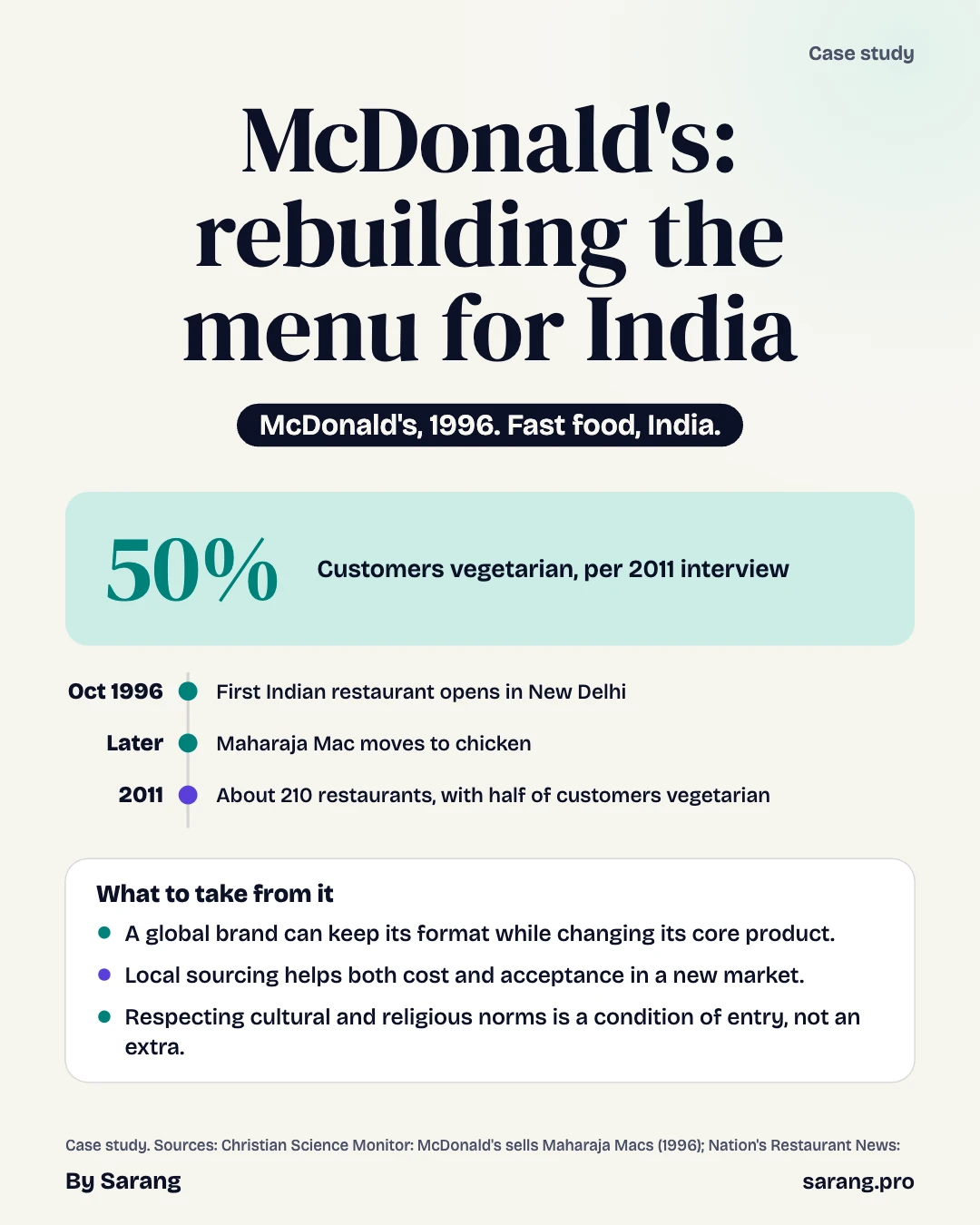
- 50%
The situation
In October 1996 McDonald’s opened its first restaurant in India, in a suburb of New Delhi, on a Sunday. It did so quietly. The company had been warned that it could suffer the fate of KFC’s outlet in Bangalore, which activists had attacked several times, and it wanted no protest on opening day. The menu told the story of the problem it faced. There was no Big Mac, because the cow is sacred to most Hindus. There was no pork, because Muslims, about 12% of the population at the time, do not eat it. In their place stood a double-decker burger called the Maharaja Mac, a vegetable nugget meal with tamarind sauce, and a vegetarian menu prepared in separate kitchens.
The chain had spent about three years on research and roughly Rs 20 crore on infrastructure and vendor development before it served a single customer. The price point was set to match: a small burger or veggie sandwich from Rs 12, and a full McBurger meal for Rs 39, which one contemporary report put at about twice the average Indian daily wage.
By September 2012 the experiment had become a business of some size. Press reports that month counted between about 250 and 271 McDonald’s restaurants in India, out of more than 33,000 worldwide, and the company announced what it described as its first vegetarian-only restaurants, planned for pilgrimage towns. The menu was by then roughly half vegetarian, and one potato burger, the McAloo Tikki, was reported to account for about a quarter of sales. This case follows how a company built on beef moved its core product out of the way, what that cost and earned, and where the model started to strain.
Background
A global formula meets a market without beef
McDonald’s grew worldwide on a standard format: a short menu of burgers, fries and shakes, made the same way in every restaurant. The Indian launch showed how far the company had to bend that format. Reports at the time noted that the India restaurant did not sell beef or pork derivatives, unlike the other 19,400 or so restaurants in the chain, and that it carried a large vegetarian selection. Lamb burgers took the place of hamburgers in the McBurger meal.
The company was not new to local variation. A 1996 report from Business Standard pointed to black currant shakes in Poland and shrimp salad in Germany as examples. India was a harder case because the restriction was religious and near-total on the core product, not a matter of flavour.
Two Indian partners, two regions
McDonald’s did not enter alone. It formed two 50:50 joint ventures: Connaught Plaza Restaurants in New Delhi, with Vikram Bakshi, and Hardcastle Restaurants in Mumbai, with Amit Jatia. The 1996 report says both partners trained at McDonald’s Hamburger University in Illinois. Bakshi was described as the managing director leading the India business, and he told reporters that McDonald’s India was an Indian company.
The split mattered later. Connaught Plaza ran the north and east, and Hardcastle ran the west and south, so the two halves of the country developed under different owners with different pace and results.
Local supply, local ingredients
The launch relied on local sourcing. The Business Standard report named Dynamix Dairy in Maharashtra, VST Industries in Hyderabad and Ooty Farms for lettuce among its suppliers, and said ingredients came from Ooty and Phillaur. The Rs 20 crore spent on infrastructure and vendor development went partly on building this supply chain, which is slow, costly work that rivals could not copy quickly.
The industry
When McDonald’s arrived, Western chains in India had a mixed record. The 1996 reports noted that Pizza Hut was already in the country, that Planet Hollywood planned to open in Bombay the following year, and that KFC had struggled. Local rivals named by Business Standard included Wimpy, Domino’s, KFC and Nirulas, a Delhi chain.
The opposition was real. Animal-rights activist Maneka Gandhi, who had led the protests against KFC, said McDonald’s was “the largest killer of cows in the world”. Critics also argued that fast food harmed health, and militant farmer groups said processed food depleted grain that should feed people. A south Indian sanitary-ware merchant threatened to sue over the golden arches logo. Bakshi’s reply was that McDonald’s had been “very sensitive to our culture”.
By 2012 the market looked very different. A report in The Week, drawing on BBC, Financial Times, Guardian and other coverage, put India’s fast-food market at $12 billion a year, mostly held by local independent restaurants. Chains such as McDonald’s held about 5%, a share expected to double by 2016. A 2006 poll cited by the Associated Press found about 40% of Indians did not eat meat, and The Week gave a figure of up to 42%. For a company that sold burgers, that was a large part of the market that a beef or chicken menu could not serve well.
Diet was also a matter of reputation. In 2002, McDonald’s had agreed to pay $10 million to Hindu and other groups in the United States to settle lawsuits claiming that fries and hash browns labelled vegetarian contained beef flavouring. The 1996 launch material stressed separate kitchens and utensils that never touched meat, which fits a company that had already paid to settle one labelling dispute.
The decision
The decision was never a single moment. It was a set of choices made over three years of preparation before the 1996 launch, and then revisited as the market changed. The sources show three main options in play.
Option one: copy the global menu and accept the protests
The alternative was to enter with the standard menu, including beef, and rely on the brand. The record of KFC in Bangalore argued against this. The company chose a quiet opening precisely to avoid the scene that had met KFC. Given that the cow is sacred to most Hindus, a beef-based menu would have turned away much of the market and attracted open hostility.
Option two: remove beef and pork and substitute
This is what McDonald’s did. The Maharaja Mac took the place of the Big Mac. At launch, sources differ on what went into it: the Christian Science Monitor in 1996 described lamb burgers in the McBurger meal, while Business Standard described mutton patties in the Maharaja Mac. By 2012, reports agreed that lamb had not gone down well and that the Maharaja Mac was made with chicken. The two accounts are consistent with a menu that began with sheep meat and moved to chicken, but the sources do not give the date of the change.
Option three: build a vegetarian core
The vegetarian menu was not an afterthought. McDonald’s said it sold no beef or pork and had a dedicated vegetarian menu, with vegetarian food prepared in separate kitchens using utensils that never touched meat. Business Standard quoted that position directly in 1996. The vegetable nugget meal came with McMasala or McImli (tamarind) sauce. This option made the brand credible to vegetarian families, who would otherwise have no reason to enter.
What was at stake
The stakes were commercial and cultural. If the local adaptation failed, the company would have spent three years and Rs 20 crore on an experiment that ended like KFC’s. If it succeeded, India offered a population of 1.2 billion, where a large share avoided meat and the chain’s share of fast food was small. A Business Standard report quoted McDonald’s vice president Steve Simpson saying the company would not let competitors dictate its business.
What they did
1996: a quiet opening and a vegetarian promise
The first restaurant opened in New Delhi in October 1996. A later report places it at Basant Lok in Vasant Vihar, and calls it the world’s first beefless McDonald’s. The company kept the launch low key to avoid protests. A second restaurant was planned for Mumbai before the end of the same month.
The menu centred on the Maharaja Mac and a lower-priced range: a small McBurger or veggie sandwich from Rs 12, a McBurger meal at Rs 39, and a Vegetable McNuggets meal at Rs 57. The restaurant was reported to sell thousands of burgers a day within its first weeks. One student waiting for a vegetable burger told the Christian Science Monitor that beef did not matter to her: “I’m here for the experience.”
Building the supply chain and training
Training centres were set up in Delhi and Mumbai, and local suppliers were developed. This is the less visible half of localisation. A menu without beef still needs consistent potatoes, cheese, sauces and buns delivered cold and on time to every outlet. The 1996 spending on vendor development reflects that.
2000s onwards: growing the menu beyond substitution
Sources do not give a full menu history, but they show where it ended up. The McAloo Tikki, a spiced breaded potato patty with onions, tomato and a vegetable sauce, became the biggest seller. The Week reported in 2012 that it accounted for about a quarter of total sales. The McSpicy Paneer, with a patty of Indian cheese, joined it. Maini said in 2012 that many new vegetarian options still had to be developed, so the menu was treated as unfinished work rather than a settled list.
2012: vegetarian-only restaurants
On 4 September 2012 the Associated Press reported that McDonald’s was opening what it believed were its first vegetarian-only restaurants anywhere, in popular pilgrimage areas. The Week named the sites: Amritsar, home of the Golden Temple, where meat is barred, and Katra, the base for pilgrims visiting the Vaishno Devi shrine. Rajesh Kumar Maini, a McDonald’s spokesman in northern India, said vegetarian restaurants made “absolute sense” in pilgrimage towns.
The timing had a global reason. The AP noted that a key sales measure for the whole company had been flat in July 2012, its weakest showing in more than nine years, and that McDonald’s said it would focus on local-taste menu options to grow sales.
2013 to 2017: partner conflict and reset
While the menu matured, the northern joint venture ran into trouble. According to a 2019 Scroll report, McDonald’s offered in 2008 to buy Bakshi’s stake for $5 million (Rs 35 crore), the sum he had invested in 1996, and he refused. In 2013 McDonald’s removed him as managing director of Connaught Plaza. He challenged this, and the tribunal reinstated him in July 2017. In August 2017, according to Business Today, McDonald’s terminated the franchise agreements for 169 outlets. The dispute ended in a settlement announced on 9 May 2019, under which McDonald’s bought out Bakshi and his wife.
What happened
Growth in outlets
Restaurant counts rose through the period, though the sources count different things at different dates, so the figures are best read as markers rather than a single series.
| Date | What the source reports |
|---|---|
| 2008 | Bakshi had set up 70 outlets in the north (Scroll) |
| September 2012 | About 250 restaurants (AP) or 271 (The Week), in India |
| March 2017 | Over 400 restaurants at last count (Quartz) |
| July 2018 | About 275 restaurants in west and south, with a target of nearly 500 within four years (Business Standard) |
| May 2019 | 169 outlets in the north and east (Scroll) |
Profit came slowly
Localisation won customers but not quick profits. Connaught Plaza declared its first profit, Rs 9.32 crore, in 2010, according to Scroll. At the level of McDonald’s India Private Limited, which holds the company’s interests, Business Today reported a net profit of Rs 65.2 lakh in the 2017-18 financial year, its first profit in 22 years in India. That came after a net loss of Rs 305 crore in 2016-17 and accumulated losses of Rs 421 crore since 1996. It had set aside Rs 198.2 crore as a provision in June 2018 for losses linked to the legal dispute with Connaught Plaza. Royalty income rose 8% to Rs 119.6 crore.
The menu worked
The evidence that the menu choices worked is in the sales mix. By 2012 the Indian menu was roughly half vegetarian and the potato burger was the lead seller. The company had gone from a launch built around lamb or mutton burgers and caution to a menu where a potato burger was the lead seller.
The west and south
In the west and south, the operator is Westlife Foodworld. For the 2024-25 financial year it reported revenue from operations of Rs 2,515.66 crore, up 4.37% from Rs 2,410.27 crore, though profit in the final quarter fell sharply to Rs 1.52 crore from Rs 7.01 crore in the previous quarter, according to the Free Press Journal and Restaurant India reports of May 2025.
Reading the 2012 figures
The 2012 numbers deserve a careful look. The Associated Press counted about 250 restaurants and The Week counted 271, a gap that probably reflects different reporting dates. Both agree on the scale of the bet: a chain with more than 33,000 restaurants worldwide had under 1% of them in a country of 1.2 billion people. Chains held about 5% of a $12 billion fast-food market, and the expectation that this share would double by 2016 explains why the company kept investing in a menu that suited local rules.
The Quartz view in 2017
By March 2017, Quartz counted over 400 restaurants at last count and argued that India had changed. Low-priced burgers and weak store experiences, it said, no longer won customers. The article’s own title says McDonald’s was “finally taking note”, which is a criticism of how long the company took to move beyond its first formula. The opened excerpt does not describe the strategy that followed.
Other views
Activists and critics in 1996
Maneka Gandhi’s remark about cows shows that removing beef did not end the argument for everyone. Some objections were about the brand itself rather than the menu: health, the effect on grain supply, and the use of a foreign symbol. The 1996 reports show a company that expected hostility and planned for it.
Industry observers on the vegetarian restaurants
Writing in 2012, Slate’s Matthew Yglesias said that if the India effort “takes off at all” it could be a testing ground for the idea in other markets. The Week noted that the United States has about 15 million vegetarians. Maini himself said the company would still need to develop many new vegetarian options, an admission that the menu was not finished.
A shrinking novelty
A 2017 Quartz article argued that Indian customers had moved on from the McAloo Tikki and that cheap burgers and tired restaurants were no longer enough. The reported quarter-to-quarter profit drop at Westlife in 2025 and the net losses at the parent in the 2010s suggest that a good localised menu does not by itself produce strong margins.
Limits of the evidence
The sources are mostly news reports, which count restaurants differently and rarely give market share by product. The change from lamb to chicken in the Maharaja Mac is not dated in any source opened. The share of sales from vegetarian items is reported only for the McAloo Tikki and only for one year. Readers should treat the numbers as indicative.
Reading it through a framework
Ansoff matrix: market development with product adaptation
Ansoff’s matrix separates growth by new products and new markets. Entering India was market development: an existing product, the burger, in a new market. But the facts show it required product development too, since beef and pork came off the menu, and chicken, paneer and potato items were added. That sits close to the hardest quadrant of the matrix, where both product and market change at once, and it helps explain the three years of research and the Rs 20 crore of up-front spending. The 2012 vegetarian-only restaurants take the same logic further by adapting the format to a place, not only a country.
Value chain: where the adaptation sat
Porter’s value chain looks at the activities behind a product. The India case shows adaptation in several: inbound logistics (local suppliers such as Dynamix Dairy and Ooty Farms), operations (separate vegetarian kitchens and utensils), marketing (a quiet launch, then pricing from Rs 12), and service (training centres in Delhi and Mumbai). A menu change alone would not have worked without these. The same lens shows why rivals found it hard to copy: much of the advantage lay in the supply chain and kitchen design rather than in the recipe.
Since then
The northern business changed hands. After the May 2019 settlement, McDonald’s India Private Limited and McDonald’s Global Markets owned Connaught Plaza outright. Press reports in 2025 describe Westlife Foodworld as the operator of McDonald’s restaurants in West and South India. A Restaurant India page from May 2025 carried a headline that McDonald’s had reached 500 restaurants in the west and south, but the page opened did not confirm the figure, so it is treated here as unverified.
The 2025 results show a business that is still growing but under pressure on profit. Revenue from operations for 2024-25 was Rs 2,515.66 crore, up 4.37%, while the fourth-quarter profit was Rs 1.52 crore.
What to take from it
- Local adaptation at McDonald’s India started with a constraint, no beef or pork, and the company treated it as a design brief for the whole menu, not a footnote.
- A localised product needs a localised supply chain behind it, and the 1996 spending on vendors and training shows this was planned from the start.
- The best-selling item reported in 2012 was the McAloo Tikki, a potato burger, not the substitute for the Big Mac.
- Joint ventures can divide a market and then split under pressure, as the Connaught Plaza dispute shows, and the cost can outlast the launch.
- A menu that wins early customers does not guarantee profit, since McDonald’s India reported its first profit only in 2017-18, after 22 years.
Questions to think about
- Which parts of the McDonald’s format could not be changed in India, and which could? What decides the line?
- Why might a company announce vegetarian-only restaurants in two pilgrimage towns instead of rolling the idea out across the country?
- If you were advising a partner in a 50:50 joint venture, what terms would you want agreed before the first restaurant opened?
- How would you judge whether a localised menu is working: sales mix, profit, customer trust, or something else?
Concepts at work
This case draws on market development, the value chain and joint ventures. Explore them in Insights.
Written from the public sources listed below. Figures are as those sources report them.
Framework
Timeline
- 1995McDonald's forms two 50:50 joint ventures, Connaught Plaza (Delhi) and Hardcastle (Mumbai)
- Oct 1996First restaurant opens in New Delhi with no beef or pork
- Oct 1996Mumbai restaurant planned for later the same month
- 2002McDonald's settles US lawsuits over beef flavouring in fries for $10 million
- 2008McDonald's offers to buy out Vikram Bakshi for $5 million; he refuses
- 2010Connaught Plaza reports its first profit, Rs 9.32 crore
- Sep 2012McDonald's announces vegetarian-only restaurants for pilgrimage towns
- 2013McDonald's removes Bakshi as managing director of Connaught Plaza
- Jul 2017Tribunal reinstates Bakshi
- Aug 2017McDonald's terminates franchise agreements for 169 outlets
- May 2019Settlement: McDonald's buys out Bakshi
- May 2025Westlife reports 2024-25 revenue of Rs 2,515.66 crore
Recap cards
Tap a card to check yourself.
Sources and credits
- Christian Science Monitor: To Curry Favor in India Debut, McDonald's Sells Maharaja Macs (1996)
- Business Standard: Maharaja Mac conquers the capital (1996)
- Associated Press via Christian Science Monitor: McDonald's to open vegetarian-only restaurants in India (2012)
- Associated Press via Fox News: McDonald's to open its first-ever vegetarian-only restaurant
- The Week: The world's first vegetarian McDonald's, a guide (2012)
- Business Today: McDonald's posts its first-ever profit in India after 22 years
- Business Standard: McDonald's does a first in India, converts used cooking oil into biodiesel (2018)
- Scroll.in: McDonald's and Vikram Bakshi settlement (2019)
- Quartz India: McDonald's is finally taking note that Indians have moved beyond the humble McAloo Tikki burger (2017)
- Restaurant India: Westlife Foodworld Q4 profit falls 78 pc despite full-year revenue growth (2025)