Epic Games: how a free game paid for a fight with Apple and Google
Fortnite's free battle royale earned Epic $5.8bn in 2018 alone, money that funded an 88/12 PC store and lawsuits that cut Apple's and Google's app fees.
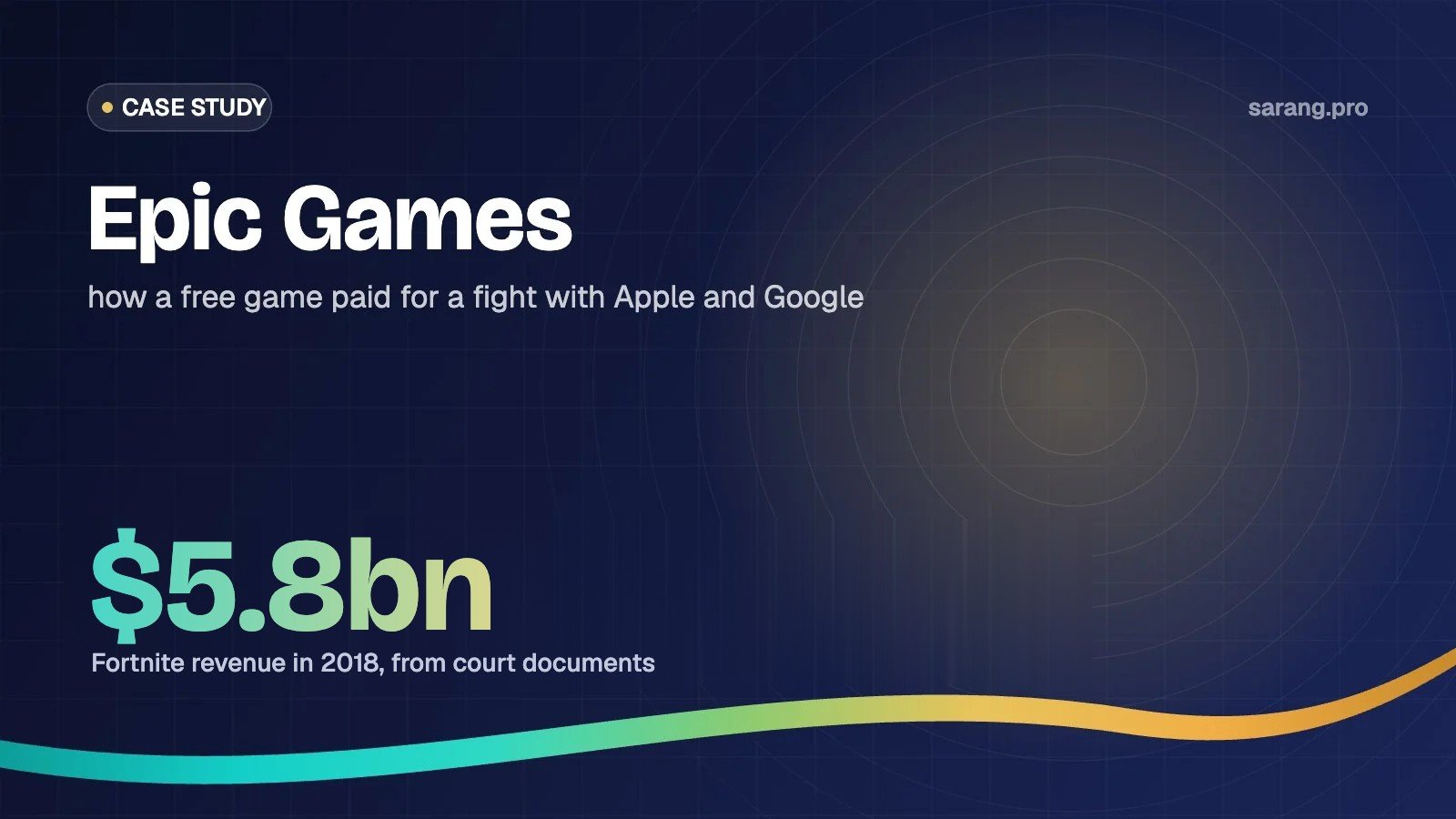
- Fortnite revenue in 2018, from court documents
- $5.8bn
- Unreal Engine revenue across 2018 and 2019
- $220m
- players of the free battle royale within two weeks of launch
- 10m
- share of store revenue kept by developers on Epic's store
- 88%
The situation
In September 2017 Epic Games, a privately held developer based in Cary, North Carolina, had to decide what to do with a new mode it had built for Fortnite. Fortnite itself had gone on sale on 24 July 2017 for PC, PlayStation 4, Xbox One and Mac as a paid game costing roughly $40. The new mode was a battle royale: 100 players drop onto a map and fight until one is left. The format was already associated with another game, PlayerUnknown’s Battlegrounds (PUBG).
Epic could fold the battle royale mode into the paid game, which would reward existing buyers and protect revenue from each copy sold. Or it could release the mode as a separate free game and earn money only from optional purchases inside it. It chose to give it away. On launch day one million people played. Within two weeks there were ten million.
That decision reshaped the company. Documents filed in court in 2021 showed that Fortnite brought in $5.8bn of revenue in 2018 and $3.7bn in 2019, and that Epic earned profits of about $5.5bn over those two years. The money then paid for two fights with the companies that controlled how games reached players: first a new PC store that took a much smaller cut than the market leader, and then lawsuits against Apple and Google over the rules of their mobile app stores. This case follows both decisions, the free game and the use of its proceeds, and what came of them.
Background
Tim Sweeney founded the company in 1991 as Potomac Computer Systems, working from his parents’ house in Potomac, Maryland, while a student at the University of Maryland. Its first hit, ZZT, was a text-based shareware game with a built-in editor. Around early 1992 Sweeney renamed the company Epic MegaGames; he later said the grand name was meant to make a small firm look like a big one. Epic published shareware titles such as Jill of the Jungle, Jazz Jackrabbit and Epic Pinball, paying outside developers royalties of 40% to 50% of sales. Work on a 3D engine called Unreal began around 1994, and the company moved to the Raleigh area of North Carolina in 1998.
For the next two decades Epic had two businesses. It made games, including Unreal Tournament and Gears of War 3, and it licensed Unreal Engine, the toolkit it used to make them, to other studios. The engine gave Epic a steady income and a view of how the rest of the industry built games. At one stage studios paid a monthly fee; later Epic made the engine free to use and took a royalty on commercial games built with it, set at 5% of revenue. Variety reported that this change brought the engine its largest profits in the company’s history.
In 2012 Epic decided its business model had to change. Big boxed games sold once with heavy marketing were giving way to games that were free or cheap to start and updated for years. Sweeney later described the moment as “seeing the writing on the wall”. Epic called the new plan Epic 4.0 and focused development on three games run as live services: Paragon, Unreal Tournament and Fortnite. Fortnite stayed in development for nearly five years. In the same year Epic sold about 48% of its outstanding shares, roughly 40% of the company once options were counted, to the Chinese internet group Tencent for $330m. Sweeney remained the controlling shareholder.
Before 2017 the company’s money came mainly from Unreal Engine and from sales of its own games. Court documents later showed how small the non-Fortnite businesses were by comparison. Across 2018 and 2019, Unreal Engine earned $220m and Epic’s other games, Rocket League and Battle Breakers, earned $108m.
The industry
Video games reach players through a small number of gatekeepers. On consoles, Sony, Microsoft and Nintendo control which games appear on their machines and take a share of sales. On mobile phones, Apple’s App Store is the only approved way to install apps on an iPhone, and Google Play distributed more than 95% of Android apps, according to evidence summarised during the Google case. Both charged commissions of 15% to 30% on in-app purchases of digital goods and required developers to use their own payment systems. On PC, Valve’s Steam store was the shop to beat. On 30 November 2018 Valve announced new revenue share tiers for its largest games, days before Epic announced its own store.
Apple described the scale of its platform in November 2020: 1.8 million apps, more than 1.5 billion active devices in 175 countries, and $519bn of commerce facilitated by the App Store ecosystem in 2019. For a game publisher, that reach is the attraction. The 30% commission on every in-app purchase is the price.
The business model of games was shifting at the same time. Free-to-play games charge nothing to start and make money from in-game purchases. Some sell items that make a player stronger, which can drive away those who will not pay. Others sell only cosmetic items, such as costumes, which change how a character looks but not how well it plays. The cosmetic route keeps the game fair but depends on players caring enough about appearance to spend. Fortnite chose this route.
Porter-style reasoning shows why the platform owners held so much power over a publisher like Epic. Supplier power, in the form of the platforms that sit between game and player, was high because there were few of them and no easy way round them on phones. Buyer power, at the level of individual players, was low, but players could switch easily to another free game. The threat of new entrants into game making was high because engines such as Unreal had lowered the cost of development. Rivalry among free games was intense: PUBG’s developers publicly objected to Fortnite’s battle royale mode within weeks of its release. In such a market, the cut taken by the gatekeeper was one of the largest costs a successful publisher faced.
Exhibit 1: Commission rates on the main digital storefronts
| Store | Standard rate | Later changes |
|---|---|---|
| Apple App Store | 30% on in-app purchases | 15% for developers earning up to $1m a year from January 2021 |
| Google Play | 30% on in-app purchases | 15% on the first $1m of revenue a year from July 2021; 9% to 20% under the November 2025 settlement filing |
| Epic Games Store | 12% of sales (88/12 split) | No Unreal Engine royalty on store sales; 100% to developers for six months under some programmes |
Sources: Apple Newsroom, 18 November 2020; Android Developers Blog, 16 March 2021; Video Games Chronicle, 12 November 2025; Epic Games Store 2024 year in review.
The decision
Free or paid in 2017
The choice over the battle royale mode was the first decision. Keeping it inside the paid game would protect the $40 price, avoid upsetting players who had already bought Fortnite, and limit server costs to paying customers. Making it free would remove the main barrier to trying the game, especially for younger players and for people who would never pay $40 for a game they had not tried. The risk was that revenue per player would be zero unless players chose to spend, and that Epic would carry the cost of servers and support for millions who never paid.
Epic also had to decide what to sell. Items that gave paying players an advantage would earn more from each spender but would damage a competitive game in which 100 players faced each other. Cosmetic items would keep the game fair. Epic chose cosmetics. When the mode launched in late September 2017, GameSpot reported that cosmetic purchases were planned for a later date.
What to do with the money
The second set of choices came once the money arrived. Epic could keep paying the platform owners their share and reinvest its profits in games and in Unreal Engine. Or it could use its size to attack the share itself. One route was to open its own PC store with a lower fee and win developers and players away from Steam. Another was to challenge Apple and Google directly over the rule that every in-app purchase had to go through their payment systems.
The arguments for attacking were that the 30% norm took a large share of Fortnite’s revenue, that Epic’s player base gave it bargaining power few developers had, and that Unreal Engine’s customers would also gain from lower fees. The arguments against were cost, distraction and risk. A store would need years of spending on exclusive deals and free games before it could rival Steam. A legal fight with Apple and Google would mean losing access to hundreds of millions of phones for as long as the fight lasted. Sweeney had complained about Apple’s rules since at least 2015, according to CNBC, so the question by 2020 was less whether to challenge them than how.
What they did
Making Fortnite free
Epic released the battle royale mode as a free game in late September 2017, on the same platforms as the paid version. One million people played on launch day, and on Sunday 8 October 3.7 million played, with a peak of 525,000 at once. By the end of the second week Epic said ten million people had played. It added a store of cosmetic items, such as costumes and pickaxes. Nothing on sale made a player stronger.
By July 2018, a year after the original launch, Fortnite had 125 million players, about 40 million of them playing the free battle royale each month, and the game had earned more than $1bn, with in-game purchases bringing in millions of dollars a day. Analysts cited by Variety in 2018 expected Fortnite to earn $2bn that year. The court documents later showed it earned $5.8bn.
The Epic Games Store
In December 2018 Epic opened the Epic Games Store for PC and Mac. Developers would keep 88% of revenue and Epic would take 12%, with no tiers. For games built with Unreal Engine, Epic waived the engine royalty on store sales. The store was open to games built on any engine. Epic used two other tools to attract players and publishers. It gave away free games on a regular schedule, and it paid some publishers for exclusives, so that certain games were sold on PC only through its store. The size of those payments came out in court in 2021 but was not widely reported in the sources checked for this case. The store ran at a loss in its early years, according to the same documents.
Taking on Apple and Google
On 13 August 2020 Epic updated Fortnite on phones to let players buy V-Bucks, the in-game currency, directly from Epic at a 20% discount, bypassing Apple’s and Google’s payment systems. Apple removed Fortnite from the App Store and Google removed it from Google Play. Epic sued Apple the same day and also sued Google. The suits had been prepared in advance under a plan Epic called Project Liberty. On 28 August Apple terminated Epic’s developer account, blocking new apps and Fortnite updates on its platforms.
Apple countersued in September 2020 for breach of contract, saying that Epic had earned more than $600m through the App Store and that “Epic’s lawsuit is nothing more than a basic disagreement over money”. Apple asked the court to make Epic return the money collected through its own payment system and to ban external payment mechanisms in all apps.
The two cases took different paths. Epic’s case against Apple was heard by Judge Yvonne Gonzalez Rogers without a jury in Oakland in May 2021. Its case against Google went to a jury before Judge James Donato in San Francisco in 2023.
What happened
The money
The free model worked on a scale few had predicted. Exhibit 2 shows the figures from Epic’s internal documents, filed in the Apple case and reported in May 2021.
Exhibit 2: Epic Games revenue by source, 2018 and 2019
| Source | 2018 | 2019 | Two-year total |
|---|---|---|---|
| Fortnite | $5.8bn | $3.7bn | $9.1bn (as reported; $9.5bn if the yearly figures are added) |
| Rocket League and Battle Breakers | n/a by year | $108m | |
| Unreal Engine | n/a by year | $220m | |
| Epic profit, whole company | n/a by year | About $5.5bn | |
| Analysts’ 2018 expectation for Fortnite (Variety) | $2bn | n/a | n/a |
Sources: PC Gamer, 4 May 2021, reporting documents first covered by The Verge and Eurogamer; Variety, 2018.
There is an arithmetic oddity in the reporting: $5.8bn and $3.7bn add to $9.5bn, not the $9.1bn in the headline figure. The difference is probably rounding or different revenue definitions in different documents, but the sources do not explain it. Either way, Fortnite produced more than 25 times the revenue of Unreal Engine over the two years, and one free game had changed the size of the company. The fall from 2018 to 2019 also showed how quickly revenue from a single hit could move.
The store
The store grew its user base faster than it grew spending on other publishers’ games. Epic’s own figures for 2024 reported 295 million PC users, up 25 million on the year, and a peak of 74 million monthly active users, down from 75 million in 2023. Total player spending on the store reached $1.09bn, up 15%, but spending on third-party games through Epic’s payment system fell 18% to $255m. Most spending on the store was on Epic’s own games, Fortnite above all. Epic gave away 89 free games in 2024, claimed 595 million times. It has kept adding incentives: programmes under which developers keep 100% of net revenue for the first six months after release, and a cut in the Unreal Engine royalty from 5% to 3.5% for eligible games that launch on its store as well as elsewhere.
Exhibit 3: Epic Games Store operating figures, 2024
| Measure | 2024 | Change on 2023 |
|---|---|---|
| PC users | 295 million | Up 25 million |
| Peak monthly active users | 74 million | Down from 75 million |
| Total player spending, including Epic’s games | $1.09bn | Up 15% |
| Spending on third-party games via Epic payments | $255m | Down 18% |
| Free games given away | 89 | Fifth year of weekly giveaways |
| New games released on the store | 1,100 | n/a |
| Third-party gameplay hours | 2.68bn | Up 11% |
Source: Epic Games Store 2024 year in review.
The Apple case
The Apple case went mostly against Epic at first. On 10 September 2021 Judge Gonzalez Rogers ruled for Apple on nine of ten counts. She said the court could not conclude that Apple was a monopolist under federal or California antitrust law and wrote that “success is not illegal”. She did find that Apple’s anti-steering rules, which barred developers from telling users about cheaper ways to pay, broke California’s unfair competition law, and she barred Apple from enforcing them. Epic was found to have breached its contract and was ordered to pay Apple 30% of the revenue it had collected through its own payment system in the iPhone version of Fortnite. On 24 April 2023 the Ninth Circuit appeals court upheld the ruling in full on these points, while finding some legal errors in the antitrust analysis that it held to be harmless.
The anti-steering ruling turned out to matter more over time, as the dispute moved on to whether Apple had complied with it. In April 2025 Judge Gonzalez Rogers found Apple in wilful violation of her injunction and ruled that developers must be able to send users to outside payment without paying Apple a fee. Fortnite returned to the US App Store on 20 May 2025, almost five years after its removal, with an offer of 20% back for players who bought items directly from Epic. It had already returned on iPhones in the European Union in 2024, through Epic’s own mobile store, after EU rules forced Apple to allow other app stores there.
The Google case
The Google case went further. In 2023 a jury found Google’s Android app store to be an illegal monopoly. In October 2024 Judge Donato ordered Google to dismantle barriers protecting its store, including a requirement to carry rival app stores inside Google Play. In July 2025 the Ninth Circuit unanimously upheld the verdict. On 4 November 2025 the two companies filed a settlement under which Google would cap its commission on in-app payments at 20% for purchases that affect gameplay and 9% for cosmetic items and subscriptions, and would let rival stores register for easier installation on future versions of Android. Sweeney called it an awesome proposal.
Judge Donato was not convinced. At a hearing on 12 November 2025 he postponed approval, said US law required a significant change in circumstances to undo a jury verdict, and questioned why the two former opponents were suddenly working together. “I don’t want to do this in the dark,” he said. Fortnite returned to Google Play in the US in December 2025 and worldwide on 19 March 2026. Engadget reported in March 2026 that Google had cut its in-app fee to between 10% and 20%, a slightly different floor from the 9% in the November filing, and that Sweeney had reportedly agreed not to criticise the Play Store publicly until 2032. The sources checked do not say whether the court has approved the final terms.
Exhibit 4: The two lawsuits at a glance
| Date | Epic v Apple | Epic v Google |
|---|---|---|
| 13 August 2020 | Fortnite removed; Epic sues | Fortnite removed; Epic sues |
| 2021 | Apple wins 9 of 10 counts; anti-steering rules barred (September) | n/a |
| 2023 | Ninth Circuit upholds ruling (April) | Jury finds Google Play an illegal monopoly |
| 2024 | Fortnite returns on iPhone in the EU via Epic’s store | Court orders Google to open Android to rival stores (October) |
| 2025 | Apple found in wilful violation (April); Fortnite back on US App Store (20 May) | Ninth Circuit upholds verdict (July); settlement filed (4 November) |
| 2026 | n/a in sources checked | Fortnite back on Google Play worldwide (19 March) |
Sources: CNBC, 8 September 2020 and 10 September 2021; US Court of Appeals for the Ninth Circuit, 24 April 2023; TechCrunch, 20 May 2025; AP via ABC7, 5 November 2025; Video Games Chronicle, 12 November 2025; Engadget, 17 March 2026.
Other views
Apple’s account of the dispute was that Epic wanted a better deal for itself and dressed it up as a cause. In its 2020 countersuit Apple called Epic a multi-billion-dollar enterprise portraying itself as a modern corporate Robin Hood, and pointed out that Epic executives had publicly thanked Apple for promoting Fortnite events as recently as April 2020. After the 2021 ruling Apple said the court had confirmed that the App Store did not break antitrust law and that customers and developers chose it because its products were the best in the world. The 2021 ruling and the 2023 appeal backed Apple on the main antitrust claim.
The judges’ own views were mixed. Judge Gonzalez Rogers rejected Epic’s monopoly case but found that the anti-steering rules hid critical information from consumers, and during the trial she told Apple’s chief executive Tim Cook that it did not seem to her that Apple felt any pressure or competition. Judge Donato, having presided over a jury verdict in Epic’s favour, was sceptical of the settlement the parties later reached, which suggests that a court and a winning plaintiff do not always want the same outcome.
Regulators found fault with Epic too. In December 2022 Epic agreed to pay $520m to settle claims by the US Federal Trade Commission: a $275m penalty for collecting personal information from children without parental consent, the largest ever obtained for breaking an FTC rule, and $245m in refunds to customers. The FTC said Epic had used design tricks, which it called dark patterns, to lead players into unintended purchases, had let children buy V-Bucks without parental consent until 2018, and had ignored more than one million user complaints. Epic, which presented itself as a champion of fair treatment for developers and players against the platform owners, was found to have treated some of its own young players unfairly.
Players have pushed back at times. In March 2026 Epic raised the price of V-Bucks and reduced the monthly V-Bucks grant in its Fortnite Crew subscription from 1,000 to 800. “The cost of running Fortnite has gone up a lot and we’re raising prices to help pay the bills,” the company said. Some players organised a boycott for 19 March, the day Fortnite returned to Google Play worldwide.
The 2024 figures raise a question about the store’s model. They show that free games and lower fees attracted users but that spending on third-party games through Epic fell. A store that depends on one in-house game for most of its spending is in a weak position to win the independent publishers it was meant to serve.
Reading it through a framework
Ansoff matrix
Igor Ansoff’s matrix maps growth options by whether the product and the market are new or existing. Making Fortnite’s battle royale free combined market penetration with market development: the same basic game reached far more players by removing the price, including people who would never have paid $40 for it. Cosmetic sales then drew revenue from that larger base. The jump from about $1bn in Fortnite’s first year to $5.8bn in 2018 shows how large the effect was.
The Epic Games Store was a move into a new business, digital distribution, using an existing customer base. Fortnite players already had Epic accounts, so the store started with millions of users. In Ansoff’s terms this is closer to diversification, the riskiest box, and the results fit that warning. The store reached 295 million PC users by 2024, but third-party spending through it fell 18% that year to $255m, about a quarter of the store’s total $1.09bn. Users who arrive for one free game, or for weekly giveaways, do not always become paying customers for other publishers.
Porter’s five forces
The five forces explain why Epic spent so heavily on lawsuits. For a game publisher, Apple and Google acted as powerful suppliers of access to customers. Each controlled the only approved way to install and pay for apps on most of its devices, and each charged up to 30%. As an illustration, if a third of Fortnite’s 2018 revenue of $5.8bn had come through phones, a 30% commission on it would have cost Epic about $580m. That is a very strong bargaining position, and it took a fixed share of every pound or dollar Fortnite earned on mobile.
Epic’s response attacked that power from two directions. The 88/12 store split put pressure on the standard store cut in PC games. The lawsuits went after the rules that kept developers from using cheaper payment routes on phones. The outcomes show the limits of each tool. The courts did not find Apple to be a monopolist, so its power was trimmed through anti-steering rules, not removed. The Google case produced a structural remedy and then a negotiated cut in fees to a range with a top rate of 20%. In both cases the bargaining power of the platform owners fell. Apple and Google also introduced 15% rates for small developers in 2021, after Epic sued, although neither announcement mentioned the lawsuits.
Since then
Fortnite remains Epic’s core business. The FTC said in 2022 that it had more than 400 million users worldwide. Epic launched its own mobile store in 2024, on Android worldwide and on iPhones in the EU, and planned to open self-publishing to all mobile developers in 2025. In April 2026 it made Fortnite’s original paid mode, Save the World, free to play on most platforms, completing the move that began with the battle royale in 2017.
The economics have tightened. Epic’s March 2026 price rise, explained as a response to higher running costs, came with the reduction in subscription grants and a public backlash. Reports in March 2026 also described job cuts at Epic, but this case was not able to confirm the details from a primary source, so they are not given here.
The legal fights have produced most of what Epic asked for, though slowly. Fortnite was back on both major phone platforms by March 2026, more than five and a half years after its removal. Apple developers in the US can now point customers to outside payment without a fee, and Android users can install rival app stores more easily. The final shape of the Google settlement, and any further appeals in the Apple contempt proceedings, were still matters to check as of October 2026.
What to take from it
- Removing the price of a product can create a far larger business if there is a fair way to charge the most engaged users, as Fortnite’s move from a $40 paid game to $5.8bn of revenue in 2018 showed.
- Cosmetic-only purchases protect the core experience, which keeps non-paying players in the game and gives paying ones a reason to stay.
- Cash from one hit can fund an attack on the intermediaries that take a share of it, but those fights take years and the main gains may come from a minor part of the first ruling.
- Gaining users for a new store is easier than changing where those users spend money, as the 18% fall in third-party spending on Epic’s store in 2024 showed.
- A company that campaigns on fairness to customers will be judged by the same standard, as the FTC’s $520m settlement with Epic in 2022 made clear.
Questions to think about
- Would Fortnite have reached the same scale if Epic had kept the battle royale mode inside the $40 paid game for its first year? What evidence from the first two weeks of the free version supports your answer?
- Fortnite earned $5.8bn in 2018 and $3.7bn in 2019. What does a fall of more than a third in one year suggest about the risk of a company relying on a single free-to-play hit?
- Epic lost nine of ten counts against Apple in 2021 but gained a fee-free route to outside payment by 2025. How should a company value a lawsuit when the main gains arrive years later and from a narrow part of the ruling?
- In 2024, third-party spending through Epic’s store was $255m out of $1.09bn total. What would it take for the store to win a larger share of spending on other publishers’ games, and is the 12% fee the right lever?
- Estimate how much Epic would save each year if half of Fortnite’s revenue passed through mobile app stores and the commission fell from 30% to 20%. Use Fortnite’s 2019 revenue as a base.
- How should Epic’s position as both a critic of platform owners and the operator of its own store and payment system shape the way regulators treat it?
Concepts at work
Freemium model, Platform power, Ansoff matrix. Explore them in Insights.
Further reading
Oxford University Press covers this story as a teaching case in Cases in Strategy on Oxford Business Trove. The sources below are the public record this page was written from.
Written from the public sources listed below. Figures are as those sources report them.
Framework
Timeline
- 1991Tim Sweeney founds Potomac Computer Systems, later Epic MegaGames
- 2012Tencent buys about 40% of Epic for $330m as Epic shifts to live games
- Jul 2017Fortnite launches as a paid game at about $40
- Sep 2017Battle royale mode released free; ten million players in two weeks
- Jul 2018Fortnite reaches 125 million players
- Dec 2018Epic Games Store opens with an 88/12 split
- Aug 2020Fortnite removed from Apple's and Google's stores; Epic sues both
- Sep 2021Apple wins nine of ten counts but anti-steering rules are barred
- Dec 2022Epic agrees to pay $520m to settle FTC claims
- 2023Jury finds Google's Android app store an illegal monopoly
- Apr 2025Judge finds Apple in wilful violation of her injunction
- May 2025Fortnite returns to the US App Store
- Nov 2025Epic and Google file a settlement capping fees at 9% to 20%
- Mar 2026Fortnite returns to Google Play worldwide
Recap cards
Tap a card to check yourself.
Sources and credits
- Game Developer: From the past to the future, Tim Sweeney talks (25 May 2009)
- Variety: Fortnite and Epic Games' billion-dollar decision (2018)
- GameSpot: Fortnite Battle Royale has hit 10 million players (12 October 2017)
- CNBC: Fortnite's one-year anniversary (24 July 2018)
- Steamworks: New revenue share tiers and other updates to the Steam Distribution Agreement (30 November 2018)
- CNBC: Apple seeks damages from Epic for breach of contract (8 September 2020)
- Apple Newsroom: Apple announces App Store Small Business Program (18 November 2020)
- Android Developers Blog: Boosting developer success on Google Play (16 March 2021)
- PC Gamer: Fortnite raked in $9.1 billion over two years (4 May 2021)
- CNBC: Epic Games v. Apple judge reaches decision (10 September 2021)
- Federal Trade Commission: Fortnite video game maker Epic Games to pay more than half a billion dollars over FTC allegations (19 December 2022)
- US Court of Appeals for the Ninth Circuit: Epic Games v. Apple, opinion (24 April 2023)
- Epic Games: Epic Games Store 2024 year in review
- TechCrunch: Fortnite returns to the US App Store after a five-year gap (20 May 2025)
- Associated Press via ABC7: Epic Games and Google say they're settling five-year legal fight (5 November 2025)
- Video Games Chronicle: Judge postpones approval of Epic vs Google settlement (12 November 2025)
- PC Gamer: Fortnite players revolt over V-Bucks changes (13 March 2026)
- Engadget: Fortnite will return to Google's Play Store globally on March 19 (17 March 2026)