Amazon: how a retailer turned its own infrastructure into AWS
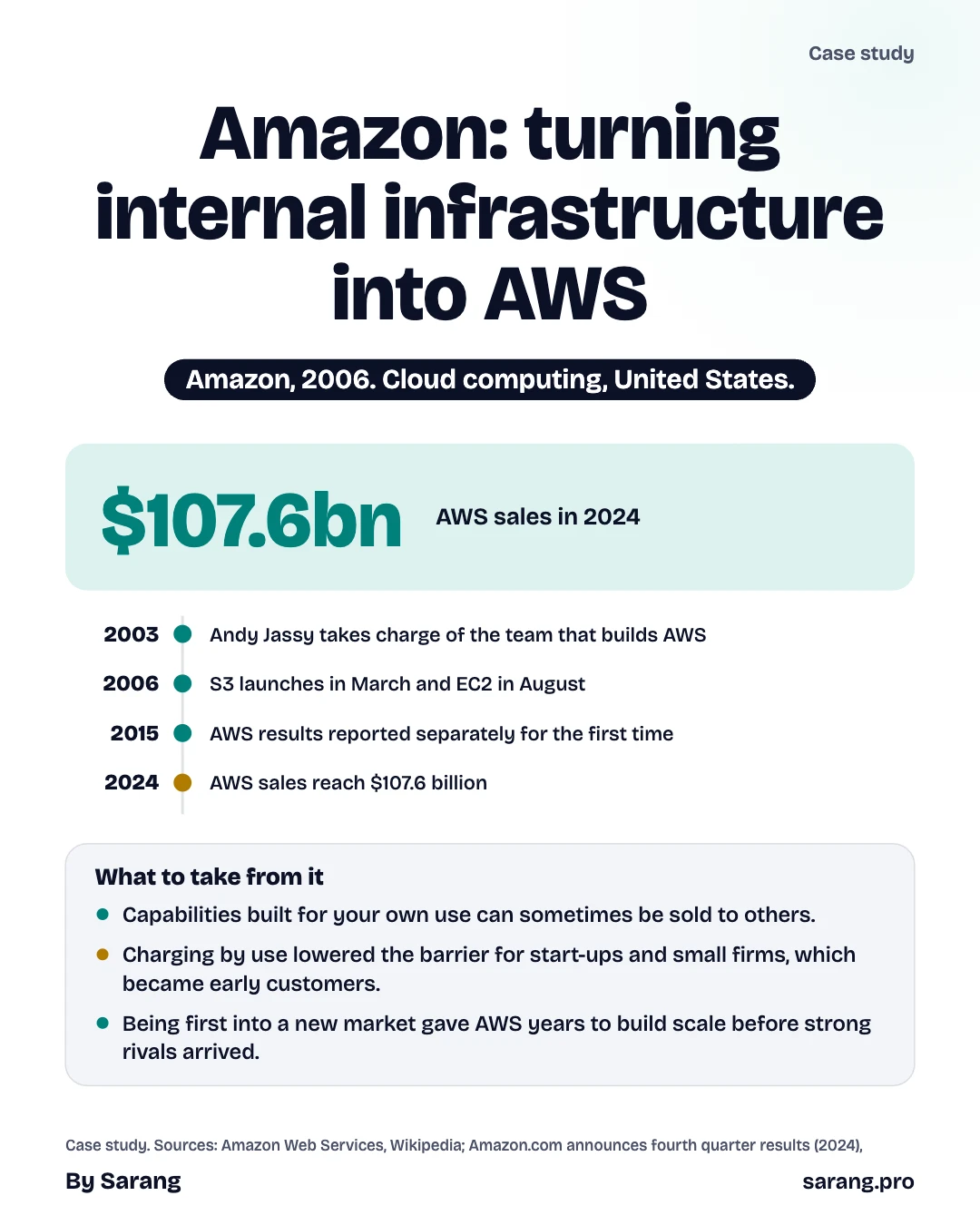
Amazon launched S3 in March 2006 and EC2 that August, and by 2025 AWS reported 128.7 billion dollars of sales and 45.6 billion of operating income.

- S3 storage price per gigabyte per month in 2006, with no minimum fee
- 15 cents
- people who launched S3 and built EC2, according to Andy Jassy
- 13 and 11
- AWS net sales in 2015, up from 3.1 billion in 2013
- 7.9 billion dollars
- AWS share of Amazon operating profit in 2020, on 12% of revenue
- 59%
The situation
On 14 March 2006 Amazon announced a service that had nothing obvious to do with books. Amazon S3, the Simple Storage Service, let any developer store files on Amazon’s computers and pay for what they used: 15 cents per gigabyte per month for storage and 20 cents per gigabyte for data transferred, with no minimum fee. A few months later, on 25 August 2006, the company switched on the first beta instance of a second service, the Elastic Compute Cloud, which rented out computing power by the hour. The business that grew from these two products became Amazon Web Services, or AWS.
The numbers show how far it travelled. In its annual report for 2015, Amazon reported AWS as a separate segment: net sales of 3.1 billion dollars in 2013, 4.6 billion in 2014 and 7.9 billion in 2015, with operating income of 1.9 billion dollars in the last of those years. For 2025 the company reported AWS sales of 128.7 billion dollars and operating income of 45.6 billion, out of group sales of 716.9 billion. A unit that began as a way to stop engineers rebuilding the same tools had, by 2020, supplied 59% of the group’s operating profit on 12% of its revenue.
This case follows how that happened. It asks why a retailer chose to sell its infrastructure rather than keep it as an internal advantage, how it priced and built the product, and what the risks look like now that AWS is a core part of how many other companies run, and a subject of regulatory attention.
Background
A retailer with a web-scale problem
Amazon opened on the web in July 1995. By the early 2000s it was a large online retailer whose website had to cope with sharp swings in traffic. An account of the origins of EC2 records that Black Friday surges forced the company to refine its infrastructure, and that Amazon began looking at building internal services to simplify software production around 2000. In a TechXplore history of AWS, Andy Jassy, who would run the business, recalled that engineers felt they were reinventing the wheel with every project.
Amazon had also started to open parts of its platform to outsiders. On 16 July 2002 it launched Amazon.com Web Services, a free first version for developers and website owners. Outside sites could search and display Amazon products and let visitors add items to Amazon shopping carts, using XML and SOAP. The Associates Program, launched in 1996, then had more than 800,000 enrolled sites. Jeff Bezos said the company was “putting out a welcome mat for developers”, and called it an important beginning and a new direction.
From a platform for sellers to a platform for builders
The step from sharing product data to selling infrastructure was taken in 2003. According to the TechXplore history, Jassy proposed a digital infrastructure division of 57 people that year, and it was approved that autumn with him leading it. Another history places the idea of selling infrastructure services at an executive offsite at Bezos’s house in 2003. In December 2004 Amazon opened an engineering office in South Africa to start building what became EC2, led by Chris Pinkham, a director who wanted to return home.
The team behind S3 was small. In his 2024 letter to shareholders, Jassy wrote that S3 was launched with 13 people and EC2 built with 11. The scale of the company that was building them was large, with group sales of 74.5 billion dollars in 2013 and 107 billion in 2015, but the first products came from small teams.
The industry
The market for renting infrastructure over the internet was young when S3 launched. Werner Vogels, Amazon’s chief technology officer, estimated that early internet entrepreneurs spent about 70% of their engineering time on infrastructure and 30% on products. AWS’s pitch was to cut that share.
The competitors came later. Microsoft launched its cloud division in 2010 and Google followed in 2011, according to the TechXplore history. By the first quarter of 2024, the research group SRG gave Amazon 31% of the worldwide market for cloud infrastructure services, Microsoft 25% and Google 11%. Enterprise spending that quarter was well over 76 billion dollars, up 21% on the year before, and the three leaders held 72% of public cloud between them. SRG described Amazon’s lead as strong, but said Microsoft and Google were growing faster.
The economics of the business are those of heavy fixed investment and large scale. Data centres, networks and chips cost a great deal to build and last many years. Jassy’s 2024 letter said data centres are useful for at least 15 to 20 years, which is why the spending is large up front and earned back over time. In the fourth-quarter release for 2025, Amazon said it expected to spend about 200 billion dollars on capital expenditure across the company in 2026, and noted that free cash flow for the trailing twelve months had fallen to 11.2 billion dollars, mainly because of spending on AI.
Regulation is now part of the picture. The United Kingdom’s Competition and Markets Authority opened a market investigation into cloud services in October 2023 after a referral from Ofcom, published provisional findings on 28 January 2025 and its final decision on 31 July 2025. Its recommendations included that the authority should consider designating Microsoft and AWS, the two largest providers, as having strategic market status under its digital markets powers.
The decision
The decision at the centre of this case was whether to turn tools built for Amazon’s own use into a product for anyone to buy. The sources describe the outcome and some of the reasoning, but not a formal list of options. The alternatives below are the obvious ones, presented as such.
Option one: keep the infrastructure as an internal advantage
Amazon could have treated its infrastructure as a private strength that helped it run its stores faster and more cheaply than rivals. This would have avoided the cost of building a separate customer-facing business. The case against it was in Jassy’s recollection: engineers were rebuilding the same components for every project, which suggested that standard, well-built services had value even inside the company.
Option two: sell tools and data, not infrastructure
The 2002 web services launch shows a half-step. Amazon gave outside sites access to product search and shopping carts, and gave Associates a way to earn referral fees. This extended the retail business and fitted its existing strength. It did not require Amazon to run general-purpose computing for others.
Option three: sell the infrastructure itself, on demand and by usage
The path Amazon took was to offer storage and computing as services priced by use. The S3 announcement is explicit about the terms: storage at 15 cents per gigabyte per month, transfer at 20 cents per gigabyte, no minimum fee, objects from 1 byte up to 5 gigabytes, a reliability target of 99.99% availability. Jassy said S3 was based on the idea that quality internet-based storage should be taken for granted, and that it let developers focus on innovating with data instead of working out how to store it. EC2’s name carried the same logic: computing power that could be turned on when needed and shut down afterwards.
What they did
Web services, 2002
The first step was the free developer platform of July 2002. It established that outsiders could build on Amazon’s systems and gave the company experience of supporting developers, which later became central to AWS.
A dedicated team, 2003 to 2004
In 2003 the infrastructure idea became an organisation. The division Jassy proposed was approved that autumn. In late 2004 Amazon began the work that led to EC2 in a South African office. S3 came about six months before EC2, as a beta.
S3 and EC2, 2006
The S3 launch release set out the product in plain terms. Each object stored got a unique key chosen by the developer, objects could be private or public, access could be granted to specific users, and the service worked through REST and SOAP interfaces. The release also said AWS had more than 150,000 developer sign-ups by then, which gave the new product a ready audience.
S3 launched on 14 March 2006 with early customers that showed the range of uses. A University of California, Berkeley project, Stardust@Home, stored 60 million images to be reviewed by 100,000 volunteers hunting for dust from a comet. A transcription firm, CastingWords, stored audio files and transcripts, and a filmmaking site shared storyboards. The Berkeley project director said the service let the team “quickly ramp up and back down again without a huge investment”. Within two months, the TechXplore history says, the number of stored objects exceeded the expectations of Amazon’s own developers by a factor of 100. EC2 followed on 25 August 2006.
Scale and disclosure, 2013 to 2015
Amazon’s 2015 annual report gives AWS as a separate segment. Its description of the business says it serves developers and enterprises of all sizes, including start-ups, government agencies and academic institutions, and offers a broad set of global compute, storage, database and other services. The table below shows the figures for the three years it covers.
| Year | AWS net sales (million dollars) | AWS operating income (million dollars) | Group net sales (million dollars) | AWS share of sales |
|---|---|---|---|---|
| 2013 | 3,108 | 673 | 74,452 | 4% |
| 2014 | 4,644 | 660 | 88,988 | 5% |
| 2015 | 7,880 | 1,863 | 107,006 | 7% |
The pattern is clear. Sales grew 49% in 2014 and 70% in 2015, while operating income was flat in 2014 and nearly tripled in 2015. Operating margin went from 22% in 2013 to 14% in 2014 and 24% in 2015, calculated from the table.
What happened
Growth
The 2024 shareholder letter puts AWS revenue at 91 billion dollars in 2023 and 108 billion in 2024, up 19%, and notes that ten years earlier it was 4.6 billion. The 2025 figures, from Amazon’s fourth-quarter release, are 128.7 billion dollars of sales for the year, up 20%, and 45.6 billion of operating income, against 107.6 billion and 39.8 billion in 2024. In the fourth quarter alone AWS sold 35.6 billion dollars, up 24%, with operating income of 12.5 billion.
Importance to the group
In 2020, according to the TechXplore history, AWS made up 59% of Amazon’s 22.9 billion dollars of operating profit while contributing 12% of revenue. In 2025 AWS sales of 128.7 billion dollars were about 18% of the group’s 716.9 billion. The release excerpt used here does not give group operating income, so no profit share is calculated for 2025.
Where it sits in the market
By SRG’s count, AWS led with 31% of worldwide cloud infrastructure services in the first quarter of 2024, ahead of Microsoft at 25% and Google at 11%. A figure the TechXplore history quotes from Canalys for 2021 was 31% for AWS, 20% for Microsoft and 7% for Google. The two series come from different firms and are not defined in the same way, so they cannot be read as a trend.
AI and the next round of spending
The 2024 letter says AWS’s AI business was growing at triple-digit annual rates and had reached a multi-billion-dollar annual run rate. It also describes Trainium2 chips offering 30 to 40% better price performance than current GPU-based instances. The cost side is visible in the 2025 figures: capital expenditure planned at about 200 billion dollars for 2026 and free cash flow of 11.2 billion dollars over the last twelve months.
Other views
Dependence and lock-in
Chirag Shah, a professor at the University of Washington, said in the TechXplore history that without these services it is “really hard to be alive as a business”. On leaving, he said it is “not easy to pack things up and go to a different service provider”. He also asked whether customers can really trust a provider that runs their entire business. This is a view from outside the company, and it describes a trade-off that AWS customers accept: lower upfront cost and quick scaling in return for dependence on a single supplier.
Outages
The most visible risk of concentration is failure. On 28 February 2017 the S3 service in the Northern Virginia region stopped serving requests for about four hours and 17 minutes, from 9:37 am to 1:54 pm Pacific time. Amazon’s own account says a team member, debugging a slow billing process, entered one input to a command incorrectly and removed far more servers than intended. Services that depended on S3 were affected, including new EC2 instance launches and AWS Lambda. The status dashboard itself could not be updated for individual services until 11:37 am because its admin console depended on S3.
The incident is worth setting against the 2006 design target. The S3 launch release listed 99.99% availability as the reliability goal. Over a year, that target allows roughly 53 minutes of unavailability. The 2017 event lasted about 257 minutes in one region. A regional outage is not the same as a breach of a contractual commitment, and the sources used here do not give the terms of any customer agreement, so the comparison shows only the size of the gap between a design aim and what one failure can do.
Regulators
The CMA’s final decision in July 2025 closed its market investigation. It recommended that the authority prioritise strategic market status investigations that would consider Microsoft and AWS. The pages used here list egress fees, free switching programmes and licensing as topics of the work but do not give the findings, so this case does not state them. The authority said in January 2025 that it had provisionally found competition concerns in these markets.
Competitors and the limits of the numbers
Amazon’s own 2015 annual report warns that some competitors have greater resources, longer histories and more customers, and that competition may intensify as rivals form alliances. SRG’s 2024 data shows Microsoft and Google growing faster than AWS. The figures also depend on definitions: SRG counts infrastructure and platform services, while Amazon reports its own segment, so the two should not be compared line by line.
Reading it through a framework
Core competence
A core competence is a skill that a company does better than rivals and can apply across several products. Amazon’s was running reliable, large-scale web systems for a retail site with sharp traffic spikes. The TechXplore history supports this: engineers were rebuilding common parts for each project, and the EC2 history points to Black Friday as a stress test. Selling the same capability to others used skills that the company had built for its own needs, and the small teams behind S3 and EC2 show how much could be done with them. The framework also warns that a competence only becomes a business if outsiders value it and it can be packaged. S3’s published prices and design target did that.
Switching costs
Switching costs are what a customer pays to move from one supplier to another. In cloud services they include rewriting software, moving data and retraining staff. Shah’s comment on how hard it is to pack up and go elsewhere is an informal statement of the idea. The regulatory work on egress fees and switching programmes points the same way. The effect for AWS is that early customers who built on it are costly to move, which helps explain why a lead in share can persist even when rivals grow faster. For customers the same effect is a risk, and for regulators it is the reason to look at the market at all.
Since then
AWS has continued to grow while the market has widened. In 2025 it reported 128.7 billion dollars of sales, and its fourth-quarter growth of 24% was faster than the 20% for the year. Amazon said it expects to invest about 200 billion dollars in capital expenditure across the company in 2026, mainly for AI. Jassy, who led the infrastructure division from 2003, wrote the 2024 shareholder letter as Amazon’s chief executive and described data centre investment as spending that is earned back over many years.
The regulatory story has moved on from the CMA’s July 2025 decision. The authority said its board expected to decide in the first quarter of 2026 which strategic market status investigations to prioritise. The sources used here do not report that decision, so it is not described.
What to take from it
- A company can find a new business in the tools it builds for itself, but only if the capability is general enough that outsiders will pay for it.
- Small teams can launch a product that grows very large: S3 was launched with 13 people and EC2 built with 11, according to Jassy.
- Simple, published usage pricing lowers the barrier to trying a new service, as the S3 price of 15 cents per gigabyte per month with no minimum did.
- Segment reporting can change how a business is judged: AWS sales of 7.9 billion dollars and operating income of 1.9 billion in 2015 became visible only once the segment was reported separately.
- Success in infrastructure brings dependence and scrutiny, in the form of outages that spread across customers and regulators who ask whether switching is too costly.
Questions to think about
- What conditions made it sensible for a retailer to sell its infrastructure, and in which other industries could a similar move work?
- AWS operating margin fell in 2014 and then rose in 2015. What could explain that pattern, and which additional data would you want?
- Is vendor lock-in a failure of the market, a normal price of convenience, or both? How should a customer weigh it?
- With capital expenditure of about 200 billion dollars planned for 2026, what would need to be true for the investment to pay off?
Concepts at work
This case draws on core competence, switching costs and economies of scale. Explore them in Insights.
Written from the public sources listed below. Figures are as those sources report them.
Framework
Timeline
- Jul 1995Amazon opens on the web
- Jul 2002Amazon.com Web Services launches, free, for developers
- Autumn 2003Jassy's infrastructure division approved
- Dec 2004Amazon opens an engineering office in South Africa to build what became EC2
- 14 Mar 2006Amazon S3 launches
- 25 Aug 2006First EC2 beta instance switched on
- 2010Microsoft launches its cloud division
- 2011Google follows
- 2015Amazon's annual report shows AWS as a separate segment: 7.9 billion dollars of sales
- 28 Feb 2017S3 outage in Northern Virginia lasts about four hours and 17 minutes
- 31 Jul 2025UK CMA publishes its final cloud market decision
- 2026Amazon reports AWS sales of 128.7 billion dollars for 2025
Recap cards
Tap a card to check yourself.
Sources and credits
- Amazon (press release): Amazon.com launches web services (July 2002)
- Amazon (press release): Amazon Web Services launches Amazon S3 (14 March 2006)
- TechXplore: In the 15 years since its launch, Amazon Web Services transformed how companies do business
- DP Tribune: How Amazon EC2 grew from a notion into a foundational element of cloud computing
- Amazon (SEC Form 10-K): Annual report for 2015
- Amazon: Andy Jassy 2024 letter to shareholders
- Amazon (investor release): Amazon.com announces fourth quarter results (2025)
- Synergy Research Group: Huge cloud market sees a strong bounce in growth rate (30 April 2024)
- AWS: Summary of the Amazon S3 service disruption in the Northern Virginia region (28 February 2017)
- UK Competition and Markets Authority: Cloud services market investigation



