Dollar Shave Club: a $4,500 video and a $1bn sale
Dollar Shave Club made a razor-subscription start-up from a $4,500 launch video, took share from Gillette, and was bought by Unilever in 2016 for a reported $1bn.
- Reported cost of the 2012 launch video
- $4,500
- Sign-ups on the day the video went up, per Time
- 5,000
- Members at the time of the Unilever deal in July 2016
- 3.2m
- Reported cash price paid by Unilever, about five times expected revenue
- $1bn
The situation
On 19 July 2016, Unilever agreed to buy Dollar Shave Club. Fortune reported that the price was $1bn in cash, citing several sources, because the two companies did not publish the terms. The target was a five-year-old business that sold razors by post for a few dollars a month. It had about 3.2 million members, according to Fortune later that week, and the same article said the price was roughly five times the revenue the company was expected to make that year. Fortune also reported that Unilever approached Dollar Shave Club, not the other way round.
The reaction was sharp because of who had been hurt. Gillette, owned by Procter & Gamble, had held about 70 per cent of the US market for razors and blades. Fortune reported that P&G’s share of North American razors and blades fell from 71 per cent to 59 per cent in the five years after Dollar Shave Club launched. The company that had spent about $750 million developing a single razor in the late 1990s had lost ground to a start-up whose first video cost $4,500.
This case follows how that happened: a founder with an improv background, a cheap razor from an overseas supplier, a funny video, and a subscription model that took a product people bought rarely and in a hurry and made it a monthly habit. It also looks at the limits. The sale price rested on a strong brand and a customer list, not on proven profit, and the new owners later sold most of the business.
The decision at the centre has two sides. For Dollar Shave Club it was whether to stay independent or sell. For Gillette it was how to respond to a rival that undercut its prices by a wide margin without damaging a premium brand.
Background
The founders
Michael Dubin trained as an improv performer at the Upright Citizens Brigade in New York and worked in digital marketing. Forbes, in April 2012, said he had been marketing director at Feed Company, which seeded online videos for brands including Capital One, Ford and Gillette. His co-founder Mark Levine came from manufacturing and was 56 at the time. They met at a party in 2010 and began working on the business full time in January 2011, according to the same article.
The money
Forbes said the founders put in $45,000 of their own money and accepted $100,000 from Science, a Los Angeles incubator. Time identified the founder of Science as Mike Jones, a former chief executive of Myspace. The company then raised $1 million from investors that Forbes named as Kleiner Perkins, Andreessen Horowitz, Shasta Ventures and others. Fortune’s 2016 report says Forerunner Ventures led the seed round, which is a different account. The two articles may describe different parts of the same round. By 2016 the company had raised more than $160 million in venture capital, with Venrock leading the Series A and B and Technology Crossover Ventures the two later rounds. The latest round, in November 2015, valued it at $539 million, Fortune said. The Washington Post, a few months earlier, had put the figure at about $600 million.
The product
The company sold three plans. Time listed them in March 2012: the Humble Twin at $1 a month for five two-blade cartridges, with shipping extra; the 4X at $6 a month for four four-blade cartridges with shipping included; and the Executive at $9 a month for three five-blade cartridges, also with shipping. Forbes quoted the entry price as $2 and said the Executive worked out at about $3 per unit including shipping. The difference is most likely down to shipping charges on the cheapest plan. Forbes also reported that 35 per cent of customers chose the cheapest plan.
Forbes said the company designed its razors, had them manufactured overseas and shipped them itself. Dubin told Forbes it was not hard to copy the techniques of the big companies and that “Razor technology is out there for anybody to duplicate.” In a 2015 report on Gillette’s patent suit, the Boston Globe noted that Dorco, a South Korean manufacturer that supplies Dollar Shave Club, had sold coated blades around the world for more than a decade, according to the investor David Pakman.
The industry
The Washington Post put the US shaving business at about $3.3 billion in 2015 and said Gillette held 68 per cent of the US market for razors and blades. These are products that cost little to make and carry high margins. The model, which the Post described, is to give away or discount the handle and earn money on the refill blades. Gillette had long sent free razors to American men on their 18th birthdays and absorbed the loss on handles to profit from the blades. It invested heavily in technology: about $750 million to develop the Mach3 in the late 1990s and about $300 million to promote it in its first year. The Post noted that Gillette had been raising prices every year, which the paper said pushed shoppers towards the web.
The retail experience shaped the market too. Forbes’s reporter spent about $40 a month on blades and found a Gillette Fusion ProGlide at over $5 per razor at a New York Walgreens. Razors were, the article said, the fifth most shoplifted product in the US. Cartridges kept behind locked cases or glass doors are an obstacle that a delivery service avoids.
Online sales were small but growing fast. Slice Intelligence told the Boston Globe that online razor and blade sales rose 70 per cent to $189 million between 2013 and 2014. In 2015 Dollar Shave Club held nearly 53 per cent of online razor and blade sales, the same research found, against 20 per cent for Gillette and 10 per cent for Harry’s, a rival subscription start-up. Euromonitor, cited in the same report, put Gillette’s share of the whole US men’s market at nearly 70 per cent. Taken together these figures show a small online channel dominated by the upstart, inside a large market still dominated by the incumbent.
Gillette’s parent was under pressure as well. The Boston Globe reported that P&G’s grooming division, which includes Gillette, Braun and Venus, saw net sales fall 14 per cent to $1.7 billion in one quarter of 2015 compared with a year earlier. P&G does not report Gillette’s shaving sales separately.
The decision
Two decisions matter here: the one Dollar Shave Club’s founders took about how to enter the market, and the one Unilever and P&G took in response.
Option one: compete on technology
The obvious route for a razor start-up was to build a better blade. That would have meant research budgets of the kind Gillette spent on the Mach3, and it would have put a small company in a fight where the incumbent was strongest. Dubin rejected it by saying that razor technology was available to anyone. The company chose to present itself as good enough and cheap.
Option two: compete on price and convenience
The route taken was to sell a decent razor at a price well below the shelf, deliver it, and make the purchase automatic. Forbes said the company sold for almost half the price of big-name competitors. Because customers subscribe, the company knows who they are and when they will buy again, which is something a retailer’s supplier does not usually learn.
Option three: sell, or stay independent
By 2016 the company had the money to continue. It had raised over $160 million and its latest round valued it at $539 million. Selling to Unilever would give it a large parent with distribution and a place in a wider personal-care business. Fortune said the deal was expected to speed up expansion into new geographies and strengthen distribution in existing ones, and that Dubin would continue as chief executive with the company staying independent for its direct-to-consumer razor business. Dubin was quoted as saying that Unilever’s category expertise was unmatched.
The incumbent’s choice
Gillette could cut its prices, copy the subscription model, or sue. It did all three, in this order: a Gillette Shave Club in 2015, a patent suit in December 2015, and price cuts in 2017. The Fortune column of 21 July 2016 said P&G treated personal care as nearly disruption-proof, and relayed what an unnamed source told the Wall Street Journal: the threat “was probably on the radar, but we weren’t necessarily having the right conversation” about what might disrupt the company.
What they did
2010 to 2011: forming the company
Dubin and Levine met in 2010 and began full-time work in January 2011, as Forbes reported. The founders spent $45,000 of their own money on product, web development and marketing.
March 2012: the video
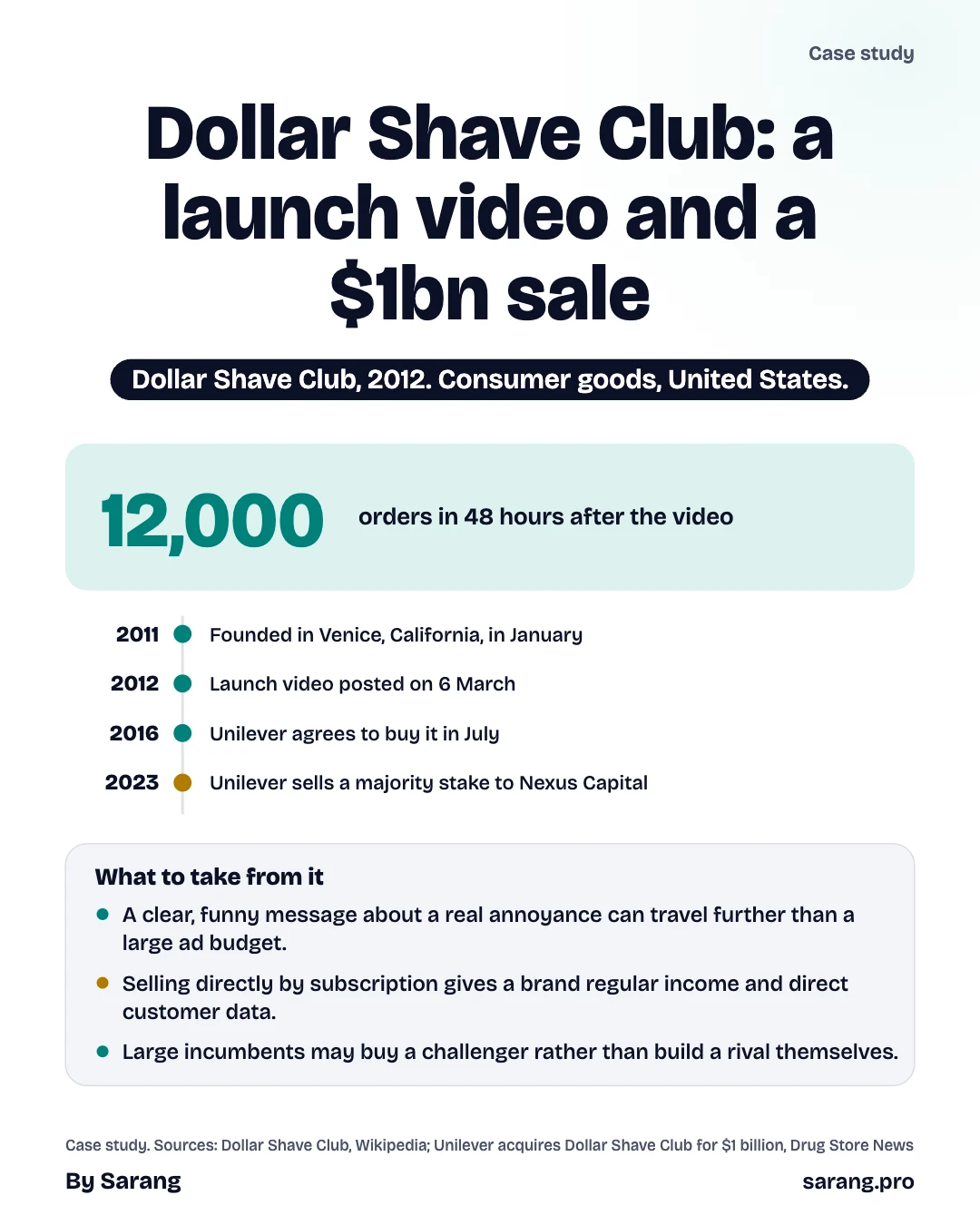
The launch video made the company. Forbes said it cost $4,500 and credited Dubin’s improv background for much of its success. In the clip Dubin asks viewers whether their razor needs “a vibrating handle, a flashlight, a back-scratcher, and 10 blades”. Time reported two million YouTube views in the first four days and about 5,000 sign-ups on the day it went up. Forbes counted about 4 million views by 3 April. Dubin declined to give sales figures, saying only that “tens upon tens of thousands of people” paid monthly, and the Forbes writer estimated revenue of about $200,000 a month on the assumption of 50,000 customers at an average of $4, which the writer labelled an assumption. A figure of 12,000 orders in 48 hours is widely repeated, but it could not be traced to a source opened for this case, so it is not used.
2012 to 2015: money and growth
The company raised $1 million in 2012 and then larger rounds. Forbes in April 2012 reported five employees with a goal of 15 by the end of the year, plans to add shaving cream and moisturiser, and ambitions in the women’s market, the UK and Canada. Boston Globe reported 2.4 million members in November 2015. The Washington Post said the company had signed up more than two million subscribers by December 2015, about one tenth the size of Gillette’s customer base but growing quickly.
December 2015: Gillette sues
On 17 December 2015 P&G filed a patent suit in federal court in Delaware. It alleged that three Dollar Shave Club razors, the Humble Twin, the 4X and the Executive, used a patented formula for coating blades, including those used on Gillette’s Fusion line. It sought an order stopping the use of the formulas and damages to be set by a judge. A P&G spokeswoman, Kara Buckley, said the suit was not about squelching competition. Dollar Shave Club declined to comment. The suit came after Gillette had launched Gillette Shave Club, a subscription service, earlier in 2015.
July 2016: the sale
Unilever’s agreement came seven months later. Fortune reported that Dubin said Dollar Shave Club could not be happier to have “the world’s most innovative and progressive consumer-product company” in its corner. Unilever got a brand with 3.2 million members and, as Fortune’s columnist Geoff Colvin pointed out, a stream of direct customer data.
What happened
The incumbent’s response
On 23 February 2017 Fortune reported that P&G would cut prices on some Gillette razor blades by as much as 20 per cent from 20 March. Chief financial officer Jon Moeller said the company would make pricing interventions to place its brands at every level of the price ladder. In November 2017 CNN Business reported that Gillette would launch two cheaper razors, the Gillette3 at $8 and the Gillette5 at $10, in January, along with a Sensor3 Cool disposable from $5. It also said Gillette had expanded Gillette on Demand, a text-message delivery service, and that Gillette’s US razor share had fallen 11 per cent over two years, according to a Macquarie Research report, to about 56 per cent. P&G’s grooming sales had slipped 6 per cent in the latest quarter.
Analysts blamed the delay. Joe Agnese of CFRA Research said Gillette was poorly positioned to defend its share as consumers moved to cheaper razors. Erin Lash of Morningstar said consumers would not pay up when they could not see the added value. Nelson Peltz’s Trian Partners, which Fortune reported had taken a $3.5 billion stake in P&G in February 2017, wrote of a lack of innovation and competitive response, and said Gillette was playing catch up.
The new owner’s years
| Date | Event | Source |
|---|---|---|
| Nov 2015 | 2.4 million members; valuation $539 million | Boston Globe, Fortune |
| Jul 2016 | 3.2 million members; sale to Unilever for a reported $1bn | Fortune |
| Mar 2017 | Gillette price cuts of up to 20 per cent begin | Fortune |
| Nov 2017 | Gillette share about 56 per cent; new $8 and $10 razors announced | CNN Business |
| 26 Oct 2023 | Unilever announces sale of a majority stake to Nexus Capital Management | Unilever |
Unilever announced on 26 October 2023 that it would sell Dollar Shave Club to Nexus Capital Management, a Los Angeles private equity firm founded in 2013, and keep a 35 per cent minority stake. Fabian Garcia of Unilever described the sale as a step in moving its portfolio towards core strategic growth areas. Financial terms were not disclosed, and the release gave no revenue or membership figure. Nexus pointed to the brand’s loyalty, its direct-to-consumer model and its presence across channels.
Other views
Did the video do the work?
The popular version of the story says a funny video built a billion-dollar company. The sources suggest a more mixed picture. The video drew millions of views and thousands of sign-ups in days, but Forbes reported that the company had raised $1 million at that point, and it took until 2015 to reach more than two million members. The video was the start, not the finish. The subscription model and a price well below the shelf did the slower work of keeping customers.
Was $1bn a good price?
Fortune’s columnist said the price was about five times expected revenue, and argued that Unilever valued the direct customer data. Another reading is that Unilever paid for a brand that could take share from an incumbent and reach new customers online. Seven years later it sold a majority stake, and neither side disclosed terms, so the sources do not let us judge the return. What can be said is that a business bought for $1bn in 2016 was sold with undisclosed financial terms in 2023.
The lawsuit and the limits of a moat
Gillette’s patent claim suggested that its coated-blade technology gave it some protection. The Boston Globe’s coverage points the other way: the venture capitalist David Pakman said Dorco had sold coated blades for over a decade. A patent suit is a signal of concern, not proof of a strong moat. The Washington Post’s description of Gillette’s economics, where the handle is cheap and the blade is expensive, also shows how exposed the model was to a rival offering cheaper blades.
The incumbent’s own account
Gillette was not simply asleep. The Washington Post and Boston Globe both note that it launched its own subscription service in 2015, and by 2017 it had cut prices and launched cheaper products. Colvin’s view in Fortune was that P&G believed personal care was nearly immune to disruption, and he said he shared that view. His own words were that even he thought it was impossible for a start-up to disrupt Gillette.
Reading it through a framework
Disruptive innovation
Clayton Christensen’s theory describes entrants who start with a product that incumbents’ best customers do not want, usually simpler and cheaper, then move up. Dollar Shave Club fits the first half. Its Humble Twin was a two-blade razor at $1 a month, and the 4X and Executive plans were priced against Gillette’s premium range. Dubin’s line about vibrating handles and ten blades argued that the premium features were more than many men needed. Gillette’s own investment in technology, such as the Mach3 and the $12 ProGlide FlexBall that the Washington Post described, made its range expensive.
The match is not perfect. The entrant did not stay at the bottom: it added the Executive plan and, by Forbes’s account, planned shaving cream, moisturiser and a women’s range. Also, Christensen’s account would predict the incumbent to ignore the threat because the margin on a low-end product is small. P&G’s response over 2015 to 2017 was to launch a subscription, litigate, and cut prices, which is a faster reaction than the theory expects, though still after the share loss.
Switching costs and the razor-and-blades model
The razor-and-blades model works because the handle locks the customer into a cartridge family. A subscription adds a second kind of lock: habit and convenience. A customer who receives blades every month does not go to a shop, does not compare prices at a shelf, and does not run out. Dollar Shave Club turned a purchase made on impulse at the shelf into a recurring decision made once.
The framework also shows where switching costs are weak. Cartridges that fit a competitor’s handle make it easy to leave, and a rival such as Harry’s, with 2.6 million active members according to the Boston Globe, offered nearly the same thing. The subscription model also makes cancellation a one-click act in principle. The company’s value therefore rested on brand, price and service rather than on a technical lock-in.
Since then
Unilever owned Dollar Shave Club from 2016. In October 2023 it announced the sale of a majority stake to Nexus Capital Management while keeping 35 per cent. Axios reported in September 2025 that the company had moved its headquarters from Los Angeles to Durham, North Carolina, leasing 17,500 square feet at the American Tobacco Campus with room for about 80 staff. The chief executive, Larry Bodner, joined in 2023. The company was revamping its razor line, had launched a new advertising campaign and was planning new products and possible acquisitions in personal care. Axios did not report revenue or membership.
The wider market kept moving. After Gillette’s 2017 price cuts and new low-price razors, the rivals remained: Dollar Shave Club, Harry’s and others named in the CNN report. Colvin’s advice to incumbents, in the 2016 Fortune column, was to stop asking whether disruption could happen to them and ask how it will.
What to take from it
- A product people buy by habit and at a high markup is open to a rival who offers an adequate version at a much lower price and removes the shopping trip.
- A cheap video can attract attention, but the business has to be able to serve the orders that follow; Dollar Shave Club had a supplier and a subscription system ready to handle them.
- Incumbents tend to answer late and in pieces: a subscription copy, then a lawsuit, then price cuts, each after the share had already moved.
- Customer data and a direct relationship can be worth a large premium to an established company, which is how Fortune explained a price of about five times expected revenue.
- A high sale price does not guarantee that the buyer keeps the business; Unilever sold most of it seven years later on undisclosed terms.
Questions to think about
- Dubin said razor technology was available to anyone. What does a start-up need to own, if not technology, to keep a lead?
- Was Gillette’s slow response a failure of information, of incentives, or of belief? What evidence in the sources points to each?
- If you were advising Unilever in 2016, what would you want to know that the sources here do not report, such as profit, churn and repeat orders?
- How should a company decide when to cut price on a premium brand, and what did Gillette risk by doing so in 2017?
Concepts at work
Three ideas run through this case: disruptive innovation, switching costs, and the razor-and-blades pricing model. Explore them in Insights.
Written from the public sources listed below. Figures are as those sources report them.
Framework
Timeline
- 2010Dubin meets Levine at a party
- Jan 2011Both begin working on the company full time
- Mar 2012Launch video released; about 5,000 sign-ups on day one
- 2012$1 million seed round
- 2015Gillette Shave Club launched
- Nov 20152.4 million members; valuation of $539 million
- 17 Dec 2015P&G sues Dollar Shave Club for patent infringement
- 19 Jul 2016Unilever agrees to buy the company for a reported $1bn
- 20 Mar 2017Gillette price cuts of up to 20 per cent start
- Nov 2017Gillette announces $8 and $10 razors; US share about 56 per cent
- 26 Oct 2023Unilever agrees to sell a majority stake to Nexus Capital Management
- Sep 2025Headquarters moves from Los Angeles to Durham, North Carolina
Recap cards
Tap a card to check yourself.
Sources and credits
- Time: Dollar Shave Club, a start-up's viral ad (12 Mar 2012)
- Forbes: Dollar Shave Club, breaking the razor blade monopoly (3 Apr 2012)
- Boston Globe: Gillette sues Dollar Shave Club for patent infringement (17 Dec 2015)
- Washington Post: Gillette's lawsuit could tilt the battle for America's beards (18 Dec 2015)
- Fortune: Unilever buys Dollar Shave Club for $1 billion (19 Jul 2016)
- Fortune: How P&G missed out on Dollar Shave Club's rise (21 Jul 2016)
- Fortune: Why Procter & Gamble is shaving the price of its Gillette razors (23 Feb 2017)
- CNN Money: Gillette unveils new, cheaper razors to keep Dollar Shave at bay (29 Nov 2017)
- Unilever: Unilever announces the sale of Dollar Shave Club (26 Oct 2023)
- Axios Raleigh: Dollar Shave Club shifts HQ from LA to Durham (9 Sep 2025)