Coca-Cola: New Coke lasted 79 days before the original formula came back
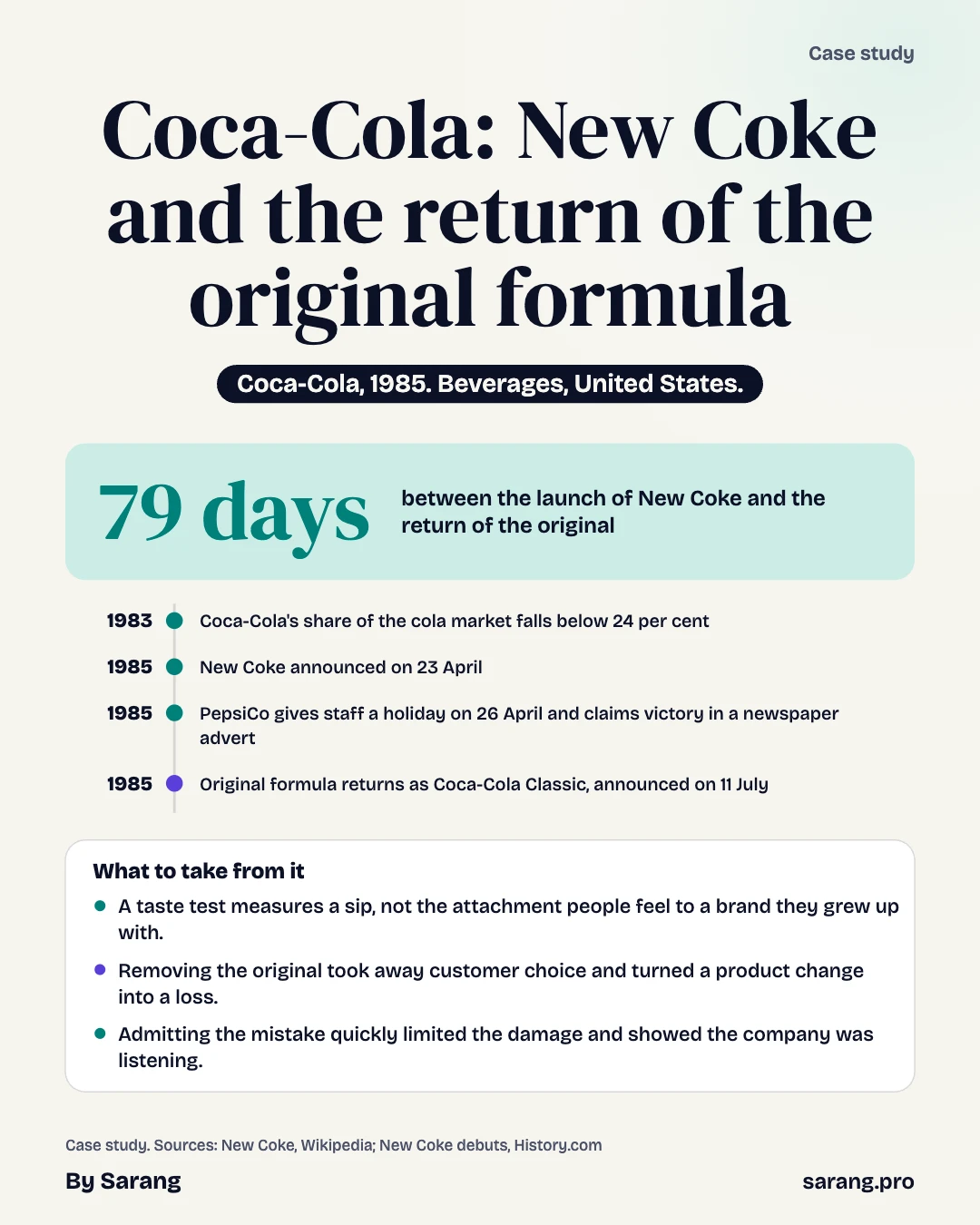
In April 1985 Coca-Cola replaced its 99-year-old formula after taste tests favoured a sweeter drink, then brought the original back 79 days later after thousands of calls a day.
- Age of the original formula when it was changed
- 99 years
- Coke share of the US soft-drink market in 1984, against Pepsi at 18.8%
- 21.8%
- People who preferred the new taste in company tests, by the company's account
- Nearly 200,000
- Calls a day to the company at the peak
- Up to 8,000
The situation
On 23 April 1985, The Coca-Cola Company announced that it was changing the formula of its flagship drink for the first time in 99 years. The new version was sweeter than the old one. Chairman and chief executive Roberto Goizueta called the move “the surest move ever made”, according to the Atlanta Journal-Constitution’s 2025 look back. The company had tested the new taste on nearly 200,000 people, by its own account, and says most of them preferred it.
Within days the mood turned. History.com reports that the company received up to 8,000 calls a day and about 40,000 letters of complaint. One letter was addressed to the “Chief Dodo” of the company. Protest groups formed, among them the Old Cola Drinkers of America, which claimed 100,000 members. On 10 July 1985 ABC’s Peter Jennings interrupted the soap opera General Hospital to say that the original recipe was coming back, under the name Coca-Cola Classic. It returned to shelves on 11 July, 79 days after the change.
The story is often told as the biggest marketing blunder in history. The sources give a more mixed picture. The new drink sold reasonably in some tests, the company recovered quickly, and some people who worked on the project and later historians argue that the real lesson is not about taste at all. This case looks at why a company with a 99-year-old product and a large research budget changed it, what the research could and could not measure, and what the reversal tells managers about customers who are attached to a brand.
| Measure | Figure | Source |
|---|---|---|
| Coke share of US soft-drink market, 1948 | About 60% | Time, 2015 |
| Coke share, 1984 | 21.8% | Time, 2015 |
| Pepsi share, 1984 | 18.8% | Time, 2015 |
| Launch to reversal | 79 days | History.com; Time |
| Peak daily calls to the company | Up to 8,000 | History.com; Time |
| Letters of complaint | About 40,000 | History.com |
Background
A single product for 74 years
John Pemberton created the original formula in Atlanta in 1886 and sold it to Asa Candler, whose salesmen had put Coca-Cola on sale in every state by 1895, according to the Time account. The company then grew through licensed bottlers. Time says there were about 1,200 of them by the 1920s, which spread the drink across rural America. Phil Mooney, a company archivist who retired in 2013, told the Atlanta Journal-Constitution that Coca-Cola was the company’s only product from 1886 until 1960. That fact helps explain why the drink was treated almost as a national object rather than as one item in a range.
The attachment was strongest in the South. Time reports that resistance to New Coke was fiercest there, where the original formula was a matter of regional pride. Historian James Cobb, quoted in the same article, reads the backlash as a reaction by people who felt their control over an everyday choice had been taken away.
The challenge from Pepsi
The company’s share of the American soft-drink market fell from about 60 per cent in 1948 to 21.8 per cent in 1984, while Pepsi reached 18.8 per cent, the figures Time cites from the New York Times. Part of the shift came from changes in how people bought soft drinks. Time notes that supermarkets handled three-quarters of grocery sales by 1982 and that fast-food chains tended to stock whichever brand was most popular, which turned shelf and menu space into a contest.
Pepsi also attacked directly. Its Pepsi Challenge, launched in 1975, asked people to take sips from unmarked cups and pick a winner. The Mediavillage piece on the Classic return says the campaign helped start the “cola wars” and worried Coca-Cola’s executives. Pepsi’s sweeter taste is the explanation Time gives for its gains, and Mother Jones adds that Coke was losing sales in shops even though it still did well in places where customers had no choice of brand, such as restaurants. Coke had also been slow to follow Pepsi in other ways: Diet Pepsi appeared in 1964, and Diet Coke came 18 years later, Mother Jones notes.
The industry
Cola in the early 1980s
Soft drinks in the United States were a two-brand fight at the top. The prize was repeat purchase by people who drank cola every day, and the two firms competed through advertising, price promotions and control of the places where cans and bottles were sold. Sales happened in two quite different settings. Mother Jones says Coke was losing store sales to Pepsi while still selling well in captive markets such as restaurants, where the customer does not pick between brands. In supermarkets, where shoppers compared brands on the shelf, the Pepsi taste advantage showed in sales.
Taste as the battleground
Because Pepsi chose to compete on blind taste tests, Coke’s managers had a problem that went beyond sales figures. The more Pepsi advertised sip-test wins, the more the original formula looked like a weaker product. Time says the new formula was meant to counter Pepsi’s gains and that consumer experts saw the change as risky. Pepsi-Cola chief executive Roger Enrico later said, as ABC7 reports, that the episode taught Coca-Cola it was a caretaker of its heritage and could not simply change its flagship’s taste or image. He had every reason to say so, which readers should bear in mind.
Bottlers and distribution
Coca-Cola had grown through licensed bottlers, about 1,200 of them by the 1920s according to Time. The sources describe the pressure of 1985 in terms of public anger rather than bottler finances, so this case leaves the economics of the bottling system aside.
The decision
Inside Coca-Cola the question was how to reverse the slide in share. Mother Jones reports that the project was code-named Kansas, and that planners drew on the way the D-Day landings were planned. The sources do not set out a formal list of options, so the alternatives below are the obvious ones, framed as such.
Option one: leave the formula alone and fight with marketing
The company could have kept the original formula and spent more on advertising, price promotion and shelf space. This had the advantage of leaving a 99-year-old asset untouched. Its weakness was the one Pepsi’s challenge exposed: if consumers kept choosing the other cup in sip tests, advertising alone would be pushing against the evidence. There is no sign in the sources that the company treated this as a serious choice, although it did launch Diet Coke in 1982, which is a line extension rather than a change to the flagship.
Option two: add a second, sweeter cola beside the original
The company could have launched the new formula as a separate product and kept the old one on sale. This is the route that the later Cherry Coke and Diet Coke launches took. A second product would have tested the market without risk to the original. The Henry Ford museum’s account notes that the company later credited the return of the original with a large sales gain, although studies suggested the quiet rollout of Cherry Coke was the main driver. That suggests line extension was already working for the firm. The sources do not explain why it was set aside for the flagship, though one reason is plain from the way the project was framed: management wanted one answer to Pepsi, in one drink.
Option three: replace the original
This is what the company did. The case for it was that the company’s own research, and Pepsi’s, showed that people preferred a sweeter taste. The case against it was that nobody had a way to measure what the old drink meant to its users. Donald Keough, the company’s president, said afterwards, as reported by Time, that the company could not measure the emotional attachment people felt. The Henry Ford account makes the same point: the core problem was the removal of the original, and blind taste tests did not capture the attachment.
What the research said
According to the company, quoted in the ABC7 account, nearly 200,000 customers preferred the new formula in tests before launch, and the same account says these tests did not capture consumers’ emotional bond with the original. Mother Jones adds detail: New Coke beat the old version in tests nationwide, although in the South its lead was narrow, 52 to 48, and when testers were told which sample was which, New Coke’s popularity rose nine points. Phil Mooney argued to the Atlanta Journal-Constitution that quick sip tests mislead because people tend to prefer the sweeter sip, yet may feel differently about drinking a whole can every day. Mother Jones disputes this partly, saying many people still prefer Pepsi after a full can and that surveys after launch matched the sip results. The evidence on taste itself is therefore disputed.
What they did
23 April 1985: the announcement
Goizueta announced the change in New York. Time reports that he described the new formula as “bolder”, “rounder” and “harmonious”, and that he did not say it was sweeter. The label on the can said Coke, with “new” marking the formula, according to the ABC7 account. The company’s message was that consumer interest in Coke, and in cola generally, was falling, and that this change would win people back.
May and June 1985: the backlash
Public anger spread within days. Protesters at a May giveaway in Atlanta’s Woodruff Park carried signs, and the Atlanta Journal-Constitution quotes one that read “Our Children Will Never Know Refreshment”. People poured the new drink away, hoarded the old one and complained to a company phone line. ABC7 reports one man in San Antonio buying $1,000 worth of the old Coke from a local bottler. Two groups formed: the Society for the Preservation of the Real Thing and the Old Cola Drinkers of America. Time records critics comparing the change with burning the flag or rewriting the Constitution.
Mother Jones offers a more sceptical picture. It argues that the critics were a small group amplified by the media. Gay Mullins, who founded Old Cola Drinkers of America, claimed 100,000 members, sold “war kits” and ran a complaint line. The article says he asked Coke for a $200,000 endorsement, which Coke declined, and that membership in his group fell by 90 per cent after New Coke was dropped. It adds that early signs for the new drink were good: sales rose in Miami and Detroit, and weekly phone surveys of 900 consumers showed high favourability.
10 and 11 July 1985: the reversal
On Wednesday 10 July, Peter Jennings broke into General Hospital to announce that the original recipe would come back. Mediavillage says the original formula was taken out of a bank vault and relaunched that afternoon, though this detail comes from a single source and the company’s own accounts speak of the return on 11 July. The old drink was renamed Coca-Cola Classic and sold beside the new one. ABC7 says the news led two network newscasts and appeared on the front page of many major papers.
After July: two colas on one shelf
For a period the two drinks shared shelves. The Henry Ford account says New Coke was renamed Coke II in 1992 and sold alongside Classic until 2002, and that the Classic name was dropped in 2009. The AJC puts the end of New Coke in the early 2000s.
What happened
Sales and share
The sources agree that Classic sold strongly after its return. History.com says it quickly regained its place as the dominant cola, and Mediavillage says market share rebounded. The Henry Ford account says the company credited Classic’s return for a large sales increase that year, but later studies suggested that the quiet rollout of Cherry Coke was the main driver. The sources listed below do not give audited figures for sales or share in 1985 or 1986, so the size of the recovery is left unquantified here.
What it cost
The Henry Ford account says the company spent over $4 million on development, testing and marketing. ABC7’s source says Coca-Cola lost millions in research and advertising but got about three times as much in free publicity, a claim that is difficult to check and which that account presents as an opinion. A second view, in the same account, is that the episode indirectly put Coca-Cola back at the top of the beverage industry, and that conspiracy theorists claim this was planned. Mooney, in the AJC, offers a plainer lesson: listen more closely to consumers.
The company’s own verdict
At a 1995 meeting marking ten years since the launch, Goizueta described the episode as “taking intelligent risks”, History.com reports. Keough’s earlier line, that the company could not measure the emotional bond, remains the clearest statement of what the research missed.
Cultural afterlife
New Coke has stayed in public memory. The AJC notes that a Harvard Business School case summary called it “marketing’s most famous public disaster”.
Other views
It was a taste problem
The simplest reading is that people did not like the new drink. The evidence does not support that strongly. Blind tests favoured New Coke, early sales were healthy in some cities, and Mother Jones reports that recent tastings have rated New Coke favourably. The same article suggests that this may be because it resembles today’s Diet Coke.
It was a research problem
The company’s own explanation, and Mooney’s, is that sip tests overstate the appeal of sweeter drinks and ignore the daily experience and emotional value of the original. The Mother Jones article cites Malcolm Gladwell’s view, from his book Blink, that first-sip tests favour sweet drinks. The article’s counter-argument, that post-launch surveys matched the sip results, shows that the research was not simply wrong about taste, but that it asked the wrong question.
It was a social problem
Mother Jones argues that the backlash was less about soda than about a sense of dispossession and resistance to change, and that Coke underestimated how far a few loud critics could sway neutral buyers. The author, drawing on Thomas Oliver’s 1986 book The Real Coke, The Real Story, says the backlash had a Southern reactionary tone. This is an interpretation, and a contested one, since the article also notes that many protesters’ complaints were really about wider cultural changes.
It was a strategy problem
A fourth view is that the company confused two jobs. One was to answer Pepsi in the supermarket aisle. The other was to look after the oldest product in its portfolio. The sources do not use these words, but Enrico’s remark about being a caretaker of heritage, and Mooney’s note that there was only one product for 74 years, point at the same tension.
Limits of the evidence
Most of what is known about the internal decision comes from the company, from books written soon after, or from journalists reflecting years later. The sources disagree on small points: ABC7 and History.com put the interval at 79 days, while at least one account elsewhere gives 77. The cost figure is incomplete. Readers should treat the numbers as indicative.
Reading it through a framework
Jobs to be done
The jobs-to-be-done lens asks what customers hire a product to do. Coca-Cola’s research treated the job as refreshment with a pleasant taste, a job the sweeter formula did well in a sip. The sources suggest that for many drinkers the job also included continuity, regional identity and something familiar to reach for. The Henry Ford account says the core problem was the removal of the original. Keough’s admission that the attachment could not be measured shows that the company had tested the product’s function but not its meaning. Classic then served the second job, and New Coke, once the original was back, could be bought by those who simply liked the taste.
Porter’s five forces
Porter’s five forces help to explain why the company felt it had to act. Rivalry was intense, since Pepsi had reached 18.8 per cent against Coke’s 21.8 per cent. The power of buyers was growing because supermarkets handled three-quarters of grocery sales and fast-food chains stocked the most popular brand. In captive channels the company kept pricing power, but in supermarkets, where shoppers chose freely, it was losing. The threat of substitutes included diet and other drinks, and the company’s late move on diet cola is the sign of it. The framework also shows why a line extension might have been safer: it addressed rivalry without putting the whole base of loyal buyers at risk.
Since then
New Coke became Coke II in 1992 and was sold until 2002, according to the Henry Ford account. In 2019 Coca-Cola brought it back for a short time in a tie-in with the Netflix series Stranger Things, which was set in 1985. CBS News reported the return on 21 May 2019, ahead of the 4 July release of the third season, and the AJC adds that it was offered as a gift with purchase from the company’s online store. In 2025 the AJC marked 40 years since the launch, noting that Coca-Cola declined to comment on the anniversary. Mooney told the paper he doubted a protest over a new taste today would be as extreme as it was in 1985.
What to take from it
- Research that measures the product can miss what the product means, so a company with a heritage brand should test for attachment as well as for taste.
- A winning result in a blind sip test does not show that people will prefer the drink when they know the brand, drink a whole can and have to give up the old version.
- Adding a second product usually carries less risk than replacing the first, because customers keep the choice they had.
- A fast, public reversal can limit damage: Coca-Cola took 79 days to bring the original back and the original sold strongly afterwards.
- Vocal critics may not represent the majority, but a firm still has to treat them as a force that can change what neutral buyers think.
Questions to think about
- If Coca-Cola had launched the new formula as a second drink and kept the original, what would it have learned, and what would it have lost?
- How could a company measure the emotional value of a product before changing it, and would the answer have changed the decision?
- Mother Jones argues that the critics were a small, loud group. How should a manager decide when a minority is a warning sign and when it is noise?
- Does it matter whether the episode was a mistake or a lucky outcome, if Classic ended up selling so well?
Concepts at work
Three ideas sit behind this case: jobs to be done, brand attachment and the limits of blind taste testing. Explore them in Insights.
Written from the public sources listed below. Figures are as those sources report them.
Framework
Timeline
- 1886John Pemberton develops the original formula in Atlanta
- 1960Coca-Cola stops being the company's only product
- 1964Diet Pepsi launches
- 1975Pepsi Challenge begins
- 1982Diet Coke launches
- 1984Coke share 21.8%, Pepsi 18.8%
- 23 Apr 1985New Coke announced
- May 1985Protests, including at an Atlanta giveaway
- 10 Jul 1985ABC announces the return of the original
- 11 Jul 1985Coca-Cola Classic returns
- 1992New Coke renamed Coke II
- 2002Coke II discontinued
- 2019New Coke briefly reissued for Stranger Things
Recap cards
Tap a card to check yourself.
Sources and credits
- History.com: New Coke debuts, one of the biggest product flops in history
- Atlanta Journal-Constitution: Coca-Cola made its biggest flub 40 years ago, New Coke
- Time: What the New Coke fiasco tells us about America
- Mother Jones: What if we've all been wrong about what killed New Coke?
- The Henry Ford: New Coke
- ABC7 News: Beverage backlash, history of New Coke
- MediaVillage: HISTORY's Moment in Media, the return of Coca-Cola Classic
- CBS News: New Coke is coming back