Costco: low markups funded by membership fees
Costco earned $5.32 billion from membership fees in fiscal 2025, about half its operating income, which let it hold gross margin to 11.12% of $269.9 billion in sales.
- membership fees, fiscal 2025
- $5.32 billion
- gross margin, fiscal 2025
- 11.12%
- membership renewal rate, US and Canada, 2025
- 92.3%
- paid members, 2025
- 81.0 million
The situation
In the year to 31 August 2025, Costco sold $269.9 billion of goods and kept $30.0 billion after paying for them, a gross margin of 11.12% of sales. A typical supermarket marks up goods by about 25% and a department store by about 50%, according to a Fortune profile of Costco from 2006. After paying $25.0 billion of store and head office costs (9.25% of sales), Costco was left with about $5.1 billion from selling goods. Its operating income, which I calculate from the figures in its annual report, was about $10.4 billion. The other half came from one line: $5.3 billion of membership fees.
That split is the point of the case. Costco does not try to make its money on the shelf. It charges a fee to walk in, and uses the income to keep prices low enough that customers renew. By the company’s own count, 92.3% of members in the United States and Canada renewed in 2025, and 89.8% did so worldwide. The decision this case follows is the long-running choice to keep markups low and to treat the fee, not the margin, as the profit engine. The latest test came on 1 September 2024, when the company raised its fees in the United States and Canada.
Background
From Price Club to Costco
The membership warehouse idea came from Price Club, which Sol Price and his son Robert opened in San Diego in 1976, according to a Quartr profile that is promotional in tone and should be read with that in mind. Jim Sinegal joined Price’s company in 1979, as the encyclopedia entry on him records. By 1982 it had 10 outlets and $366 million of sales. In 1983 Sinegal left to co-found Costco with Jeffrey Brotman. The first Costco opened in Seattle and, like Price Club, charged a small membership fee. In 1993 the two companies merged.
Fortune described Sinegal’s own start: he began at Fed-Mart at 18, unloading mattresses for $1.25 an hour, and at 26 he became manager of a struggling San Diego store and returned it to profit. In 2006 he was 70 and had spent 52 years in retail.
The model in 2006
The Fortune article, published in October 2006, gives the clearest picture of the model before it became a global business. Costco had sales of $59 billion from 488 warehouses. It had nearly 48 million members paying $50 a year, and membership fee income of $1.1 billion in the previous fiscal year. It carried about 4,000 items, compared with about 40,000 in a typical supermarket and 150,000 in a Wal-Mart supercenter. About 3,000 were always in stock and about 1,000 rotated in and out as what the article called “treasure hunt” items. No item was marked up more than 14%. Fortune put the company’s pretax margin at about 3%.
The article’s comparison with Sam’s Club shows how the model worked in practice. Costco had 82 fewer outlets than Sam’s Club and about $20 billion more in sales. Fortune cited UBS data for sales per square foot: Costco $918, Sam’s Club $552 and Wal-Mart an estimated $438. A UBS analyst, Neil Currie, estimated that the average member made about 22 trips a year.
People and pay
Costco’s reputation for pay was part of the model from early on. The encyclopedia entry reported that cashiers could earn up to $40,000 a year after four years of service, which was unusual for discount retail. In 2003 Sinegal earned $350,000 and turned down a bonus. Fortune reported that his salary and bonus were $450,000 in the last year, and said wages and benefits were not being cut. Today’s annual report states the company’s philosophy plainly: “not to seek to minimize” wages and benefits.
The industry
Warehouse clubs sell in bulk, in plain buildings, to people who have paid to be members. The competition described in the 2025 annual report is “vigorous and widespread” and takes in global, national and regional wholesalers and retailers, including those with online sales. Named rivals in the sources I opened were Sam’s Club, BJ’s and Wal-Mart in Fortune’s 2006 table of sales per square foot, where Costco sat just behind Best Buy and well ahead of the others.
The economics of the industry are different from ordinary retail. A grocer marks goods up by 25% or so and carries a large range, which costs more to run. A warehouse club carries fewer than 4,000 active items in each core warehouse, according to the 2025 and 2023 annual reports, and limits most products to fast-selling models, sizes and colours. A short range means big orders per item, and big orders mean better terms from suppliers. The fee lets Costco pass on those savings. The company describes itself as running on low prices and high volume, with “significantly lower gross margins” than most other retailers, as its 2023 filing puts it.
Regulation and trade policy matter more than they once did. The 2025 annual report names tariffs as a risk to merchandise costs and margins and states: “Higher tariffs are more likely to adversely impact rather than improve our results.” A business that depends on holding prices down is exposed when its suppliers’ costs rise by decree.
The decision
What was at stake
Every retailer chooses a point between price and margin. A company that sells a lot at a thin margin has little room for error. If it lifts prices, it risks the customers who came for the prices. If it holds them, it relies on volume and on the fee. The choice was not made once. It was repeated every time the company set a price, a wage or a fee. This section sets out the obvious alternatives as options, because the sources do not describe a board meeting where they were weighed.
Option one: price for a larger margin
The encyclopedia entry on Sinegal notes that critics said high wages hurt profits, and that others argued they reduced turnover and theft. The same logic applies to prices. A markup of 14% is well below the 25% typical of a supermarket, and any item could earn more if priced higher. Costco could have taken some of the gap. Fortune quoted Sinegal on the aim of the model: “We always look to see how much of a gulf we can create between ourselves and the competition.” Taking the margin would have narrowed that gulf.
Option two: keep margins thin and charge for entry
This is the course Costco followed. The fee covers a large part of the profit, and the thin markup brings the volume and the renewals. The Fortune article shows it in numbers: 48 million members, $1.1 billion of fee income in 2006. The model also relies on discipline about range. The 2023 annual report describes private-label items as generally carrying higher margins than national brands, so the company has a margin lever of its own that does not depend on raising the price of branded goods.
Option three: raise the fee instead of prices
Because the fee is the profit engine, a fee increase is the natural way to raise profit without touching shelf prices. The sources show the US fee at $50 in 2006, $60 for Gold Star and Business in the 2023 annual report, and $65 in the 2025 annual report. The Executive upgrade rose from an extra $60 to an extra $65, which makes the Executive total $130 against $120 by my arithmetic. The company took this route, and its renewal rates stayed above 92% in the United States and Canada.
What they did
1983 to 1993: a fee-funded warehouse
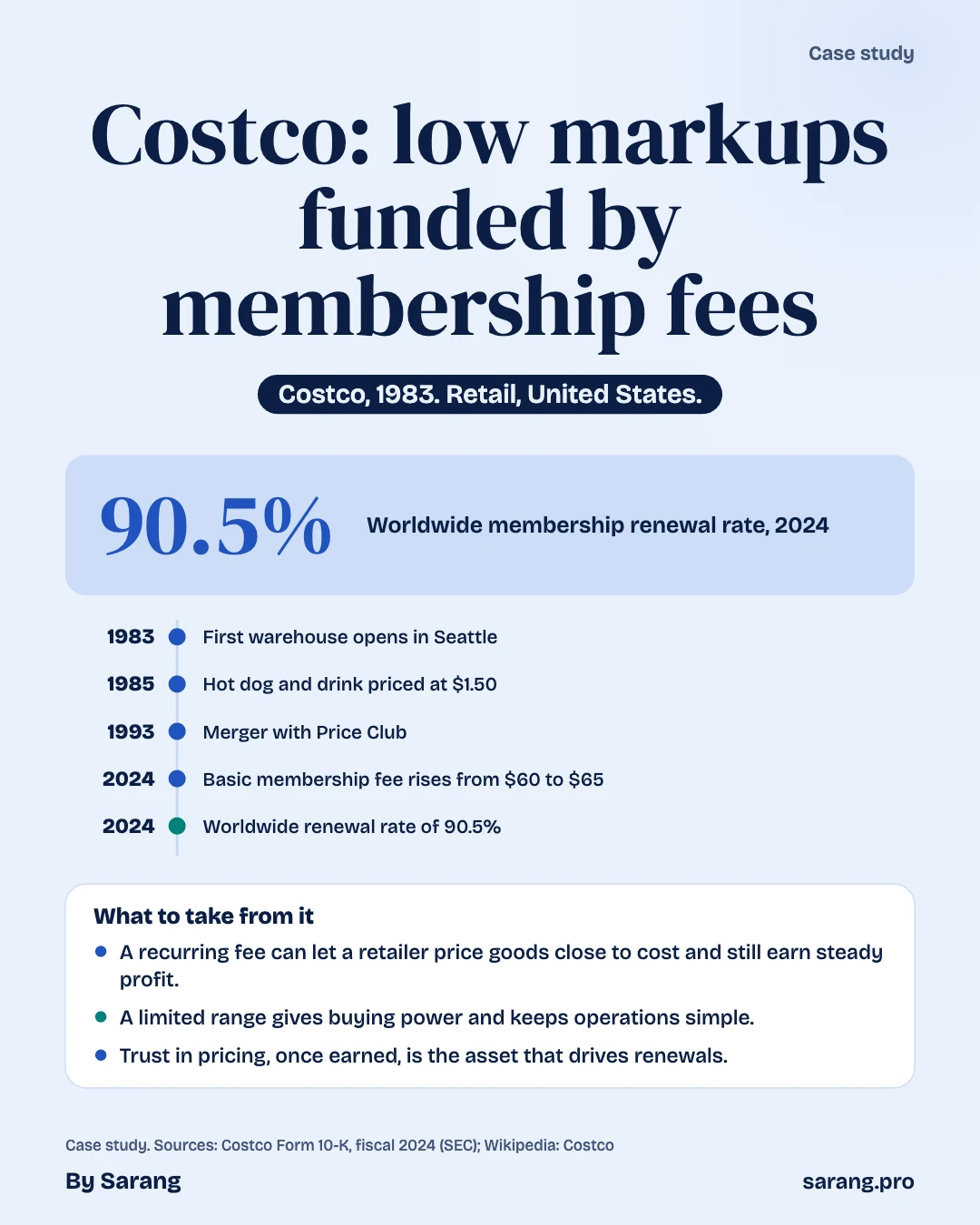
Costco opened in Seattle in 1983 on the Price Club model of low margins and a membership fee. Quartr reported that it reached three locations by the end of its first year, listed in 1985 with 17 stores and launched a $1.50 hot dog and soda combination that the article says has not changed price. In 1993 it merged with Price Club. Quartr adds that Price Club had earlier turned down an approach from Sam Walton’s Sam’s Club, and that the combined company had nearly 200 locations.
Holding the markup line
Fortune reported in 2006 that no item was marked up more than 14%. The encyclopedia entry put Sinegal’s markups at roughly 12 to 15 percent and said he kept costs down by minimising sales staff, fixtures and backup inventory. A Quartr summary of an analysis by the investor Nick Sleep gives a typical markup of 14 to 15%. The sources agree on the range even if the exact cap differs by writer.
Paying people more than the sector
The 2025 annual report says the company aims for pay and benefits “better than the industry average for much of our workforce” so as to reduce turnover and raise productivity. The reasoning is the same as Fortune’s 2006 note that Costco’s wages were the envy of big-box staff. Employees numbered 341,000 at the end of the 2025 fiscal year, up from 316,000 in 2023.
Expanding the base and the upgrade
The annual reports show steady growth: 861 warehouses in 2023, 890 in 2024 and 914 in 2025. In 2025, 629 were in the United States and Puerto Rico, 110 in Canada and 175 elsewhere. The Executive tier grew from 32.3 million members in 2023 to 38.7 million in 2025. Executive members earn a 2% reward, generally up to $1,250 a year, and they accounted for about 73.6% of worldwide net sales in 2025.
Services around the warehouse
Costco’s investor pages describe more than a shop. Every membership includes a free household card and a 100% satisfaction guarantee. Executive members get savings on services such as auto and home insurance. Some warehouses in the United States, Canada, Australia, Japan, the United Kingdom, Spain, Mexico, Taiwan and Iceland run self-service petrol stations. A division, Costco Wholesale Industries, runs manufacturing operations that include meat processing, optical labs, special food packaging and jewellery distribution. The 2025 annual report adds that the online catalogue averages 9,000 to 10,000 items, well above the warehouse range, and that digitally enabled sales, which include Costco Travel, were about 10% of net sales. These extras give members more reasons to renew without adding to the markup on the core range.
The September 2024 fee increase
The company raised its fees in the United States and Canada effective 1 September 2024. The 2025 annual report says the increase accounted for approximately 40% of the growth in membership fee income that year.
What happened
Growth in sales and fees
The table sets the 2006 picture from Fortune against the three most recent annual reports.
| Measure | 2006 | FY2023 | FY2024 | FY2025 |
|---|---|---|---|---|
| Warehouses | 488 | 861 | 890 | 914 |
| Net sales | $59 billion | $237.7 billion | $249.6 billion | $269.9 billion |
| Membership fees | $1.1 billion | $4.58 billion | $4.83 billion | $5.32 billion |
| Gross margin | not stated | 10.57% | 10.92% | 11.12% |
The 2006 figures are the latest year in the Fortune article, so the periods are not exactly aligned. Fee income in 2025 is about five times the 2006 figure, and sales are over four times as large. The 2024 fiscal year had 52 weeks against 53 in fiscal 2023, and Costco’s own release for August 2024 put annual net sales at $249.6 billion, up 5.0%.
Where the profit comes from
Using the annual report’s gross margin, store costs and fees, I calculate operating income of about $8.1 billion in 2023, $9.3 billion in 2024 and $10.4 billion in 2025. Membership fees were then about 56%, 52% and 51% of operating income. Net income reached $8.1 billion in 2025 against $7.4 billion in 2024. The fee share is falling slowly, as merchandise profit grows faster, but the business still earns about half of its operating profit from a charge that does not depend on what people buy.
Loyalty
Paid members rose from 71.0 million in 2023 to 81.0 million in 2025, and total cardholders from 127.9 million to 145.2 million. Renewal rates were 92.7% in the United States and Canada and 90.4% worldwide at the end of 2023, and 92.3% and 89.8% two years later. The sources do not say why the rates slipped slightly.
Other views
Analysts and investors
The Quartr profile quotes Charlie Munger, who sat on the board for over two decades, as calling Costco one of the most admirable capitalistic institutions in the world, and the investor Nick Sleep as describing it as a clear case of “scale economies shared”. The profile is promotional and has little independent data, so these are views, not measures. The Fortune piece of 2006 gives numbers but is nearly twenty years old.
Pay and profit
The encyclopedia entry records the argument that high wages hurt profits, set against the argument that they cut turnover and theft. The sources do not settle it. What can be said is that, on my calculation from the annual reports, operating income rose every year from about $6.7 billion in 2021 to $10.4 billion in 2025, while the company kept to its pay stance.
Dependence on the fee
A business that earns half its operating income from a fee is exposed if members stop renewing or if growth in new members slows. The renewal rate has stayed above 89% worldwide. But the fee rise of September 2024 supplied about 40% of the 2025 growth in fee income, so a single price decision flattered one year’s growth. Fee increases cannot be repeated often without testing the members’ patience.
Trade policy and costs
The company itself warns that tariffs are more likely to hurt than help its results. With gross margin of about 11%, there is little cushion if costs rise and the company holds its prices.
Reading it through a framework
Porter’s generic strategies
Michael Porter described cost leadership, differentiation and focus as the basic ways to compete. Costco is a cost leader, and unusually, it shares the savings with customers. Its short range (under 4,000 items per warehouse), large orders and plain buildings produce low costs, and its markup cap converts them into low prices. Fortune’s comparison with Sam’s Club, where Costco had fewer outlets and about $20 billion more in sales, is evidence of the result. Porter warned of getting stuck in the middle, and Costco avoids that by being clear about one thing. Its range is narrow, but within it the goods are good value, and the private label, which the 2023 report says carries higher margins than national brands, adds a differentiated element.
Switching costs and recurring revenue
A fee paid in advance is a form of switching cost. Once a household has paid $65 for the year, it has a reason to use the warehouse enough to justify it, and members who have upgraded to Executive have a further reason, since the reward of 2% up to $1,250 only pays out on spending. The 2025 numbers fit this: Executive members were 38.7 million of 81.0 million paid members but about 73.6% of net sales. The renewal rate shows that the logic works. It is an interpretation rather than a stated company aim, and the sources do not report the share of members who renew mainly for the reward.
Since then
The company has kept growing. In fiscal 2025 net sales rose 8% and comparable sales 6%. E-commerce was about 7% of net sales and grew 16%. Net income was $8.1 billion, with diluted earnings of $18.21 a share. Ron Vachris, who became chief executive in 2024, said on the third quarter earnings call that great value on quality merchandise was well received in every region and that he expected no major changes soon, as Quartr reported. The September 2024 fee increase was the main change to the model.
The open risks are those the company names. Tariffs affect merchandise cost, and the filing says higher tariffs are likely to harm results. Gross margin edged up to 11.12% in 2025 on fresh foods and a co-branded credit card programme, partly offset by a charge for higher merchandise costs.
What to take from it
- A business can price its goods close to cost if another revenue line, here the membership fee, carries the profit.
- A narrow range is a cost decision as well as a marketing one, because large orders on few items give better terms from suppliers.
- Renewal rates above 90% in the core markets show that customers see the fee as good value, and that is what makes a fee increase possible.
- Paying staff better than the sector can be a cost-control policy when it lowers turnover, though the sources show this is argued rather than proved.
- A model that rests on one profit line is exposed to that line, and a fee rise can flatter growth for a year without proving future growth.
Questions to think about
- Costco earned about half its operating income from fees in 2025. How would you judge when that share becomes a risk rather than a strength?
- What would a markup of 20% instead of 14% do to members’ behaviour, and how would you test it without losing them?
- The September 2024 increase supplied about 40% of one year’s fee income growth. How often could a company repeat an increase like that?
- Which other businesses charge for entry and sell at thin margins, and what do they share with Costco?
Concepts at work
This case draws on cost leadership, switching costs and recurring revenue models. Explore them in Insights.
Written from the public sources listed below. Figures are as those sources report them.
Framework
Timeline
- 1976Price Club opens in San Diego (Quartr)
- 1983Jim Sinegal and Jeffrey Brotman open the first Costco in Seattle
- 1993Price Club and Costco merge
- 2006Fortune reports $59 billion sales, 488 warehouses, 48 million members and a $50 fee
- Fiscal 2023Fee income $4.58 billion; 861 warehouses; Gold Star fee $60
- 1 Sep 2024Fees rise in the US and Canada to $65 for Gold Star and Business
- Fiscal 2024Net sales $249.6 billion; fee income $4.83 billion
- Fiscal 2025Net sales $269.9 billion; fee income $5.32 billion; 914 warehouses
Recap cards
Tap a card to check yourself.
Sources and credits
- Costco Wholesale: Form 10-K for fiscal year ended 31 August 2025
- Costco Wholesale: Form 10-K for fiscal year ended 3 September 2023
- Fortune: Why Costco is so addictive (30 Oct 2006)
- Encyclopedia.com: Sinegal, James D.
- Costco Wholesale: Reports August sales results (Sep 2024)
- Costco Wholesale: Company profile
- Quartr: Costco Wholesale, the model of scalable simplicity (May 2025)



