Amazon: Prime, a $79 yearly fee for unlimited two-day delivery
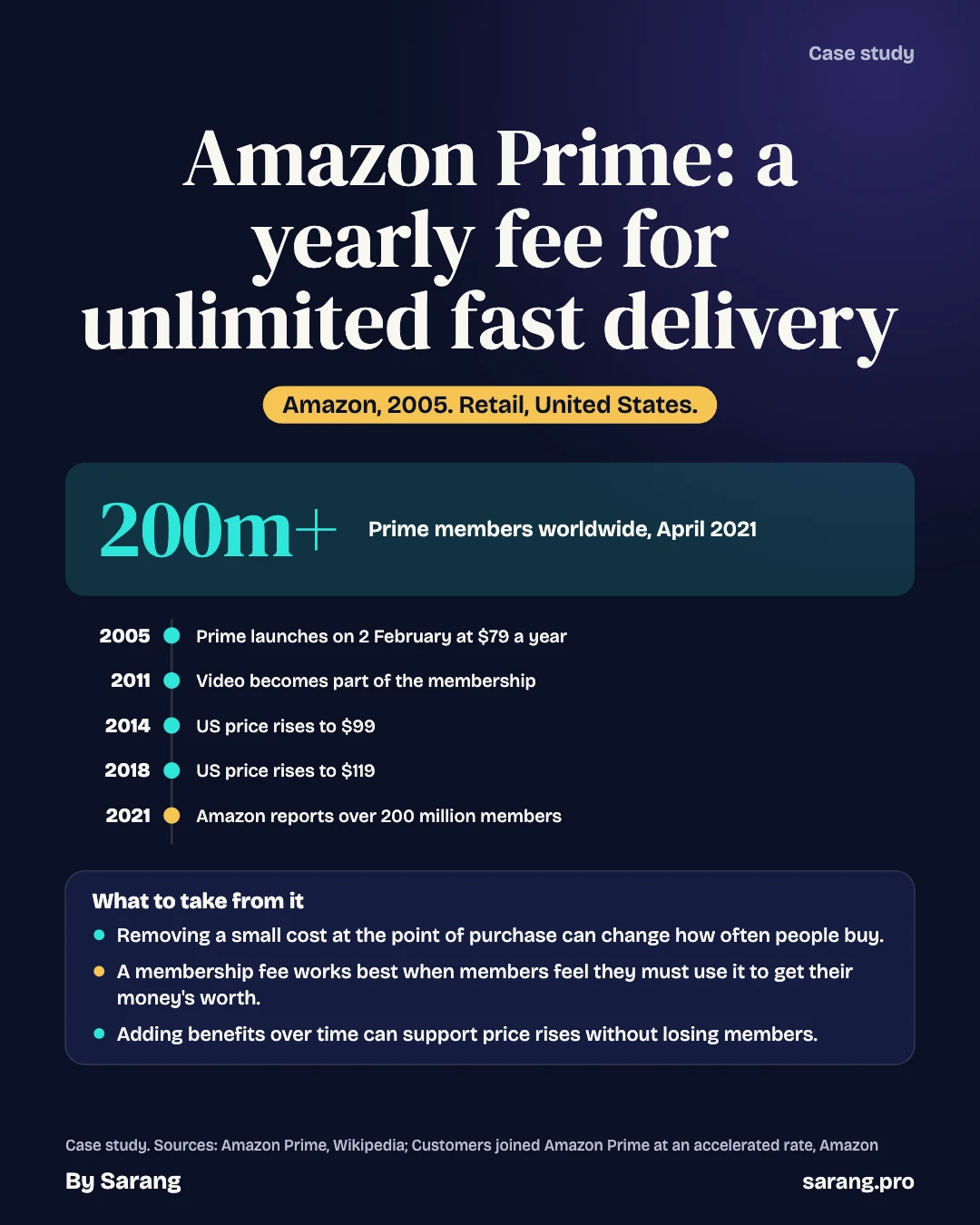
In 2005 Amazon launched Prime at $79 a year for unlimited two-day shipping, despite doubts it could pay; by 2021 Bezos claimed 200 million members, and in 2025 the FTC won a $2.5 billion settlement.
- Original yearly fee, February 2005
- $79
- US yearly fee from February 2022
- $139
- First official member count, April 2018
- 100 million
- Members claimed by Bezos, 2021
- 200 million
The situation
In late 2004, Jeff Bezos called senior Amazon executives to the boathouse behind his home and gave them a deadline. He wanted a proposal for a shipping club that could be announced alongside the company’s results at the end of January. Staff had been talking about the idea for some time, and it had reached him through an internal suggestion channel. Accounts of the exact timing differ slightly. One says the meeting was in November 2004, another says it was a few weeks before the February 2005 earnings report. Both agree that the time allowed was short.
The product that came out of the meeting was Amazon Prime. It launched on 2 February 2005 at $79 a year and promised unlimited two-day shipping on most orders. At the time, two-day delivery was a premium option that shoppers paid for order by order. Amazon was offering to take the per-parcel charge away for a flat annual fee, and Bezos told customers on the homepage that he expected the scheme to be expensive for the company in the short term.
The bet was an odd one. Wall Street observers doubted that the fee could cover the cost of shipping. Bezos later said that when the finance team ran the numbers, the results were “horrifying”, because the heaviest shoppers would join first. Free shipping was a cost that grew with every order, and a flat fee capped the income from each member. The case is about why Amazon went ahead anyway, what it learned, and what the scheme became.
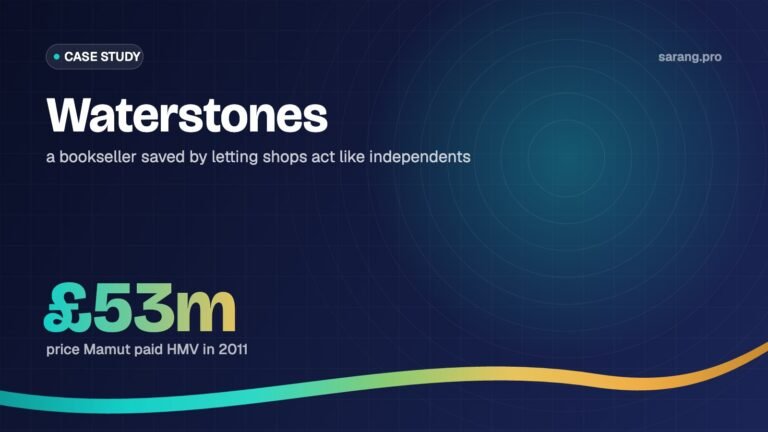
The figures give a sense of the distance travelled. A 2015 estimate put Prime at 40 million or more members and about $4 billion in yearly fees. Amazon gave its first official count, 100 million, in April 2018, and Bezos claimed 200 million in 2021. The price in the United States went from $79 to $99 in March 2014, and later to $119 and then $139 in February 2022. In 2025 the US Federal Trade Commission secured a $2.5 billion settlement over how Amazon enrolled people in Prime and how hard it made cancelling. The scheme shaped Amazon and its rivals, and it also drew regulatory attention.
Background
An online shop built on volume
By 2004 Amazon was a retailer that earned money by selling goods at low prices and moving them in large volumes. It had been a books business, and it was widening into other categories. A later article on the economics of the scheme links Amazon’s quarterly revenue growth in early 2010, from $4.89 billion to $7.13 billion, to the rise of non-book sales, which gives a sense of how far the product range stretched in the years after Prime began.
Delivery was the weak point in this model. A shopper ordering online faced two problems that a shop visit did not have: waiting, and paying to receive the goods. Amazon already offered free shipping on orders of $25 or more, but the delivery was slow, and customers had to wait several extra days. Faster delivery was available, but each order carried a price. That price discouraged small, frequent orders, which are the orders a retailer with a wide range most wants.
An idea from the ranks
Prime did not begin in the boardroom. Accounts name a software engineer, Charlie Ward, who proposed the idea through an internal digital suggestion box. He believed customers would pay for faster shipping and would shop more often once they had paid. Bezos described the origin in a 2018 interview as an idea from a junior software engineer, and he framed it as an “all-you-can-eat” offer of fast shipping rather than a conventional loyalty scheme.
A book on Amazon, quoted by one of the articles listed below, reports that Bezos reacted to the idea by calling it a big one and urging the team to move quickly. The same account says the $79 price was chosen as an amount large enough to matter to shoppers but small enough to encourage them to try it, and that it was set largely without research on likely sign-ups or usage. That detail matters for what followed. Amazon launched without knowing how members would behave.
The industry
How retailers treated delivery
Before Prime, the common approach among traditional retailers was to charge for delivery and explain the charge to shoppers. A 2025 analysis of Prime’s effect on retail argues that rivals chose to justify shipping costs to customers rather than absorb them as Amazon did. The same piece quotes an Amazon executive, Lisa Leung, recalling that people in the industry believed free two-day delivery would bankrupt the company.
Carriers and costs
Shipping companies were affected early. According to that analysis, they were the first to be alarmed, because Amazon’s volumes were moving towards direct deliveries. The cost of moving parcels was the main variable in the economics of the offer, and it rose over time. When Amazon raised prices in later years, it blamed higher labour and shipping costs. In February 2022 it lifted the US fee from $119 to $139, and for the United Kingdom in September 2022 it cited inflation and rising operating costs.
Competitors’ reactions
The same article reports that in 2016 the chief executive of Macy’s, Terry Lundgren, downplayed Amazon’s impact and pointed to online returns as a bigger issue. The piece’s view is that competitors have struggled to adapt to Amazon’s approach to online retail. It also quotes the e-commerce consultant Scot Wingo, who says Prime created a lock-down among customers and that Amazon’s lead now feels insurmountable. These are opinions from one analysis rather than measured outcomes, and they should be read as such. The sources used for this case do not give rival retailers’ own figures, so this case does not claim how particular competitors fared.
What members spent
The evidence on members’ behaviour comes mainly from analysts. In 2015, Consumer Intelligence Research Partners estimated that Prime members spent about 2.5 times as much as non-members and accounted for about two thirds of US retail revenue, as the estimate puts it. Amazon’s finance chief at the time, Tom Szkutak, said members “step up their purchases considerably” after joining. Both statements point the same way, though one is an outside estimate and the other is a company view, and Amazon did not publish detailed member data.
The decision
The choice facing Bezos and his team in late 2004 was not whether to offer faster delivery, which Amazon already did for a charge, but how to charge for it. Three approaches were open. The sources show that Amazon chose the second, and the other two are framed here as the obvious alternatives.
Option one: keep charging per order
Amazon could have continued with the system it had, in which free shipping was available on larger orders and faster delivery cost extra. This was low risk. Each parcel paid for its own postage, and the retailer carried no open-ended obligation. The weakness was that it did nothing to change how often people bought. A shopper who had to decide on delivery speed and cost for each order had a reason to hold small orders back and group them.
Option two: a flat annual fee for unlimited fast shipping
The second approach was the one the engineer proposed. A member pays once and then faces no marginal charge for delivery. The attraction was behavioural. Once the fee is paid, each extra order feels free, which encourages buying more often, and the annual payment gives the customer a reason to use Amazon rather than a rival to get the value back. The risk was equally plain. Bezos said the finance work gave a horrifying picture, and his own early worry was that the heaviest customers would join first. A flat fee meant Amazon would pay more to ship exactly the people who were most active.
Option three: a smaller or narrower scheme
A middle route would have been a limited scheme, for example one with a spending threshold, a cap on the number of free parcels, or a higher fee that matched costs more closely. This would have reduced the exposure. It would also have weakened the message. The strength of the Prime idea was that it was simple to describe and removed a decision from the customer. Bezos used the phrase “all-you-can-eat” for it, and a version with limits would not have fitted that description. The sources do not show that Amazon examined this option in detail, so it is presented only as a plausible alternative.
What was at stake
The stakes were financial and strategic. In financial terms, an open-ended shipping cost could do damage if members behaved badly. Strategically, the scheme offered a way to turn occasional customers into regular ones. Bezos said at the time that Prime would not pay off for years. He went ahead because he judged the upside to be large, and in the 2018 interview he said that all good decisions require some level of instinct and risk-taking.
What they did
November 2004 to January 2005: a fast proposal
After the boathouse meeting, a small team had until the end of January to turn an idea into a product. The deadline was tied to the earnings call, which gave the project a public date. The team settled on a yearly fee of $79 and a promise of unlimited two-day shipping on most orders.
2 February 2005: launch
Prime went live on 2 February 2005. Bezos greeted shoppers on the homepage and said he expected Prime to be expensive for Amazon.com in the short term. In the first month, tens of thousands of customers signed up. The early press coverage focused on the cost of two-day shipping rather than on the possible effect on online shopping, which suggests that outsiders saw it mainly as a risk to margins.
About 2006: opening Prime to sellers
About a year after Prime began, Amazon introduced Fulfilment by Amazon, which let third-party sellers use Amazon’s warehouses and its fast shipping. This widened the range of goods that could be delivered under the Prime promise, since sellers could store their stock in Amazon’s network and have orders sent out with the same service levels. The article that reports this does not say how much it contributed to Prime’s growth.
2011: adding streaming and books
In February 2011 Amazon added Prime Instant Video, a streaming service, and about nine months later the Kindle Owners’ Lending Library, which lets members borrow digital books. Around then Greg Greeley, who ran Prime, said the scheme had “millions” of members. One estimate puts the number of paying households at about four million six years after launch. The additions changed what the fee bought. A scheme that began as a delivery offer was becoming a bundle of benefits. A survey by RBC Capital Markets of 1,774 members in September 2014 found that 10.1 per cent considered unlimited video streaming the most important reason for joining, so shipping still mattered most to the rest.
March 2014: the first price rise
Amazon raised the US fee by $20 to $99 in March 2014. Four of the five original members were still subscribers at that point, as reported in 2015. The scheme had kept its price for nine years, and the rise tested whether members valued it enough to pay more. Prime’s membership grew by 53 per cent in 2014, including 50 per cent in the United States, so the rise did not stop growth.
Later changes: groceries, speed and entertainment
Later additions included unlimited photo storage, a music service, ebook rentals, original television series, same-day and two-hour delivery, and Whole Foods groceries. Amazon bought Whole Foods for $13.7 billion. A report from the period said Amazon had considered spending $1 billion on a single television series, which shows how far the offer had moved from parcels. Fees rose again, from $99 to $119 and, in February 2022, to $139. In the United Kingdom the annual fee went from £79 to £95 on 15 September 2022, and the monthly fee from £7.99 to £8.99. Amazon pointed out that the new annual fee worked out at £7.92 a month, below the monthly price.
What happened
Membership and revenue
Amazon does not publish member numbers regularly. The figures that exist show a steep rise. The table sets out the main data points reported in the sources.
| Date | Figure | Source type |
|---|---|---|
| February 2005 | Tens of thousands joined in the first month | Reported at the time |
| About 2011 | About four million households (estimate) | Estimate |
| February 2015 | 40 million or more (analyst estimate), about $4 billion in fees | Analyst estimate |
| April 2018 | 100 million, first figure disclosed | Company |
| 2021 | 200 million claimed by Bezos | Company statement |
The step from tens of thousands to more than 200 million came with a changing offer, so growth cannot be put down to any single feature. The 2015 estimate for the following year, from RBC, was 55 million to 85 million members and up to $8.5 billion in fees. A 2025 article puts Prime’s revenue at no less than $40 billion about twenty years after launch, though it does not explain how the figure was calculated, so it should be treated as an estimate.
Amazon’s results
In the fourth quarter of 2014, Amazon reported a profit of $214 million on sales of $29.3 billion, ahead of expectations, and the share price closed at $364.47 on the day Prime reached its tenth anniversary. For the whole of 2024, Amazon reported net sales of $638 billion, up 11 per cent from $574.8 billion in 2023, and net income of $59.2 billion, up from $30.4 billion. Subscription services sales in the fourth quarter of 2024 rose 10 per cent to $11.5 billion. That category is wider than Prime, so it is not a direct measure of the scheme.
Effects on behaviour and rivals
The evidence that members shop more is consistent: the CIRP estimate that members spend 2.5 times as much, and the finance chief’s comment about stepping up purchases. The sources do not give figures for how rivals’ own delivery schemes performed. What they do show is the pressure on the sector. One article describes Amazon’s lead as feeling insurmountable.
The cost of the original fear
The worry that heavy users would sink the economics did not, on the available evidence, prevent the scheme from lasting. Amazon has not published a profit figure for Prime, so the evidence is indirect. The price rises show that Amazon considered rising costs a problem it had to pass on. Michael Pachter of Wedbush estimated that the later rise from $99 to $119 would add about $1.4 billion in sales.
Other views
Analysts and sceptics at the start
Many people on Wall Street thought the scheme could not pay its way. Amazon’s own executive recalled that sceptics thought the company was crazy. The sceptics were right that shipping is expensive, and Bezos agreed. Where they were wrong, on the evidence, was in treating the cost as a loss rather than as an investment in how often people shopped.
Analysts on later pricing
Michael Pachter at Wedbush argued that Prime had become essential for many consumers and that price rises would be accepted. He pointed out that the annual cost remained below the standard annual Netflix plan, which supports the idea that Amazon compared Prime with entertainment subscriptions as well as retail. This is one analyst’s judgement, and the argument depends on members valuing the video and other extras.
Regulators
The strongest criticism came from the US Federal Trade Commission. It first charged Amazon in June 2023 and announced a settlement on 25 September 2025. The FTC alleged that Amazon enrolled millions of consumers in Prime without their consent, used confusing interfaces, and made cancelling complicated. The terms were a $1 billion civil penalty, which the FTC described as the largest ever in a case involving a violation of an FTC rule, and $1.5 billion in redress for an estimated 35 million people. The FTC cited internal comments, including one calling subscription driving “a bit of a shady world”. The order requires a clear button to decline Prime and a cancellation route as easy as the sign-up route. This is a settlement and the FTC’s account of the allegations, so the facts are as the regulator states them.
Limits of the evidence
Much of what is said about Prime’s effect comes from estimates. Amazon does not break out the profit or loss of the scheme or the numbers of members by year. The claims that members spend more are correlations, since people who shop more are also the people most likely to join. The sources do not separate the two.
Reading it through a framework
Jobs to be done
The jobs-to-be-done view asks what job a customer hires a product to do. For online shoppers the job went beyond delivery: it was to stop thinking about delivery. Before Prime, each order brought a small calculation about speed and cost, which pushed people to batch purchases. Prime paid the fee once and removed the calculation. That fits the engineer’s belief that members would shop more often, and the reported 2.5 times spend figure. The later additions of video, books and music show Amazon widening the job from delivering parcels to being the first place to look for many things, though the sources show the largest group of members still came for shipping.
Switching costs
Switching costs are the losses a customer faces in moving to a rival. Prime made them real. Having paid for the year, a member who bought elsewhere was wasting part of the fee. As Prime added services, leaving meant losing more. Scot Wingo’s remark that Prime created a lock-down describes this effect, and the retention figure that four of five original members were still subscribers in 2015 supports it. The same framework explains the 2025 regulatory case. When leaving a subscription is hard to do, the lock-in comes from design rather than value, and the FTC’s complaint was that Amazon made cancelling harder than joining.
Since then
Since the 2018 and 2021 figures, Amazon has not published an updated member count, and one source says the number is probably higher now. Prices have kept rising: $139 a year in the United States from February 2022, and £95 a year in the United Kingdom from September 2022. A 2025 article gives the US fee as $139, so it had not changed by then.
Amazon’s results have grown over the same period. In 2024 net sales reached $638 billion and net income $59.2 billion. The FTC settlement in September 2025 carried the largest penalty the regulator described for a rule violation, and it set the rules for how Prime can be sold and cancelled in the United States.
What to take from it
- A flat fee that removes a small repeated decision, such as paying for each delivery, can change how often customers buy, even when the numbers look alarming at first.
- Bezos launched Prime with a price set largely without research on usage, and the scheme survived because Amazon could adjust the price and the benefits over time.
- Adding benefits to a subscription changes what customers believe they are paying for, and the RBC survey shows that members join for different reasons.
- Evidence on subscription schemes is often indirect, and claims that members spend more need care because heavy shoppers are the most likely to join.
- A scheme that depends on the difficulty of leaving carries legal and reputational risk, as the FTC settlement of $2.5 billion shows.
Questions to think about
- If the finance team’s early numbers were “horrifying”, what information would you have wanted before approving the launch, and what would have made you stop?
- How would you test whether Prime members buy more because of the scheme, or whether heavy shoppers simply choose to join?
- When does a subscription add value for customers, and when does it only make leaving harder?
- Which of the options in this case would suit a small UK or Indian online shop, and why might the answer differ from Amazon’s?
Concepts at work
Jobs to be done, switching costs and subscription pricing all appear in this case. Explore them in Insights.
Written from the public sources listed below. Figures are as those sources report them.
Framework
Timeline
- Late 2004Bezos asks executives for a shipping club proposal at his boathouse
- 2 Feb 2005Prime launches at $79 a year
- About 2006Fulfilment by Amazon opens Prime delivery to third-party sellers
- Feb 2011Prime Instant Video added
- Nov 2011Kindle Owners' Lending Library added
- Mar 2014US fee rises to $99
- Apr 2018Amazon discloses 100 million members
- 2021Bezos claims 200 million members
- Feb 2022US fee rises to $139
- Sep 2022UK fee rises to 95 pounds a year
- Jun 2023FTC files its case over Prime enrolment and cancellation
- Sep 2025$2.5 billion FTC settlement announced
Recap cards
Tap a card to check yourself.
Sources and credits
- Phys.org: 10 years later, Amazon celebrates Prime's growth
- Engadget: How 19 years of Amazon Prime has satisfied our need for speed
- ABC57: How Amazon made Prime into an indispensable product you'd pay anything for
- Retail Brew: How Amazon Prime backed the retail industry into a corner
- Benzinga: Jeff Bezos once spoke about Amazon Prime's risky beginnings
- US Federal Trade Commission: FTC secures historic $2.5 billion settlement against Amazon
- TheWrap: Amazon earnings Q4 2024
- Silicon UK: Amazon UK to raise cost of Prime service
- The Grocer: Amazon hikes Prime membership fee to 8.99 pounds per month