Amul: a farmer owned cooperative that built a national brand
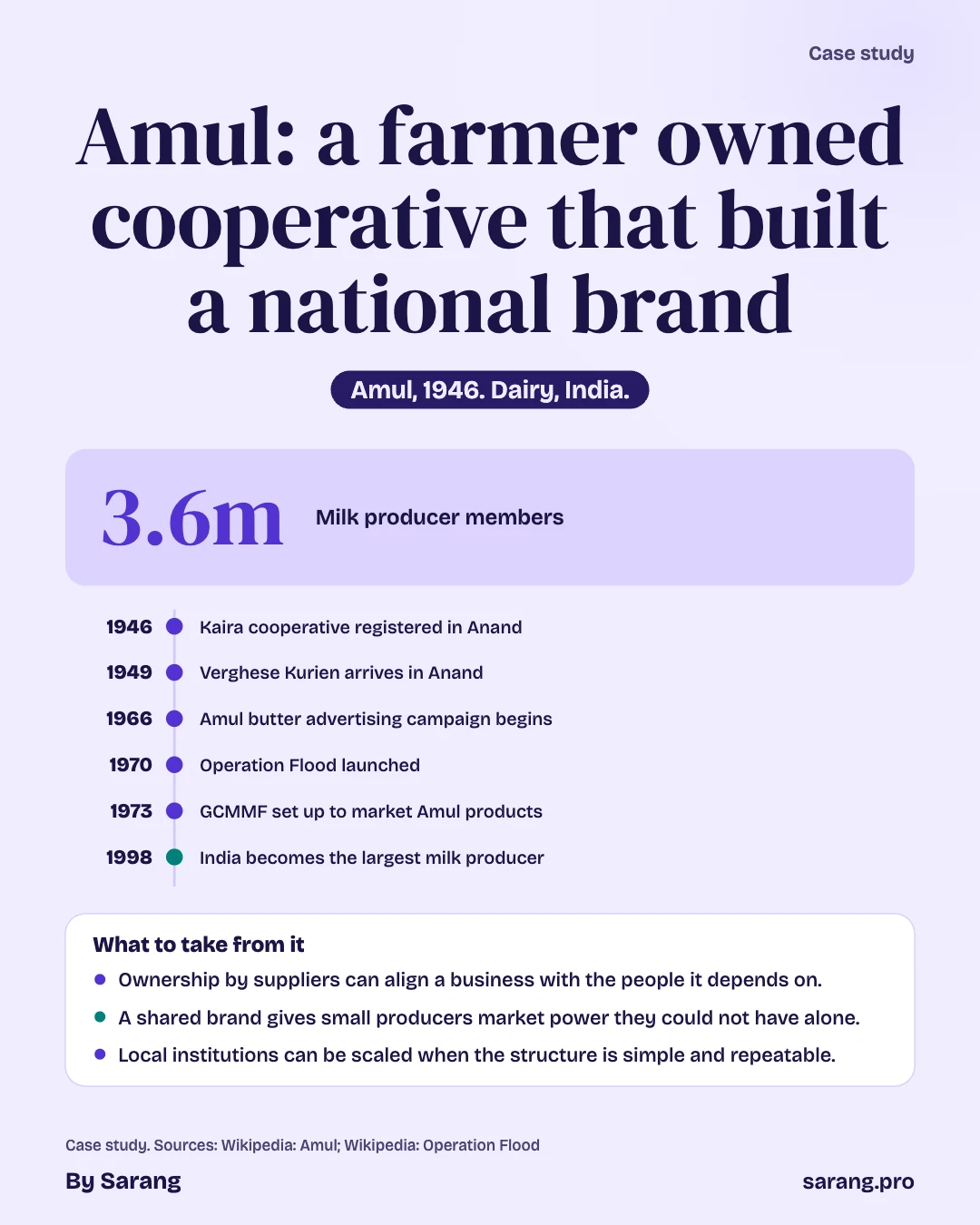
Amul began in 1946 as a union of Gujarat milk farmers and by 2026 had brand sales above Rs 1 lakh crore, owned by 36 lakh farmers.
- GCMMF sales, 2025 to 2026
- Rs 73,450 crore
- Amul brand turnover, 2025 to 2026
- Rs 1 lakh crore
- farmer members
- 36 lakh
- milk collected a day
- 31 million litres
The situation
In April 2026 the federation behind the Amul brand reported that its brand turnover had passed Rs 1 lakh crore, about US$12 billion, for the year to March 2026. The federation itself, the Gujarat Co-operative Milk Marketing Federation (GCMMF), booked sales of Rs 73,450 crore, up 11.4% from Rs 65,911 crore the year before. Its chairman credited 36 lakh (3.6 million) dairy farmers. The federation collects about 31 million litres of milk a day, sells more than 1,200 products and ships over 24 billion packs a year to more than 50 countries.
The unusual part is who owns all this. No founder family, private equity fund or listed parent holds the equity. The owners are farmers, most of whom own one or two animals, organised in village societies. The same structure that began in 1946 in a handful of villages in Gujarat now competes with multinational food companies and sells fresh milk in the United States.
Two numbers help to read the 2026 result. First, the figures are not all on one base. Amul uses “GCMMF turnover” for the federation’s own sales and a larger “brand turnover” for everything sold under the Amul name, including the 18 member unions that also operate under it. One trade report from April 2026 even gives both Rs 90,000 crore and Rs 1 lakh crore for the brand, so the reader has to check which base is meant. Second, the federation says it returns 80 to 85% of what consumers pay to its milk producer members. A company that sends that share of its revenue back to suppliers has chosen a very different set of goals from a listed dairy business.
This case asks how a cooperative came to hold that position, what the model gave up to get there, and where the evidence is thinner than the celebration suggests.
Background
Polson and the farmers of Kaira
The origin story is told consistently in the sources, although the details differ. In the 1940s the Polson company had what R.S. Sodhi, a former managing director of GCMMF, calls an effective monopoly on collecting milk in the Kaira area of Gujarat and supplying it to Bombay. Prices varied with the season and farmers had little say. According to Sodhi, speaking in a 2023 interview published in Indian Dairyman, Sardar Vallabhbhai Patel advised the farmers to own the whole chain themselves, and the cooperative followed a farmers’ strike against the colonial government’s arrangements. Sodhi dates the founding to 1946.
The structure that grew out of this has three tiers. Village dairy societies collect milk from members and pay them. District unions process and package it. A state federation markets everything under one brand. Money flows back down through the same tiers. Sodhi describes his own job as managing director as “diagonally opposite” to that of a corporate chief executive, because a corporate CEO is rewarded for buying raw material cheaply while he aimed to pay farmers more so that their income stayed steady.
Kurien arrives
Verghese Kurien was born in Kozhikode on 26 November 1921 and trained as an engineer, finishing a master’s degree at Michigan State University on a government scholarship. Business Today’s 2012 obituary says he came back to India in 1949 and was posted to a government creamery in Anand under a bond that was meant to last only a few years. He joined the Kaira District Cooperative Milk Producers’ Union at the request of its chairman, Tribhuvandas Patel, and stayed in Anand for decades. A colleague, quoted in the same article, called him a “dynamic person, who never took no for an answer”.
Kurien did not fit the picture of a cooperative saint. The Economist’s obituary, as quoted by Outlook, said he was born a Christian, became an atheist, ate beef and liked a drink, but disliked milk. His real skill was building an organisation in which professional managers answered to farmer boards.
From a district union to a federation
Sodhi says the union moved from selling liquid milk in Bombay into ghee in the 1950s and butter in the late 1950s, taking on Polson’s well-known butter. Kurien rejected an English brand name in favour of an Indian one, and “Amul” was taken from a Sanskrit word for priceless. A mid-1960s advertising campaign with a cartoon girl and the line “Utterly Butterly Delicious” followed. Sodhi dates it to 1965, while other accounts give 1966, so the year is uncertain.
In 1973 Kurien brought the district unions under GCMMF, which marketed their products under Amul. By 2011 to 2012 the federation had a turnover of Rs 13,000 crore, 15 district unions, more than 30 lakh farmers and about 16,000 villages, according to Business Today.
How the money worked
Two figures sum up the economics. The federation told reporters in 2023 that it passes 80 to 85% of the consumer rupee back to milk producer members. Sodhi gave a similar claim in his interview: Indian farmers get up to 80% of the price a city consumer pays for a litre, against roughly a third in most developed countries. Both figures come from the cooperative’s own people, not from an independent audit, and they apply to liquid milk more than to the whole product range.
The industry
India is a milk economy before it is a packaged food economy. Output grew slowly in the decades after independence. A World Bank evaluation (Operation Evaluation Department, Report 16848, June 1997) puts growth in dairy production at 0.7% a year before the programme known as Operation Flood and 4.27% a year after it. Another review of the Bank’s later study by Candler and Kumar gives 0.6% before 1969 and 4.7% after. Per capita milk consumption rose from 107 grams per head in 1970 to 193 grams in 1994, according to the Bank’s summary.
The supply side is fragmented. Millions of households keep one or two animals and sell what they can spare. Sodhi says about 70% of the milk-pouring members of Amul’s societies are small, marginal or landless. This is why the cooperative form made sense: a single farmer has no bargaining power with a processor, but a few hundred pooling their milk at a village collection point do.
The processing side is where private and state-backed rivals sit. The World Bank summary notes that excess processing capacity grew in the corporate sector and that some states gave corporate plants subsidies of up to 50% of capital cost plus tax holidays, which cooperatives did not always receive. Mother Dairy, set up in 1974 according to Outlook, is one of the other large names. On the demand side, the federation’s 2023 results show where growth was coming from: fresh products grew 21% and made up half of turnover, ice cream grew 41% and consumer products 23%.
Rules matter as well. Because dairy is local and perishable, state governments sit close to it. A recurring theme in the evaluations is how far state governments should control the appointments, staffing and pricing of cooperatives. The model works best, the Bank concluded, where farmers and professional managers hold control. This tension returned in 2023, when the question of one state’s cooperative entering another’s market became a political fight.
The decision
Several decisions are bundled in this case, and the sources let us see three of them. All three are framed here as choices between alternatives, because the sources describe what was done but rarely record what was rejected.
Stay with the monopoly buyer, or own the chain
In the 1940s, farmers in Kaira could keep selling to Polson at its prices, try to bargain collectively as sellers while leaving the processing in someone else’s hands, or take ownership of collection and processing. Sodhi’s account is that the advice from Patel was the third option. The choice matters because it put the margin in the farmers’ hands but also made them responsible for capital, quality and running a dairy. Farmers who had only ever sold milk were being asked to become part owners of a plant.
Many local brands, or one
By the early 1970s several district unions in Gujarat were running successfully on the Anand pattern. They could have kept separate brands and sold separately. The decision in 1973 was to form GCMMF as a marketing federation under one brand. The gain was scale in advertising and distribution. The cost was that unions gave up some commercial independence. For consumers, a single name became shorthand for a product that was always the same.
Stay in liquid milk, or move into branded products
Fluid milk is a low margin business with high volumes. Butter, ghee, cheese and ice cream carry higher margins and brand loyalty. The 2023 federation results show that ice cream and consumer products grew faster than fresh milk. The sources do not give margins by product, so the case cannot say how much more a tub of ice cream earns than a pack of milk. They do show the direction of the effort, since the federation reports its fastest growth outside plain milk.
Stay in Gujarat, or go national and global
The federation’s farmers and villages are in Gujarat: 18,600 villages, according to its 2023 results. Selling outside the state, and then abroad, means competing with other states’ cooperatives and with local brands in each new market. The United States launch in 2024 of four fresh milk variants aimed at the Indian diaspora was an example of the global branch of the choice. The 2023 plan to sell in Bengaluru was the national one.
What they did
1946 to 1950: build the union
The Kaira union was founded in 1946 in Anand. The sources agree on the direction of travel: farmers organised, Kurien joined in 1949 at the request of the union’s chairman, and he stayed to build the processing side.
1950s to 1960s: products and a brand
Per Sodhi, surplus milk went into ghee in the 1950s and butter in the late 1950s. The name and the cartoon girl turned a dairy product into a brand. Advertising for a farmer-owned business was still a bold idea in those years.
1970s to 1990s: replicate the pattern
Operation Flood, which Sodhi dates from the 1970s to the 1990s, was designed to copy the Anand model elsewhere. The World Bank notes it was Kurien’s programme, endorsed by the government, and not a Bank project, although the Bank financed five dairy projects from 1974. The Bank’s summary describes a three-level system of about 57,000 village societies, 172 unions and 22 state federations, with the National Dairy Development Board at the top. The total cost of the projects was about US$2.98 billion according to the review of Candler and Kumar, of which about US$2.73 billion went to Operation Flood and related activities. The Boston Globe’s obituary says the network reached about 10 million milk producers across 96,000 cooperatives by the time of Kurien’s death in 2012.
2000s to 2022: scale up the brand
The federation’s turnover was about Rs 13,000 crore in 2011 to 2012. By 2022 to 2023 it was Rs 55,055 crore, up 18.5% on the year, with 98 dairy plants set up by member unions, 82 branch and warehouse facilities and a plan to add more, focusing on the top 400 towns by population. It stated a target of Rs 1 lakh crore in sales by 2025, and the wider brand measure passed that mark in 2025 to 2026.
2023: the Bengaluru plan
On 5 April 2023 Amul’s account on X teased milk and curd sales in Bengaluru, from Kengeri to Whitefield, with quick delivery. Karnataka’s farmers and politicians objected, because the state has its own cooperative, KMF, which sells under the Nandini brand. South First reported farmers saying they were paid about Rs 29 to 30 a litre against costs they put at Rs 40 to 45, and a Karnataka Kisan Congress leader saying a big federation entering at that moment would lead to a collapse. A former KMF managing director said Amul had tried before, in 2010 to 2015, and that talks had stopped it. The case shows the limit of cooperative solidarity once two cooperatives meet in one city.
2024 and 2025: abroad and price moves
In 2024 the federation entered the United States with four fresh milk variants. In January 2025 it cut the price of one-litre packs by Rs 1 a litre to push buyers towards larger packs, after raising milk prices in June 2024 because input costs had risen, according to BestMediaInfo.
What happened
The financial record
| Year | GCMMF turnover | Note |
|---|---|---|
| 2011 to 2012 | Rs 13,000 crore | 15 unions, 30 lakh farmers, about 16,000 villages |
| 2022 to 2023 | Rs 55,055 crore | Up 18.5%, provisional |
| 2023 to 2024 | about Rs 59,259 crore | Up 8%, BestMediaInfo figure; another report gives Rs 59,545 crore |
| 2024 to 2025 | Rs 65,911 crore | Up 11% |
| 2025 to 2026 | Rs 73,450 crore | Up 11.4%; brand turnover passed Rs 1 lakh crore |
The federation’s unduplicated group turnover was said to be above Rs 72,000 crore (about US$9 billion) in 2022 to 2023 and about Rs 90,000 crore in 2024 to 2025, with Rs 80,000 crore the year before. Sales growth has been in double digits in most recent years, and the federation ranks eighth among the top 20 dairy companies by milk processing, according to the International Farm Comparison Network as cited in its own results.
The farmers
Membership grew from more than 30 lakh in 2011 to 2012 to 36 lakh by 2023 and 2026, and daily procurement was about 270 lakh litres in 2022 to 2023 and about 310 lakh litres by 2026. The federation says it passes most of the consumer rupee back to members. Sodhi says about 70% of the members who pour milk are small, marginal or landless. If these claims hold, the model has done what it was set up to do: keep the margin with the people who keep the animals.
The national programme
The World Bank’s 1997 study concluded that Operation Flood and related policy changes raised dairy growth from 0.7% to 4.27% a year, and said the impact was comparable to the Green Revolution. It estimated that farmers’ dairy revenues had quadrupled, and that the programme directly served about 6.1 million producers, 60% of them marginal, small or landless. The Candler and Kumar review found milk output growing at 4.7% a year after 1969 and credited the programme with about 43 million tonnes of extra milk a year.
Other views
The attribution problem
The review of the Bank’s study in the Indian Journal of Agricultural Economics points out that Operation Flood handled only 6.3% of India’s milk output, although it covered 22 states and 9.3 million members. The reviewer adds that the study’s own arithmetic shows how small a share of the gain needs to be credited to Bank money for the investment to pay (0.56% of the production increase for a 10% return), and that he found its consumer and producer surplus estimates tenuous. In plain terms: the programme was large in members and modest in share of output, so it is hard to say how much of India’s milk growth it caused.
Cooperatives that did not work
The same review notes that Operation Flood and the National Dairy Project were meant to grow from the ground up but in practice became top-down, with growth targets set from outside. In some states governments kept control of dairy plants and prices. In Madhya Pradesh, the share of active village societies fell from 77% in 1983 to 55% in 1996, and nearly a quarter of village societies across the programme became weak or dysfunctional. The Bank’s own summary says some states did not observe the Anand principles, and that state interference led to losses. Gujarat is the model; it is not the average.
Breeds, health and the A1 and A2 argument
Outlook’s tribute to Kurien records a critique that the push for higher yields led to heavy crossbreeding with Jersey and Holstein cattle, harming native breeds and starting a health debate over A1 and A2 milk. The article presents this as a point of discussion, not as a settled finding. The Bank’s summary adds a related limit: Operation Flood was primarily a marketing project, so help with breeding and veterinary services came second.
Farmers on the other side of a state border
The Karnataka dispute of 2023 shows the view of farmers who belong to a different cooperative. Their worry was that a larger rival would take their market when milk supply was already short because of lumpy skin disease. The Union Home Minister, who also holds the cooperation portfolio, had called for Amul and Nandini to work together, according to South First, and farmers read that as a threat.
Reading the cooperative’s own numbers
Most of the recent figures here come from the federation, its executives or trade press repeating its statements. Turnover bases differ across reports, and one 2026 article contradicts itself on the brand figure. Claims about the farmer share of the consumer rupee come from insiders. They are consistent with each other, but this case did not find an independent audit.
Reading it through a framework
Value chain analysis
In a value chain, a firm’s profit is the margin between the price customers pay and the cost of the activities it performs. Polson controlled collection and the supply to the city, and so held the margin. The cooperative’s key move was to capture all the activities in the chain and give the margin to members: collection by village societies, processing by unions, marketing by the federation. Kurien’s contribution was the support activities that made the chain work, such as professional management, plant engineering and brand building. The framework also shows the risk. A firm that keeps every link must fund every link, and the Operation Flood experience in states with state-owned plants shows what happens when one link is controlled by someone with different goals.
Stakeholder mapping
Stakeholder mapping sorts people by their power over a decision and their interest in the outcome. Farmers have high interest and, through elected boards, formal power. Managers like Kurien and later Sodhi have operational power. State governments have high power through regulation and funding and, in the weaker cooperatives, interfered with it. Consumers have low individual power but collective power through brand trust. Rivals such as private dairies and other state cooperatives have power over the market. The Bengaluru episode in 2023 is a stakeholder map in action: the same product was welcomed by consumers, opposed by farmers who supply a rival cooperative, and politicised by parties who saw votes in it.
Since then
The years since 2023 have been about scale, geography and price. The federation’s sales rose to Rs 65,911 crore in 2024 to 2025 and Rs 73,450 crore in 2025 to 2026. It reached the United States with fresh milk in 2024, and the 2026 trade report says fresh milk was also launched in other markets, including Europe. In January 2025 it cut the price of one-litre packs by Rs 1, a signal that it will trade margin for volume. Its chairman, Ashok Chaudhary, tied the Rs 1 lakh crore milestone to 3.6 million farmers, and the International Cooperative Alliance ranked Amul as the world’s top cooperative, according to the same report. The article also mentions the launch on 6 July 2025 of a new cooperative dairy federation named for Sardar Patel, which shows the cooperative idea being repeated outside Gujarat.
Open questions remain. Growth now depends on value-added products and exports, where the cooperative competes on brand more than on farmer ownership. Milk prices to farmers must stay attractive as costs rise. And inter-state cooperative rivalry, the 2023 Karnataka fight, has not been settled by any rule that the sources describe.
What to take from it
- Ownership can be a strategy. Because farmers own the federation, the margin stays with suppliers, and that is the reason suppliers keep supplying.
- Professional management inside a member-owned structure is a design choice. Kurien and his successors ran Amul as a business while farmers held the board seats, and the Bank’s evaluation says the model weakens where states take over appointments and prices.
- A single brand turns many small producers into one competitor. GCMMF’s decision in 1973 to market all unions under Amul gave advertising scale that no district union could have afforded.
- A model that works in one place does not copy automatically. Operation Flood reached 22 states, but the review of the Bank’s study found top-down delivery and weak societies in several of them.
- Headline growth figures need a base. The Amul numbers differ by federation, brand, fiscal year and source, and a careful reader asks which one is meant before comparing.
Questions to think about
- If a cooperative returns 80 to 85% of the consumer rupee to suppliers, what limits how much it can spend on advertising, new plants and entering new markets?
- Karnataka’s farmers saw Amul’s entry as a threat even though both are cooperatives. Should cooperatives compete with each other, and who should decide?
- Operation Flood handled only 6.3% of India’s milk but is often credited with the whole revolution. How should a policymaker judge a programme whose effect is hard to separate from everything else going on?
- Would a private company that copied Amul’s structure, giving farmers equity, keep the same advantages?
Concepts at work
This case draws on vertical integration, cooperative governance and brand building. Explore them in Insights.
Written from the public sources listed below. Figures are as those sources report them.
Framework
Timeline
- 1946Kaira farmers form a cooperative union in Anand to escape Polson's monopoly
- 1949Verghese Kurien joins the union at Tribhuvandas Patel's request
- 1950sUnion adds ghee and butter and adopts an Indian brand name
- 1965Advertising campaign with the Amul girl begins (some accounts say 1966)
- 1973District unions brought under GCMMF
- 1974First World Bank dairy project approved for Operation Flood
- 2011 to 2012GCMMF turnover about Rs 13,000 crore
- Apr 2023Amul teases Bengaluru entry, Karnataka farmers object
- 2022 to 2023Turnover Rs 55,055 crore, up 18.5%
- 2024US launch of four fresh milk variants
- Jan 2025One litre pack prices cut by Rs 1
- 2025 to 2026GCMMF sales Rs 73,450 crore, brand turnover above Rs 1 lakh crore
Recap cards
Tap a card to check yourself.
Sources and credits
- BestMediaInfo: Amul's revenue rises to Rs 90,000 cr in FY25, up from Rs 80,000 cr in FY24
- Dairy Business MEA: Amul reports turnover of US$12B in FY 2025/2026
- Indian Cooperative: Amul's turnover crosses Rs 55,055 crores, annual growth at 18.5%
- Indian Dairyman (Indian Dairy Association): interview with R.S. Sodhi, August 2023
- Business Today: Verghese Kurien made Amul a force to reckon with, 10 September 2012
- Boston Globe: Verghese Kurien, led India's dairy industry revolution, 11 September 2012
- Outlook India: Dr Verghese Kurien (1921-2012)
- World Bank Independent Evaluation Group: India dairy development and Operation Flood (OED Report 16848, 1997)
- Indian Journal of Agricultural Economics: review of Candler and Kumar, India: The Dairy Revolution (1998)
- South First: As Gujarat-based Amul announces entry into Bengaluru retail market, farmers worry for Nandini, April 2023