HCL Technologies: putting employees first and making managers answer to them
Under Vineet Nayar from 2005, HCL Technologies made managers answer to frontline staff, and its revenue rose about sixfold to some $4.7bn in eight years.
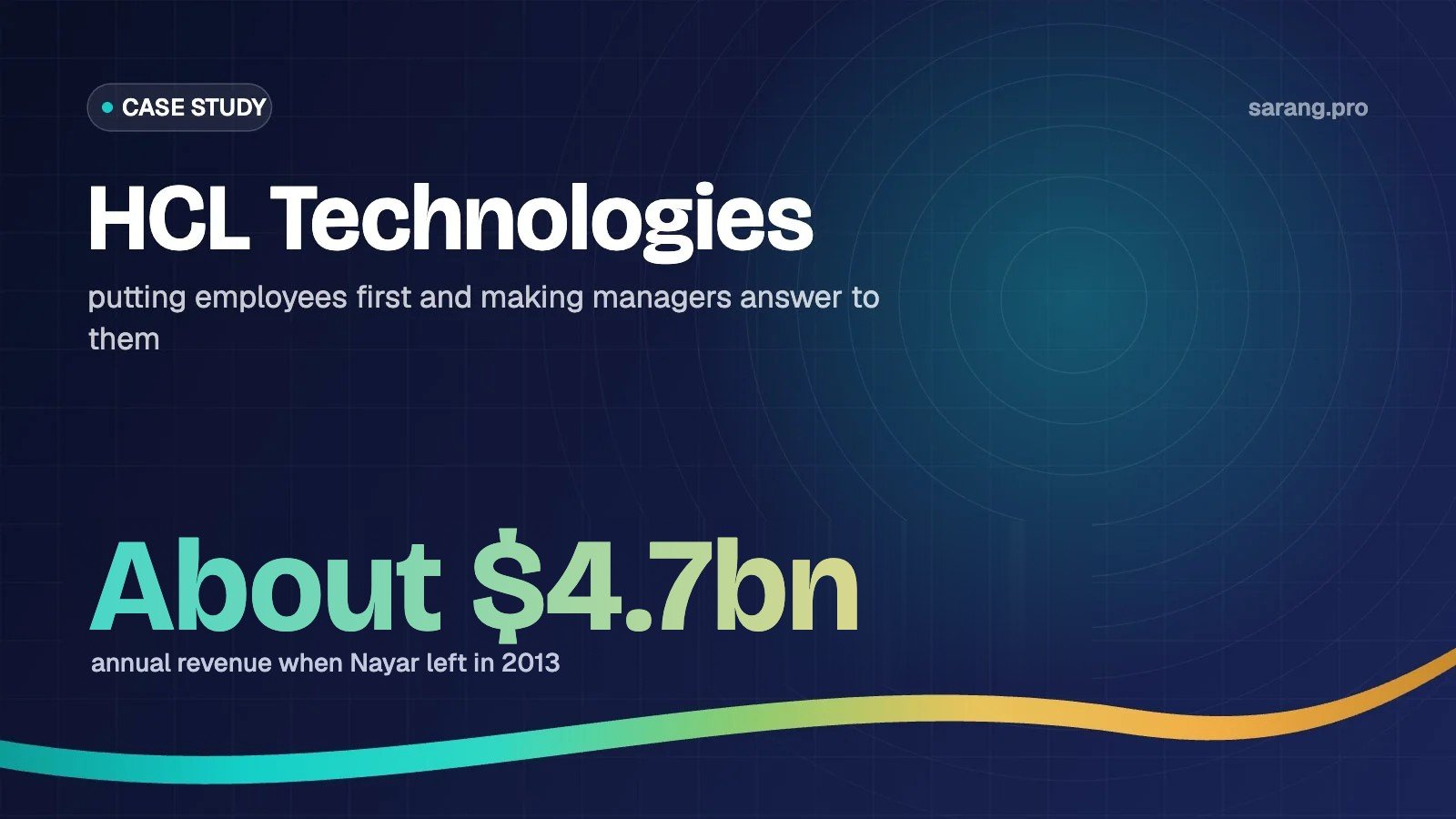
- annual revenue when Nayar left in 2013
- About $4.7bn
- HCL Technologies revenue in 2005
- $762m
- revenue growth from 2009 to 2011
- $2.18bn to $3.55bn
- growth Nayar reported from September 2008 to January 2010
- 23%
The situation
In April 2005 Vineet Nayar became president of HCL Technologies, the IT services arm of one of India’s oldest computer groups. He had spent twenty years inside HCL and had built one of its businesses from scratch, but he had been planning to leave corporate life for social work. Shiv Nadar, HCL’s founder and chairman, asked him to stay and run the company instead.
What Nayar inherited was a business that was growing but losing ground. HCL Technologies had revenue of about $762m in the year to June 2005, according to figures Nayar later gave to CIO magazine (other accounts round it to about $700m). Its Indian rivals, Tata Consultancy Services, Infosys and Wipro, were larger and growing faster, and so were the multinationals that competed for the same contracts. A Harvard Business School case written about this period describes HCL as poorly positioned for a more competitive market, having fallen behind both Indian and multinational competitors as the industry shifted from hardware towards software and services.
Nayar’s diagnosis was that the company’s problem lay in how it was managed. In an IT services firm the product is the work of the engineers who sit with clients and solve their problems. In HCL, as in most companies, those engineers sat at the bottom of a pyramid. Managers and support functions such as human resources and finance sat above them and expected to be served. Nayar decided to turn that relationship round, and gave the effort a name designed to provoke: Employees First, Customers Second.
The decision he faced was whether to bet the company’s recovery on changing its internal management, which was slow, hard to measure and risky, or to rely on the usual tools of the industry, which were pricing, sales effort and acquisitions. Over the next eight years he used both, and the case is about how much of HCL’s growth came from each.
Background
HCL began in the 1970s as a hardware company. Its name originally stood for Hindustan Computers Limited, and HCL Infosystems was set up in 1976 to make calculators. Under Shiv Nadar the group grew into one of India’s leading computer makers, and in 1987 a Unix product launch made it the country’s largest. HCL Technologies was spun off on 12 November 1991 as HCL Overseas Limited, to provide software and technology development services. It became HCL Technologies in October 1999 and listed its shares in January 2000.
Nayar joined HCL in 1985 as a management trainee, straight after an MBA at XLRI in Jamshedpur, having studied engineering. In 1992 he left to co-found Comnet, a business that managed clients’ IT infrastructure remotely from India (some reports date its founding to 1993). Comnet merged with HCL Technologies in 1998 and Nayar became chief executive of the combined HCL Comnet unit. By his own account he had built a $1bn business from a start-up before he was asked to run the whole company.
The HCL group as a whole was much larger than HCL Technologies. The Harvard case gives the group’s figures at the time Nayar took over as $3.7bn of revenue, a $5.1bn market capitalisation and 41,000 employees in 11 countries. HCL Technologies made its money in the same way as its rivals: it sold software development, application maintenance, infrastructure management and engineering services, mostly to large companies in the United States and Europe, priced either by the hour or as fixed-price projects. About 90% of its revenue came from the United States and Europe, and more than 13,000 of its staff worked in research and development and engineering services by 2010. Its costs were mainly people, so its margins depended on keeping engineers busy on billable work and keeping wage costs in India well below the prices it charged clients.
The industry
Indian IT services grew from a small export business in the 1990s into one of the country’s largest industries. The model rested on a simple advantage: India produced large numbers of English-speaking engineering graduates whose salaries were a fraction of those in the United States or Europe. Indian firms took over the maintenance of clients’ existing software, then moved into development, testing, infrastructure management and business process outsourcing. By the year to March 2025 the sector’s revenue, as estimated by the trade body NASSCOM, had reached $282.6bn, of which $224.4bn came from exports, and it employed about 5.8 million people.
The leaders in the mid-2000s were Tata Consultancy Services, Infosys and Wipro, followed by HCL and US-listed Cognizant, which had most of its staff in India. All of them competed with multinationals such as IBM and Accenture, which were building large Indian workforces of their own. TCS became the first Indian IT company to pass $10bn of annual revenue, reporting $10.17bn for the year to March 2012.
The forces at work in this market favoured the large buyers. Clients ran competitive tenders, often split work between several suppliers, and pushed hard on rates. Switching costs were real once a supplier knew a client’s systems, which gave incumbents some protection, but large contracts came up for renewal and could be lost. Rivalry among the Indian firms was intense because their offers looked similar: they hired from the same colleges, used similar delivery models and quoted similar rates. The main supplier was the labour market. Engineers could move between firms for higher pay, and attrition rates in the industry were high, which raised costs and disrupted client work. Threat of entry was moderate. Small firms could start easily, but winning large outsourcing contracts required scale, references and global delivery centres. Over the longer term, automation and cloud computing threatened to substitute for some of the routine work on which the model depended.
In that setting a firm could try to stand out on price, which squeezed margins, or on the quality of its people and the relationships they built with clients. Nayar’s bet was on the second. It rested on an argument that applied with special force to IT services: if clients cannot easily tell suppliers apart on paper, they will judge them by the people they work with every day.
The decision
Nayar later said the idea started with a customer who cancelled a contract. The feedback, as he described it to strategy+business, was that HCL’s people were good but the organisation did not support them. “Your employees did nothing wrong as individuals. But your organization did not support them,” he recalled.
The options open to HCL in 2005 were broadly three. It could keep its structure and compete on price and sales effort, as most of the industry did. It could grow by acquisition, buying capabilities and client relationships it did not have. Or it could try to change how it was run from the inside, on the theory that better-supported staff would do better work for clients and that growth would follow. These were not mutually exclusive, and HCL eventually did all three. But the third was the one Nayar made his own, and it carried the most risk.
The risks were plain at the time. Senior managers stood to lose status and could resist. Sharing financial information widely might leak sensitive figures, or unsettle staff when results were poor. Opening managers’ performance reviews to their subordinates could be divisive. Clients might read the slogan as a statement that they came second. And Nayar himself admitted that he had to tell employees an uncomfortable truth first. “I had to tell our employees we will be obsolete if we don’t change,” he told CIO magazine. “I have to create dissonance.”
Against those risks, the argument for change rested on the nature of the business. In IT services nearly all the value is created by people at the point where they meet the client, which Nayar called the “value zone”. If the management structure got in the way of that work, removing the obstacles would improve the product. If it worked, it would also be hard for rivals to copy, because it depended on culture and habits built over years and not on anything a competitor could buy.
What they did
The programme began in 2005 and was built from a series of practical changes, not one announcement. Nayar’s own account, set out in a short book HCL published and later in a full book with Harvard Business Press in 2010, divides it into four phases.
Phase one: confronting the truth
Nayar called the first phase “Mirror Mirror”. The aim was to get managers and staff to agree on how far HCL had fallen behind and why. He believed that until people accepted that the company was in trouble, they would not accept the changes that followed.
Phase two: transparency to build trust
HCL began sharing detailed financial information with employees, broken down by business unit and delivered to their desktops. It shared bad results as well as good ones. Nayar launched an online forum, “U&I”, where any employee could put a question to him in the open, with their name attached. The early questions were hostile, and the decision to share financial data followed. In 2006 he started a series of large staff meetings called Directions. He broke with the usual format of the first one by dancing on stage, and then spent two hours in open discussion with staff.
Phase three: inverting the pyramid
The third phase turned the management structure upside down. Managers and enabling functions such as HR and finance were made accountable to frontline employees in the value zone, while those employees remained accountable to their managers. Nayar called this reverse accountability. Two systems made it work.
The first was the Smart Service Desk. Any employee could raise a ticket about a problem, from a broken laptop to an unclear policy, and the ticket was assigned to the manager or function responsible for fixing it. Only the employee who raised the ticket could close it. According to HCL, the desk resolved thousands of problems that had been left unsolved for years.
The second was the open 360-degree review. Most companies collect feedback on managers from their staff and peers and keep the results private. HCL opened each manager’s review to everyone that manager might influence, and posted the results on the intranet so that anyone who had given feedback could see them. Nayar posted his own.
Phase four: recasting the role of the chief executive
The last phase aimed to move decisions and ideas down the organisation. HCL set up a Value Portal where employees could propose changes; the company later said it had produced more than 500 implemented ideas worth over $25m. It also changed how it dealt with clients. Its annual customer meeting became a day and a half of unstructured discussion led by the clients, with no sales pitches. In 2009 about 650 executives attended against 400 expected. HCL began offering contracts in which it shared revenue with clients on jointly designed products, instead of relying only on fees.
Exhibit 1: The main Employees First, Customers Second mechanisms
| Mechanism | What it did | Reported scale or result |
|---|---|---|
| Business-unit financials shared with staff | Gave employees detailed results for their own units, good and bad | Delivered to employees’ desktops through a balanced scorecard |
| U&I online forum | Let any employee question the chief executive publicly, by name | Early hostility prompted wider sharing of financial data |
| Directions meetings (from 2006) | Large staff meetings with long open question sessions | First meeting followed by two hours of open discussion |
| Open 360-degree reviews | Opened managers’ reviews to everyone they influenced and posted results | The chief executive published his own |
| Smart Service Desk | Tickets against managers and support functions, closable only by the employee | Thousands of long-standing problems resolved, per HCL |
| Value Portal | Platform for employees’ ideas for change | More than 500 implemented ideas worth over $25m, per HCL |
| Customer summit | Unstructured, client-led annual meeting with no sales pitches | About 650 executives attended in 2009 |
Sources: HCL Technologies, Employees First mini-book; strategy+business (2010); CIO (2010). Figures are the company’s own unless stated.
The acquisition of Axon
Alongside the management changes HCL bought growth. In December 2008, three months after the collapse of Lehman Brothers, it won control of Axon Group, a British consultancy specialising in SAP and other enterprise software, outbidding Infosys. Infosys had offered £407m; Nayar added about £40m late in the contest. Reports put the final price at about £440m. “We gave Infosys little time to respond,” he recalled. HCL merged its own enterprise applications business into Axon, and that division’s share of HCL’s revenue rose from under 9% at the time of the deal to more than 22% three years later.
The integration was not smooth. Axon had charged about twice as much as HCL for similar work, and clients wanted Axon’s consultants at HCL’s prices. Steve Cardell, Axon’s former chief executive, said HCL started losing money on deals because it was putting high-end consultants on them. Analysts were sceptical of the purchase at first, though Peter Bendor-Samuel of the Everest Group later called its success “remarkable”.
Through the downturn
The approach was tested in the 2008 to 2009 recession. Nayar told strategy+business that between September 2008 and January 2010 HCL grew by 23% and increased its global market share by 21%, while letting go about 3% of its lowest performers. Revenue rose from about $1.9bn in the year to June 2008 to $2.18bn in the year to June 2009, with net profit of $249m. HCL’s share price rose by more than 70% in the twelve months to early 2010.
What happened
Revenue grew strongly throughout Nayar’s time in charge. Business Today reported in August 2008 that revenue had risen by 150% to $1.9bn since he took over. In the year to June 2011 revenue reached $3.55bn and net profit $378m. A company publication from around 2012 described HCL as a $3.9bn business with 83,076 staff in 26 countries, and claimed compound annual growth of 24% over the previous three years, a 186% rise in market capitalisation and a tripling in the number of clients worth more than $100m a year. By the time Nayar left, revenue was about $4.7bn a year, roughly six times its level in 2005, according to Forbes.
Exhibit 2: HCL Technologies revenue and staff, 2005 to 2013
| Period | Revenue | Net profit | Employees | Source |
|---|---|---|---|---|
| Year to June 2005 | $762m (about $700m in another account) | n/a | n/a | CIO; strategy+business |
| Year to June 2008 | About $1.9bn | n/a | n/a | Business Today, August 2008 |
| Year to June 2009 | $2.18bn | $249m | n/a | Business Today, October 2011 |
| Early to late 2010 | About $2.6bn to $2.7bn | n/a | 55,000 to 65,000 (accounts differ) | strategy+business; CIO |
| Year to June 2011 | $3.55bn | $378m | n/a | Business Today, October 2011 |
| Around 2012 | $3.9bn | n/a | 83,076 | HCL mini-book |
| Year to June 2013 | About $4.7bn | n/a | More than 87,000 by December 2013 | Forbes; Business Today, December 2013 |
HCL’s financial year ran to June during this period. Business Today described HCL as a “$4 billion” company when Nayar left the board in December 2013, while Forbes gives about $4.7bn for annual revenue at the end of his tenure; the difference appears to be rounding and timing.
Margins improved late in his tenure. In the quarter to December 2012, HCL reported revenue of Rs 6,274 crore, up 19.6% on a year earlier, net profit of Rs 965 crore, up 68.5%, and an operating margin of 19.8%, up four percentage points. Shiv Nadar called 2012 an “exceptional” year.
Nayar stepped down as chief executive in January 2013. Anant Gupta became president and chief executive, and Nayar stayed on as vice chairman and, until July 2013, joint managing director. He left the board in December 2013 to spend more time on the Sampark Foundation, an education charity he had set up, while remaining a senior adviser. He had sold his entire HCL shareholding in June 2012 for about Rs 134 crore and put the money into the foundation. “There are very few organisations where one could rise up the ranks and become the CEO and Vice Chairman,” he said on leaving.
Nayar’s book, Employees First, Customers Second: Turning Conventional Management Upside Down, was published by Harvard Business Press in 2010 and made him a well-known management speaker. He told CIO magazine that in the six months before the interview he had spoken to 56 company boards about the approach, and that HCL offered workshops on it to boards and clients free of charge.
Other views
Almost everything published about Employees First, Customers Second in its early years came from Nayar or from HCL. That makes it hard to separate the effect of the management changes from the effect of everything else that was happening at the same time.
The first difficulty is the growth of the market. Indian IT services expanded rapidly through the 2000s, and all of HCL’s main rivals grew strongly too. Some of HCL’s growth would have happened whatever its management style. A fair test would compare HCL’s growth with its peers’ over the same period, and the company’s own claim, that it grew faster than its rivals in the recession, is the strongest evidence it offers. Independent comparisons over the full period were not available in the sources checked for this case.
The second difficulty is the role of acquisitions. The Axon deal transformed HCL’s enterprise applications business and its access to high-value consulting work. Business Today credited it with a 50% rise in HCL’s market share in the three years after the purchase. A sceptic could argue that this, more than the service desk or the open reviews, explains HCL’s move into larger contracts. Even after Axon, Business Today reported in 2011 that 78% of HCL’s revenue still came from lower-value services.
Academic reviewers raised a third point, about the evidence itself. Kenneth Long, reviewing Nayar’s book in the Journal of Organizational Change Management in 2011, noted that it was told almost entirely from the chief executive’s point of view. He found little about initiatives that failed, little about power and resistance inside the company, and little about whether the approach would work elsewhere. He also asked whether the early phases amounted to participation ordered from the top under the label of empowerment, and whether the approach succeeded because of circumstances particular to HCL. The French marketing writer Christophe Lachnitt called the philosophy “brilliant” but the book uninspiring, complaining that Nayar “never questions himself”.
The interviewer at CIO magazine pressed Nayar on a further point: that putting employees first sat oddly with chief executive pay many times that of the average employee. Nayar’s reply did not address the pay gap directly. HCL itself said it let go of about 3% of its lowest performers during the downturn. That is consistent with a demanding meritocracy, but it shows that “employees first” did not mean job security.
Against these criticisms, the case has supporters beyond HCL. Harvard Business School wrote a teaching case on HCL’s transformation in 2007 and added a video of Nayar in 2009. The approach has been studied as a model of innovation through employees: a 2021 chapter by Anabella Davila, published by Cambridge University Press, analysed HCL’s reports from 2011 to 2019 and found that the philosophy rested on employee wellbeing, employee empowerment and innovation through value co-creation, each supported by specific management practices. Davila’s reading of the company’s reports up to 2019 also suggests that the language and practices outlived Nayar’s time in charge.
Reading it through a framework
The service-profit chain
The service-profit chain, set out by James Heskett and colleagues at Harvard Business School in the 1990s, links internal service quality to employee satisfaction and retention, then to the value of the service customers receive, then to customer satisfaction and loyalty, and finally to growth and profit. Its central claim is that in service businesses the experience of staff shapes the experience of customers.
Employees First, Customers Second reads almost as a direct application of the chain. The value zone is the point in the chain where staff and customers meet. The Smart Service Desk and reverse accountability were meant to raise internal service quality, the first link, by making support functions answer to the people they served. Open reviews and shared financial results were meant to raise trust and engagement. Nayar’s argument was that better-supported engineers would deliver more value to clients, and that clients would reward HCL with more and larger contracts.
The evidence fits the later links in the chain. HCL said the number of clients worth more than $100m a year tripled in the three years to around 2012, and revenue rose from $2.18bn in 2009 to $3.55bn in 2011. Net profit rose from $249m to $378m over the same two years, a rise of about 52%. What the public record does not show clearly is the middle of the chain: independent measures of employee satisfaction, retention and client satisfaction over the whole period. Without them, the chain’s logic suggests a plausible mechanism, but it cannot prove that the management changes caused the financial results rather than the growth of the market or the Axon acquisition.
McKinsey 7-S
The McKinsey 7-S model looks at seven linked elements of an organisation: strategy, structure, systems, shared values, style, staff and skills. It holds that change lasts only when the elements move together, because any element left behind will pull the others back.
HCL’s programme touched most of them at once. Structure changed through reverse accountability, which made support functions answer to the front line. Systems changed through the Smart Service Desk, the open 360-degree review and the business-unit financials sent to employees. Shared values were captured, deliberately provocatively, in the slogan. Style changed most visibly at the top: a chief executive who danced on stage at the first Directions meeting, published his own review and answered questions in an open forum signalled that the new rules applied to him as well. Strategy moved towards larger, longer contracts and higher-value consulting, and skills were added by acquisition when Axon brought in enterprise software consultants.
The 7-S view also points to a weak spot. The Axon integration showed that skills and systems did not line up at first: Axon’s consultants were priced for high-end work while HCL’s systems and pricing were built for volume, and the company lost money on some deals until the two were brought together. The model would predict exactly that friction. It would also predict that the changes most likely to last were the ones built into systems, such as tickets that only the employee could close, and not the ones that depended on one leader’s personal style.
Since then
Anant Gupta led HCL from 2013 to 2016 and was succeeded by C Vijayakumar, who was still chief executive in 2026. The company, now branded HCLTech, passed $10bn of annual revenue in 2021.
Exhibit 3: HCL Technologies then and now
| Measure | Around 2005 | Year to March 2025 | Latest (quarter to September 2026) |
|---|---|---|---|
| Revenue | About $762m a year | $13.84bn, up 4.3% in dollars | $3.7bn for the quarter, up 2.2% on a year earlier |
| Operating (EBIT) margin | n/a | 18.3% | 18.2% |
| Employees | n/a for HCL Technologies alone | More than 223,000 | More than 230,000 |
| Countries | Operations in about 26 countries by 2010 | 60 | n/a |
| Revenue per employee | n/a | n/a | $65,400 a year, up 2.4% |
Sources: CIO (2010); strategy+business (2010); HCLTech press releases of 22 April 2025 and 12 October 2026.
In the year to March 2025 HCLTech reported revenue of $13.84bn and more than 223,000 employees in 60 countries. Its chief executive said it had grown fastest among its peers for the second year running. In the quarter to September 2026 it reported record bookings of new business of $3.3bn and said revenue from advanced artificial intelligence services had reached an annual rate of $876m. It guided to revenue growth of 2.5% to 4% for the year to March 2027 in constant currency.
The industry around it had matured. NASSCOM estimated that Indian technology revenue grew by only 5.1% in the year to March 2025, up from 4% the year before, and artificial intelligence was raising questions about the future of labour-based outsourcing. HCLTech’s own revenue per employee, about $65,400 a year, showed how far the business still depended on large numbers of people.
What to take from it
- In a service business the point where staff meet customers is where most value is created, and management structures can fairly be judged by how well they support that point.
- Making managers accountable to frontline staff needs systems to enforce it, such as service tickets that only the employee who raised them can close, because slogans alone do not change behaviour.
- Sharing financial results openly, including bad ones, builds trust only if leaders accept the hard questions that follow.
- When a turnaround combines internal change with acquisitions in a growing market, it is hard to say how much of the result each part produced, and claims of cause and effect should be treated with care.
- Evidence that comes mainly from the leader who ran a change programme needs testing against independent data and the views of employees and clients.
Questions to think about
- HCL’s revenue rose from about $762m in 2005 to about $4.7bn in 2013. Calculate the compound annual growth rate. What would you need to know about its competitors’ growth over the same period to judge whether the management changes made a difference?
- Using Exhibit 2, net profit rose from $249m to $378m between 2009 and 2011 while revenue rose from $2.18bn to $3.55bn. What happened to the net margin, and what might explain it?
- Would Employees First, Customers Second work as well in a business where staff rarely meet customers, such as manufacturing or a back-office processing centre?
- What are the risks of publishing every manager’s 360-degree review to the people who reported on them, and how would you manage those risks?
- How would you separate the effect of the Axon acquisition from the effect of the management changes on HCL’s growth between 2008 and 2011?
- Kenneth Long asked whether the early phases amounted to top-down participation under the label of empowerment. Is that a fair criticism of how Nayar ran the change, and does it matter if the results were good?
Concepts at work
Service-profit chain, McKinsey 7-S, Reverse accountability. Explore them in Insights.
Further reading
Oxford University Press covers this story as a teaching case in Cases in Organizational Behaviour on Oxford Business Trove. The sources below are the public record this page was written from.
Written from the public sources listed below. Figures are as those sources report them.
Framework
Timeline
- 1985Vineet Nayar joins HCL as a management trainee
- 1991HCL Technologies spun off as HCL Overseas
- 1998Nayar's Comnet merges into HCL Technologies
- Apr 2005Nayar becomes president; Employees First, Customers Second begins
- 2006First Directions staff meeting
- 2007Nayar becomes chief executive
- Dec 2008HCL buys Axon Group, outbidding Infosys
- 2010Nayar's book published by Harvard Business Press
- Jan 2013Nayar steps down as CEO; Anant Gupta takes over
- Dec 2013Nayar leaves the board
- 2016C Vijayakumar becomes chief executive
- Apr 2025HCLTech reports revenue of $13.84bn and more than 223,000 staff
Recap cards
Tap a card to check yourself.
Sources and credits
- Harvard Business School: HCL Technologies (A), case abstract (Hill, Khanna and Stecker, 2007)
- Harvard Business School: Vineet Nayar at HCL Unstructure 2008, video supplement abstract
- strategy+business: Vineet Nayar interview and profile (October 2010)
- CIO.com: Why Indian outsourcer HCL Technologies puts employees first (29 October 2010)
- HCL Technologies: Employees First, Customers Second mini-book (Vineet Nayar)
- Business Today: Fresh challenge, Nayar joins HCL Tech board (21 August 2008)
- Business Today: How Axon is putting HCL Technologies in the big league (October 2011)
- Goodreturns: HCL Tech Q2 results and appointment of Anant Gupta as CEO (17 January 2013)
- Business Today: Vineet Nayar steps down from HCL Tech board (28 December 2013)
- Forbes: India's Vineet Nayar seeks to transform primary education (6 July 2016)
- Journal of Organizational Change Management: Review of Employees First, Customers Second (Kenneth E. Long, 2011)
- Superception: Book review, Employees First, Customers Second (Christophe Lachnitt, 2014)
- Cambridge University Press: Innovation based on value co-creation through employees at HCL Technologies (Anabella Davila, 2021)
- Business Standard: TCS beats $10bn revenue mark in FY12 (April 2012)
- Business Standard: Indian tech sector FY25 revenues to grow 5.1% to $282.6bn, NASSCOM (24 February 2025)
- HCLTech: HCLTech delivers another year of industry-leading growth (22 April 2025)
- HCLTech: HCLTech delivers strong Q2 led by record deal bookings of $3.3 billion (12 October 2026)
- Wikipedia: HCLTech (corporate history and chief executives)