IKEA: flat-pack furniture and the customer as assembler
IKEA moved assembly to the customer through flat-pack furniture in the 1950s, and by 2024 sold EUR 45.1 billion of goods while spending EUR 2.1 billion on price cuts.
- IKEA retail sales, FY24
- EUR 45.1 billion
- external suppliers
- 800+
- catalogue print run at its peak
- 150 million
- Billy bookcases sold
- 60 million+
The situation
In the second half of the 1950s Ingvar Kamprad ran a young Swedish mail-order and furniture business that other furniture dealers were trying to push out of the market. His prices were lower than theirs, and in response dealers boycotted the company through the 1950s and 1960s, according to an obituary in the Irish Times. At the same time his firm faced a plain physical problem: assembled furniture is bulky, and shipping bulk costs money. A draughtsman at the company, Gillis Lundgren, is said to have taken the legs off a table that would not fit in his car. In 1956, by the account Guinness World Records gives, that moment became the start of flat-pack, self-assembly furniture.
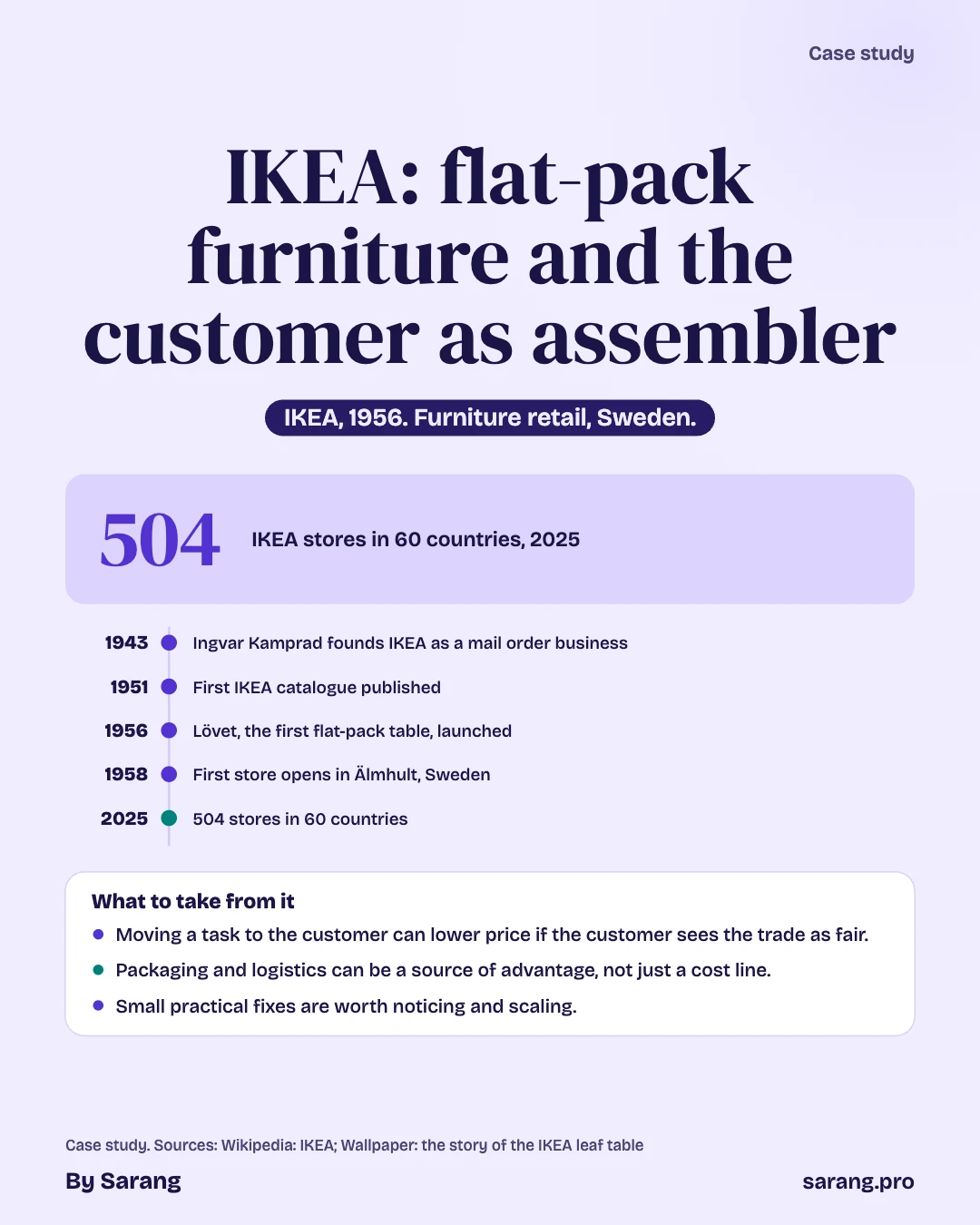
That choice shaped everything after it. By the 2024 financial year, IKEA retail sales were EUR 45.1 billion, drawn from a range made with over 800 external suppliers and about 35 factories owned by Inter IKEA. Ingka Group, the largest retailer, counted 729 million visits to its retail locations and 3.1 billion online visits in the year to August 2024.
This case follows how a small Swedish firm made the customer part of the production process, what that did for cost and design, and where the idea is being tested now. Sources differ on exactly when and with which product the idea first appeared, and the case notes where they do.
Background
A farm boy and a mail-order business
Ingvar Kamprad was born on 30 March 1926 in southern Sweden. The Irish Times says that he registered the IKEA name in 1943, aged 17. The name combines his initials with the first letters of Elmtaryd and Agunnaryd, the farm and village where he grew up in Småland. He began with mail-order sales of pencils, postcards and similar goods, and local farmers’ furniture was added later. Business Standard adds that he began selling matches at the age of five.
The first IKEA store opened in Älmhult in 1958. The mail-order catalogue grew into a central tool of the business; at its peak it ran to 150 million copies, as the Irish Times reports.
The man and the method
Kamprad described waste of resources as a mortal sin in a 1976 essay on his work as a furniture salesman, according to Business Standard. The attitude explains much of the method: cost is treated as a design problem rather than a finance problem. He led the company for about 70 years, handed ownership to his three sons in 2000 and stepped down as chairman in 2013. He died on 27 January 2018, aged 91. The record is not wholly flattering: he lived abroad, mainly in Switzerland, to avoid Swedish taxes and returned in 2014, and he apologised for membership in a far-right group in the 1940s.
Why the box matters
It is easy to read flat-pack as a gimmick. It is better read as a rule for the whole business. If a product has to fit in a flat box, the designer must think about joints, the number of parts, the weight and the instructions before any drawing is finished. That rule links design to freight, and freight to price. A bookcase that packs well is cheaper to ship, store and stack in a warehouse, and a low price lets more people buy it. The Billy figures in the Dezeen piece, more than 60 million sold and about 15 made every minute, show what that loop can reach at scale.
The industry
Anyone selling furniture at scale has to deal with three cost drivers: making it, moving it and selling it. IKEA’s design touches all three. Furniture in the 1950s was sold mostly through specialist dealers, who bought from makers and sold assembled pieces. Furniture is bulky compared with its value. A truck carrying assembled sofas, wardrobes and tables is largely carrying air. Transport and storage therefore make up a large share of the price a customer pays, and anyone able to cut that share has room to cut prices.
The dealers Kamprad competed with answered with a boycott. The Irish Times says rivals boycotted IKEA because it undercut them, and that Kamprad responded by moving production to Poland and later to other low-cost countries. Business Standard dates the Polish sourcing to the 1960s and describes Poland as communist at the time.
Today IKEA works through a franchise system. Inter IKEA Group owns the concept and range, and the franchisees, 11 groups in the FY24 summary, run the retail business across 63 markets. Ingka Group is the largest franchisee, and its share of total IKEA retail sales was 87.8 per cent in FY24. Home furnishing is a cyclical business: Ingka’s summary reports a 3.8 per cent decrease in the home furnishing sector across the markets where it operates in FY24.
The decision
What was at stake
Kamprad needed lower prices than rival dealers could match, at a quality customers would accept, and he needed to get the goods to customers without losing the saving in transport and handling. Sources do not set out the options as a formal list, so the three below are a way of framing the choices rather than a record of a board discussion.
Option one: stay with assembled furniture and squeeze suppliers
This was the route of the dealers. Assembled furniture would be bought from makers, delivered to showrooms and sold at a margin. The saving would come from pushing suppliers on price. It limited how far prices could fall, because freight and handling costs stayed fixed.
Option two: make the supply chain cheaper by moving abroad
Moving production to Poland and other lower-cost countries cut the cost of making furniture. The Irish Times links this directly to the boycott. It had a price: the move relied on building relationships with suppliers in other countries, including under a communist system in the 1960s. It also did nothing about the cost of moving bulky goods.
Option three: change what is shipped and who finishes the work
The third route was to design furniture that could be taken apart and sent flat. Guinness World Records states that shipping flat packs avoids paying to transport empty space between factory and showroom and moves the assembly work to the customer. The Irish Times reports the idea in a slightly different shape: customers who did some of the work paid less. The sources differ on the product and the date. Guinness and Dezeen place the invention in 1956, linked to Gillis Lundgren and the Lövet table, a three-legged, leaf-shaped side table. Business Standard also says flat-pack launched in 1956. The Irish Times says the first flat-pack item, a table named Max, appeared in 1952. The most careful reading is that the idea took shape in the 1950s, and that the exact first item is disputed.
The third option was not free. It asks customers to do work they used to pay others to do, and it forces designers to think about packing, joints and instructions from the start. It also needs customers to agree that the saving is worth the effort.
What they did
Designing for the box
IKEA treated the flat box as a design constraint. Dezeen lists designs that show the approach over time. Ivar, from 1968, is a customisable pine shelving system with cupboards, shelves and drawers. The Poäng chair, from 1976, was designed by the Japanese designer Noboru Nakamura and began with a tubular steel frame before moving to plywood. Billy, from 1978, is another Lundgren design, reportedly first sketched on a napkin; more than 60 million have been sold, and IKEA makes about 15 every minute. Klippan, from 1980, is a low-backed sofa that is easy to cover and reupholster. The Lövet table of 1956 returned in 2013 as Lövebacken.
Self-service
The Irish Times says self-service was introduced in 1971 when the Kungens Kurva store in Stockholm reopened after a fire. In a self-service warehouse the customer picks the flat pack from a shelf and carries it to the till, which removes the staff who would otherwise fetch it. Together, the flat box, the self-service pick and the home assembly form a chain in which each step moves a task from the company to the customer. Each step lowers cost and each depends on the one before.
Low cost sourcing and the catalogue
From the 1960s the company sourced in Poland, and later in other countries, as the boycott made local supply harder. The catalogue sold the range to households that had never visited a store, and printing at 150 million copies at its peak made it one of the most widely distributed publications of its time. Business Standard repeats the claim that the catalogue is more widely read than the Bible.
A range built with suppliers and its own factories
The Inter IKEA summary for FY24 shows what sits behind the flat box: over 800 external suppliers, with Inter IKEA making about 10 per cent of the range in-house. Most of its roughly 35 owned factories are in Europe. It names a Billy factory in Slovakia and a PAX expansion in Hultsfred, Sweden. The company has gone from buying in Poland in the 1960s to running a mixed network of partners and its own plants, but the aim, a low price on a product that packs flat, has stayed the same.
Spreading the format
The format moved to stores. The first opened in Älmhult in 1958, and the Irish Times cites 412 stores in 49 countries. By FY24 the Ingka Group summary lists 574 IKEA retail locations in 31 countries, made up of 400 IKEA stores, including city stores, and 174 plan and order points, with 43 new locations opened that year.
What happened
Scale
The model worked at large scale. Inter IKEA Group reported retail sales of EUR 45.1 billion in FY24, down from EUR 47.6 billion in FY23, a fall of 5.3 per cent or 4.0 per cent without currency effects, and net income of EUR 2.2 billion, up from EUR 1.6 billion. Ingka Group reported revenue of EUR 41.8 billion and net income of EUR 0.8 billion in FY24, with 162,293 co-workers.
| Measure | FY23 | FY24 |
|---|---|---|
| IKEA retail sales (Inter IKEA) | EUR 47.6 billion | EUR 45.1 billion |
| Inter IKEA net income | EUR 1.6 billion | EUR 2.2 billion |
| Ingka Group revenue | Not in the sources | EUR 41.8 billion |
| Ingka Group net income | Not in the sources | EUR 0.8 billion |
A hard year for prices
FY24 was difficult. Ingka invested EUR 2.1 billion in lower prices, an average cut of 9 per cent across all countries covering products and services such as interior design and assembly. Reuters, as carried by RTE on 10 October 2024, reported Ingka’s sales down 5 per cent to EUR 39.6 billion, while visits grew 3.3 per cent, to 727 million by that count, slower than the 7.4 per cent in 2023. Ingka’s own summary gives 729 million, so the two figures differ slightly. New openings fell to 41 on the Reuters count, against the 43 in Ingka’s summary. Jesper Brodin, Ingka’s chief executive, said: “We never experienced anything like that since 2008, to be honest.”
In Ireland, IKEA cut almost 3,000 products by an average of 19 per cent, investing over EUR 10 million, while its retail sales fell 2.4 per cent to EUR 246 million. In FY25 Ingka’s revenue was EUR 41.5 billion against EUR 41.8 billion, and net income rose to EUR 1.4 billion from EUR 0.8 billion.
Packaging that shrinks the work
The recent product notes in the Inter IKEA summary show the same logic. A new foldable PAX wardrobe frame can be assembled in half the time and fits smaller spaces. Paper is replacing plastic in fitting bags for several products, including Bruksvara, Brimnes, Ivar, Nysjön and Metod. The summary does not use the phrase flat pack at all and describes products as well designed, functional and low priced.
Other views
Kamprad the person
The founder’s record is mixed. Business Standard reports that he lived mainly in Switzerland to avoid high Swedish income taxes and returned in 2014 after a reorganisation of IKEA’s ownership reduced his tax bill. He also apologised for belonging to the New Swedish Movement in the 1940s. Swedes voted him the top entrepreneur of all time in 2014, and the Irish Times quotes his own remark that no one had as many fiascos as he had.
Who really invented flat pack
The accounts of the origin read like a legend. The table with its legs removed to fit in a car is told by Guinness, Dezeen and others, and Dezeen itself introduces it as a story the legend tells. The Irish Times gives an earlier date and a different product. A reader should treat the car story as an illustration of the thinking rather than as an established event, and the date as 1950s.
The customer as unpaid labour
The model rests on customers accepting work. Guinness describes the shift as moving the assembly to the customer. IKEA’s FY24 price cuts, which covered services such as assembly, and the foldable PAX frame that halves assembly time, suggest that the company sees effort and time as part of the price, and wants to reduce them. The sources here do not include customer surveys, so how customers weigh the effort is not shown.
Limits of the evidence
Most of the early history here comes from obituaries and a record-keeping body, not from company archives. The company websites for IKEA’s own history did not load during research, so claims such as the date of self-service and the first flat-pack item rest on single obituaries. Financial figures for FY24 and FY25 come from the companies’ own summaries and from Reuters, and the difference between Ingka’s group revenue, Ingka’s sales and Inter IKEA’s retail sales means the figures should not be added or compared without care. Inter IKEA’s EUR 45.1 billion counts sales across all IKEA retail, while Ingka’s EUR 39.6 billion in Reuters’ report covers the largest franchisee on a different basis from its EUR 41.8 billion revenue.
Competitors
The dealers who boycotted IKEA in the 1950s and 1960s were its first critics. The sources listed do not name competitors in the present day, and this case does not rank rivals.
Reading it through a framework
Value chain
Porter’s value chain splits a firm’s work into activities from inbound logistics to service. IKEA’s design changes the location of several. Assembly, which sits with the manufacturer or dealer in a traditional chain, moves to the customer. Picking sits with the customer in a self-service warehouse. Outbound logistics shrinks because a flat box occupies less space. Design sits at the centre, because each product is designed to fit the chain. The saving is real, but it is paid for in the customer’s time, which is why IKEA’s service offers, such as assembly, appear in its price cuts.
Positioning and trade-offs
Positioning asks which customers a company serves, with which offer, and what it declines to do. IKEA sells well-designed, functional furniture at low prices and leaves the work of collection and assembly to buyers. A firm that tried to offer both full service and the lowest prices would be caught between the two. The 2024 evidence shows the position under strain: even with EUR 2.1 billion of price cuts, sales fell in a weak market, and the company relied on more visits and new locations to compensate.
Since then
For FY25, the year ending 31 August 2025, Ingka Group reported revenue of EUR 41.5 billion and net income of EUR 1.4 billion. The Ingka site also notes that 424 stores have “As-Is” areas, which are spaces for selling used and returned items. The company continues to mix large stores, city stores and plan and order points, and to cut prices where it can. The pattern from the founder is unchanged: lower the cost of the box, the route and the assembly, and use the savings to lower the price.
The pattern across the years in the sources is consistent. In the 1950s the answer to a boycott was cheaper supply and a flatter box. In the 1970s it was self-service and a catalogue. In 2024 it was a EUR 2.1 billion investment in lower prices, plus a wardrobe frame that takes half the time to build. Each answer lowered the total cost to the customer, whether paid in money, in time or in effort. What the sources do not show is how far a customer will go on effort when money is tight, and that remains the open question for the model.
What to take from it
- A cost problem can be solved by redesigning the product so that the whole chain is cheaper, not only by negotiating with suppliers.
- Moving work to customers is a form of pricing: the saving only holds if customers accept the effort as fair for the price.
- Each piece of the model supports the others, so the flat box, the self-service warehouse and the catalogue are stronger together than apart.
- Origin stories are often tidier than the record, and the sources here differ on the first flat-pack item and the date.
- A model built on low prices needs a plan for a weak year, and in FY24 IKEA answered with EUR 2.1 billion of price cuts.
Questions to think about
- Which tasks would you hand to customers in another industry, and what would you give them in return?
- Where is the limit at which customer effort stops feeling like a fair trade for a lower price?
- How should a company respond when rivals boycott or squeeze it for being cheaper?
- If sales fall despite deep price cuts, what does that say about the role of price in the model?
Concepts at work
Value chain redesign, co-production by customers, and cost-based positioning. Explore them in Insights.
Written from the public sources listed below. Figures are as those sources report them.
Framework
Timeline
- 1943Ingvar Kamprad registers the IKEA name
- 1952First flat-pack item, a table called Max, by the Irish Times account
- 1956Gillis Lundgren and the Lövet table, by Guinness and Dezeen
- 1958First store opens in Älmhult
- 1960sBoycott by dealers and sourcing from Poland
- 1968Ivar shelving system
- 1971Self-service introduced at Kungens Kurva, Stockholm
- 1976Poäng chair and Kamprad's essay on being a furniture salesman
- 1978Billy bookcase
- 2013Kamprad steps down as chairman
- 27 Jan 2018Kamprad dies aged 91
- FY24EUR 45.1 billion sales and EUR 2.1 billion price cuts
Recap cards
Tap a card to check yourself.
Sources and credits
- Guinness World Records: First flatpack furniture
- Dezeen: Five key furniture designs launched by IKEA founder Ingvar Kamprad
- Irish Times: Ikea billionaire who turned small Swedish business into behemoth
- Business Standard: Flat-pack pioneer Kamprad built Sweden's IKEA into global brand
- Ingka Group: Annual summary FY24
- Ingka Group: Annual summary and sustainability report
- Inter IKEA Group: Financial summary FY24
- RTE (Reuters): IKEA sales down 5%