Netflix: a 60% price rise, the Qwikster apology and 800,000 lost US subscribers
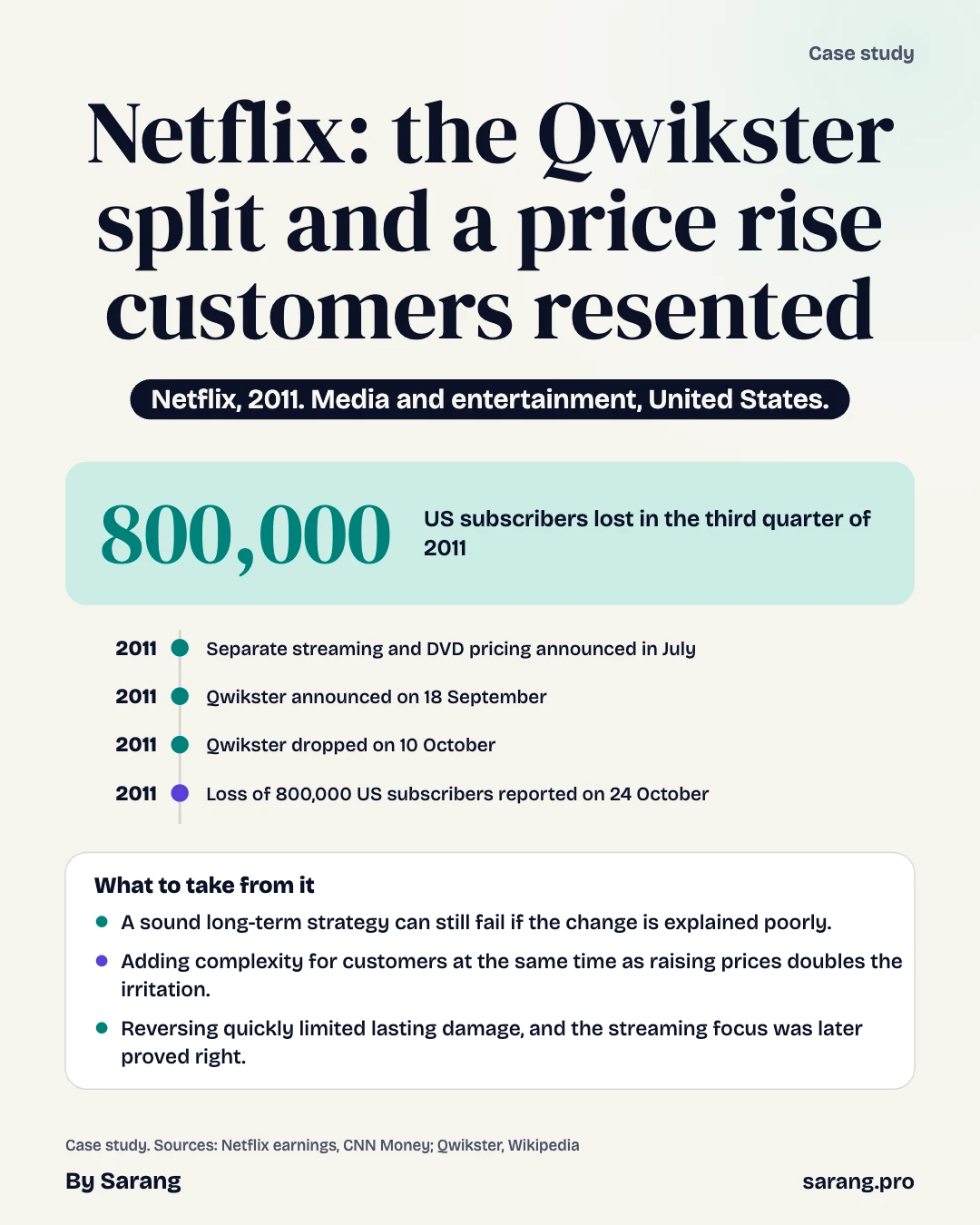
In 2011 Netflix raised prices by 60 per cent for members on both plans, then apologised and announced Qwikster in one message, and ended September with 23.8 million US subscribers.

- rise for members on both plans, from $9.99 to $15.98 a month
- 60%
- US subscribers at the end of September 2011, down 810,000 in the quarter
- 23.8 million
- share price high on 13 July 2011
- $304.79
- close on 19 September 2011, the day after the Qwikster announcement
- $143.75
The situation
Netflix spent the summer of 2011 doing something most subscription businesses fear: raising the price for the customers who used it most. Until July, a member who wanted both discs by post and streaming paid $9.99 a month. From the September renewal, the same member paid $15.98, because the two services became separate $7.99 plans. That is a rise of $5.99, or 60 per cent. Members who wanted only discs actually paid less, $7.99 instead of $9.99, and streaming-only members saw no change.
The company expected some anger. Its own letter to shareholders in July called the reaction among members who used both services “expected and unfortunate”, and forecast a US subscriber base of between 24.6 million and 25.4 million at the end of September, against 24.6 million at the end of June. The actual figure was 23.8 million, 810,000 fewer than the quarter before, according to Agence France-Presse. The result sat 800,000 below the bottom of the forecast range.
What turned a price rise into a crisis was less the number than the conversation around it. On 18 September, more than two months after the price announcement, chief executive Reed Hastings apologised to members and, in the same message, announced a plan to move the disc business to a new brand, Qwikster, with its own website. The apology was read by many customers as a second piece of bad news. On 10 October he withdrew the Qwikster plan. On 24 October the company reported its subscriber loss and its share price fell by more than a quarter after hours.
The streaming shift behind all this is covered in a separate case on this site. This case looks at the part that sits on top of it: how Netflix set the new prices, how it explained them, how customers and investors received them, and what the next six months show about changing a price and saying sorry.
Background
A price that had stopped being noticed
For years the bundle had been a single, simple price. The Q2 2011 shareholder letter shows what it covered: the $9.99 plan let a member rent discs by post and stream as well, with no separate charge for either. Because the price had held, it worked as a reference point. A member did not weigh the $9.99 against anything. It was just what Netflix cost. When a price has been the same for long enough, a change to it is felt as a loss of something the customer thought they were owed, whatever the new price looks like against rivals.
About 12 million customers used both services at the time of the Qwikster announcement, according to the Associated Press. They were the people the July pricing hit hardest, and they were arguably the most engaged members Netflix had.
A company with no reason to doubt itself
The July letter was written from strength. In the second quarter of 2011 Netflix reported 24.6 million US subscribers, up 64 per cent in a year, after adding 1.8 million in the quarter. Global subscribers were 25.6 million. Revenue was $789 million, up 52 per cent, and net income was $68 million. Domestic operating income was $125 million at a margin of 16.3 per cent, above the 14 per cent target. The company had also bought back 216,000 shares in the quarter at an average of about $238 each.
That last detail matters later. The shares peaked at $304.79 on 13 July, the day after the price announcement, according to AFP and Netflix’s annual report. Netflix was spending its own cash on its shares at about $238 just before they entered a fall that took them below $100.
How Netflix talked to its members
Netflix wrote to members by email and on its public blog, and members could reply in public on the blog and on its Facebook page. The International Business Times reported that customers “fumed” in both places. That meant every statement from the company was open to public reply. When Hastings posted his September message, ABC News counted close to 10,000 public replies on the blog and the accompanying video by the morning of 21 September, most of them unhappy.
The industry
A subscription video service sells access, not a product, and the customer can leave in a few clicks. That makes price changes riskier than they are for a business with contracts. Netflix members had no commitment beyond the month. The only things holding them were habit, a queue of saved titles, and a lack of obviously better alternatives.
The alternatives were growing. The International Business Times named Amazon and Hulu as the main competitors in October 2011. Fortune reported that Netflix faced higher costs and more competition from Amazon. Content was a particular pressure on prices. Netflix’s streaming deal with Starz, which supplied recent Disney films, was due to expire in February 2012, and the International Business Times reported that Netflix called off talks with Liberty Media’s Starz over pricing.
International growth added a second cost. The July letter raised the company’s estimate of its international operating loss for the second half of 2011 to as much as $80 million, up from $70 million, because of launch costs including possible launches in the first quarter of 2012. Netflix launched in Latin America and the Caribbean in September 2011 and planned Britain and Ireland for early 2012.
These pressures explain why the company wanted more revenue per member, even if the bundle had been generous. They do not explain why it chose to take that money in one visible step.
The decision
Netflix had three broad choices on price, and a second set of choices on how to explain whichever one it took. The sources show the option chosen and the plan to expect cancellations. The alternatives below are framed as such, since the sources do not describe a formal comparison.
Leave the bundle alone
Keeping $9.99 for both services would have protected goodwill and kept the most engaged members happy. It would also have meant that a growing share of costs, content and the price of two delivery methods, was carried by a flat fee. The sources give no sign this was seriously considered.
Raise the bundle for everyone
A single increase of, say, a dollar or two would have kept the product simple. It would have raised the price for members who only streamed or only rented discs, and therefore for people who saw no extra benefit. The July letter shows Netflix did not choose this. It lowered the DVD-only price instead.
Split the plans and price each one
This is the course Netflix took. Each service became a separate plan at $7.99. The letter argued that each was “an incredible value”, and presented a 20 per cent saving to DVD-only members as part of the gain. For members who wanted both, it created a 60 per cent increase. The design had a logic: it priced each service on its own terms and made the heavy users pay for both. The weakness was that the people most affected were the ones who could most easily see what they had lost.
Choosing how to explain it
The second decision was about communication. Netflix could have told members early, in the first person, with an offer to soften the blow, or it could issue a short announcement and let the pricing page speak. In September Hastings described his own choice with hindsight: he said he should have given members a full explanation of why the services were being split and the prices raised, and that doing so would not have altered the increase but would have been the right thing to do (ABC News). The remark implies that the company had treated the announcement itself as enough.
What they did
12 July 2011: the new plans
Netflix announced separate plans on 12 July, according to the Associated Press. The price change reached existing members at their September renewal. The July letter set out what the company expected: some members would cancel or downgrade, most would stay. The company also said a separate DVD division, led by Andy Rendich, would run discs by post, that it did not intend to sell it, and that it would resume marketing discs in the fourth quarter.
Early September: the warning
The price change took effect on 1 September for existing members. In the second week of September Netflix warned investors that it expected to end the quarter with about 600,000 fewer subscribers than in June, which the Associated Press called its worst downturn ever. The International Business Times reported that this cut the third-quarter forecast by 1 million subscribers, to 24 million at the end of the quarter. The price change was costing Netflix customers on a scale it had not expected.
18 September: the apology and Qwikster
On Sunday 18 September Hastings emailed members and published a post and a video. ABC News reported that he apologised for treating members “thoughtlessly” and said he should have given a full explanation. He wrote that he had “slid into arrogance based upon past success”, as the Associated Press reported. In the same message he announced that discs by post would be renamed Qwikster and would live on a separate site, while Netflix would be for streaming. Hastings called the move necessary and best, in the Associated Press’s account, and said both teams would work hard to regain members’ trust.
The message combined an apology for how the price change was explained with a new change the customer had not asked for. About 12 million members who used both services would, under the plan, have needed two websites. The Associated Press recorded more than 10,000 blog comments, mostly critical, and noted that readers mocked the name and questioned how sincere the apology was.
10 October: the reversal
Three weeks after the Qwikster announcement, Hastings withdrew it in a short blog post. The International Business Times quoted him: “It is clear that for many of our members two websites would make things more difficult.” Netflix told members that US customers would continue to use one website, one account and one password. Shares rose about 7 per cent in early trading. Hastings also said that the July price change was necessary and added: “we are now done with price changes”. The prices stayed where they were.
24 October onward: the numbers and the accountability
The third-quarter results confirmed the scale of the loss. On the call, Hastings said that in hindsight Qwikster was hard to justify and that it had become the symbol of Netflix not listening. He also said the company had hurt its reputation and stalled domestic growth, and that it needed a few quarters to rebuild before resuming international expansion. On 22 December Netflix cut Hastings’s 2012 stock option award by half, to $1.5 million, while leaving his base salary at $500,000, according to an Associated Press timeline.
What happened
Subscribers
The company’s own figures show the effect clearly. The table compares what Netflix forecast in July with what it reported.
| Measure (US) | End of June 2011 | July forecast for end of September | End of September (actual) | End of December (actual) |
|---|---|---|---|---|
| Total unique subscribers | 24.6 million | 24.6 to 25.4 million | 23.8 million | 24.4 million |
| Streaming subscriptions | Not given in the letter | 21.6 to 23.3 million | About 21.45 million | 21.67 million |
| DVD subscriptions | Not given in the letter | 14.6 to 15.7 million | 13.9 million | 11.2 million |
September actuals for streaming and DVD are taken from the Q4 letter, which compares the end of 2011 with the end of September. The loss in the third quarter was between 800,000 and 810,000, depending on the report: AFP says 810,000, Fortune says about 805,000, and an Associated Press timeline says 800,000. The company’s July forecast for the end of September had a floor of 24.6 million, so the actual figure was 800,000 below the lowest outcome it had foreseen.
Disc subscribers fell furthest. The base shrank from 13.9 million at the end of September to 11.2 million at the end of December, and Netflix guided to a loss of about 1.5 million more in the first quarter of 2012. Many members who had used both services moved to streaming only instead of paying more. The Q4 letter said hybrid cancellations and migration slowed during the quarter and weekly disc cancellations eased from their September peak. Domestic churn was 6.3 per cent in the third quarter and 5.3 per cent in the fourth, and cancellations fell from 5.52 million to 4.61 million.
The 2011 annual report states the cost in plain terms: the reaction to the price change, and to a lesser degree the branding announcement, was “very negative”, leading to significant cancellations. It adds that repairing the brand would take time.
Shares
| Date | Event | Share price |
|---|---|---|
| 13 July 2011 | Day after the price announcement | High of $304.79 |
| 19 September 2011 | First trading day after the apology and Qwikster | Closed at $143.75 |
| 24 October 2011 | After-hours, third-quarter results | $86.85, down 26.9 per cent |
| Fourth quarter 2011 | Intraday low for the quarter | $62.37 |
| July 2012 | A year after the peak | More than 70 per cent below the peak |
On 19 September the Associated Press said Netflix’s market value had fallen 53 per cent from its high, a loss of about $8 billion in shareholder value. The International Business Times put the fall from July to the Qwikster reversal at about 60 per cent. The sources agree on the direction and roughly on the size, though the date and share counts behind each percentage differ.
The business
The financial year did not look like a disaster, which is one reason the reaction is easy to misjudge. Netflix’s 2011 revenue was $3.2 billion and net income $226 million, and total unique subscribers, including international, rose to 26.25 million from 20.0 million a year earlier. The harm was to growth and standing rather than to that year’s profit. Hastings said in October that the company had stalled domestic growth, and the first quarter of 2012 guidance included a net loss.
Other views
Customers
The public replies to the September post followed a pattern. One typical reply, quoted by ABC News, was “This may be the end of it for me.” Many said the choice between two services got in the way of simply watching a film. In the Associated Press report, Michele Lucas of Denver said her family now paid for streaming only after the increase, and that they had a hard time finding a movie to watch. Not every customer was hostile. Scott Devine of Burbank, who had dropped discs, said he might sign up for Qwikster if the selection was good, although he thought the name was dumb.
Commentators
Fortune’s contributor Dan Mitchell wrote on 25 October that Hastings had “bungled the presentation and wildly misinterpreted the source of his customers’ anger”. His argument was that the move towards streaming was sound and the execution was the problem, that customers had a fair complaint about separate sites and billing, and that Netflix could have offered something of value for the higher price. He also thought brand management alone would not repair the damage. John Tschohl of the Service Quality Institute told the Associated Press that he did not think Netflix was listening to its customers at all. Brett Gordon of Columbia Business School read the Qwikster plan as an attempt to protect the Netflix brand from the decline of physical media.
Charlie Wolf, an analyst at Needham, summed up the reversal as: “The subscribers voted and Netflix realized the whole thing was stupid.” The remark is blunt, but it does match the company’s own account of customers rejecting the two-site plan.
Hastings and Netflix
Hastings did not retreat on the price. On 10 October he called the July change necessary and said there would be no more. On the October call, Fortune reported, he said: “The focus is on bringing back our reputation and brand strength, but it won’t happen through grand gestures.” The company’s position was consistent: the price was right, and the explanation and the two-site plan were wrong. The Q4 letter acknowledged the pain from the price changes and their effect on 2012 outlook.
Limits of the evidence
Three limits apply. The sources differ on small numbers, including the third-quarter loss and the size of the share price fall. Churn and cancellation figures come from Netflix, not an outside count. And the data cannot separate the effect of the price rise from the effect of the Qwikster announcement and the loss of Starz, which landed in the same weeks. The annual report says the price change did most of the damage and the branding “to a lesser degree”, but that is the company’s own judgement.
Reading it through a framework
Switching costs
Switching costs are what a customer gives up by moving to a rival. For Netflix members they were low: a monthly fee, no contract, and a queue that was easy to lose. The company’s July move raised the price without raising the cost of leaving, and the Qwikster plan would have made things worse, because members using both services would have needed two websites. Betting that habit alone would hold members through a 60 per cent rise was the weak point.
The recovery pattern fits the same idea. Many hybrid members did not leave Netflix; they dropped the disc half and kept streaming, because that was the part that was easy to keep. Netflix lost about 2.7 million disc subscribers between September and December 2011 yet kept most of its streaming base.
Stakeholder mapping
The case has at least five groups. Members who used both services were the most affected and least consulted. Disc-only members gained a lower price and, in the Qwikster plan, a new brand. Shareholders watched the price fall from about $300. Content owners such as Starz were negotiating over the cost of licences while the price change was under way. Employees, including Rendich who was named to run Qwikster, had to work through a plan that lasted three weeks.
The September message treated the groups as one. It spoke to members, but the plan was shaped by costs and content issues that only shareholders and licensors saw. A stakeholder map would have shown that the heaviest users carried the cost of the plan, and that telling them first, with something in return, was a larger task than a blog post. Hastings’s pay cut in December is the only sign in the sources of a personal cost to the company’s leadership, and they do not say who decided it.
Since then
The recovery was slower than the fall. In January 2012 Netflix reported 24.4 million US subscribers for the end of 2011, a gain of about 600,000 in the fourth quarter, according to an Associated Press timeline. In April 2012 it reported its first quarterly loss in seven years. A year after the peak the shares were still more than 70 per cent below it. In October 2012 the investor Carl Icahn disclosed a 10 per cent stake, and the board adopted a poison pill days later, according to an Associated Press timeline.
On 23 January 2013 the company reported a fourth-quarter profit that surprised investors, and a gain of 2 million US subscribers in the quarter, according to the same timeline.
The disc business that Qwikster was meant to carry continued to shrink. In April 2023 Ted Sarandos announced that Netflix would wind down its DVD service, with the last discs shipped on 29 September 2023, after what he called a 25 year run. The sources opened for this case do not cover Netflix’s later pricing changes, so this page makes no claim about them.
What to take from it
- Price changes are heard through the reference price a customer has learned. A rise from $9.99 to $15.98 was felt as the loss of a settled arrangement, whatever each plan looked like on its own.
- Forecast the reaction and the cost together. Netflix expected cancellations, but its July range for September subscribers sat 0.8 million above the actual figure.
- An apology works only if it asks nothing else of the customer. Hastings apologised and announced a second change in one message, and readers took the second as the bigger offence.
- Say what the customer gets for paying more. Mitchell’s point in Fortune, that Netflix could have offered something of value for the higher price, is borne out by the company’s own letters, which spoke of value but gave heavy users little new.
- Keep the decision and the explanation separate in your own head. Hastings held to the price while accepting that the explanation was wrong, and the data show that the second error cost more goodwill than the first.
Questions to think about
- If you had to keep the 60 per cent increase for members using both services, what would you have offered them in return, and who would have paid for it?
- Hastings apologised for the explanation but defended the price. Does that make an apology more credible or less?
- Who should have been told first about the Qwikster plan, members or investors, and what would each group have done with the news?
- How would you test a price change on a small group of customers before launching it, and what would that testing miss?
Concepts at work
The case draws on reference pricing, switching costs, and stakeholder communication. Explore them in Insights.
Written from the public sources listed below. Figures are as those sources report them.
Framework
Timeline
- 12 Jul 2011Netflix announces separate $7.99 plans for discs and streaming
- 13 Jul 2011Shares reach a high of $304.79
- 1 Sep 2011The price change takes effect for existing members
- 18 Sep 2011Hastings apologises and announces Qwikster
- 19 Sep 2011Shares close at $143.75
- 10 Oct 2011Netflix withdraws the Qwikster plan
- 24 Oct 2011Netflix reports 23.8 million US subscribers; shares fall after hours
- 22 Dec 2011Hastings's 2012 option award is cut by half
- 25 Jan 2012Netflix reports 24.4 million US subscribers at the end of 2011
- 31 Oct 2012Carl Icahn discloses a 10% stake
- 23 Jan 2013Netflix reports a fourth-quarter profit and 2 million US subscriber additions
- 29 Sep 2023Netflix ships its last DVDs
Recap cards
Tap a card to check yourself.
Sources and credits
- Netflix: Letter to shareholders, Q2 2011
- Netflix: Letter to shareholders, Q4 2011
- Netflix: Form 10-K for 2011
- ABC News: Netflix CEO apologizes for price increase, announces Qwikster
- Associated Press (via Phys.org): Netflix says it's sorry, then creates new uproar
- International Business Times: Netflix reverses unpopular Qwikster DVD plan
- Fortune: Netflix needs to get in touch with customers' rage
- AFP (via Raw Story): Netflix loses 810,000 US subscribers
- Associated Press (via Washington Times): A look at Netflix since stock plunged from peak
- The Scotsman: Netflix to end DVD-mailing subscriptions after 25 years